The short answer
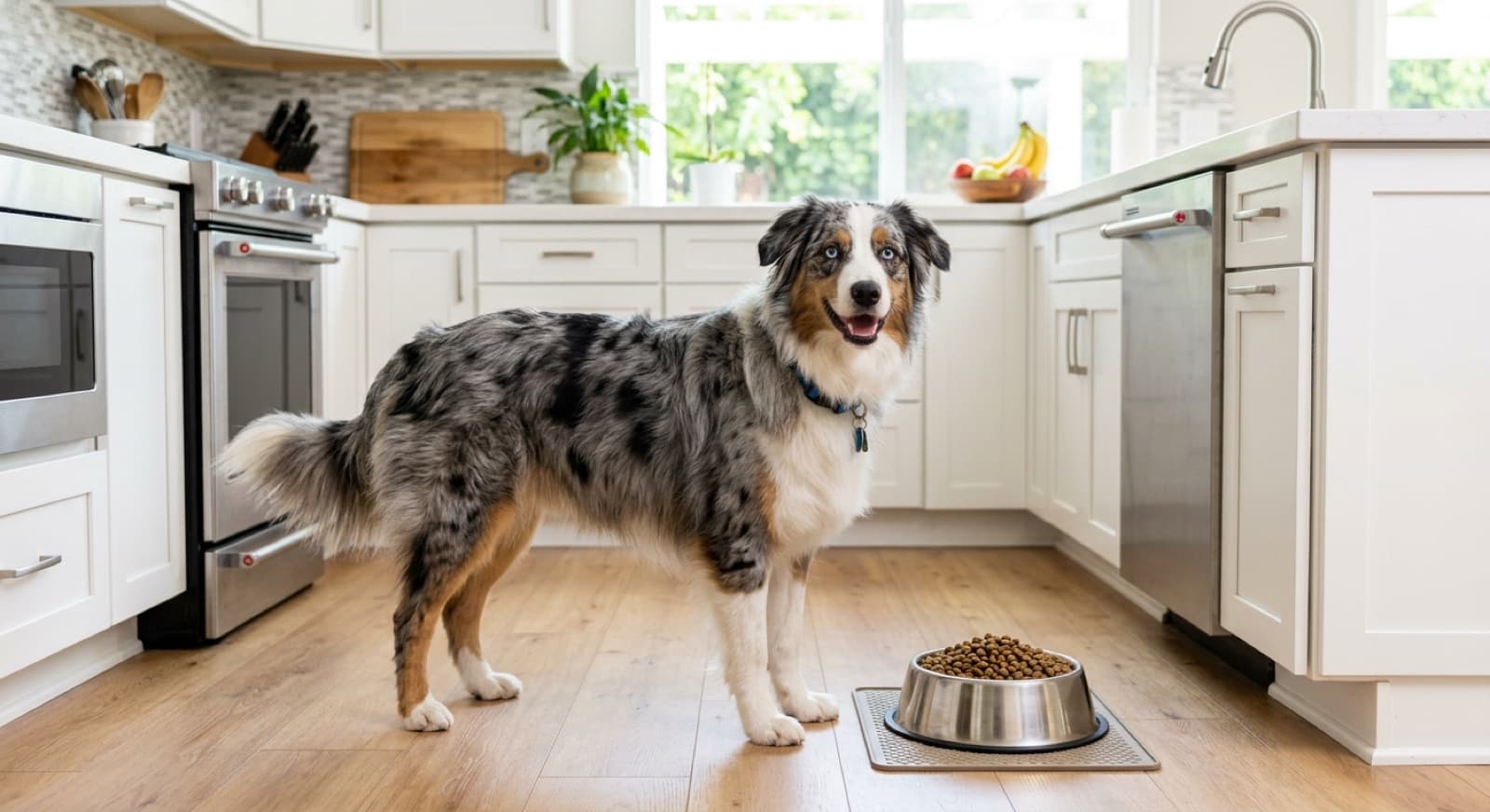
Feed an Australian Shepherd a complete formula from a nutritionist-backed brand, and portion it to the dog's real activity, not the breed's reputation. A working Aussie burns a lot; a pet Aussie burns much less and is genuinely prone to weight gain, so feed to keep the dog lean. Puppies need a large-breed puppy food to grow slowly and protect their joints. Aussies are allergy-prone, so watch the skin and coat. And the one thing that sets this breed apart: about half of Aussies carry the MDR1 gene, so never hand your dog an anti-diarrheal like Imodium or any medication without your vet. Skip grain-free unless your vet diagnoses an allergy.
What is the best food for an Australian Shepherd?
There is no single best bag, and any site that names one is selling something. What there is, is a way to choose well. The standard most vets point to comes from the WSAVA global nutrition guidelines, and it is refreshingly practical.
Pick a brand that does the science. Ask one question: does the company employ a full-time, board-certified veterinary nutritionist and run real feeding trials? The safe defaults for a healthy Aussie are Purina Pro Plan, Royal Canin, and Hill's Science Diet. Acana and Orijen are popular Canadian-made options, and Merrick is a reliable mid-priced pick owners like.
Then watch the dog, not the marketing. Aussies are an allergy-prone, active, coat-proud breed, so the right food is the one that keeps a glossy coat, firm stool, steady energy, and a lean body condition. If those are all true, you have the right food, whatever the price tier. The boutique bag with the prettiest label is often the one with the least nutrition science behind it.
How much should I feed an Australian Shepherd?
It depends almost entirely on how much your Aussie actually works, and that is where most owners go wrong. The breed's high-energy reputation makes people fear they are underfeeding, so they over-portion. But “high energy” is a description of temperament, not a calorie guarantee.
A genuine working or dog-sport Aussie running and herding all day may need 3 cups or more. A pet Aussie that gets a good walk and a fetch session has ordinary calorie needs, often closer to 1.5 to 2.5 cups split into two meals. Feed the second dog like the first and you get a chubby Aussie, which is common: the breed is genuinely prone to weight gain.
Feed to body condition, not the breed label. Run your hands over the ribs and you should feel them easily under a thin layer. Look down from above and there should be a visible waist. If you cannot feel ribs, feed less. Count training treats inside the daily total, not on top of it, since a clicker-trained Aussie can rack up a lot of them. And portions are seasonal: a long cold winter cuts daily exercise, so an Aussie still eating its summer ration through the dark months quietly gains weight.
What should I feed an Australian Shepherd puppy?
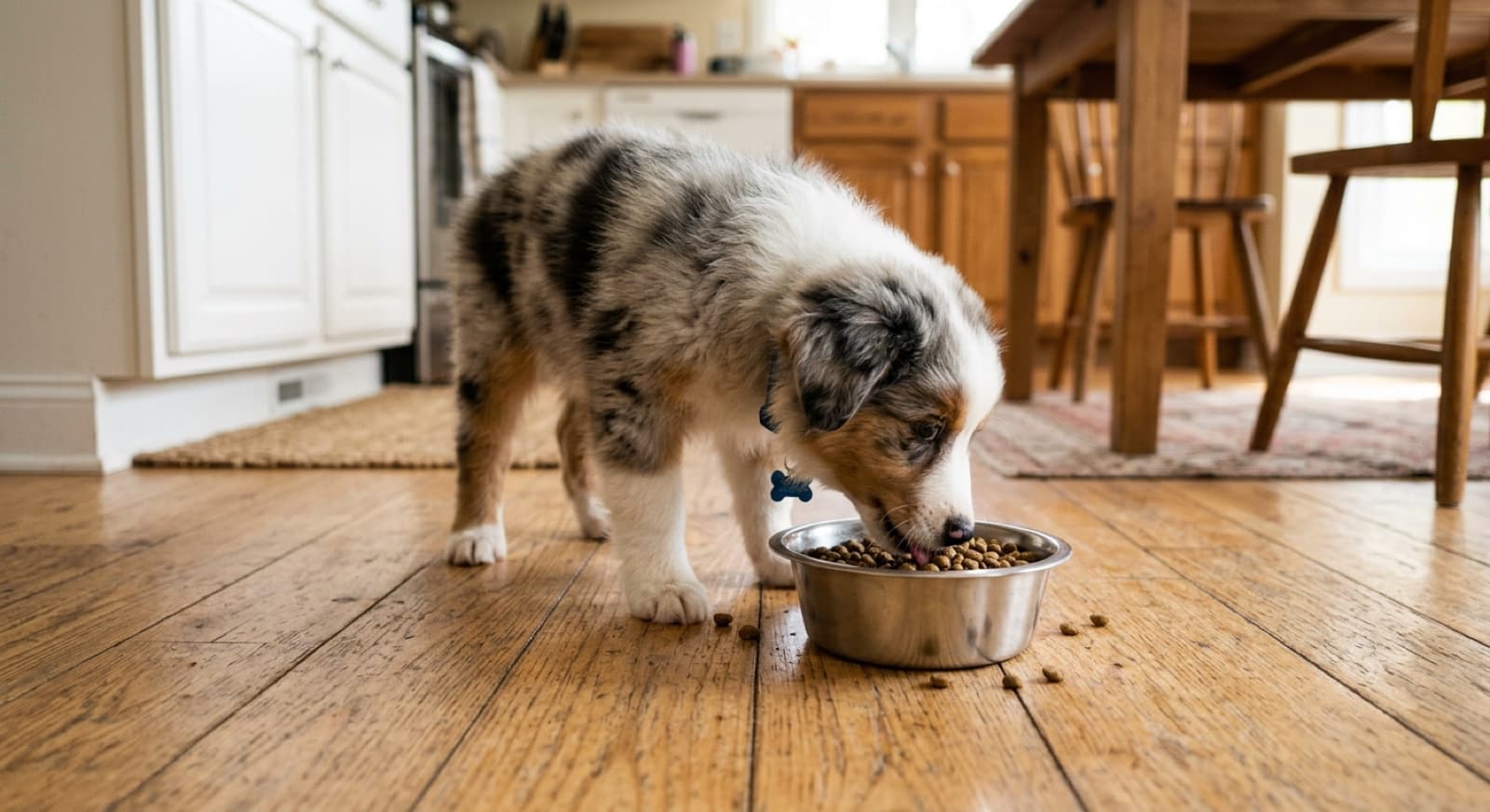
A food labelled for large-breed puppies, even though an Aussie is a medium dog. This surprises owners, but it is the right call. Large-breed puppy formulas control calcium and calories so the puppy grows slowly and evenly, which protects developing hips and elbows. Regular puppy food fuels faster growth that can load soft joints, and the breed can be prone to hip and elbow trouble already.
Feed three meals a day until about six months, then drop to two, and keep the puppy lean enough to feel the ribs. Stay on a large-breed puppy formula until roughly 12 to 15 months, then transition to adult food over a week. The American Kennel Club breed guide is a good general reference, and your vet will help you time the switch.
Should I feed my Aussie grain-free?
Not unless your vet diagnoses a grain allergy. For an itchy Aussie, grain-free usually misses the real trigger, which is almost always a protein.
The FDA has been investigating a possible link between grain-free diets, especially ones built on peas, lentils, and potatoes, and a serious heart condition called dilated cardiomyopathy. The research is still unfolding, but most vets now skip grain-free in a dog without a diagnosed grain allergy. The newer picture points at legumes high on the ingredient list rather than grain itself, which can appear in some grain-inclusive foods too, so the honest answer is to choose a nutritionist-backed brand and talk to your vet rather than chase a label.
Allergies, itchy skin, and the coat
Aussies are an allergy-prone breed, and because they carry a thick double coat, skin trouble shows up as scratching, hot spots, and recurrent ear infections. Owners most often suspect beef, chicken, or dairy, and they tie a dull coat straight to the food bowl.
The honest version is more careful. Itchy skin can come from a food allergy, but it can just as easily come from environmental allergies like pollen and dust, which look almost identical. A rough rule of thumb: year-round itching points more toward food, while itching that flares with the seasons points more toward the environment. Either way, the only way to confirm a food allergy is a vet-run elimination diet, eight to twelve weeks on a single novel or hydrolyzed protein with no other treats, then a careful reintroduction.
For the coat and general skin support, an omega-3 fish oil made for dogs is the supplement Aussie owners reach for most. It is a reasonable add for many dogs, but check with your vet on whether and how much, and use a dog-formulated product rather than a human supplement with additives.
The MDR1 warning: what is safe to give your Aussie
About half of Australian Shepherds carry the MDR1 gene mutation, which makes them dangerously sensitive to certain common drugs. This is the one thing about this breed that can turn a routine upset stomach into an emergency.
MDR1 is not a feeding topic on its face, but it lands right where feeding does: when your Aussie has loose stool or an upset stomach, the instinct is to reach for an over-the-counter anti-diarrheal. The most common one, loperamide (Imodium), is exactly the kind of drug MDR1 dogs cannot clear normally, and it can cause serious neurological problems in them.
The dogs that carry the mutation lack a protein that normally pumps certain drugs out of the brain, so those drugs build up. Washington State University's veterinary college, which developed the MDR1 test, lists loperamide, certain dewormers, and some sedatives among the problem drugs. A simple cheek-swab test tells you whether your dog carries it.
The practical rule: never give your Aussie any medication, anti-diarrheal, or dewormer without your vet, and ask about an MDR1 test. For everyday digestive upset, a brief plain diet (a little plain cooked rice and a probiotic the vet recommends) and a phone call to the clinic is the safe path, not the medicine cabinet.
Foods to avoid
Keep these away from an Australian Shepherd completely:
- Chocolate (darker is worse)
- Grapes and raisins (can cause kidney failure, even a few)
- Xylitol (in sugar-free gum, some peanut butters, and baking), which is rapidly fatal to dogs
- Onions, garlic, leeks, and chives
- Macadamia nuts
- Alcohol and caffeine
- Cooked bones (they splinter)
An Aussie is a smart, busy dog that will counter-surf out of boredom, so management beats willpower: keep food pushed back, lid the bin, and do not leave the loaf on the counter. If your Aussie does eat something on this list, call your vet, the nearest emergency clinic, or a pet poison helpline right away.
Should I feed my Australian Shepherd a raw diet?
Only with a vet or veterinary nutritionist involved. Raw feeding has a devoted following, and plenty of Aussies do fine on a properly built raw diet. But the honest version has caveats. Raw meat carries a pathogen risk (salmonella, listeria) for the dog and the people handling the bowl, which matters more in a home with young kids or anyone immune-compromised. And a homemade raw diet built without a professional recipe very commonly runs short on calcium and other nutrients, which is especially risky for a growing puppy.
For most Aussies, a complete cooked or kibble diet from a nutritionist-backed brand matches raw on the outcomes that show up at the vet. If you still want to go raw, use a complete commercial raw product or a vet-formulated recipe rather than guessing, transition slowly, and loop in your vet.
Looking to adopt an Australian Shepherd?
Sort the food and a puzzle feeder before day one, and ask the rescue about an MDR1 test. Browse Aussies and Aussie mixes available now from the rescues we track.
See Available Australian Shepherds →Where to buy Australian Shepherd food
Every brand worth feeding an Aussie is easy to find in store and online:
- Pet specialty chains (Pet Planet, Tail Blazers, Tisol, and similar). Carry Pro Plan, Royal Canin, Acana, Orijen, and most premium lines.
- Pet Valu and PetSmart. National chains that stock the major formulas, including sensitive-skin and limited-ingredient options.
- Your vet clinic. The place for prescription diets (allergy, GI) that need authorization.
- Online. The same brands ship to your door, easy to set on a recurring delivery so you never run out mid-week.
Buying the largest bag your Aussie will finish before it goes stale, and keeping it sealed in a storage bin, is the cheapest way to feed premium. The major adult formulas are all available online.
Frequently Asked Questions
What is the best food for an Australian Shepherd?
A complete formula from a brand that employs a full-time veterinary nutritionist and runs feeding trials. By the WSAVA framework that points to Purina Pro Plan, Royal Canin, and Hill’s Science Diet, with Acana and Orijen as popular Canadian-made options and Merrick as a solid mid-priced pick. The brand matters less than the food agreeing with your dog’s skin and stomach and letting you keep the dog lean. Aussies are an allergy-prone, active breed, so the right food is the one that produces a glossy coat, firm stool, and steady energy. Start with whatever the rescue was feeding, then transition over seven to ten days.
How much should I feed an Australian Shepherd?
It depends almost entirely on how much your Aussie actually works. A genuine working or sport dog running all day may need 3 cups or more; a pet Aussie that gets a walk and some fetch often needs closer to 1.5 to 2.5 cups split into two meals. The trap is feeding a couch Aussie like a working dog because the breed is famous for energy. Feed to body condition: you should feel ribs easily and see a waist from above. Most pet Aussies are more likely to end up overweight than underfed.
Why is my Australian Shepherd overweight if the breed is so high-energy?
Because the energy is a reputation, not a guarantee. A working Aussie burns enormous calories, but a pet Aussie that gets ordinary daily exercise has ordinary calorie needs, and the breed is genuinely prone to weight gain. Owners hear "high energy" and over-portion, then add training treats on top. Judge the dog by body condition, not by the breed label, count treats inside the daily total, and adjust portions down in winter when walks get shorter.
What should I feed an Australian Shepherd puppy?
A food labelled for large-breed puppies, even though an Aussie is a medium dog. Large-breed puppy formulas control calcium and calories so the puppy grows slowly and evenly, which protects the hips and elbows the breed can be prone to. Feed three meals a day until about six months, then two, and keep the puppy lean. Stay on a large-breed puppy formula until roughly 12 to 15 months, then transition to adult food. Your vet will help you time the switch.
Why is my Aussie so itchy, and is it the food?
Maybe, but allergies are tricky. Aussies are prone to itchy skin, hot spots, and ear infections, and food can be a cause, with beef, chicken, and dairy the usual protein suspects. The catch is that environmental allergies (pollen, dust) look almost identical, so itching that flares with the seasons points more toward the environment. The only reliable way to confirm a food allergy is a vet-run elimination diet on a single novel protein for eight to twelve weeks. An omega-3 fish oil made for dogs is the supplement owners reach for most to support skin and coat, but check with your vet first.
Is it safe to give my Aussie Imodium for diarrhea?
Not without your vet, and this is a real Aussie-specific danger. About half of Australian Shepherds carry the MDR1 gene mutation, which makes them far more sensitive to certain drugs, and loperamide (Imodium) is one of the medications that can cause serious problems in MDR1 dogs. Since loose stool is a common reason owners reach for it, this matters. Do not give any anti-diarrheal, dewormer, or sedative without talking to your vet, and ask about a simple cheek-swab MDR1 test. For everyday digestive upset, a vet is the safe first call.
Should I feed my Australian Shepherd grain-free?
Not unless your vet diagnoses a grain allergy. The FDA has been investigating a possible link between grain-free diets built on peas, lentils, and potatoes and a heart condition called dilated cardiomyopathy, so most vets take the cautious line. And here is the part owners miss: a true food allergy is almost always to a protein, not a grain, so grabbing the grain-free bag for an itchy Aussie usually misses the real trigger. If your Aussie has chronic skin or stomach issues, that is a vet conversation, not a guess off the shelf.
Should I feed my Australian Shepherd a raw diet?
Only with a vet or veterinary nutritionist involved. Some Aussies do well on a properly built raw diet, but raw meat carries a pathogen risk for the dog and the household, and a homemade raw diet without a professional recipe routinely runs short on calcium and other nutrients, which is especially risky for a growing puppy. For most Aussies, a complete cooked or kibble diet from a nutritionist-backed brand delivers the same results. If you still want raw, use a complete commercial product or a vet-formulated recipe and loop in your vet.
Australian Shepherd Health Issues
MDR1, hips and elbows, eyes, and the conditions diet and weight can affect.
Aussie Exercise Needs
How much a high-energy Aussie really needs, which sets the calorie budget for feeding.
Australian Shepherd Adoption
Where to find Aussies and Aussie mixes, real costs, and what to expect from the breed.
Australian Shepherds for Adoption
Live listings of Aussies and Aussie mixes from the rescues we track.