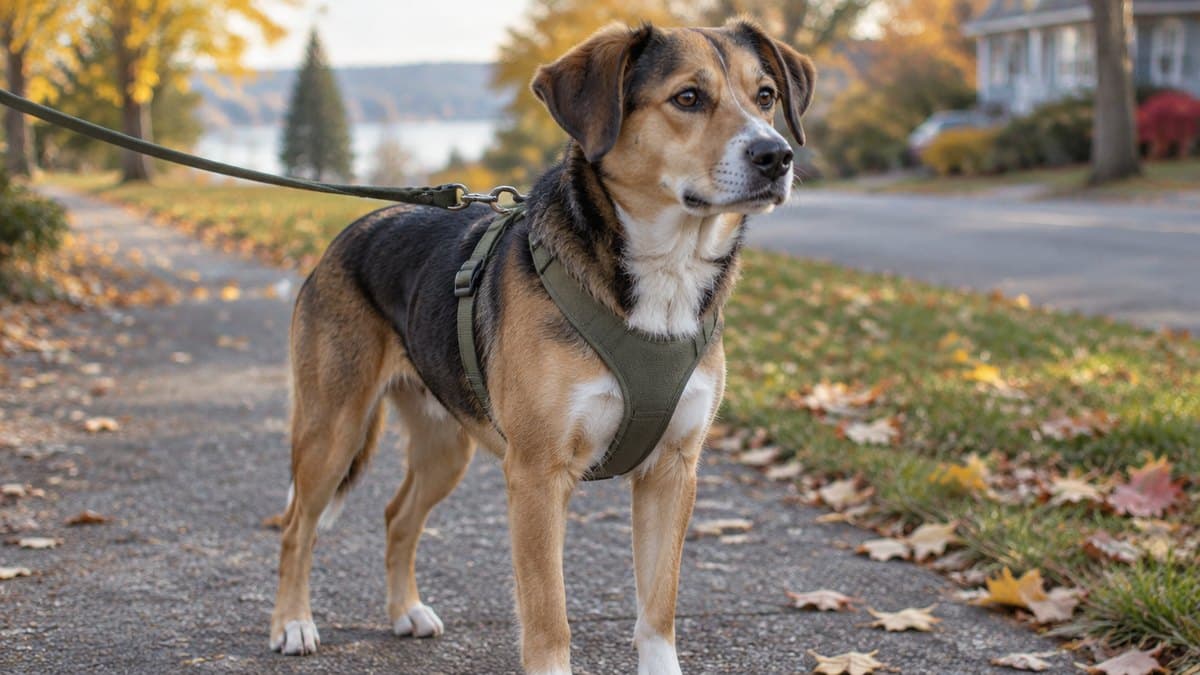
The short answer
Buy the rabbitgoo no-pull for most dogs, the Voyager step-in for a small one, and the Ruffwear Web Master if your dog has ever backed out of anything. Measure the chest girth behind the front legs and buy on that, not on weight. And if you have just adopted, use a harness rather than a collar from day one — a frightened dog can reverse out of a collar in a single twist, which is how newly adopted dogs go missing in their first fortnight.
The three harnesses worth buying
Harnesses look interchangeable on a shelf and are not. They solve three different problems, and buying the wrong one is how people end up with a drawer of them.
rabbitgoo No-Pull — the default
rabbitgoo's no-pull harness is the one to buy if nothing unusual applies. It has both a front and a back clip, adjusts at four points so it fits an odd-shaped dog properly, comes in XS through XL, and costs about thirty dollars. Use the front clip while your dog is still learning not to pull — it turns them gently toward you when they surge, which takes away the leverage — and the back clip once walks are calm. With over 185,000 reviews it is about as well-tested a product as exists in this category.
Best Pet Supplies Voyager — for a small dog
The Voyager step-in is the better shape for a small or nervous dog. A step-in means the dog puts their front feet through two openings and you fasten it over the back, rather than pushing a harness over the head of a dog who would rather you did not. The padded mesh spreads pressure across a small chest, and it comes in sizes down to XXXS, which genuinely matters for a chihuahua or a small terrier that swims in most “small” harnesses.
Ruffwear Web Master — for an escape artist
The Ruffwear Web Master is the one genuinely escape-resistant harness here, and the reason is structural: a third strap behind the ribcage, where a standard two-strap harness leaves the gap a frightened dog reverses through. It costs two to three times the rabbitgoo, and for a settled dog that is money wasted. For a newly adopted rescue, a sighthound, or any dog that has already got loose once, it is the right purchase.
One harness that is not interchangeable with these: a car restraint. If you want your dog secured while driving, that is a separate crash-tested product like the Kurgo Tru-Fit. A walking harness clipped to a seatbelt is not built for crash forces and can injure the dog it is meant to protect.
Some links on this page are Amazon affiliate links — we may earn a small commission at no extra cost to you. It never changes which harnesses we recommend.
Why a new rescue should not be walked on a collar
A frightened dog can back out of a flat collar in one movement, and the first two weeks after adoption are exactly when a dog is most likely to be frightened by something ordinary. Most newly adopted dogs that go missing were on a collar when they bolted.
This is the part worth taking seriously. A dog who has just changed homes has no reason yet to run back to you, and a bus, a firework or a dropped bin lid is enough. A collar leaves a dog one panicked reverse away from being loose in a neighbourhood they do not know. A properly fitted harness — especially one with a third strap — removes that failure mode.
There is a health argument too, separate from escapes. A collar concentrates force on the throat, and as VCA notes, tracheal collapse is a recognised problem in small breeds; flat-faced dogs, meanwhile, already have compromised airways before you add pressure. The American Kennel Club covers the comparison in more depth. None of this means collars are bad — a collar is the right place for ID and licence tags, worn permanently. It means the lead should clip to a harness.
Measuring, and the two-finger rule
Measure girth, not weight. Put a soft tape around the chest at its widest point, just behind the front legs, and buy on that number. Weight is a poor guide because body shape varies enormously at the same weight — a barrel-chested boxer and a deep-chested greyhound at 30 kg need different sizes. If the harness goes over the head, measure the neck too. Between sizes, take the larger and adjust down.
Then check the fit with the two-finger rule: you should be able to slide two fingers flat under any strap, and no more. Looser than that and a dog can back out or work a leg through; tighter and it chafes behind the elbows on a long walk. Re-check after a week, because most people fit a harness too loosely the first time out of concern for comfort, and that is the single most common cause of an escape.
For a Canadian winter, one practical note: a harness fitted over a thick coat in January will be loose in July. If your dog wears a jacket, fit the harness over it and re-check when the coat comes off in spring.
What it costs, and where to buy it in Canada
Budget $25 to $40 for a good no-pull harness, which covers most dogs and most situations. Escape-resistant and crash-tested designs run $70 to $90. There is genuinely little to gain above forty dollars for ordinary neighbourhood walking — the premium buys escape resistance, crash testing, or heavy-duty hardware for a very strong dog, and if none of those apply you are paying for a brand.
Buying on Amazon.ca keeps pricing in Canadian dollars with taxes settled at checkout and makes returns straightforward, which matters more than usual here because sizing is the hard part and a first attempt sometimes goes back. Canadian pet retailers have the advantage of letting you try the harness on the dog, which is worth the trip for an awkwardly shaped dog or a first harness.
Frequently Asked Questions
What is the best dog harness in Canada?
For most dogs, rabbitgoo’s no-pull harness is the sensible buy: a front clip that gives you leverage on a puller, adjustable at four points, and around thirty dollars. Small dogs are usually better in a step-in style like the Best Pet Supplies Voyager, which avoids lifting a nervous little dog’s legs through openings. For a dog that has already backed out of something, Ruffwear’s Web Master adds a third strap behind the ribcage and is the one genuinely escape-resistant option of the three. Match the harness to the problem rather than buying the most expensive one.
Is a harness better than a collar for a dog?
For walking, usually yes, and for some dogs it is not optional. A collar concentrates force on the throat, which matters because small breeds are prone to tracheal collapse and flat-faced breeds already have compromised airways. A harness spreads the load across the chest instead. Collars remain the right place for ID tags and licence tags, which is a separate job — the sensible arrangement is a collar worn permanently with tags on it, and a harness clipped on for walks.
Front clip or back clip?
Front clip for a dog that pulls, back clip for a dog that does not. A front attachment turns the dog gently toward you when they surge forward, which removes the leverage they get from pulling straight ahead — it is a management tool that makes training possible rather than a training method on its own. Back clips are more comfortable for a settled walker and better for running or hiking, because nothing crosses the shoulders awkwardly. Many harnesses, including the rabbitgoo, have both.
How do I measure my dog for a harness?
Measure the girth: the circumference of the chest at its widest point, just behind the front legs. Measure the neck too if the harness has an over-the-head opening. Buy on those numbers rather than on weight, because two 20 kg dogs can be shaped very differently — a barrel-chested boxer and a deep, narrow greyhound need different sizes at the same weight. If you land between sizes, take the larger and use the adjusters.
How much does a dog harness cost in Canada?
A good no-pull harness runs about $25 to $40 in Canadian dollars, which covers most dogs. Specialist designs cost more: an escape-resistant harness with a third strap is in the $70 to $90 range, and a crash-tested car harness similar. There is little reason to spend more than $40 for ordinary neighbourhood walking; the premium above that buys escape resistance, crash testing or genuinely heavy-duty hardware, and if you do not need one of those three you are buying branding.
My rescue dog backed out of their harness. What now?
This is common in the first weeks and it is how newly adopted dogs get lost. A frightened dog can reverse out of a standard two-strap harness in one twist. Until they have settled, use an escape-resistant design with a third strap behind the ribcage, and clip the lead to both the harness and a martingale collar as a backup. Check the fit properly too: you should be able to slide two fingers under any strap, and no more. Most escapes are a fit problem rather than a design one.
Can I use a walking harness in the car?
No. A standard walking harness is not built to hold a dog in a crash and can fail or cause injury under those forces. If you want your dog restrained in the car, that is a separate, crash-tested product designed and tested for the purpose — the Kurgo Tru-Fit is the common Canadian option. Clipping a walking harness to a seatbelt feels like a solution and is not one.
Best Dog Food in Canada
Which food to buy, and why the ingredient list tells you less than you think.
Best Dog DNA Test in Canada
Embark or Wisdom Panel, and the cheap kits to skip.
Dogs for Adoption in Canada
Rescue dogs from shelters and foster networks across the country.
Explore Dog Breeds
Size, temperament and care, breed by breed.