The short answer
Take 4 weeks and don't skip steps. Week 1: safe room with total separation and scent swapping. Week 2: controlled-exposure proximity exercises. Week 3: visual contact through a sturdy baby gate with the dog on a 6-ft leash. Week 4: supervised face-to-face in a neutral space with the dog on leash. Stay on leash for 2 to 4 weeks of direct contact, then transition to drag-leash, then no leash with supervision. Give the cat elevated escape routes and dog-free zones for litter, food, and water. Most failed placements come from rushing the meeting; cats are more sensitive than dogs to high-tension first impressions.
Before you start: is this a viable match?
Not every cat and dog will get along. Look at the cat's rescue profile for clues:
- “Good with dogs” or “Lived with dogs”: high probability of success.
- “Unknown with dogs”: most common. Plan for the full slow intro.
- “Not good with dogs” or “Cat-only home”: don't adopt this cat into a home with dogs.
Look at your dog's history with cats and their general behaviour around small animals:
- Has lived with cats before: usually fine.
- Indifferent to cats outdoors: likely fine.
- Strong prey drive (chases squirrels obsessively in your neighbourhood): proceed cautiously, may not be safe.
- Has chased or harmed cats before: don't risk it. Find a different cat, or stay dog-only.
Cat-only rescues often haven't tested their cats with dogs, so when a profile says “unknown with dogs”, default to the full 4-week plan. Foster home observation is the single most reliable predictor: ask the foster explicitly whether this cat has lived calmly around dogs. The American Association of Feline Practitioners (AAFP) Feline Behaviour Guidelines recommend a phased, low-stress introduction for any new cat entering a multi-pet home. The protocol below is built around that principle.
Week 1: total separation (safe room)
- The cat lives in a safe room (bathroom, bedroom, office) with the door closed and everything it needs: food, water, litter box, hiding spots, and scratching surfaces. No visual contact with the dog at all.
- Feed the dog and cat on opposite sides of the closed door. They begin to associate each other's scent with positive things (food).
- Begin scent swapping around day 3: gently rub a clean cloth on the cat's cheeks and another on the dog's body, then exchange the cloths between spaces.
- Don't let the dog stand at the door barking or scratching. If they do, redirect with training. A dog who can't calm down at the door is a red flag for the eventual intro.
- End of week 1: cat eating well, using the litter box, coming out of hiding when you visit alone; dog calm around the closed door.
Week 2: controlled exposure + scent
- Continue safe-room separation but start active scent exchange:
- Rub a soft cloth on the cat (gently). Place it under the dog's food bowl.
- Rub a soft cloth on the dog. Place it in the safe room.
- Switch towels and bedding between rooms.
- Give the cat access to the rest of the home while the dog is crated or confined to one room, so the cat can map the layout without the dog present. Then swap: dog out, cat back in the safe room. Repeat daily for several days.
- Add food-bowl proximity: the dog's bowl just outside the closed safe-room door, the cat's bowl inside near the door. Both eat in proximity through the door.
- Watch for: dog can eat and rest calmly with cat scent and presence on the other side of the door (positive); dog refuses food or stares fixated at the door (slow down).
Week 3: visual contact through a gate
- Set the cat up in the safe room with the door slightly open behind a sturdy tall pressure-mounted baby gate (not the flimsy kind). The dog approaches on a 6-foot leash, sits or lies down near the gate, and observes.
- Start with short sessions (5 to 10 minutes) and build gradually. The dog stays on leash throughout; reward calm behaviour with treats. The cat decides whether to approach the gate or retreat. Most cats hide at first. That's fine.
- Read body language. Relaxed body, soft eyes, taking treats gently, and looking away from the cat are positive. Stiffening, intense staring, a hard mouth on treats, lunging, or whining mean increase distance immediately.
- End of week 3: dog can be at the gate calmly for 30+ minutes without fixating; cat approaches the gate without panicking.
Week 4 and beyond: supervised face-to-face
- Dog on a leash. Always. For at least 2 to 4 weeks of face-to-face contact, even if it's going great. An unexpected stimulus can trigger prey drive instantly.
- First meeting: pick a neutral room that isn't the cat's safe room and isn't the dog's favourite spot. Dog on a sit-stay (or held by a calm adult). Let the cat enter on its own. Don't carry the cat to the dog.
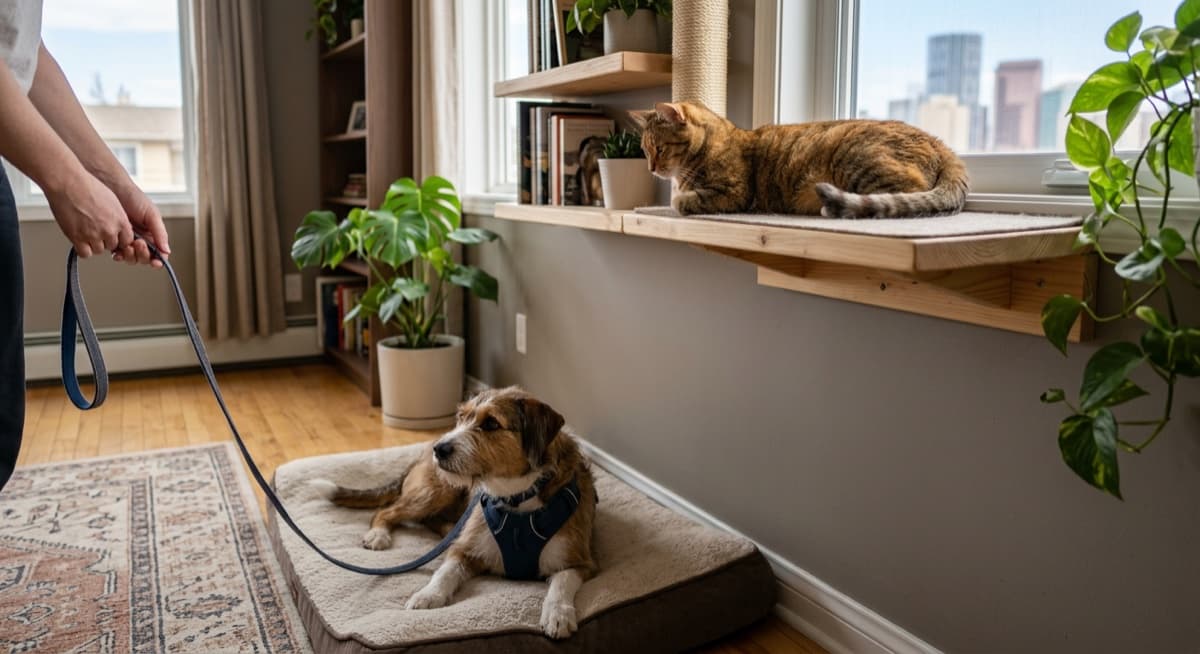
- Provide elevated escape routes: a tall cat tree, shelves, or the top of a bookcase the dog can't reach.
- Watch body language. The ASPCA and International Cat Care both stress that body-language signals are the most reliable indicator of whether to continue or stop a session:
- Cat: tail flicking, pinned ears, hissing = uncomfortable. Stop the session and return the cat to the safe room.
- Dog: stiff body, hard stare, lunging = prey drive activated. End immediately. Work on impulse control before retrying.
- Calm signs (good): sniffing without lunging, looking away, lying down, normal breathing.
- Sessions: 10 to 15 minutes initially, building up. Decrease distance over multiple sessions only if both stay relaxed. Eventually move to a drag-leash (leash on the dog, you don't hold it but can step on it), then to no leash with continued supervision. Most introductions stabilise enough for unsupervised time by week 6 to 12.
Long-term coexistence rules
- Cat keeps a dog-free safe space permanently. A high cat tree, a closet shelf, or a baby-gated room. Cats need to retreat.
- Litter box out of the dog's reach. Many dogs eat cat poop, and a harassed cat stops using the box. Use a covered box, a baby gate with a small cat-sized opening, or a room only the cat can access.
- Cat food up high. Dogs will steal cat food (it's richer). Feed the cat on a counter or shelf the dog can't reach.
- A pheromone diffuser can take the edge off. A plug-in cat pheromone diffuser reduces territorial tension during the settling weeks for some cats. It's a supplement to the protocol, not a substitute.
- Never leave them unsupervised together for the first month. Crate the dog or separate them when you leave the house. The American Veterinary Medical Association (AVMA) notes that unsupervised first-month introductions are a leading cause of injury during multi-pet integration.
A couple of the product links in this guide are Amazon affiliate links — we may earn a small commission at no extra cost to you. It never changes which products we recommend.
Red flags: when it's not working
- Cat hasn't come out of hiding after 2 weeks even with the dog completely separated.
- Dog won't calm down at the gate after a week of training.
- Cat is no longer eating, using the litter, or grooming. These are signs of severe stress.
- Any actual aggression: dog lunges or snaps, or the cat redirects fear-aggression to humans.
If any of these persist past 2 to 3 weeks of slow intro, contact the rescue. Most will support a return without judgement, which is a better outcome than risking an unsafe situation. Some cats genuinely cannot live with dogs, and that's OK. For a behaviour-led second opinion before giving up, the International Association of Animal Behaviour Consultants (IAABC) directory lists certified consultants who handle cat-dog conflict cases remotely.
Cats most likely to do well with dogs
- Confident, mature cats (3+ years old).
- Cats with a documented “lived with dogs” or “good with dogs” history.
- Younger cats or kittens paired with a low-prey-drive dog. Kittens are small and fast-moving, so the dog's impulse control matters more than the cat's temperament here.
- Outgoing or social personalities (described as “social” or “dog-like”). These cats are many adopters' favourite for multi-pet homes.
Filter for these on the main listing using the “Gets Along With → Dogs” option. Each profile that appears has been positively flagged for dog compatibility by the rescue.
Frequently asked questions
How do I know if my dog will be safe with a cat?
Foster home observation is the most reliable predictor. Rescues with cat-experienced foster homes can tell you whether a specific cat has lived calmly with dogs and how the cat reacted. For your existing dog, key indicators of cat-safety: low prey drive (the dog does not intensely chase squirrels, rabbits, or birds on walks; some chase is normal; obsessive intense focus on small animals is the warning sign), calm response to other animals through windows or fences (dogs who lose composure at the sight of cats are not safe candidates), willingness to settle down on command, and prior calm exposure to cats (dogs raised with cats from puppyhood are typically safer). Working breeds with high prey drive (sighthounds, certain herding breeds, terriers) require more careful evaluation; some individual dogs of these breeds are cat-safe, but the breed-level statistics warrant caution. If your dog has injured or killed small animals before, or shows obsessive prey-drive behaviour, do not adopt a cat without working with a certified force-free trainer first.
What is week 1 of the cat-dog introduction protocol?
Total separation in different parts of the home. The new cat lives in a safe starter room (bathroom, bedroom, or office) with food, water, litter box, hiding spots, and scratching surfaces. The dog has full access to the rest of the home. The cat and dog do not see each other; the dog may smell the cat through the door and the cat may smell the dog. Begin scent swapping on day 3: take a clean cloth, gently rub the cat's cheeks and the dog's body, then exchange the cloths between spaces. The cat investigates the dog's scent; the dog investigates the cat's scent. Watch the dog's reaction: calm sniffing followed by losing interest is positive; intense fixation, whining, scratching at the closed door, or excited tail-wagging combined with high alertness is a warning sign. End of week 1: dog calm around the closed door; cat eating well in the safe room.
What is week 2 of the cat-dog introduction protocol?
Continued separation plus controlled-exposure exercises. Begin to give the cat access to the rest of the home while the dog is crated or confined to one room. The cat explores, smells, and gets comfortable with the home's layout without the dog present. Swap: the dog has full access while the cat is in the safe room. Repeat daily for several days. Now begin food-bowl proximity: place the dog's food bowl outside the cat's closed door at meal time; place the cat's food bowl inside the safe room near the door. Both eat in proximity through the closed door. Continue scent swapping. Watch for: dog can eat calmly with cat scent and presence on the other side of the door (positive); dog refuses food or stares fixated at the door (slow down). End of week 2: dog eats and rests calmly with the cat's scent throughout the home and at meal-time proximity to the safe-room door.
What is week 3 of the cat-dog introduction protocol?
Visual contact through a barrier with the dog on leash. The cat is in the safe room with the door slightly open behind a sturdy baby gate (a tall pressure-mounted gate; not the cheap kind). The dog approaches on a 6-foot leash, sits or lies down near the gate, and observes the cat. Start with short sessions (5 to 10 minutes) and increase gradually. The dog stays on leash throughout; use treats to reward calm behaviour. The cat has freedom to approach the gate or retreat to the room; never force the cat to interact. Watch dog body language: relaxed body, soft eyes, treat-acceptance, looking away from the cat (positive); stiffening, intense staring, hard mouth on treats, lunging, whining (warning signs requiring immediate distance increase). End of week 3: dog can be at the gate calmly for 30+ minutes without intense fixation; cat is comfortable approaching the gate without panicking.
What is week 4 and beyond?
Supervised direct contact with the dog on leash in a neutral space. Choose a room that is not the cat's safe room (so the cat has somewhere to retreat) and not the dog's favourite spot. Provide elevated escape routes for the cat (cat tree, shelves, top of bookcase). Begin with short sessions (10 to 15 minutes) with the dog on leash and sitting at a distance from the cat. Reward calm behaviour from both animals. If both are relaxed, decrease distance over multiple sessions. The dog stays on leash for the first 2 to 4 weeks of direct contact (even if everything seems to be going well; an unexpected stimulus can trigger the dog's prey drive instantly). Eventually transition to drag-leash (leash on the dog but you do not hold it; you can step on it if needed). Eventually transition to no leash with continued supervision. Most cat-dog introductions stabilise by week 6 to 12 to allow unsupervised time, depending on the dog.
What are red flags requiring me to pause the protocol?
Several signs warrant immediate pause back to earlier weeks. (1) Dog shows intense prey-drive fixation: hard stare, stalking posture, inability to break attention from the cat, refusal of treats. (2) Cat shows severe stress: refusing to eat, hiding constantly, urinating outside the litter box, excessive grooming. (3) Dog lunges, snarls, or attempts to grab the cat. (4) Cat swats or hisses persistently at the dog despite slow protocol (some hissing is normal; persistent reactive behaviour is a stress signal). (5) Either animal is losing weight or showing other physical stress signs. Pause back to total separation. Consider working with a certified force-free trainer or behaviour consultant (CCPDT-CFTS, KPA, IAABC certified) who works with multi-species households. Cost typically $150 to $300 per session; remote consultations are widely available. The investment is far less than the cost of a failed introduction.
What if my dog has high prey drive?
Honest framing: some dogs are not safe to live with cats, no matter how slow the introduction. High-prey-drive breeds (sighthounds, certain herding breeds, certain terriers, working-line breeds bred for hunting) include individual dogs who simply cannot suppress prey drive on small fast animals. Foster home observation is the most reliable test: a dog who lived with cats in foster care without incident is genuinely cat-safe. A dog who has not been tested with cats requires the slow protocol plus realistic expectations that the introduction may not succeed. If your dog has a prior history of chasing or injuring small animals, do not assume training can change that; some prey-drive behaviour is hard-wired. Rescue dogs often have foster home compatibility notes; ask explicitly during the phone screen. If you have a high-prey-drive dog and are considering a cat, work with a certified force-free trainer for assessment BEFORE adopting the cat.
How do I set up my home for a cat-dog household?
Several environmental modifications make cat-dog cohabitation safer and more successful. (1) Elevated escape routes for the cat: cat trees in main rooms, shelves at cat-jumping height, top of bookcase access, refrigerator-top access. The cat needs vertical escape routes the dog cannot follow. (2) Dog-free zones: the cat's safe room or a designated retreat space the dog cannot enter (a baby gate with a cat-door cutout works well). (3) Cat-only access to food, water, and litter box: place these in dog-free zones; dogs eating cat food and drinking from cat water bowls is common and unwanted. (4) Litter box management: cats stop using boxes if dogs harass them during use; cat-only access (in a dog-free zone or behind a cat-door barrier) eliminates this. (5) Resource separation: dog toys and cat toys stored separately; dog food and cat food in different feeding zones. (6) Indoor environmental enrichment: bored dogs invent problems; ensure your dog has appropriate exercise and mental stimulation independently of the cat.
Does cold-weather close-quarters time affect cat-dog dynamics?
Yes. Both species can become more stressed during a long cold snap when furnace heat dries indoor air and short, dark days keep everyone inside. Practical responses: an indoor humidifier keeping humidity around 35 to 45 percent helps both species (dry winter air can drop indoor humidity to 15 to 25 percent). Extended winter close-quarters time can intensify minor tensions; make sure both pets have independent enrichment and exercise (the dog walked daily even in cold; the cat with indoor play, climbing, and puzzle feeders). If you have flexibility, avoid timing a major new-pet introduction for deep winter; cats and dogs stuck in close indoor proximity for weeks can become entrenched in negative patterns. If the introduction is happening in winter anyway, slow the protocol down and add extra environmental enrichment for both pets.
When should I work with a professional behaviour consultant?
If the 4-week protocol stalls or fails despite consistent execution. Signs warranting professional consultation: the dog cannot break prey-drive fixation despite a slow protocol, the cat is showing chronic stress (urinary issues, weight loss, hiding), the dog and cat have established a stable negative pattern that persists, or you are unable to identify what is going wrong. Certified force-free behaviour consultants (CCPDT-CFTS, KPA, IAABC Feline Behaviour Consultants, AVSAB-affiliated specialists) can assess your specific situation. Cost typically $150 to $300 per session; remote consultations are widely available. The investment is far less than the cost of giving up and rehoming a cat, and it addresses the underlying issue rather than just managing symptoms. Some dogs simply are not safe with cats; a good behaviour consultant can help you make that honest assessment if needed.
Bottom line for a cat-dog introduction?
Four-week structured protocol. Week 1: total separation with scent swapping. Week 2: controlled-exposure proximity exercises. Week 3: visual contact through a sturdy gate with the dog on leash. Week 4: supervised direct contact with the dog on leash in a neutral space with elevated cat escape routes. Stay on leash for 2 to 4 weeks of direct contact before transitioning to drag-leash and eventually unsupervised time. Provide elevated escape routes for the cat (cat trees, shelves), dog-free zones for the cat's litter, food, and water, and resource separation. Foster home observation of the dog's cat-tolerance and the cat's dog-tolerance is the most reliable predictor; ask explicitly during the phone screen. High-prey-drive dogs require honest assessment and may not be safe with cats regardless of protocol. Winter close-quarters time increases baseline stress; a humidifier helps. Certified force-free trainers and behaviour consultants help when protocols stall.
Find a dog-friendly cat
Browse rescue cats specifically flagged as good with dogs, and set up the safe room before day one.
Browse Adoptable Cats →More guides
For the first-week decompression plan (3-3-3 rule, safe-room basics) we defer to our first-week rescue-cat guide. For cat-to-cat introductions (different protocol, faster timeline), see our cat-to-cat introduction guide.