The short answer
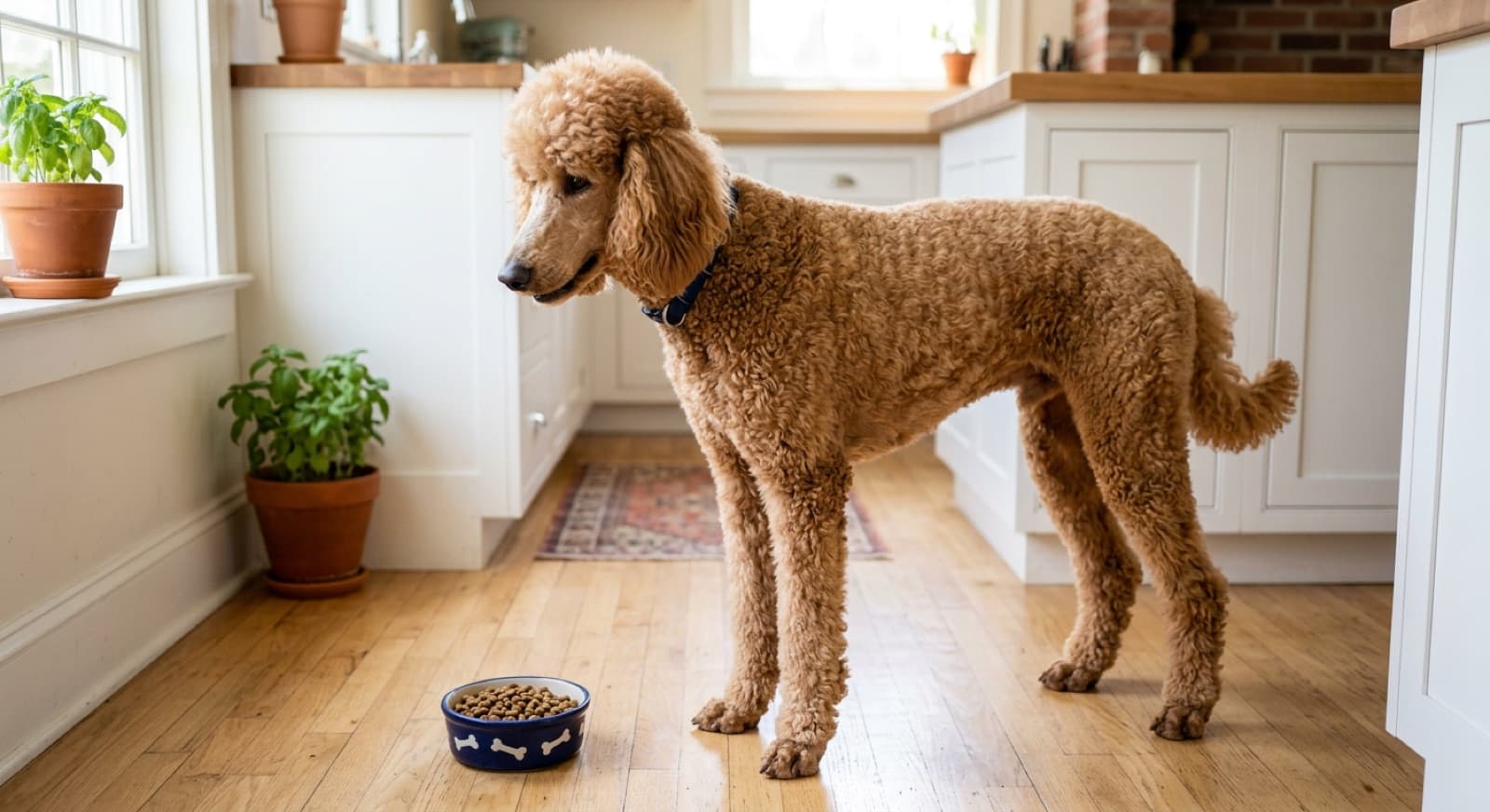
Feed a Standard Poodle as the large, deep-chested breed it is: a complete food in measured meals, kept lean, fed from the floor. Bloat is the headline risk that sets the Standard apart from Toy and Mini poodles, so feed two or three smaller meals a day, never from a raised bowl, and consider a gastropexy. Grow the puppy slowly on a controlled-calcium large-breed formula with no supplements. Judge weight by feeling the ribs under that coat, not by sight. And know that Addison's disease and sebaceous adenitis, both common in the breed, are genetic, not diet problems.
Bloat: the concern that sets the Standard apart
Raised or elevated bowls do not prevent bloat. The large Purdue study found they increase the risk in large breeds. Feed a Standard Poodle from the floor.
If you have owned a Toy or Mini poodle, this is the part that is genuinely different. The Standard is a deep-chested large breed and appears on the recognized bloat risk lists, and the Poodle Club of America lists gastric dilatation-volvulus among breed health concerns. Bloat is when the stomach fills with gas and twists, and it is rapidly fatal, with a high mortality rate even when treated promptly, per Cornell.
The research-backed risk factors come from the large Purdue study: older age, having a first-degree relative that has bloated, faster eating, and a raised food bowl. So feed a Standard from the floor, give two or three smaller meals a day instead of one large one, slow a fast eater with a slow-feeder bowl, and avoid hard exercise right around meals. The single most reliable protection is a preventive gastropexy, which tacks the stomach so it cannot twist; it is commonly done at the same time as spaying or neutering and has a very low complication rate. A swollen, drum-tight belly with unproductive retching is a go-to-the-emergency-vet-now situation.
Growing a Standard Poodle puppy
Here is the second big difference from the small varieties: a Standard Poodle puppy needs a large-breed puppy formula. As VCA explains, large-breed puppy foods deliberately control calcium and calories to slow growth and protect developing joints, and a large-breed puppy cannot down-regulate the calcium it absorbs.
That leads to one firm rule: do not add a calcium supplement or multivitamin to a complete large-breed puppy food, because excess calcium during growth causes skeletal problems rather than building a sturdier dog. Keep the puppy lean throughout, feel for the ribs rather than going by the bag, and transition to an adult food around 12 to 18 months on your vet's timing, since large breeds mature later than the Toy and Mini. A Mini or Toy poodle, by contrast, should never be on large-breed puppy food; the size really does change the rules.
When “sensitive stomach” is really Addison's
This is the most important fact-check in the article for the breed. Standard Poodles are notably prone to Addison's disease, a hormonal condition where the adrenal glands fail. The Merck Veterinary Manual describes it as an immune-mediated disease, and the breed is a primary research model for its strong genetic component. It is not caused by diet and no food cures it.
The reason it belongs in a feeding article is that Addison's classically shows up as waxing and waning appetite, vomiting, diarrhea, weight loss, and lethargy, exactly the picture owners write off as a sensitive stomach or a picky eater. So if your Standard has unexplained, recurring GI upset or appetite swings, ask your vet to keep Addison's on the differential rather than just switching foods again. This is the breed where “my poodle has a delicate stomach” deserves a second look.
Picky eating, sensitive stomachs, and allergies
Poodles have a real reputation for being fussy and not strongly food-motivated, and the biggest owner-driven cause is constant food-switching plus too many treats. The fix is to commit to one quality food, limit treats to under about 10 percent of daily calories, and feed scheduled meals rather than free-feeding. Warming the food or adding a small topper can help a genuine holdout.
The “sensitive stomach” reputation is, interestingly, somewhat overstated; experienced owners note that online forums over-represent problem stomachs because people with healthy dogs do not post. True food allergies are also less common than owners assume, and when they exist the usual triggers are proteins like beef, dairy, and chicken, not grains in general. If you genuinely suspect a food allergy, the reliable path is a vet-supervised elimination diet, not guesswork. And remember the section above: in a Standard, a sudden or recurring change in appetite is worth ruling out Addison's before blaming the bag.
Skin, omega-3, and the grain-free question
Standard Poodles are prone to sebaceous adenitis, a hereditary skin condition that the Merck Veterinary Manual describes as an inflammatory destruction of the skin's oil glands. It is genetic, not a food allergy, so no diet cures it. Diet can support the skin, though: omega-3 fatty acids help reduce inflammation and improve coat resilience as part of a management plan whose mainstay is topical therapy. Think of omega-3 as supportive, not a treatment.
On grain-free, the FDA has investigated a possible link between grain-free, legume-heavy diets and dilated cardiomyopathy without proving causation. The mainstream veterinary position, per Tufts, is to favour established brands that employ a qualified nutritionist and avoid boutique diets with pulses high in the ingredient list unless a vet recommends otherwise. For a Standard Poodle, that established-brand default is the safe choice.
Judging weight under the coat
A Standard Poodle's thick, curly coat hides its body, and that is a real trap, especially in the weeks between grooms when a dog can quietly gain weight nobody sees. So judge condition by feel, not by sight. Run your hands over the ribs: you should feel them easily under a light layer of fat, feel a waist behind them, and feel a tuck at the belly. If you have to press to find the ribs, the dog is overweight.
This matters because Standard Poodles have a meaningful rate of hip dysplasia, and as the PetMD breed material and breed-club screening guidance note, keeping the dog lean reduces the load on those joints. Aim for a lean 4 to 5 on the 9-point body condition scale. Portions vary widely with the food's calorie density and the dog's activity, so use the bag as a starting point only, weigh the food, and adjust to hold that lean condition.
Foods to avoid
Keep these away from a Standard Poodle completely:
- Chocolate (darker is worse)
- Grapes and raisins (can cause kidney failure, even a few)
- Xylitol (in sugar-free gum, some peanut butters, and baking), which is rapidly fatal to dogs
- Onions, garlic, leeks, and chives
- Macadamia nuts
- Alcohol and caffeine
- Cooked bones (they splinter)
A tall, clever Standard can reach counters and open low cupboards, so keep food secured. If your dog eats something on this list, call your vet, the nearest emergency clinic, or a pet poison helpline right away.
Looking to adopt a Standard Poodle?
Plan the large-breed feeding and bloat-prevention routine before day one. Browse Standard Poodles and Poodle mixes available now from the rescues we track across Canada.
See Available Standard Poodles →Where to buy Standard Poodle food
Every brand worth feeding a Standard is easy to find:
- Pet specialty chains (Pet Planet, Tail Blazers, Tisol). Carry Pro Plan, Royal Canin, and large-breed formulas.
- Pet Valu and PetSmart. Stock the major large-breed puppy and adult formulas.
- Your vet clinic. The best source for large-breed puppy guidance and any therapeutic diet if Addison's or a skin condition is diagnosed.
- Costco. Kirkland Signature large-breed is a cheaper everyday adult option.
A quality large-breed formula from an established brand is right for a Standard, and a quality omega-3 supplement is a sensible add for the skin and coat. Both are easy to set on a recurring delivery.
Frequently Asked Questions
How is feeding a Standard Poodle different from a Toy or Miniature?
The Standard is the only one of the three that is a genuine large, deep-chested breed at roughly 40 to 70 pounds, and that flips the priorities. For a Standard, the headline concerns are bloat, controlled large-breed puppy growth, and keeping the dog lean for its joints, none of which are big issues for a 6 to 12 pound Toy or Mini. The Toy and Mini worry instead about hypoglycemia and tiny-dog portion precision. So a Standard needs large-breed feeding habits: meals split through the day from a floor-level bowl, a controlled-calcium puppy food, and body-condition feeding.
Are Standard Poodles at risk of bloat?
Yes. The Standard Poodle is a deep-chested large breed and appears on the recognized bloat risk lists, and bloat is a true emergency with a high mortality rate even when treated. The research-backed risk factors include older age, having a first-degree relative that has bloated, fast eating, and, counterintuitively, a raised food bowl. So feed a Standard from the floor, give two or three smaller meals a day rather than one large one, slow a fast eater with a slow-feeder bowl, and avoid hard exercise right around meals. Many Standard owners also choose a preventive gastropexy, often done at spay or neuter.
Do raised bowls prevent bloat in a Standard Poodle?
No, the opposite. This is the myth most worth correcting for the breed. The large Purdue study on bloat found that a raised feeding bowl was associated with an increased risk in large and giant dogs, not a reduced one. So the old advice to elevate the bowl is reversed: feed a Standard Poodle from the floor. The feeding habits that genuinely lower risk are smaller, more frequent meals, slowing a fast eater, and keeping hard exercise away from mealtimes. The single most reliable protection is a preventive gastropexy, which tacks the stomach so it cannot twist.
Do I feed a Standard Poodle puppy large-breed puppy food?
Yes, and this is a real difference from the smaller varieties. A Standard is a large breed, so feed a food formulated for large-breed growth, which controls calcium and calories to slow growth and protect the joints. A large-breed puppy cannot regulate the calcium it absorbs, so do not add a calcium supplement or multivitamin to a complete puppy food, because excess calcium causes skeletal problems. Keep the puppy lean, let it grow slowly, and transition to adult food around 12 to 18 months on your vet's timing, since large breeds mature later than small ones.
My Standard Poodle has a sensitive stomach and picky appetite. Could it be something more?
Possibly, and this is worth knowing for the breed. Standard Poodles are notably prone to Addison's disease, a genetic hormonal condition, not a diet problem, that classically causes waxing and waning appetite, vomiting, diarrhea, weight loss, and lethargy. Owners easily mistake it for a sensitive stomach or pickiness. So if your Standard has unexplained, recurring GI upset or appetite swings, ask your vet to keep Addison's on the list; a diet change alone will not fix it. For ordinary pickiness, the fix is committing to one quality food, limiting treats, and feeding scheduled meals rather than constantly switching.
Can diet fix my Standard Poodle's skin or sebaceous adenitis?
Not cure it. Sebaceous adenitis is a hereditary skin condition concentrated in Standard Poodles, and it is not caused by food, so no diet cures it. What diet can do is support the skin: omega-3 fatty acids help reduce inflammation and improve coat resilience as part of a management plan whose mainstay is topical therapy like oil soaks and medicated shampoos. So think of omega-3 as supportive, not a treatment, and work the skin problem up with your vet rather than chasing it with food changes.
How do I tell if my Standard Poodle is overweight under the coat?
By feel, because the thick curly coat hides the body and is a real trap, especially between grooms. Run your hands over the rib cage: you should feel the ribs easily under a light layer of fat, feel a waist behind them, and feel a tuck at the belly. If you have to press to find the ribs, the dog is overweight no matter how it looks. Aim for a lean body condition of 4 to 5 on the 9-point scale. Keeping a Standard lean matters because the breed has a meaningful rate of hip dysplasia, and extra weight loads those joints.
What to Feed a Miniature Poodle
The mid-size poodle, where picky eating and the calorie budget lead.
What to Feed a Toy Poodle
The smallest poodle, with hypoglycemia and tiny-dog portion precision.
Standard vs Mini vs Toy Poodle
How the three poodle sizes differ in care, temperament, and health.
Standard Poodles for Adoption
Live listings of Standard Poodles and Poodle mixes from the rescues we track.