The short answer
Cats scratch to maintain claws, mark territory, and stretch. You can't stop it. You redirect it. Place tall, sturdy, sisal-wrapped scratching posts (vertical) and big cardboard scratchers (horizontal) right next to the furniture they target. Add a Feliway pheromone diffuser. Trim claws every 2 to 3 weeks. Cover problem furniture spots temporarily. Result: most cats redirect within 1 to 2 weeks.
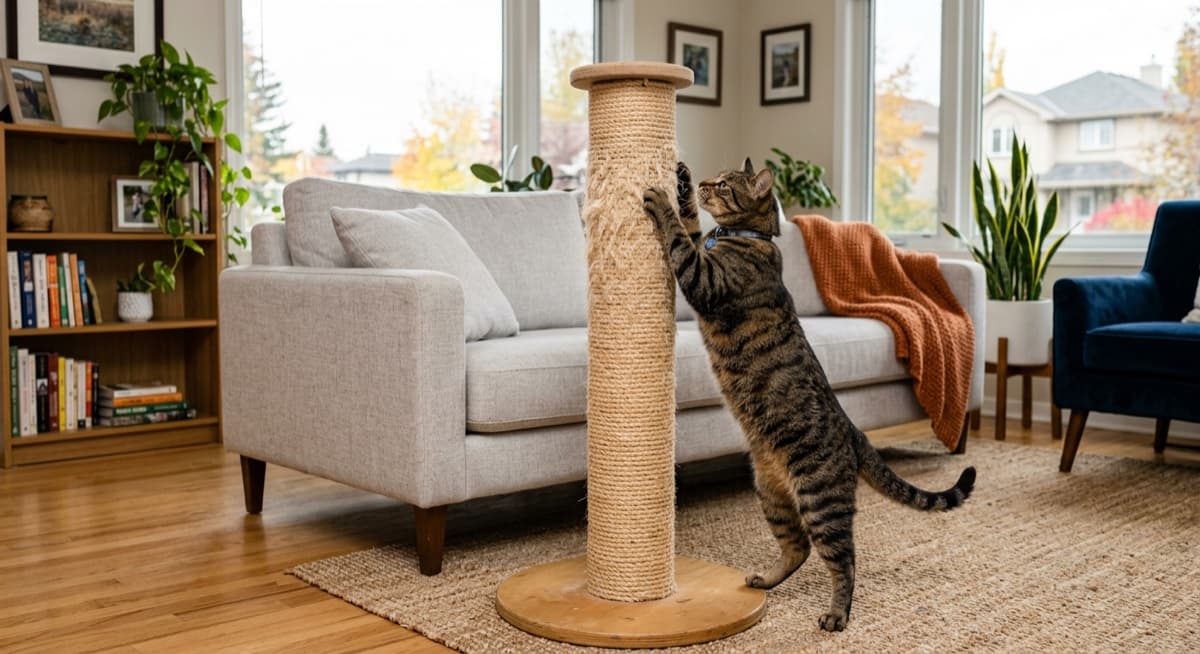
Why cats scratch (it's not optional for them)
- Claw maintenance. Scratching sheds the outer claw sheath, exposing fresh claw underneath.
- Territory marking. Cats have scent glands in their paw pads. Scratching leaves both visible marks AND scent.
- Full-body stretch. Watch a cat scratch a vertical post. They stretch from toes to spine.
- Stress release. Cats scratch more when anxious, after sleep, after meals, when excited.
You can't train this behaviour out. The goal is to give them a more attractive option than your furniture. International Cat Care describes scratching as a normal, essential behaviour, not a discipline problem.
The 80% rule for choosing scratchers
Most pet store scratching posts fail because they're too short. A scratching post needs to be:
- Tall enough that the cat can fully stretch up against it. Most adult cats need 30+ inches. Maine Coons and large cats need 36+ inches.
- Sturdy. Doesn't wobble. Cats won't use a post that tips. Heavy weighted base, or one that's anchored.
- Sisal-wrapped (not carpet). Carpet posts confuse cats. Carpet on the floor isn't for scratching, then you put it on a post and the message goes mixed. Sisal is the gold standard.
Spend $50 to $100 on one good scratcher rather than $20 on a bad one. Brands like SmartCat Ultimate Scratching Post or Cat Tree King are popular for a reason.
Vertical vs horizontal: offer both
Cats develop strong preferences early. Most cats prefer one or the other; some like both. Provide:
- Vertical posts. For stretching upward and territorial marking.
- Horizontal cardboard scratchers. For horizontal stretching and corner-of-the-couch type behaviour. Replace inserts as they wear out.
- Angled scratchers. Some cats love these. Worth trying if vertical and horizontal aren't catching on.
The American Association of Feline Practitioners (AAFP) recommends offering both vertical and horizontal scratching surfaces and matching texture to the cat's observed preference.
Placement: where you put it matters more than what you buy
Cats scratch where they want to mark and stretch, not in the basement. Put scratching posts:
- Right next to the furniture they're targeting. If your couch arm is the problem, put a tall post directly next to it. Move the post 6 inches a week toward where you actually want it after they switch.
- Near sleeping spots. Cats stretch and scratch immediately after waking.
- In high-traffic rooms. The basement post they never see won't work. Living room and bedroom posts will.
- Multiple locations. 1 to 2 scratchers per cat in different rooms, minimum.
Make the furniture less appealing (temporarily)
- Double-sided sticky tape on the targeted spots (Sticky Paws). Cats hate sticky paws.
- Aluminum foil on couch arms or door frames temporarily. Cats hate the texture.
- Citrus spray on furniture (cats dislike citrus). Test on fabric first.
- Furniture protectors. Clear plastic guards stick to corners. $15 to $25.
These are training tools, not permanent fixes. Use them for 4 to 6 weeks while the cat builds the scratcher habit, then remove.
Trim claws every 2 to 3 weeks
Less damage when accidents happen, and shorter claws are less rewarding to scratch with. How:
- Buy cat-specific scissor or guillotine clippers ($10 to $15).
- Press gently on the paw pad to extend the claw.
- Clip just the white tip, well clear of the pink quick (the blood vessel inside).
- Start with one claw at a time. Reward heavily. Build up gradually.
- If you cut the quick, it bleeds but heals. Apply styptic powder ($5) or a bar of soap pressed on the tip.
Why declawing is illegal in Alberta
Declawing is illegal for veterinarians to perform in Alberta. The Alberta Veterinary Medical Association (ABVMA) prohibits it on animal welfare grounds, and the same position is held by veterinary regulators across most of Canada. Declawing is not a nail trim. It's amputation of the last bone of each toe (onychectomy). The American Veterinary Medical Association (AVMA) declawing policy and the AAFP position statement on declawing both discourage the procedure for behavioural reasons and document the welfare cost. The reported harms include:
- Chronic pain in many cats (sometimes lifelong)
- Behavioural changes such as biting (the only defence left) and litter avoidance (litter hurts on amputated paws)
- Permanent gait changes affecting joints and muscle development
Some cat owners ask about “Soft Paws” or claw caps as an alternative. They work but need replacement every 4 to 6 weeks. Most cats tolerate them with patience. Available at most Calgary pet stores. Behavioural redirection (this article) works for almost every cat without needing caps.
What if nothing works?
- Reconsider scratcher quality. A wobbly 20-inch post is the most common reason redirect fails.
- Try a Feliway pheromone diffuser ($40 to $60). Reduces territorial scratching specifically.
- Increase environmental enrichment. Bored cats scratch more. Daily wand-toy play, puzzle feeders, cat tree by a window.
- Vet check for stress-induced scratching if it's sudden onset. Dental pain, urinary issues, and other underlying conditions can manifest as anxious scratching.
- Consider a Feliscratch product (synthetic pheromone applied directly to the scratcher). It signals “scratch HERE” chemically.
If sudden-onset scratching is paired with litter box changes, that points at a medical or stress trigger. Our cat litter box problems guide walks through the vet-first checklist. For new-arrival cats still settling into a Calgary home, see our first week with a rescue cat guide and the broader Calgary cat adoption guide.
Find a cat in Calgary
All cats scratch. The home setup matters. Browse adoptable cats in Calgary.
Browse Adoptable Cats →