The short answer
For most Calgary adopters, the Basset Hound is right if four conditions hold. One: you accept the dog will live on a leash or behind a fence for life because the nose overrides recall every time. Two: baying and howling will not get you evicted or divorced. Three: you can budget routine ear and back vet care, plus a serious commitment to IVDD prevention (ramps, no stairs, no jumping). Four: you find stubborn comic charm endearing rather than maddening. The breed is gentle with kids, dog-social, and a wonderful family companion when the fit is right. The deal-breakers are lifestyle mismatch, not temperament. If those four fit, keep reading. If even one is shaky, our resources hub covers steadier first-dog options.
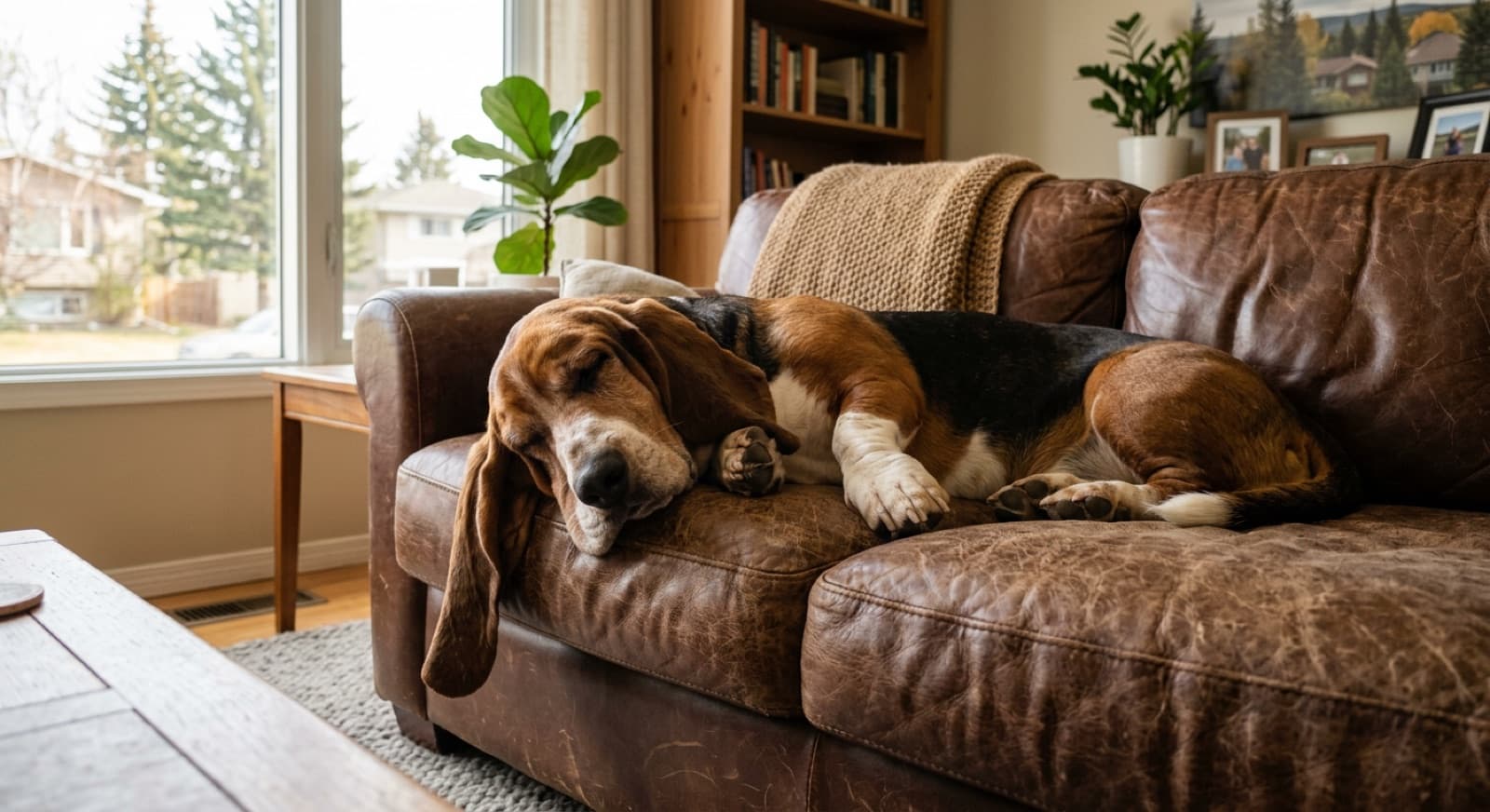
Honest Pros: Why People Love the Basset Hound
Gentle with kids and family-bonded
Bassets are calm, patient, and tolerant of household chaos. The low slung body means kids can pet the dog without lifting it, and the easygoing temperament absorbs noise, sudden movement, and toddler hands well. The breed wants to be in the room with you, lying on a comfortable bed, watching the day go by. For families looking for a calm and affectionate dog that genuinely shares the home, the Basset is one of the best options in the medium-large category.
Low-energy lounger most of the day
Bassets are not high-drive working dogs. The breed sleeps 14 to 16 hours a day as an adult, lounging on couches, dog beds, and sun patches. Daily exercise needs are moderate (30 to 60 minutes total), which suits owners who want a dog without the marathon-walking commitment of a Husky or Border Collie. The catch is the breed still needs that 30 to 60 minutes; couch-only Bassets become obese, and obesity multiplies IVDD risk.
Generally non-aggressive
Bassets were bred to hunt rabbits in packs alongside other hounds and human handlers. Aggression toward people or other dogs was selected out of the breed for centuries. Most Bassets are friendly with strangers, dog-social, and gentle in handling. This makes the breed approachable for first-time large-dog owners who are intimidated by guardian breeds. The behaviours that get misread as problems are stubbornness, bayed protest, and selective hearing. Those are training and management issues, not aggression.
Good with other dogs
Pack heritage means most Bassets are dog-social. Multi-dog households work well for the breed, and many Bassets are happier with a canine housemate than alone. Calgary off-leash spaces like the fenced section at Sue Higgins Park are great for socialising your Basset with other dogs in a safe environment. The breed will rarely start trouble, though Bassets will hold their own if pressed.
Comic personality and quiet humour
Basset owners describe the breed’s personality as a slow-burn comedy. The dog will steal sandwiches off counters with deliberate stealth, hide treats inside cushions for later, and protest a leash on rainy days with full-body dramatic flops. Bassets are not slapstick like a Lab puppy. The humour is observational and patient. For owners who enjoy a dog with character, the breed delivers.
Reasonable lifespan when well-managed
Bassets live 12 to 13 years on average, longer than many medium-large breeds. Lean body condition, regular ear care, IVDD prevention, and routine vet visits push that toward the high end. Obesity is the single biggest lifespan-shortener for the breed (roughly 2 to 3 years off the average), so the dog you want is the lean dog. The Canadian Kennel Club and the American Kennel Club publish breed-specific health and longevity guidance worth reading.
Adaptable to a range of living situations
The low-energy temperament means Bassets adapt well to single-story homes, suburban houses, acreages, and many apartments (with the caveat about baying and thin walls). The breed does not need acres of land to be content. What it does need is a securely fenced yard or a willingness to long-line walk daily, plus IVDD-aware household design. Stairs-heavy homes work if you commit to ramps or carrying the dog.
Honest Cons: What the Sleepy-Ear Photos Do Not Show
Notoriously stubborn
Bassets are smart, but they are independent thinkers from a scent-hound heritage that prized self-directed problem-solving. The breed asks “why” before complying, and if the answer is not interesting, the dog opts out. Old-school obedience expectations (snappy recall, immediate sit, crisp heel) frustrate Basset owners within months. Force-free training with high-value rewards works; harsh corrections and dominance methods backfire. The Calgary go-tos for force-free training are Raising Canine and Pup City Pup Academy.
Baying and howling that carries through walls
Bassets do not just bark. They bay. The deep, resonant, hound-throat sound carries through condo walls, townhouse partitions, and across yards. Triggers include separation, doorbells, sirens, other dogs, mealtimes, and occasionally nothing. Apartment dwellers and townhouse owners with shared walls need to factor in neighbour tolerance honestly. Training can reduce frequency, but the breed is vocal by design. If quiet is a household requirement, choose a different breed.
Scent-hound recall failure means leash-life
Once a Basset locks onto a scent (rabbit, deer, food wrapper, neighbour’s barbecue) the recall fails. The nose was bred to override every other instinct, and the dog will follow the trail through traffic, across fields, and over property lines. This is not a training failure. It is the breed’s functional design. Universal Basset advice is: never off-leash in unfenced spaces. The realistic options are a fenced yard, the fenced section at Sue Higgins Park, Sniffspot rentals at $15 to $30 an hour, or long-line walks with a 15 to 30 foot biothane line ($30 to $80). Calgary off-leash spaces like Nose Hill and Fish Creek are not safe for an off-leash Basset.
IVDD back risk
Intervertebral disc disease affects roughly 15 to 20 percent of Bassets in their lifetime. The long-back short-leg conformation puts mechanical stress on the spine, and the risk multiplies with obesity, stair use, and jumping on and off furniture. Prevention means a structural household commitment: ramps onto couches and beds, no stairs (or carry the dog), no jumping on or off vehicles, harness rather than collar to spare the neck, and a lean body condition. Acute back pain is a same-day vet emergency. Calgary specialty referral for serious cases goes to Western Veterinary Specialist Centre. Pet insurance from a young age is often worth the math for the breed.
Chronic ear infections
Roughly 50 to 70 percent of Bassets have recurring ear infections. The long pendulous ears trap moisture, warmth, and debris, creating the perfect environment for yeast and bacteria. Weekly ear cleaning with a vet-recommended solution is non-negotiable. Watch for head-shaking, ear-scratching, redness, foul odour, or dark discharge. Treated ear infections clear; ignored ones progress to chronic otitis that needs surgical intervention. Budget for routine vet visits even on a healthy dog.
Glaucoma risk
Bassets are predisposed to glaucoma, a painful condition where pressure builds inside the eye and can cause blindness if untreated. Annual eye exams from a vet (or ideally a veterinary ophthalmologist if a family history suggests risk) are essential. Watch for cloudy eyes, squinting, redness, vision changes, or rubbing at the face. Acute glaucoma is an emergency. The Canadian Eye Registration Foundation and the Orthopedic Foundation for Animals publish breed-specific screening recommendations responsible breeders follow.
Obesity epidemic
Bassets are food-driven, sneaky thieves, and built to lounge. The combination produces an obesity rate well above most breeds. Obesity in a Basset is not cosmetic; it shortens lifespan by 2 to 3 years, multiplies IVDD risk, accelerates joint disease, and worsens chronic ear and skin issues. Strict portion control, treat budgeting, and twice-weekly weigh-ins are part of the breed’s standard care. The dog you want is the lean dog with a visible waist when viewed from above.
Drool, hound smell, and surprisingly heavy shed
Bassets drool. Not as much as a Mastiff, but more than most owners expect, especially after drinking water or seeing food. The breed also carries a distinct hound musk that bathing reduces but does not eliminate. And despite the short coat, Bassets shed year-round, with the short hairs working into upholstery, car seats, and dark clothing. Households with a high standard for a clean, hair-free, odour-free home should reconsider. Households that accept dog-life-on-the-furniture will be fine.
Bloat (GDV) risk
Bassets are deep-chested, which raises the lifetime risk of gastric dilatation-volvulus, a stomach torsion that is fatal within hours without surgery. Mitigations are feeding two or three smaller meals rather than one large meal, slow-feeder bowls to reduce gulping, no vigorous exercise within an hour of eating, and elevated bowls only if your vet specifically recommends them (research on this is mixed). Sudden distended abdomen, unproductive retching, restlessness, and pale gums are emergency signs. Drive immediately to a 24-hour clinic.
Who Bassets Are RIGHT For
Patient households with a force-free training mindset
If you find a dog that takes its sweet time to follow a cue charming rather than infuriating, the Basset will reward you. The breed responds beautifully to high-value rewards, short positive sessions, and a sense of humour. Force-free trainers like Raising Canine and Pup City Pup Academy are the Calgary go-to for owners who want a structured class for their hound.
Households with a fenced yard or long-line commitment
A securely fenced yard is the gold standard for a Basset because it lets the dog explore, sniff, and lounge safely without the recall question coming up. If a fenced yard is not available, a 15 to 30 foot biothane long-line on neighbourhood walks works well, especially in quiet residential streets and along the Bow River pathway in low-traffic stretches. Plan the gear and the route before adoption.
Kid-tolerant family households
Bassets thrive in households with kids of any age. The breed is patient, gentle, and tolerant of household activity. The two rules to teach kids are: never pick the dog up (back protection), and never let the dog jump from furniture. Beyond that, the Basset is one of the most child-friendly breeds in the medium-large category.
Owners who enjoy scent-game enrichment
A Basset’s nose is a feature, not a bug, when you build enrichment around it. Snuffle mats, scatter feeding, hide-and-find treat games, and basic nose-work classes give the dog mental work that is genuinely rewarding for the breed. Calgary-area scent-work classes run through several local trainers, and the discipline plays to every Basset strength.
Single-story homes or ramp-committed households
Stairs are the single biggest IVDD risk factor in Calgary homes. A single-story house or condo (no basement, no upstairs bedroom) is ideal. Two-story homes work if you commit to a baby gate at the stairs and carry the dog up and down for life, or install ramps where the dog accesses furniture. Make that commitment honestly before adopting.
Vet-budget-comfortable households
Routine ear infections, annual eye exams, IVDD-aware care, and the elevated risk of bloat mean the Basset costs more in vet care than the average medium dog. Pet insurance from a young age is often worth the math, especially the IVDD coverage. If the vet budget is tight, the breed will eventually outpace it.
Who Bassets Are NOT Right For
Apartments with thin walls
The single most common Basset complaint from neighbours is the baying. The sound is deep, carries far, and triggers from doorbells, sirens, other dogs, and separation distress. If your building has thin walls or a noise-sensitive neighbour, the breed will create problems within months. Townhouse owners with shared walls should think hard before adopting. Detached homes are fine; condos with thick concrete construction are usually fine; thin-wall buildings are a poor fit.
Owners expecting fast obedience
If you want a dog that sits the instant you cue it, recalls reliably off-leash, and competes in obedience trials, choose a different breed. The Basset will frustrate you. The breed is smart but independent, and the “will you?” question is built into the breed’s response to every cue. Owners who reframe the relationship as cooperation rather than command do well. Owners who do not, surrender within 18 months.
Off-leash hiking lifestyles
If your weekends are off-leash trail hikes in Kananaskis or scrambles around the foothills, the Basset is the wrong dog. The breed cannot do this safely. Once a scent locks in, the dog disappears. Pick a recall-reliable breed (a well-trained Lab, Golden, or Aussie Shepherd, for example) if off-leash mountain life is non-negotiable.
Spotless-home, kid-free households where drool and smell are intolerable
Bassets drool, shed, and carry a hound musk. Owners who keep an immaculate furniture-no-dog-allowed home will be miserable. Owners who already live with kids and dogs and accept the trade-offs will not notice. Be honest about your home standard.
Low-vet-budget households
Bassets cost more in vet care than the breed’s laid-back demeanour suggests. Recurring ear infections, IVDD risk, glaucoma screening, bloat risk, and routine senior care add up. If the budget is tight, the breed will outpace it. Pet insurance from a young age helps, but the breed is not a low-cost-of-ownership pick.
Stairs-only homes without ramp commitment
Stairs are the biggest in-home IVDD trigger. Two-story or split-level homes work only if you commit to carrying the dog (for a 35 to 65 lb hound, this becomes hard fast) or installing ramps everywhere the dog moves between levels. Tall couches and beds also need ramps. If you cannot commit to that structural change, the breed is the wrong pick.
Adult vs Puppy vs Senior: Which Basset Should You Adopt?
For most Calgary adopters, an adult Basset between 3 and 7 years old is the safer pick. The rescue has evaluated how the dog does with kids, cats, other dogs, vets, alone time, grooming, and ear handling. You match a known temperament to your home instead of betting on a developing one. Adults also have established IVDD habits (no jumping, ramp use, calm furniture behaviour) and most are past the puppy chaos.
A Basset puppy is the right pick only if:
- You can install ramps and enforce no-stairs, no-jumping rules from the day the puppy arrives at week 8 (back protection starts immediately for the breed, and that is hard for first-time owners).
- You can commit to a force-free puppy class from week 10.
- You accept the puppy-stage workload: mouthing, baying practice, household chaos, and a slow growth curve where the dog looks small for months before filling out.
- You have time at home during the 6 to 16 week socialisation window.
Senior Bassets aged 8 and up are a wonderful option that adopters often overlook. Calmer, fully trained (or untrainable in known ways), past the destructive phase, and often surrendered through no fault of their own. Realistic expectations on remaining lifespan (3 to 5 years typically) and senior vet costs are the trade-off. Calgary Humane Society, AARCS, and ARF Alberta sometimes have senior Bassets who would thrive in a calm retirement home.
For first-time Basset owners specifically, a 3 to 7 year old adult is the sweet spot. See our full adoption guide for where to find rescue Bassets in Calgary and what reputable rescues assess.
Bassador vs Purebred: The Lab Cross Question
Bassets cross with several breeds, but the most common in Calgary rescue intake is the Bassador (Basset crossed with a Labrador Retriever). Other crosses include the Bagle Hound (Basset crossed with a Beagle) and the Basschshund (Basset crossed with a Dachshund). The Bassador is worth understanding because it is often a better first-time Basset experience.
A Bassador typically inherits:
- The Basset’s gentle temperament, family-bonding, and dog-social nature.
- The Lab’s slightly higher trainability, food motivation, and willingness to engage with handlers.
- A more athletic body (longer legs, less extreme back length), which moderately reduces IVDD risk compared to a purebred Basset.
- The Lab’s recall potential (still not off-leash reliable, but better than a purebred Basset).
- The Basset’s nose and stubbornness in some lines, the Lab’s biddability in others. You get a roll of the dice on the ratio.
Bagle Hounds amplify the scent-hound stubbornness and recall-failure pattern (Beagles share the trait). Basschshunds amplify the IVDD risk because both parent breeds have long backs. For most first-time Basset-leaning families in Calgary, a Bassador from rescue is often a softer landing than a purebred, while still delivering the gentle hound character. Ask the rescue specifically about temperament evaluation results.
The Calgary Lifestyle Math
Calgary is unusually well-suited to Basset Hound ownership in some ways and challenging in others. The honest picture:
- Winter helps the breed: Cold weather settles the dog, reduces excess energy, and makes the typical Basset cooped-up vocalising less intense. Most Bassets handle Calgary winters down to -15C comfortably with paw protection on salted sidewalks. Below -20C, walks shorten and the dog rests indoors.
- Summer is the harder season: Calgary July and August above 22C are challenging for the heavy-build breed. Walks shift to before 8 AM and after 8 PM. Midday is rest indoors with cool tile floors and possibly air conditioning. Above 25C, no hard exercise.
- Off-leash spaces are not realistic: Nose Hill, Fish Creek, Bowmont, and Edworthy are not safe for an off-leash Basset. The only realistic Calgary off-leash option is the fenced section at Sue Higgins Park. Sniffspot rentals at $15 to $30 an hour are the better answer for solo off-leash time.
- Bow River pathway is a good long-line route: The pathway has long stretches with low foot traffic, good sight-lines, and a moderate scent environment. A 15 to 30 foot biothane line gives the dog freedom to explore safely.
- Rescue availability is sporadic: Pure-breed Basset Hound rescues do not maintain a Calgary chapter, so most Calgary Bassets end up at general rescues like Calgary Humane Society, AARCS, BARCS, ARF Alberta, Cochrane Humane, and Pawsitive Match. Typical intake is 1 to 3 Bassets a year across the city, so be patient and set up rescue alerts.
- Calgary vet access is good: The city has plenty of double-doctor practices comfortable with Basset-specific issues (ears, eyes, backs). Specialty referral for IVDD or glaucoma goes to Western Veterinary Specialist Centre.
The “I Want One” Reality Check: Daily and Weekly Time
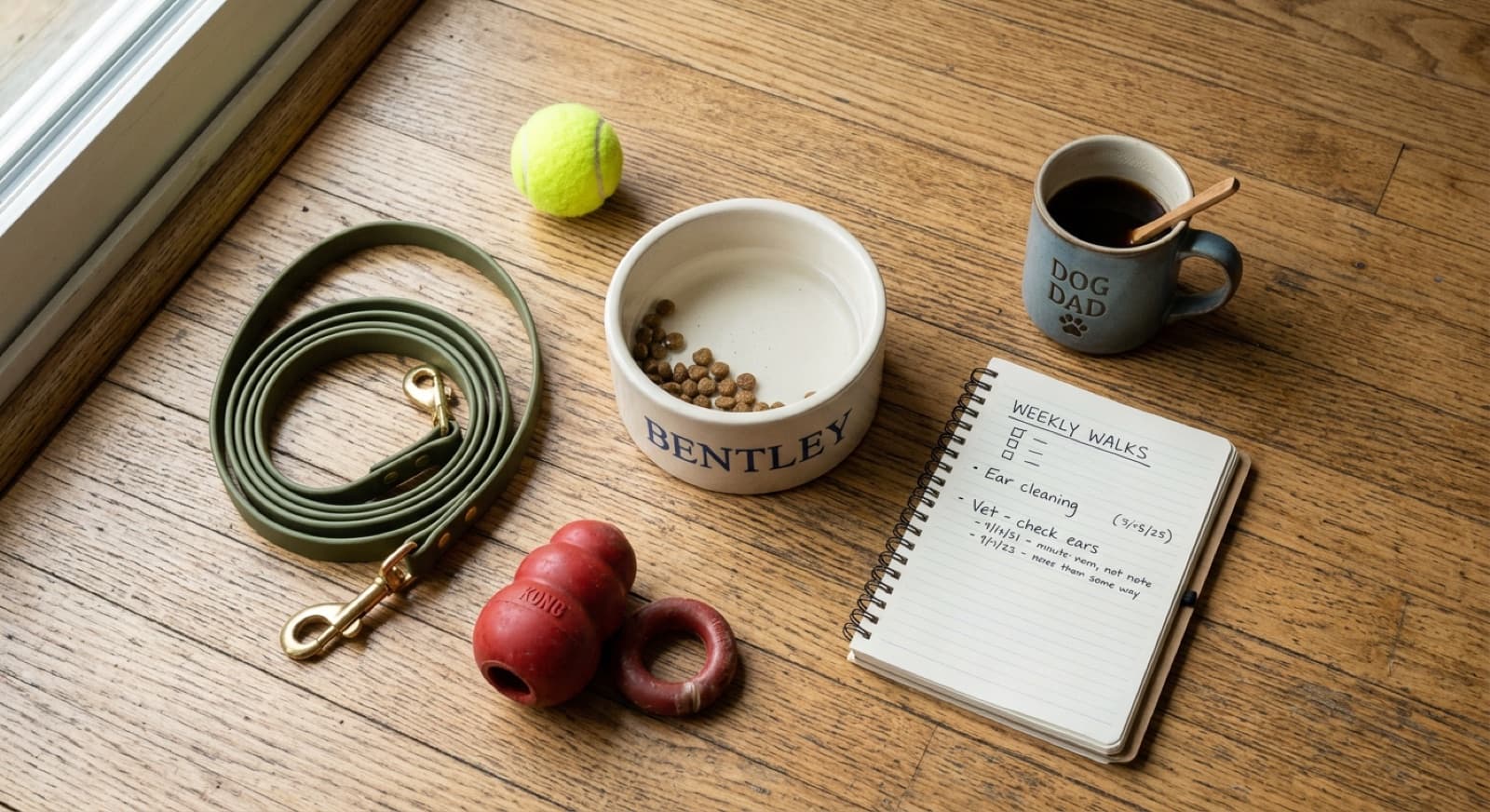
Most Basset adoption regret comes from underestimating the routine care burden. The breed is low-energy, but it is not low-maintenance. Run the actual numbers:
- Daily walks: 30 to 60 minutes total, split into 2 or 3 short outings. On-leash or in a fenced yard. Add long-line route variety once a week.
- Daily portion control: Measured meals, no free-feeding, treat budgeting. Weekly weigh-ins. Obesity is the single biggest preventable cause of shortened Basset lifespan.
- Weekly ear cleaning: 5 to 10 minutes with a vet-recommended solution. Non-negotiable for the breed.
- Weekly brushing: Twice-weekly with a rubber curry or deshedding tool, 10 to 15 minutes per session. Coat blow weeks in spring and fall add a third weekly session.
- Mental enrichment: 15 to 30 minutes daily of snuffle mats, scatter feeding, scent games, or short force-free training. Bassets need brain work even if they do not need a marathon walk.
- Vet visits: Annual wellness with eye exam, plus 2 to 4 ear-related visits a year for many Bassets. Senior dogs need more.
- IVDD-aware household routine: Ramps, no jumping, no stairs (or carrying). Built into the home design once, then maintained for life.
Combined daily minimum, conservative: roughly 60 to 90 minutes of dog-focused time, every day, for the next 12 to 13 years. Plus the structural household design and the vet budget. Compare honestly to the time and resources you have.
Browse adoptable Basset Hounds in Calgary
Calgary Basset intake is sporadic (typically 1 to 3 a year across the city), so foster-trial routes through rescues like Calgary Humane Society, AARCS, and BARCS are the realistic adoption path. Set up rescue alerts and check the live inventory page regularly. Bassadors and other Basset crosses come up more often than purebreds.
See Available Basset Hounds →10-Question Self-Assessment
Answer honestly. If you answer “no” or “not sure” to more than two, the Basset is probably not the right fit right now. That is useful information, not a judgment.
1. Will I accept that this dog lives on a leash or behind a fence for life?
Universal Basset advice: never off-leash in unfenced spaces. If you wanted an off-leash hiking partner, the breed will frustrate you. Be honest with yourself before you adopt, not after.
2. Will baying and howling create a household or neighbour problem?
Apartment dwellers with thin walls, townhouse owners with shared walls, and households with a noise-sensitive partner need to factor this in honestly. Training can reduce frequency, but the breed is vocal by design.
3. Can I commit to IVDD prevention: ramps, no stairs, no jumping?
Structural household commitment from day one. Ramps to couches and beds, baby gates at stairs (or carrying the dog), and a no-jumping rule taught from puppyhood or transition. Honest commitment matters more than budget here.
4. Can I budget for routine ear care and the elevated lifetime vet cost?
Chronic ear infections, annual eye exams, IVDD-aware care, bloat risk, and senior care add up. Pet insurance from a young age is often worth the math. If the budget is tight, the breed will outpace it.
5. Am I willing to use force-free, positive-only training methods?
No alpha rolls, no leash pops, no e-collars. Bassets shut down or stubbornly disengage with harsh handling. Force-free trainers like Raising Canine and Pup City Pup Academy are the Calgary go-to.
6. Do I have a fenced yard, or will I commit to long-line walks?
A securely fenced yard is the gold standard. Without one, you need a 15 to 30 foot biothane long-line, a route plan, and time to walk it daily. Sniffspot rentals at $15 to $30 an hour fill the off-leash gap. Plan the gear before adoption.
7. Will my household tolerate drool, hound smell, and heavy shedding?
All three are real and persistent. If your home standard requires a spotless, odour-free, hair-free environment, the breed is the wrong fit. If you already live with kids and dogs and accept the trade-offs, you will not notice.
8. Can I manage Calgary summer heat above 22C with a routine shift?
Early-morning and late-evening walks, no hard exercise above 25C, indoor rest with cool floors, paw burn checks on hot asphalt. The Calgary summer plan is part of the breed’s ownership math.
9. Am I committed to strict portion control to prevent obesity?
Measured meals, no free-feeding, treat budgeting, weekly weigh-ins. Obesity is the single biggest preventable cause of shortened Basset lifespan and a major IVDD risk multiplier. Lean dogs live longer.
10. Am I ready for a 12 to 13 year commitment with patience as the daily currency?
Bassets reward patience and frustrate impatience. If you find slow charming, the breed is wonderful. If you find slow infuriating, the breed will wear you down within a year.
Frequently Asked Questions
Are Basset Hounds good for first-time owners?
Sometimes, with realistic expectations. Bassets are gentle, family-bonded, low-energy most of the day, and generally non-aggressive, which makes them friendlier on paper than many hounds. The catches are stubbornness, scent-hound recall failure that locks them into leash-life, chronic ear infections that recur in roughly 50 to 70 percent of dogs, and IVDD back risk that demands a ramps-and-no-jumping household. First-time owners who succeed in Calgary tend to have patience, a force-free training mindset, a budget for routine ear and back vet visits, and a fenced yard or a willingness to long-line walk. If those fit, a Basset is a wonderful first dog. If you wanted a recall-reliable off-leash hiking partner, choose a different breed.
What are the biggest cons of owning a Basset Hound?
Notorious stubbornness from scent-hound independence, baying and howling that carries through condo walls, recall failure once a scent locks in (meaning leash-life or fenced-yard only), IVDD back risk that needs a no-stairs-no-jumping household, chronic ear infections that recur in most dogs, glaucoma risk that requires regular eye exams, obesity that takes years off the lifespan, drool on furniture and visitors, a distinctive hound smell, and surprisingly heavy shedding for a short-coated dog. None are deal-breakers alone. Together they explain why Bassets surrender to rescue more often than the sleepy-eared photos suggest.
Who should NOT get a Basset Hound?
Apartment dwellers with thin walls, owners who want fast obedience and crisp recall, off-leash hiking enthusiasts, families with a low tolerance for drool and hound smell, low-vet-budget households, stairs-only homes without ramp commitment, and anyone expecting a quiet low-maintenance breed. The Basset is a high-investment companion in subtle ways. A mismatch is not the dog's fault.
Are Basset Hounds good with kids?
Yes, generally excellent. Bassets are gentle, patient, and tolerant of household noise and activity. The low slung body and easygoing temperament make the breed one of the better large-ish family choices for households with young kids. The caveats are size (35 to 65 lbs of solid dog can knock a toddler over) and back protection (kids must learn never to pick up the dog or let it jump from furniture). With basic supervision and respect-based teaching, the Basset is a calm and affectionate family dog.
Are Basset Hounds good with other dogs?
Yes, usually very good. Bassets were bred to hunt in packs, and the dog-social temperament shows. Most Bassets are friendly with other dogs at the park, in multi-dog homes, and on neighbourhood walks. The breed rarely shows dog aggression, and many Bassets are happier with a canine housemate than alone. Cats and small pets are more nuanced: the prey drive is real but moderate, so cats raised with a Basset usually coexist, while introducing a Basset to a resident small pet (rabbit, hamster) needs care.
Can a Basset Hound ever be off-leash?
Effectively never in unfenced spaces. This is universal Basset advice, not a personality quirk. The breed’s nose was engineered for tracking, and once a scent locks in, the dog will follow it through traffic, across fields, and over the horizon. Calgary off-leash spaces like Nose Hill and Fish Creek are not safe for an off-leash Basset. The realistic options are a securely fenced yard, the fenced section at Sue Higgins Park, paid Sniffspot rentals at roughly $15 to $30 an hour, or long-line walks with a 15 to 30 foot biothane line (around $30 to $80). Plan for leash-life from day one. See our full recall and leash-life guide for the gear and the routine.
How bad is Basset Hound shedding?
Heavier than people expect for a short-coated dog. Bassets shed year-round and blow coat lightly in spring and fall. Plan on twice-weekly brushing with a rubber curry or a deshedding tool, weekly ear cleaning, and frequent vacuuming. The short hairs work into upholstery, car seats, and dark clothing. Households with a high standard for a hair-free home will struggle. Households that accept dog-hair-as-decor will be fine.
How serious is IVDD risk in a Basset Hound?
Serious enough to shape household design. Intervertebral disc disease affects roughly 15 to 20 percent of Bassets in their lifetime because the long-back short-leg conformation puts mechanical stress on the spine. Prevention is structural: ramps onto couches and beds, no jumping on or off furniture, no stairs (or carry the dog), keep the dog at a lean body condition (obesity multiplies IVDD risk), and use a harness rather than a collar to avoid neck strain. Acute back pain is a same-day vet emergency. Calgary specialty referral for serious cases goes to Western Veterinary Specialist Centre. Pet insurance from a young age is often worth the math.
How hot is too hot for a Basset Hound in Calgary?
Above 22C requires planning. Bassets are not Arctic dogs, but the heavy build and short legs make heat dissipation slow, and the long ears trap heat and moisture. Above 25C, walks shift to early morning and late evening, and the midday is rest indoors. Above 28C, no hard exercise. Hot asphalt is a paw risk; test with the back of your hand for 5 seconds. The breed handles a Calgary winter well with paw protection on salted sidewalks, but Calgary July and August demand a real summer routine.
Should I adopt a Basset Hound puppy or adult?
For most first-time Basset owners, an adult is the safer pick. Basset puppies need full back-protection from week 8 (no stairs, no jumping, ramps installed) and that is hard for households juggling other responsibilities. Adults arrive temperament-evaluated by the rescue (how the dog does with kids, cats, other dogs, vets, alone time, grooming, and ear handling). You match a known temperament to your home. The sweet spot is a 3 to 7 year old adult: past the puppy chaos, plenty of life ahead, IVDD habits already established. Seniors aged 8 plus are also a wonderful option if you have realistic expectations on lifespan and vet costs.
Sources and further reading
- Basset Hound Club of Canada: breed standard, health screening recommendations, and ethical breeding guidelines.
- Canadian Kennel Club (CKC) at ckc.ca: breed group, registered breeders, and Canadian breed standards.
- American Kennel Club (AKC) at akc.org: Basset Hound breed page, temperament, lifespan, and breed history.
- Orthopedic Foundation for Animals: breed-specific screening recommendations for hips, elbows, and eyes.
- Calgary Humane Society at calgaryhumane.ca: local adoption process and surrender support.
This article is informational only and not a substitute for veterinary, behavioural, or insurance advice. Consult a Calgary veterinarian, a force-free trainer, and a Basset-experienced rescue for personalised guidance.
Related Basset Hound guides
Basset Hound Adoption Calgary →
Where to find a rescue Basset in Calgary, real adoption costs, what reputable rescues assess, and the foster-trial route.
Basset Hound Training and Recall Calgary →
The leash-life routine, long-line gear, fenced spaces, and the force-free approach that actually works on a scent hound.
Basset Hound Health Issues Calgary →
IVDD prevention, chronic ear care, glaucoma screening, bloat awareness, and pet insurance ROI for the breed.
Basset Hounds for Adoption in Calgary →
Live listing of available Basset Hounds and Basset mixes across Calgary rescues when inventory exists.
New dog? Start with these care guides
Everything a new adopter needs to set up a safe, happy home.