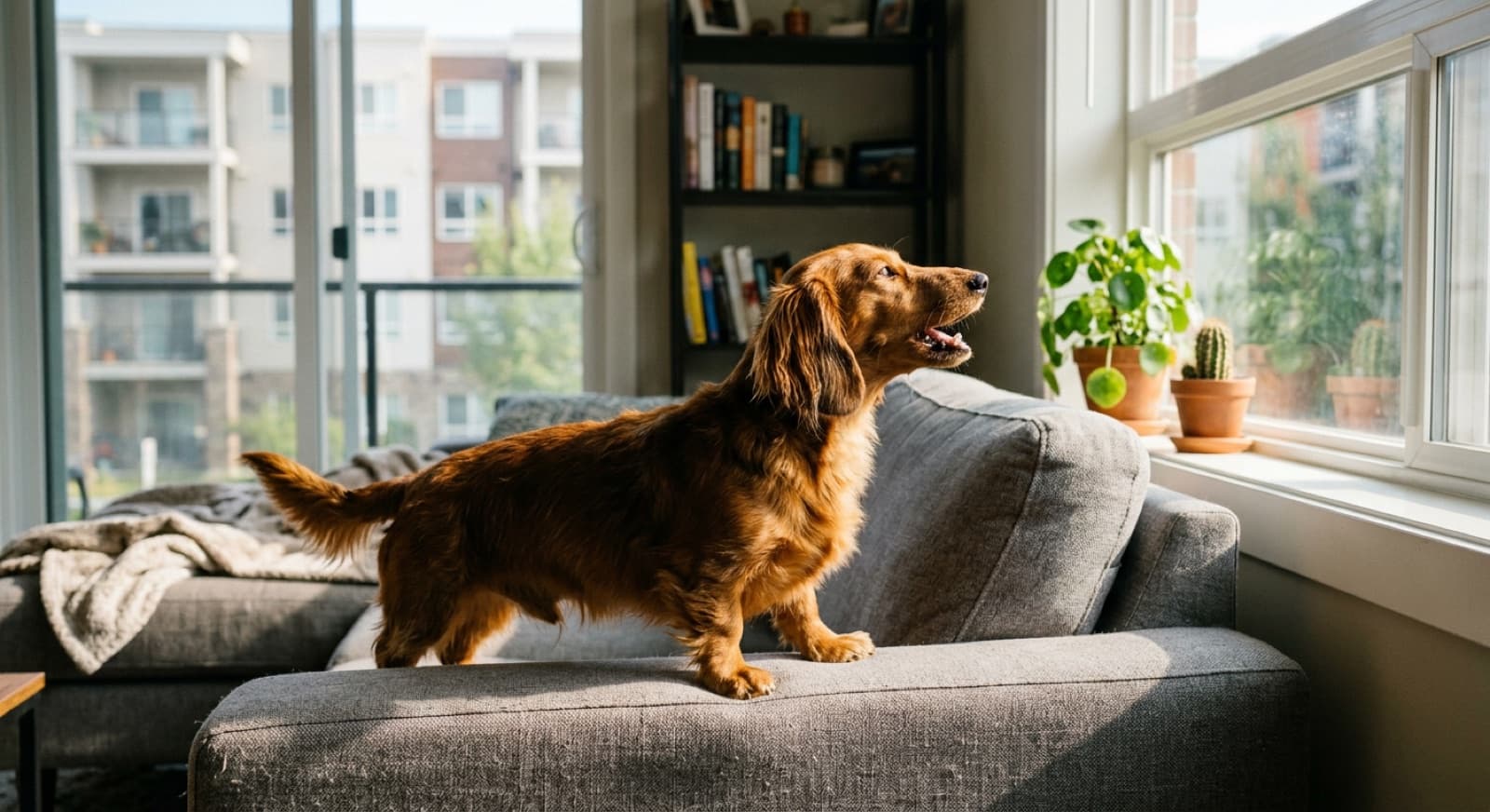
The short answer
Dachshunds bark because the breed was designed to bark. Bred in Germany to hunt badgers underground, the breed's job was to corner prey in a tunnel and bark continuously so the hunter above could find the dog through several feet of soil. The loud, deep bark is breed engineering, not training failure. Three types of barking show up: alert barking (door, mail carrier, passing dog), demand barking (food, attention, couch access), and anxiety barking (separation, isolation). Each type needs a different protocol. Dachshunds also score higher than most breeds on owner-directed aggression in the Duffy 2008 study, mostly tied to handling without consent, being moved off furniture, and resource guarding. Leash reactivity is common (defensive, not offensive). Prey drive is bred-in and not safely overridden by recall training. With kids, the breed is more kid-fragile (back injury risk) than kid-aggressive. The fix for all of it is the same five-step force-free protocol used by Calgary trainers Dogma, ImPAWSible Possible, Calgary K-9, and Sit Happens. Most Doxies improve substantially within 8 to 16 weeks. The barking can be reduced, not eliminated.
Your Dachshund is not broken. He is doing the job the breed was selected for, in an apartment.
For 300 years German hunters bred Dachshunds to be loud, opinionated, and fearless against animals larger than themselves. The vocal alert was the entire point. Calgary apartment life and that breeding history are in tension, but the tension is manageable. Expect to train bark control, not bark elimination. Expect a vocal dog with strong opinions. Manage the back, respect consent around handling, and the rest of the behaviour usually stays in a workable range.
Why Dachshunds bark: it is breed design
Vocal alert was the breed's job. Dachshunds were bred in Germany to track badgers, follow them into their tunnels, corner them, and then bark loudly and continuously so the hunter above ground could locate the dog through meters of dirt and roots.
The bark is not loud by accident. It is loud by design. A 10 to 15-pound Dachshund produces a deep, carrying bark closer to what you would expect from a 40-pound dog. That sound was selected for over 300 years because hunters needed to hear the dog through soil, root systems, and the burrow walls. The trait is hardwired now. You cannot train it out the way you might suppress vocalization in a Whippet or Basenji.
This matters because most online “stop your dog barking” advice was written for breeds that bark accidentally or out of poor training. Dachshund barking is on-purpose by ancestry. The realistic goal is bark control, not bark elimination:
- Which triggers earn a bark response
- How long the response lasts (three seconds versus three minutes)
- What behaviour the dog defaults to when the trigger passes (quiet on a mat, not continued patrol)
- How much volume the dog uses (a single alert bark versus a five-minute siege)
Owners who accept this framing get good results. Owners who keep trying to produce a silent Dachshund get frustrated, escalate to aversive methods that make the problem worse, and often surrender the dog within the first year.
The three types of Dachshund barking
| Type | Trigger | Fix approach |
|---|---|---|
| Alert barking | Door, mail carrier, passing dog, sounds in the hallway | Environmental management plus quiet-cue training |
| Demand barking | Wants food, attention, couch access, the patio door opened | Extinction protocol (stop reinforcing, never ever respond to the bark) |
| Anxiety barking | Owner leaves, dog is alone, dog is confined away from people | Separation anxiety desensitization, sometimes behaviour medication |
Mixing protocols across types is the most common mistake. Owners ignore demand barking thinking it is anxiety, or they reinforce anxiety barking thinking it is alert behaviour. Each type needs its own approach.
Alert barking is the breed's default and the most legitimate type. The dog hears or sees something and announces it. The protocol is to manage the environment (frosted window film, drawn blinds during peak mail hours, white noise), reward calm after the first few barks, and redirect to a place cue. The goal is three to five seconds of bark, then quiet, not zero barks.
Demand barking is the type that drives apartment owners insane. The dog wants something (food, the couch, your attention) and barks until you give in. Any response reinforces it, including yelling, looking at the dog, picking the dog up, or putting the dog in another room. The fix is full extinction: zero response to demand barking, every time, by every household member, for as long as it takes. The first week gets worse before it gets better (extinction burst). Most demand barking resolves in 2 to 4 weeks of perfect consistency. One inconsistent household member resets the timer.
Anxiety barking is a different problem with a different fix. If your Dachshund barks for hours when alone, that is separation anxiety, not alert or demand barking. Standard bark training will not help and may make it worse. See the separate Dachshund separation anxiety guide for the desensitization protocol and the role of behaviour medication.
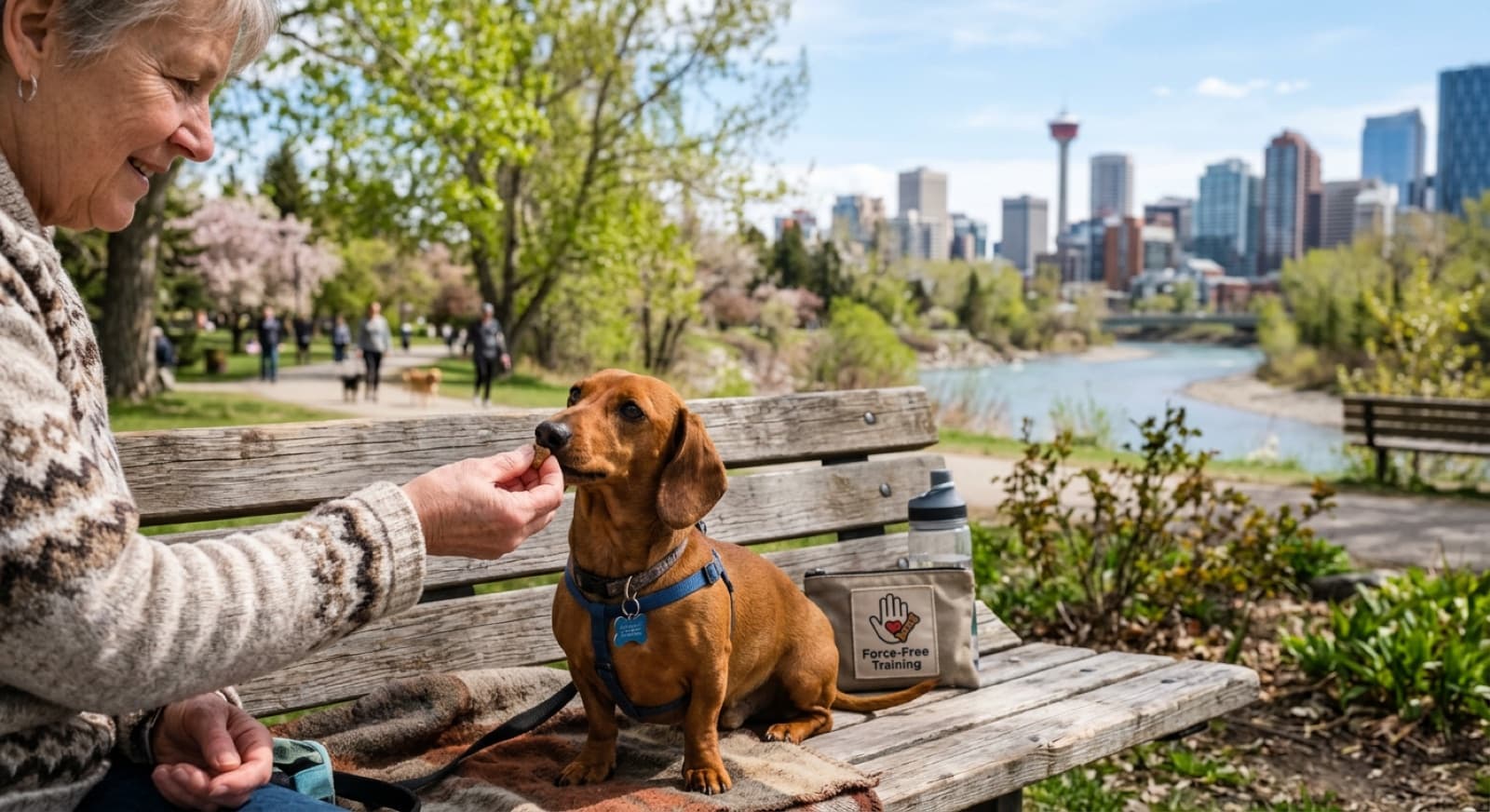
Are Dachshunds actually aggressive?
The label is overstated, but not invented. The Duffy et al. 2008 University of Pennsylvania study on breed-specific aggression found Dachshunds moderate on stranger-directed and dog-directed aggression, but notably higher than most breeds on owner-directed aggression. That last finding is the one worth understanding.
Owner-directed aggression in Dachshunds is almost always tied to specific triggers:
- Being picked up without consent. Like all small dogs, Doxies are grabbed from above more than any other size class. The grab looks like a predator strike from the dog's perspective
- Being moved off furniture. A Dachshund settled on the couch will often growl or snap when reached for. The breed has strong opinions about resting spots
- Being handled when in pain. Dachshunds carry a 25 percent lifetime IVDD risk. Many bites trace back to undiagnosed back pain. A growl during handling is medical until proven otherwise
- Being woken suddenly. Touching a sleeping Doxie produces more startle bites than in most breeds. The rule for kids: never touch a sleeping dog
- Resource guarding. Food, bones, toys, sleeping spots, sometimes a favourite person
Most Doxies are wonderful with proper handling, training, and respect for consent. The breed is opinionated, not mean. The growl-then-snap pattern the studies pick up is almost always preventable with two things: respect the dog's consent signals, and get a vet workup any time aggression appears suddenly in an adult dog, because back pain hides behind many Dachshund “personality” changes.
Leash reactivity, resource guarding, and prey drive
Leash reactivity in Dachshunds is almost always defensive. The dog feels small and exposed, sees an approaching dog, and uses noise and forward lunging to make the threat go away. It works, so it gets reinforced. Most reactive Doxies are friendly off-leash with the same dogs they bark at on-leash. The standard fix is increase distance, mark and treat at calm thresholds, walk in quiet places at off-peak times (Nose Hill weekday morning, Edworthy before 8 AM, residential side streets). Improvement in 6 to 12 weeks is typical with a Calgary force-free trainer's plan. Avoid prong and e-collars: they suppress the warning without fixing the fear and often make snapping worse.
Resource guarding shows up around food bowls, bones, high-value chews, sleeping spots, and sometimes the owner's lap. It is anxiety about loss, not dominance. Punishing the growl teaches the dog to skip the warning and go straight to a snap, which is more dangerous. The counter-conditioning protocol: walk past the bowl from a distance, drop a high-value treat in. Your approach predicts gain, not loss. Reduce distance over weeks. Never reach into the bowl, never take food away, never stand over the dog while he eats. For toys and chews, trade up: offer something better in exchange for the lower-value item. Severe cases (lunging, biting, guarding spaces or people) need a force-free trainer. Dogma and ImPAWSible Possible both run dedicated resource guarding programs.
Predatory chase and prey drive deserve their own paragraph because the management is different. Dachshunds were bred for prey drive. The breed was sent into tunnels to confront animals larger than itself. That drive does not turn off because you call. A Dachshund chasing a squirrel, rabbit, cat, or any small fast-moving object is in prey mode, and the recall cue is competing with a hardwired behaviour selected for over centuries. Working assumption: my Dachshund will chase small animals if given the chance. Off-leash time should be conditional on environment. Securely fenced yards. Never open spaces near cats or wildlife. Never dog parks where small animals might appear. Never near city pathways during gopher or jackrabbit season. Use a long line (30 feet, biothane is good for Calgary winters) for off-leash feel with safety. Recall training is still worth doing for emergencies, but trust earned through 1,000 calm recalls does not transfer to a squirrel six feet away. The prey drive is breed design, not a training failure, and environmental management is the responsible response.
Dachshunds and small children
Dachshunds are not a kid-aggressive breed. They are a kid-fragile breed. The combination of back injury risk, strong opinions about handling, and small size creates a real risk profile that families with toddlers should understand before adoption.
Two issues combine. The back: Dachshunds have a 25 percent lifetime risk of intervertebral disc disease. Rough handling by a child (lifting under the front legs, dropping, squeezing, hugging around the middle) can directly trigger a disc episode. A child who hugs a Doxie can injure the dog. The temperament: Dachshunds are opinionated and not always patient with sudden grabs, hugs, or face-approaches. A toddler grabbing a Doxie has a higher than average chance of being snapped at, not because the dog is mean, but because the dog is small, fragile, and defending against contact that hurts.
Rules for kid-and-Doxie households:
- No picking up the dog (or supervised lifting only, supporting front and rear)
- No hugging, no chasing, no face-approaches
- No approaching the dog when eating, sleeping, or settled in a resting spot
- Dog needs a safe space the kids cannot enter (crate, baby-gated room, elevated dog bed)
- Never leave a Dachshund alone with a child under 8
- Teach kids to invite the dog over rather than approach. The dog needs the option to walk away
Most Calgary Dachshund rescues ask about kid ages during the application process. Families of older kids (10+) who can follow rules tend to do well. Families with toddlers and active young kids are a higher-risk match unless adults can fully manage interactions. AARCS, Pawsitive Match, and Heaven Can Wait all have placement protocols that consider this.
The step-by-step fix
The protocol below applies to barking, leash reactivity, resource guarding, and handling-related snapping, with adjustments for the specific trigger. It is the same framework used by every certified Calgary force-free trainer.
Step 1: Identify the trigger. Get specific. Is it the doorbell? Strangers at the door? Other dogs on walks? Hands near the food bowl? Being moved off the couch? Write down every bark or snap incident for two weeks: time, place, what was happening, who was present. Patterns emerge fast. Generic “he is reactive” is not actionable. “He lunges at large dogs on leash within 15 feet during evening walks” is.
Step 2: Stop reinforcing the behaviour. For barking, do not yell back. Yelling is just louder barking from the dog's perspective and reinforces the noise. For handling-related snapping, stop the forced handling for two weeks. For leash reactivity, stop walking the dog into close-range encounters. Removing the rehearsal lets the nervous system reset.
Step 3: Counter-condition. Pair the trigger with something the dog loves (high-value treats: chicken, freeze-dried liver, cheese). The order matters. The trigger appears first, then the treat appears. Over time the dog learns that the trigger predicts good things and the emotional response shifts from fear or arousal to anticipation. Example for door barking: doorbell rings, mark with a clicker or yes, dog runs to mat, feed on mat. Example for resource guarding: walk past bowl from 10 feet, drop chicken in. Repeat 50 times across several days.
Step 4: Desensitize gradually. Increase trigger intensity only as fast as the dog stays under threshold (calm enough to take treats). If the dog stops eating or shows warning signs (lip lick, head turn, whale eye, stiff body, freeze), you moved too fast. Back off. The pace is the dog's pace, not yours. Most Dachshunds show meaningful improvement in 4 to 8 weeks. Full resolution takes 8 to 16 weeks of consistent daily practice.
Step 5: Book a force-free trainer if severity warrants. Severity flags: broken skin, repeated bites, redirected aggression (biting the nearest human when frustrated), aggression in multiple unrelated contexts, sudden onset in an adult dog. Calgary force-free options below.
Step 6: Vet workup if the behaviour is sudden or escalating. Back pain, dental disease, thyroid issues, and neurological changes can all cause sudden behaviour change. In Dachshunds especially, a sudden onset of growling or snapping is back pain until proven otherwise. Book an exam and discuss IVDD screening.
Apartment management for Calgary Doxie owners
Most Calgary Dachshunds live in apartments, condos, or townhouses where neighbours share walls. The breed's vocal range and Calgary's density make management essential. Tactics that work:
- Frosted window film on the lower half of any window the dog can see out of. Removes the visual trigger for passing dogs, neighbours, and the mail carrier
- White noise machine in the main living space. Masks hallway sounds, building footsteps, and elevator dings that trigger alert barking
- Walk timing. Calgary pathways are busy from 7 to 9 AM and 5 to 7 PM. A reactive Doxie does better on midmorning and late-evening walks. Quieter routes (residential side streets, Nose Hill weekday mornings, Edworthy before peak hours) reduce trigger density
- Crate with a covered top for daytime rest. Reduces the dog's visual access to triggers and provides a den space
- Doorbell silencer or app-based doorbell (some smart doorbells let you mute the chime inside while still receiving notifications). Removes the single biggest alert trigger in most apartments
- Notify neighbours when you start training. A polite note that you are working on bark reduction often buys 6 to 8 weeks of patience that you would not get otherwise
For condo boards or landlords who have raised concerns, a written training plan from a certified Calgary force-free trainer carries weight. Most landlords accept “owner is actively working with a professional trainer” as good faith effort. Be proactive rather than reactive.
Calgary force-free trainers and behaviourists
Force-free (also called fear-free, R+, or positive reinforcement) is the only training approach recommended by the American College of Veterinary Behaviorists. Avoid any trainer who recommends prong collars, e-collars, or “dominance” methods for barking or reactivity. They suppress warnings without fixing the underlying state and often make biting worse.
Dogma Dog Training
Calgary's best-known force-free training school. Multiple locations across the city. Group classes (puppy, reactive dog, resource guarding) run $200 to $450 for a 6-week course. Private consultations $150 to $250 per session. Strong with small breeds and bark management cases.
ImPAWSible Possible
Calgary force-free trainer specializing in reactivity and fear-aggression. Private sessions and small group reactivity classes. Pricing comparable to Dogma. Known for patient case work with vocal and reactive small breeds.
Calgary K-9
Calgary trainer with force-free programs for small breeds. Private and semi-private sessions. Good fit for owners who want one-on-one work rather than group classes.
Sit Happens
Calgary force-free trainer with group and private programs. Strong on puppy foundations and bark control. Good early-stage option for owners trying to head off problems before they become severe.
Dr. Jennifer Pelster, Calgary Veterinary Behaviour Services
The regional veterinary behaviourist for serious cases. Veterinarian with board certification in animal behaviour. Can prescribe behaviour medications (fluoxetine, trazodone, clonidine) alongside training, and rule out medical contributors. Referral is usually through your primary vet. Initial consultation $400 to $600 with a written treatment plan. Right path for: dogs that have broken skin repeatedly, bitten children, or not responded to 8+ weeks of force-free training.
Calgary Humane Society behaviour support
Free behaviour consultations for adopters in the first 30 days post-adoption. Phone and email support beyond that for any Calgary dog owner. Good first stop for early concerns.
Why so many Dachshunds end up in rescue
Calgary rescues see a steady flow of surrendered Dachshunds. Three reasons dominate the intake forms:
- Barking. Owners underestimate the breed's volume and persistence. Apartment neighbours complain. Doorbell episodes wake babies. Demand barking for attention becomes constant. Owners who expected a quiet small dog discover they got the most vocal breed in the small size class
- Housetraining difficulty. Dachshunds are notoriously slow to potty-train. Small bladder, low ground clearance, sensitivity to cold and wet (a real Calgary factor for 6 months of the year), and a stubborn temperament combine. Many Doxies are not reliably housetrained until 9 to 12 months, sometimes longer. Owners who expected the standard 4 to 6 month timeline get frustrated
- IVDD costs. Intervertebral disc disease is a breed-specific risk with a 25 percent lifetime incidence. A bad episode means surgery in the $7,000 to $12,000 range at Calgary specialty clinics, plus 6 to 12 weeks of strict crate rest. Many owners surrender after an episode because they cannot manage the recovery or afford the surgery
The fix for the high surrender rate is honest expectations before adoption. Anyone considering a Dachshund should know the breed barks more than most small dogs, takes longer to housetrain, and carries a real risk of expensive back issues. Owners who go in informed almost always keep their Doxies. Owners who expected a quiet, easy small dog often surrender within the first year. If you are reading this guide before adopting, you are already doing better than 80 percent of first-time Dachshund owners.
Frequently Asked Questions
Why does my Dachshund bark so much?
The breed was designed in Germany to bark at badgers underground. Loud, deep, continuous vocal alert was the working role. The trait is hardwired. Realistic goal is bark control (three to five seconds and quiet), not bark elimination.
Are Dachshunds actually aggressive?
Mostly no. Duffy 2008 study found moderate stranger and dog aggression but higher-than-average owner-directed aggression. Almost always tied to handling without consent, being moved off furniture, or undiagnosed back pain. Manageable with respect for consent plus vet workup for sudden onset.
How do I stop alert-barking at the door?
Environmental management (frosted window film, drawn blinds, white noise), quiet-cue training with high-value treats, and a place cue (redirect to mat away from door). Goal is three to five seconds of bark, then quiet. Most Calgary Doxies show progress in 4 to 8 weeks.
My Dachshund lunges at dogs on walks. Aggressive?
Almost always defensive leash reactivity, not offensive aggression. Increase distance, mark and treat at calm thresholds, walk in quiet places at off-peak times. Most reactive Doxies improve in 6 to 12 weeks. Avoid prong and e-collars.
My Doxie growls at the food bowl. Normal?
Yes, more common in this breed than many others. Resource guarding is anxiety about loss, not dominance. Never punish the growl. Walk past, drop high-value treats in the bowl. Trade up for toys. Severe cases need a force-free trainer (Dogma, ImPAWSible Possible).
Can I trust my Dachshund off-leash near wildlife?
No. Prey drive is breed design and does not override reliably. Securely fenced yards only, never near cats or open-area wildlife, never near gophers or jackrabbits. Use a 30-foot long line for off-leash feel with safety. Calgary has substantial wildlife your Doxie will chase.
Are Dachshunds good with kids?
Kid-fragile rather than kid-aggressive. Back injury risk plus strong opinions about handling. Rules: no picking up, no hugging, no chasing, no approach during eating or sleeping. Never alone with a child under 8. Families with older kids (10+) do better than families with toddlers.
Why do so many Dachshunds end up in rescue?
Three reasons: barking volume and persistence, slow housetraining (often 9 to 12 months), and IVDD surgery costs ($7,000 to $12,000). Owners who went in informed almost always keep their Doxies. Owners expecting a quiet easy small dog often surrender within the first year.
Dachshund Separation Anxiety Calgary
Why Dachshunds are prone to separation anxiety, the desensitization protocol, and Calgary trainer support.
Dachshund Potty Training Calgary
The realistic timeline (9 to 12 months), winter complications, and the protocol that actually works for the breed.
Dachshund IVDD Recovery
What disc disease looks like, the 6 to 12 week crate-rest protocol, surgery costs, and Calgary specialty clinics.
Dachshunds With Kids and Cats
Honest fit assessment, household rules for back-fragile dogs, and managing prey drive around resident cats.
New dog? Start with these care guides
Everything a new adopter needs to set up a safe, happy home.