The short answer
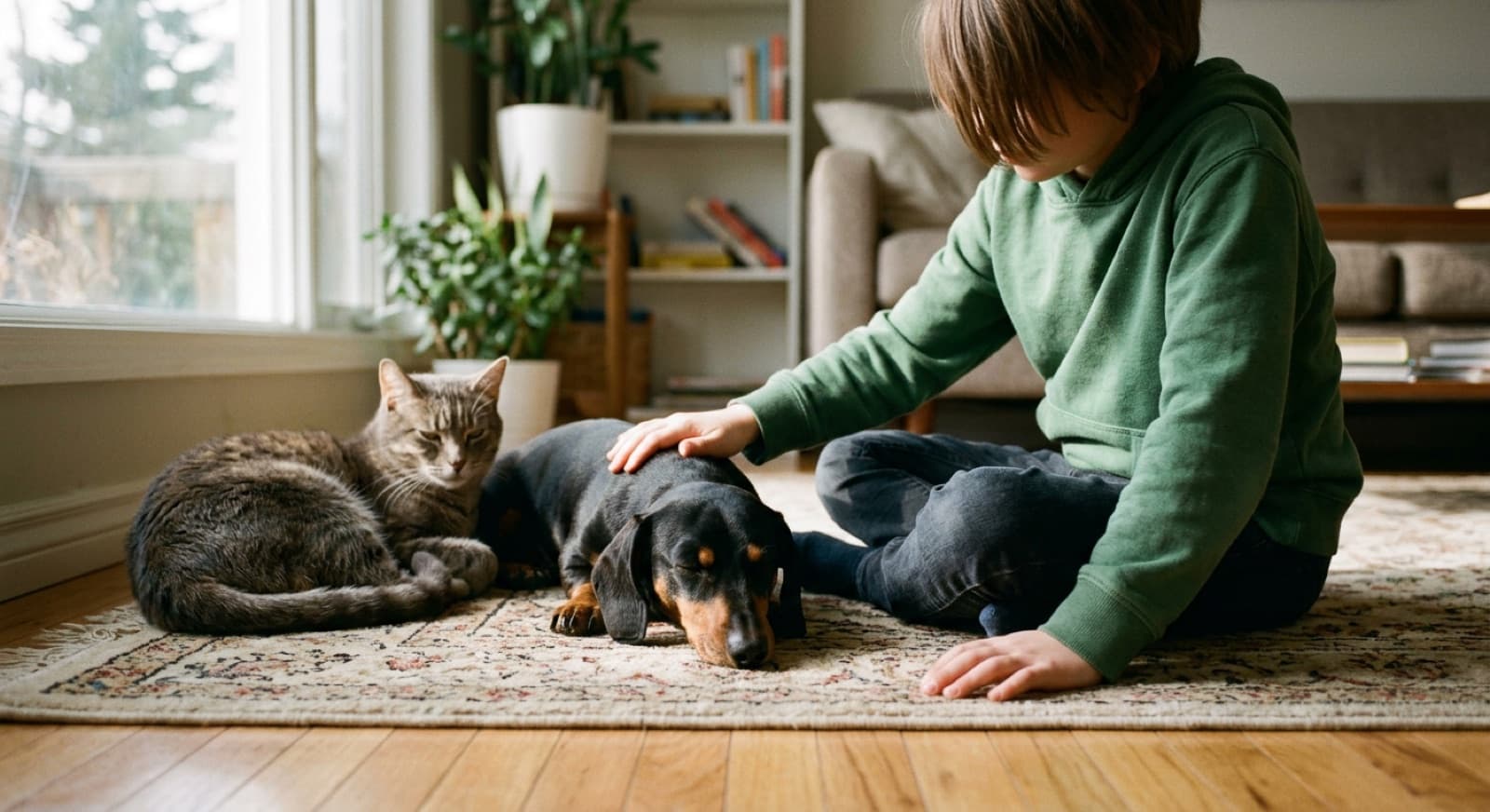
Dachshunds are a high-risk match for toddlers and a great match for kids 5 and up who can learn back-protection rules. The unique risk: a Doxie's long spine means rough handling from a small child can trigger intervertebral disc disease (IVDD), the breed's signature health problem. Most Calgary rescues, including Alberta Dachshund Rescue, will not place a Doxie in a home with children under 5, and many extend that to kids under 7 or 8. With cats, most Doxies do fine if introduced slowly (scent exchange, gates, leashed parallel exposure, gradual freedom over months), but a minority have strong prey drive and should not live with cats. With other dogs, Doxies do well with small and medium dogs of compatible energy. Be cautious with large dogs: a normal correction from a bigger dog can break a Doxie's back. Dachshunds are ideal for seniors and a poor fit for full-time workers without midday support. Foster-to-adopt through Pawsitive Match, AARCS, and Alberta Dachshund Rescue is the best way to test household fit before committing.
The toddler back-injury reality you need to understand
A toddler grabbing or pulling on a Dachshund's long body can cause spinal injury that triggers IVDD. This risk is unique to long-bodied breeds. A normal toddler interaction that would be harmless to a Lab can cost $8,000 to $12,000 in spinal surgery for a Doxie, with months of crate rest and a real risk of permanent paralysis. This is why most Calgary rescues will not adopt Dachshunds to homes with kids under 5. It is not arbitrary policy. It is a welfare decision based on hundreds of bad outcomes across the rescue community.
Why Dachshund anatomy changes the family-dog math
The Dachshund's long spine is a feature of the breed, not a defect. Doxies were bred to chase badgers down narrow tunnels. The long body and short legs are functional design. They also create a structural weakness that affects every family decision around the breed.
Intervertebral disc disease (IVDD) is the breed's signature health problem. Roughly 1 in 4 Dachshunds will experience some form of IVDD in their lifetime, the highest rate of any breed. The discs between the vertebrae degenerate, herniate, or rupture, causing pain, weakness, paralysis, or worse. Treatment ranges from strict crate rest to emergency spinal surgery costing $8,000 to $12,000 at Calgary specialty hospitals like Western Veterinary Specialist and Emergency Centre.
Common IVDD triggers include:
- Jumping on or off furniture
- Climbing stairs (especially carpeted Calgary stairwells)
- Slick floors that cause slips and twists
- Being lifted incorrectly (one hand under the front, hindquarters dangling)
- Rough handling, especially around the middle of the body
- Falls from height (couch, lap, child's arms)
- Sudden twists during play
Most of those triggers overlap with normal toddler behaviour. Toddlers lift dogs incorrectly because they cannot do it correctly yet. They drop dogs because their grip is unreliable. They run, fall, and sit on dogs by accident. They wake sleeping dogs without warning, which causes a flinch hard enough to wrench a back. None of these are bad toddler behaviour. They are normal toddler behaviour. The mismatch is the breed, not the kid.
This is why the family-dog math for Dachshunds is different from the math for most other small breeds. A Cavalier King Charles or a small mixed breed handles toddler handling with discomfort. A Doxie handles it with potential spinal injury. The risk is not theoretical. Calgary rescues see surrender cases every year tied to a single bad incident.
Dachshunds by kid age group
| Kid age | Dachshund fit | Calgary rescue stance |
|---|---|---|
| 0 to 4 (toddler) | High risk for the dog. Toddler handling can trigger IVDD | Most rescues will not place. Some hard policies, some case-by-case |
| 5 to 7 (early school) | Conditional fit. Kids must learn back-protection rules and follow them | Mixed. Many rescues prefer 7+ but consider 5+ with mature kids and trained parents |
| 8 to 12 (older school) | Often great. Kids can be active participants in care, training, walks | Widely accepted. Most rescues happy with this age range |
| 13+ (teen) | Usually wonderful. Doxies are calm companions for quieter teens | Welcomed. Sometimes the best match for a senior Doxie |
School-age (5 to 12) is the sweet spot when the household commits to teaching back-protection rules. Doxies form strong bonds with the kids in the home. They tolerate noisy playrooms, school-night routines, and weekend chaos. They are small enough for kids to walk on a leash with adult supervision. They love being included.
Teens often pair beautifully with Doxies. The breed's velcro temperament suits a teen who wants a companion during homework and quiet weekends. Senior Doxies (7+) are particularly good matches for teen households because the dog's calmer energy aligns with a teen's rhythm.
The under-5 line is firm at most Calgary rescues. Pawsitive Match, AARCS, and Alberta Dachshund Rescue all screen carefully for this. Some make case-by-case exceptions for very experienced Doxie families with a track record. Most do not. The policy is welfare-driven, not gatekeeping.
If you have a toddler and you genuinely want a Dachshund, the honest options are: wait until the youngest is 5 or older before adopting, or choose a different breed for now. A breeder will sell you a Doxie puppy at any age. A rescue will not. There is a reason.
Dachshunds and cats: the honest assessment
Most Dachshunds in Calgary rescues coexist fine with cats when introduced properly. A minority have prey drive strong enough that they should not live with cats. The difference matters, and the rescue's observation of the individual dog is the most reliable indicator.
Dachshunds were bred to hunt. The breed's entire purpose was to follow badgers and other small game into burrows and dispatch them. That prey drive is hardwired into the breed at varying intensities. Some Doxies have a faint version of it and barely notice cats. Some have a strong version that turns on the instant something small and fast moves.
The rescue's observation is the best data you will get. Ask specifically: has the dog been observed around cats? What did the dog do? Did the dog ignore them, sniff with curiosity, fixate, stalk, or chase? Foster homes give the most reliable answer because the dog has been observed for weeks in a normal household, not minutes at a shelter.
The “cat-tested at the shelter” reality: a 15-minute introduction in a noisy shelter environment tells you almost nothing about how the dog will respond to a cat in a quiet home over months. The dog may be too overstimulated by the shelter to show prey drive, or too shut down. Real cat-tolerance only shows over weeks of cohabitation. Foster-to-adopt addresses this directly.
Indicators that a specific Dachshund will likely do well with cats:
- Raised in a foster home with cats and observed calm around them
- Low to moderate prey drive in general (does not fixate on squirrels, birds, or small animals on walks)
- Calm, mature temperament (often older adults and seniors)
- Responds to redirection and recall reliably
- History of multi-species household pre-rescue
Indicators that a specific Dachshund is high risk with cats:
- Foster notes describe strong prey drive, fixation, or chasing during exposure
- The dog vocalizes intensely (screaming, baying, high-pitched whining) at small animals on walks
- The dog has a known kill history (cat, rabbit, rodent, bird)
- The dog cannot disengage from a chase even with strong recall cues
- The dog is a hunting-line Doxie still actively used for sport in some lines
The multi-cat introduction protocol
Slow is fast. The protocol below takes three to six months to complete. Done right, the household reaches stable coexistence. Done in days, the dog rehearses chasing and the cat lives stressed for years.
Phase 1: Scent exchange (week 1). Dog and cat are physically separated. Swap blankets between the two spaces so each animal smells the other without confrontation. Feed both animals near the swapped blankets so the other's scent predicts good things. No visual contact yet.
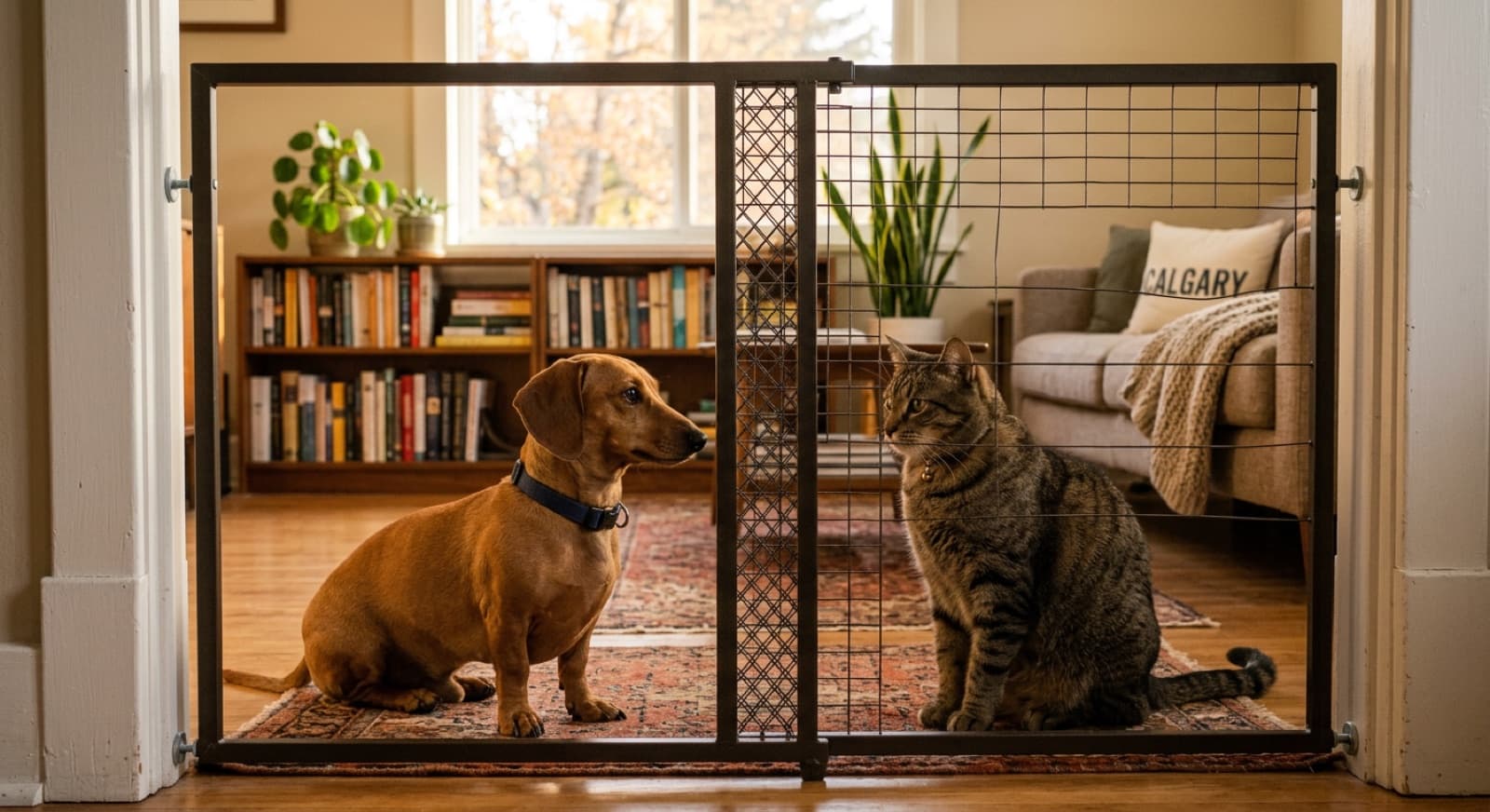
Phase 2: Gated visibility (weeks 2 to 3). Install a baby gate (or two stacked for an athletic Doxie) between the dog's space and the cat's space. Both animals can see each other but not contact. Feed treats on both sides during calm moments. End the session at the first sign of fixation, stalking, hissing, or stress. Build up to 15 to 20 minute sessions of calm coexistence with the gate between them.
Phase 3: Leashed parallel exposure (weeks 4 to 7). Dog in the same room as the cat, on a leash held by a calm handler. Treats for calm behaviour. Cat has a high escape route (cat tree, counter, separate room exit). Sessions start short (5 minutes) and grow as the dog stays under threshold. End the session at the first sign of fixation. Run multiple short sessions per day rather than one long one.
Phase 4: Drag line freedom (months 2 to 4). Dog wears a light long line (10 to 15 feet) indoors so you can interrupt instantly if a chase starts. Cat has unrestricted movement. You are present and supervising. This phase tests whether the dog can self-regulate in the cat's space without active leash control.
Phase 5: Supervised freedom (months 3 to 6+). Drag line removed when the dog has demonstrated calm coexistence for several weeks. Continue active supervision for months. Never leave the dog and cat unsupervised together until you have observed weeks of stable, calm coexistence. Some households never reach full unsupervised confidence and use crate-and-rotate as a permanent management strategy. That is fine.
If at any phase the dog cannot disengage or shows escalating fixation, drop back two phases and rebuild. Some Doxies progress steadily through the protocol in two to three months. Others plateau at gated visibility and never safely cohabit with cats. The protocol is diagnostic as well as therapeutic. It tells you which category your dog falls into.
If the dog plateaus or regresses, book a force-free Calgary trainer (Dogma, ImPAWSible Possible) for a private consult before continuing. A trainer can read the dog's body language in person and adjust the protocol.
Dachshunds and other dogs: size matters
Small and medium dogs of compatible energy are usually a smooth fit. Large dogs require careful management because the size mismatch can turn a normal correction into a spinal injury.
Dachshunds often pack confidence-without-context. They were bred to challenge animals much larger than themselves underground, and that boldness translates into a willingness to provoke much bigger dogs at the dog park, in the home, or on walks. The Doxie does not understand that a 60 pound Lab can break its back in seconds with a normal correction snap.
Calgary off-leash parks (Nose Hill, Sue Higgins, Bowmont, Edworthy) are common settings for size-mismatch incidents. A Dachshund picks a fight with a bigger dog, the bigger dog responds, and the Doxie ends up at the emergency vet. The bigger dog does not need to be aggressive. A normal warning snap or grab is enough.
Smart management for multi-dog Doxie households:
- Pair Doxies with other small dogs of similar size (under 25 pounds) when possible
- If a large dog is already in the home, supervise all play. Interrupt rough play immediately
- Separate feeding spaces, separate beds, separate high-value chews. Resource guarding is more dangerous when there is a size mismatch
- At off-leash parks, watch for the Doxie escalating with big dogs. Recall and leash if it starts
- Two Doxies often bond closely and make a stable pair
- Doxie + Cavalier, Doxie + small terrier, Doxie + small mixed breed: usually fine with good introductions
If you have a large resident dog and you are considering adopting a Doxie, foster-to-adopt is the right call. The rescue can observe how the dogs interact in the home before the placement is finalized.
Bringing a baby home to a resident Doxie
If you already have a Dachshund and are expecting a baby, prepare months ahead. The transition is doable, but the breed's sensitivity to handling and household disruption means rushed introductions go badly.
Start three to six months before the baby arrives. Steps that work for Calgary households:
- Establish a baby-free dog space. A crate, a gated room, or an elevated bed that will be off-limits to the child for the long term. The dog needs a predictable retreat space
- Train the cues you will need. Solid “place,” “leave it,” “go to your bed,” recall, and a calm sit-stay near distractions. Practice with baby noises (recorded crying on YouTube works fine)
- Adjust the routine pre-baby. Shift walks, feeding times, and attention patterns to match what life will look like post-baby. Sudden changes after the baby arrives feel like punishment to the dog
- Scent introduction. Bring home a blanket or hat the baby has worn at the hospital before the baby arrives in person. Let the dog sniff at his own pace. Pair the new scent with treats
- Classical conditioning. When the baby is present, the dog gets calm attention, treats, and chews. The baby's presence predicts good things, not less attention
- First meeting. Calm environment. The dog approaches at his own pace. No forced contact, no “come meet the baby” pressure. The dog gets to sniff and walk away. Treats for calm behaviour
- Never leave unattended. Not for a second. This rule never lifts as the child grows into a toddler. Doxie + small kid is always supervised
- Plan for temperament shifts. Some adult Doxies become more anxious after a baby arrives. The household is louder, sleep is disrupted, attention patterns change. If the dog shows new anxiety (excessive barking, house-soiling regression, withdrawal, snapping), a force-free trainer assessment in the first months is worth the cost
Calgary trainers (Dogma, Calgary K-9) offer baby prep classes specifically for families with resident dogs. Worth the $150 to $300 cost. The Family Paws program (familypaws.com) has free resources tailored to baby-and-dog introductions, often used by Canadian vet behaviourists.
The kids-respect-the-Doxie rules
Non-negotiable household rules for every Calgary family with a Dachshund and kids. These rules protect the dog's spine and prevent the bites that follow when a dog feels trapped or hurt.
- No picking up the dog. Adults pick up the Doxie with two hands supporting chest and hindquarters at the same time. Never under the front legs alone. Kids do not lift the dog at all until 10+ and trained on technique
- No chasing. If the dog walks away, the kid lets the dog walk away. Chase games teach the dog that humans are unsafe
- No riding, sitting on, or stepping over a sleeping dog. The dog needs a safe spot the kids cannot enter
- No waking a sleeping dog. Sudden startles are a common bite trigger and a common back injury trigger when the dog flinches hard
- No taking food, bones, or toys. Trade up with a higher-value item if you need to retrieve something
- No surprise hugs. Most dogs do not enjoy hugs, and a hug around the Doxie's middle is a physical risk
- No face-to-face wrestling, no rough play. Doxies are not built for that kind of body contact
- No carrying the dog up or down stairs. Adults only, with proper two-handed support, or use a ramp
- Always ask before petting. Kids invite the dog over and let the dog choose to come
- Calm voices around the dog. Yelling, sudden movements, and squealing trigger anxiety in many Doxies
Calgary force-free trainers (Dogma, Calgary K-9) offer kid-and-dog safety classes that walk both parents and children through this material. The $100 to $200 cost is small insurance against an injury or a bite incident. Calgary Humane Society also offers free behaviour consultations for adopters in the first 30 days post-adoption, which is a good touchpoint for any household with both kids and a new dog.
Calgary rescue restrictions, plainly
Most Calgary rescues limit Dachshund placements based on kid age. The specific cutoff varies by rescue and by individual dog, but the trend is consistent: no toddlers, careful screening for early-school kids, broadly open for 8+.
Alberta Dachshund Rescue is the breed-specific rescue serving Alberta and Calgary. Their default is kids 8+ for most placements, with case-by-case flexibility for younger kids if the family has prior Doxie experience and the specific dog is known to tolerate kids well. They prioritize foster placements that match a dog's observed temperament, so an individual dog may have a stricter or looser kid requirement than the rescue's general policy.
Pawsitive Match Rescue handles many small breeds including Dachshunds. Their adoption applications screen for kid ages and the rescue follows up with home visits. They use foster-to-adopt for most placements with families that have young kids, which lets the foster home observe the dog around the kids before the adoption finalizes.
AARCS (Alberta Animal Rescue Crew Society) takes intake from a wide range of sources and occasionally has Dachshunds available. Their adoption process is rigorous, with reference checks and trial periods. Foster-to-adopt is standard.
Calgary Humane Society sees Dachshunds in surrender intake occasionally. They screen for family fit and offer free behaviour support in the first 30 days post-adoption. Worth signing up for if you adopt a Doxie from them.
Heaven Can Wait Rescue Foundation in Calgary occasionally has Dachshunds. Their adoption process includes home checks and trial periods. They tend toward the cautious side on family placements.
Across all rescues, foster-to-adopt is the most reliable way to test household fit. The fee structure varies, but most Calgary rescues will let a family take a Doxie home for two to four weeks before the adoption finalizes. If it does not work, the dog returns to foster without judgment and the family loses only the application fee. It is the right approach for any breed with breed-specific compatibility considerations, and Dachshunds qualify.
Dachshunds for seniors and full-time workers
Seniors and elderly owners: often the ideal match. Dachshunds are small enough to manage in apartments and condos, have moderate exercise needs that work with limited mobility, and have the velcro temperament that suits a retired owner who is home most of the day. Two short walks plus indoor play is enough for most adult Doxies. Lifespan of 12 to 16 years means the bond is genuinely long-term. Match with an adult or senior Doxie (3+ years) rather than a puppy. Calgary Humane and Alberta Dachshund Rescue both have adult and senior Doxies looking for calm retirement homes.
Two caveats for senior owners. First, stairs and slick floors are IVDD risks, so a single-level home or one with stair gates and rugs is safer. Second, if mobility is limited enough that two daily walks are not possible, budget for a dog walker ($20 to $30 per visit in Calgary) or a daycare arrangement ($35 to $55 per day).
Full-time workers: risky without midday support. Dachshunds are one of the breeds most prone to separation anxiety because they bond intensely with their primary person. A Doxie left alone for 8 to 10 hours a day often develops destructive behaviours, excessive barking (a real issue in Calgary condos and townhouses), house-soiling regression, and chronic stress.
Realistic options for working households:
- Work-from-home or hybrid schedule (dog alone 4 to 6 hours max)
- Midday dog walker (Calgary services run $20 to $30 per visit)
- Doggy daycare 2 to 3 days a week ($35 to $55 per day at Calgary daycares like K9 Awareness, The Dog House, Wag Hotels)
- Family member or neighbour for a midday visit
- Adopt two compatible Doxies so they have each other for company
Without one of these, a Dachshund is likely to develop separation anxiety severe enough to require professional rehabilitation, which can take months. Calgary rescues screen for work schedule and may decline a placement that does not match the breed's needs. Honest framing: it is not a snub, it is welfare. The Dachshund Separation Anxiety guide linked below has the full prep protocol.
Frequently Asked Questions
Are Dachshunds good with kids?
Yes for school-age kids (5 to 12) and teens, with back-protection rules in place. High risk for toddlers because rough handling can trigger IVDD, the breed's signature spinal disease. Most Calgary rescues will not place Doxies in homes with kids under 5.
Why won't rescues adopt Doxies to homes with toddlers?
A toddler grabbing or pulling on a Dachshund's long body can trigger spinal injury that costs $8,000 to $12,000 to repair and sometimes leaves the dog permanently paralyzed. Alberta Dachshund Rescue, Pawsitive Match, and AARCS all screen carefully for this. It is welfare-driven, not arbitrary.
Are Dachshunds good with cats?
Most do fine with proper introductions (scent, gates, leashed parallel, gradual freedom over months). A minority have strong bred-in prey drive and should not live with cats. Ask the rescue specifically how the dog has been observed around cats. Foster home observation is more reliable than a 15-minute shelter test.
My Dachshund chases my cat. How do I stop it?
Stop the rehearsal first. Separate with a baby gate full time, then run the protocol: scent exchange (week 1), gated visibility (weeks 2 to 3), leashed parallel exposure (weeks 4 to 7), drag-line freedom (months 2 to 4). Most households reach stable coexistence in three to six months. Force-free trainer consult if you plateau.
Are Dachshunds good with other dogs?
Usually fine with small and medium dogs of compatible energy. Caution with large dogs: Doxies sometimes provoke bigger dogs out of confidence-without-context, and a normal correction from a 60 pound dog can break a Doxie's back. Supervise carefully at Calgary off-leash parks.
Are Dachshunds good for seniors?
Yes, often ideal. Small size, moderate exercise needs (two short walks a day), velcro temperament, long lifespan. Match with an adult or senior Doxie rather than a puppy. Watch for stairs and slick floors (IVDD risks). Calgary Humane and Alberta Dachshund Rescue both have senior Doxies looking for calm retirement homes.
Can a Dachshund handle full-time work hours?
Risky without midday support. Dachshunds are prone to separation anxiety. Realistic options: work-from-home, midday dog walker ($20 to $30), daycare 2 to 3 days a week ($35 to $55), family/neighbour visits, or adopting two compatible Doxies. Calgary rescues may decline placements without one of these supports.
Can I foster-to-adopt a Dachshund in Calgary?
Yes. Pawsitive Match Rescue, AARCS, and Alberta Dachshund Rescue all offer foster-to-adopt arrangements. The dog stays in the home for two to four weeks before the adoption finalizes. If it does not work, the dog returns to foster without judgment and the family loses only the application fee. Best way to test household fit.
Is a Dachshund Right for You?
Honest fit assessment for Calgary households, including apartment living, work schedules, and multi-pet homes.
Dachshund IVDD Recovery
The breed's signature spinal disease, prevention, treatment options at Calgary specialty hospitals, and recovery protocols.
Dachshund Separation Anxiety
Why Dachshunds are prone to separation anxiety, prevention before adoption, and Calgary force-free training support.
Dachshund Adoption Calgary
Where to adopt a Dachshund in Calgary, rescue partners, foster-to-adopt process, and what to expect from a rescue Doxie.
New dog? Start with these care guides
Everything a new adopter needs to set up a safe, happy home.