The short answer
Dobermans cycle through Calgary rescues steadily. A high-medical-cost breed produces regular surrenders. Best places: CHS, AARCS, BARCS, ARF Alberta, Pawsitive Match. Most surrendered Calgary Dobermans are 1–5 year old young adults at peak DCM diagnosis age and behaviour crisis. Adoption fee: $300–$800 vs $2,500–$5,000 from a CKC breeder. Steeldust Dobermans and Valhalla Dobermans Alberta are BREEDERS, not rescues. “Doberman” (single n) and “Dobermann” (double n) are the same breed, North American vs European spelling. European Dobermans run larger and blockier with more drive; American Dobermans are sleeker and more refined. Avoid “rare colour” premium pricing. Colour dilution alopecia hits 50–90% of blue/fawn Dobermans, and the Doberman Pinscher Club of America opposes white breeding. #1 surrender reason: DCM diagnosis ($3,000–$10,000 first-year cardiac costs). Pet insurance is essential, among the strongest ROI of any breed. Adult adoption (3–7) is right for roughly 85% of households.
The breed-defining warning every Calgary Doberman owner needs
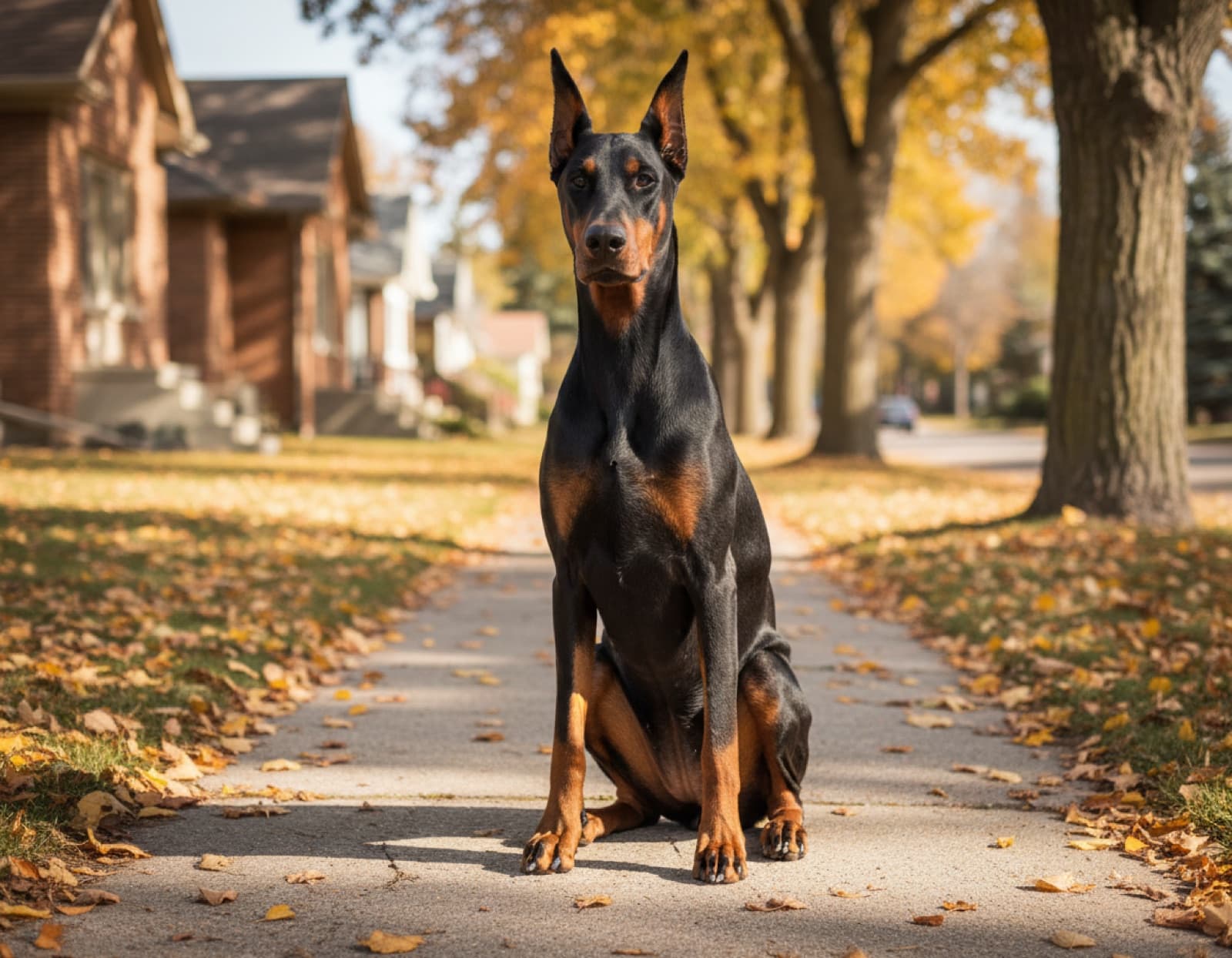
Roughly 50–60% of Dobermans develop Dilated Cardiomyopathy (DCM) in their lifetime, significantly higher than the general dog population (around 1%). DCM causes the heart muscle to weaken and dilate, eventually leading to congestive heart failure or sudden cardiac death. The terrifying reality: many Dobermans show no symptoms until a catastrophic cardiac event. Annual cardiac screening (Holter monitor and echocardiogram) starting at age 3 is essential. See our Doberman cardiac monitoring guide for the daily-living protocol, Calgary cardiology specialists, and treatment options.
Where can I adopt a Doberman in Calgary?
Calgary rescues with regular Doberman intake:
- Calgary Humane Society: largest intake, regular Dobermans
- AARCS: foster-based, often has Dobermans and mixes
- BARCS Rescue: takes Dobermans
- ARF Alberta: foster-based, regular intake
- Pawsitive Match Rescue Foundation: foster-based
- Calgary Animal Services: municipal stray and surrender intake
Provincial and national breed-specific options:
- “Doberman Rescue Alberta,” “Doberman Rescue Canada,” and “Royal City Doberman Rescue”: names that circulate in searches, but we cannot verify a real organization behind any of them (no CRA registration, no independent website, social, or adoptable listings). Treat them as unverified.
- Verified breed-specific option: Doberman Rescue Ontario (dobermanrescueontario.ca), a real eastern-Canada rescue, though it rarely places directly in Alberta.
- The reliable Calgary path: the general rescues (CHS, AARCS, BARCS, Pawsitive Match), which take in Dobermans regularly.
- Doberman Pinscher Club of Canada (DPCC): national breed club, occasional rescue referrals
Most surrendered Calgary Dobermans are 1–5 year old young adults whose first owners hit DCM cost reality, exercise and training issues, or separation anxiety. Many are surrendered after DCM diagnosis when treatment costs exceed budget.
Apply within 24–48 hours when a listing appears. Dobermans typically fast-adopt to experienced households.
Note: adopters often search “miniature doberman” expecting a small Doberman. The Miniature Pinscher (Min Pin) is a separate breed, not a downsized Doberman. If you want a Doberman in a smaller package, look at Doberman mixes (Doberman-Greyhound, Doberman-Beagle) instead.
Steeldust and Valhalla: Calgary BREEDERS, not rescues
Frequently confused in adopter searches. Both are Calgary/Alberta BREEDERS.
Steeldust Dobermans is an established Calgary-area breeder. CKC/AKC-registered, working/show focus. Typical pricing $3,500–$5,500 for puppies with full health testing. Wait list 6–18 months.
Valhalla Dobermans Alberta is a separate established Alberta breeder. CKC-registered. Similar protocols and pricing.
Ethical breeder protocol for Doberman buyers (regardless of breeder): demand documentation of:
- Hip OFA on both parents
- Cardiac auscultation by DACVIM-Cardiology specialist (NOT just GP heart listen)
- Annual echocardiogram on breeding parents
- Holter monitor results from breeding parents (24-hour cardiac monitoring)
- Thyroid panel
- Eye CERF examination
- vWD DNA testing (von Willebrand Disease bleeding disorder)
- DCM-1 / DCM-2 genetic testing
- Take-back at any age
- Health guarantees (typically 2-year minimum)
Avoid breeders who: claim “rare colours” (blue/fawn = colour dilution alopecia), don't do cardiac auscultation by a specialist, don't allow home visits, don't take dogs back, or sell puppies without full health testing.
If you specifically want a CKC-registered Doberman puppy, these are some Alberta options. If you want adoption (not purchase), Calgary general rescues are the reliable path.
European vs American Doberman
| Feature | European (Dobermann) | American (Doberman) |
|---|---|---|
| Standard | FCI | AKC / CKC |
| Size | 75–100+ lbs | 60–90 lbs |
| Build | Blockier head, broader chest | Sleeker, athletic, refined |
| Temperament | Working, protection-focused, intense drive | Show, calmer, family-pet adapted |
| Ear/tail | Natural (Europe banned cropping/docking) | Historically cropped/docked, decreasing |
| Best fits | IPO/Schutzhund, working sport, experienced handlers | Active families, agility, recreational sport |
Health concerns are similar (DCM, vWD, hip dysplasia) regardless of line.
Calgary availability: most Alberta breeders produce American (CKC) Dobermans. European imports are occasional, through specialty breeders and private imports. Calgary rescues typically receive American Dobermans.
Rescue lines are often unknown. Assess based on individual size and temperament rather than label.
Avoid: rare-colour Dobermans (blue, fawn, white)
Three issues with “rare colour” Doberman marketing. Important breed-specific concern.
(1) Blue/fawn colour dilute Dobermans are produced by a recessive dilution gene. Both develop colour dilution alopecia (CDA), a chronic skin condition with hair loss, recurrent infections, dry skin, and lifelong management. Roughly 50–90% of blue/fawn Dobermans develop CDA by age 1–3. Lifelong veterinary cost. Ethical Doberman breeders do not breed dilute colours deliberately.
(2) White/albino Dobermans are an extremely rare genetic anomaly, descended from a single 1976 albino-line female (“Sheba”). Severe health issues follow: skin cancer susceptibility, photophobia and vision issues, sometimes deafness, sometimes neurological problems. DPCA officially opposes white Doberman breeding.
(3) “Warlock” or “King” Dobermans is a historical marketing term for unusually large Dobermans, sometimes from Great Dane outcross lineage (resulting in non-standard size and joint issues). Not a real breed standard. Modern reputable breeders don't use this terminology.
Pricing red flags: any Calgary “rare colour” with “premium pricing” is likely unethical breeding. Healthy CKC-standard Dobermans (black-rust or red-rust) from ethical breeders typically cost $2,500–$5,000.
Adoption reality: Calgary rescues occasionally have surrendered blue/fawn Dobermans (often surrendered when CDA emerges). These dogs make wonderful pets, but adopters should plan for lifelong CDA management ($30–$80/month skincare costs). Reduced adoption fees ($200–$500) reflect medical reality.
Ear-cropping + tail-docking in Alberta
Mixed regulations across Canada. Alberta-specific:
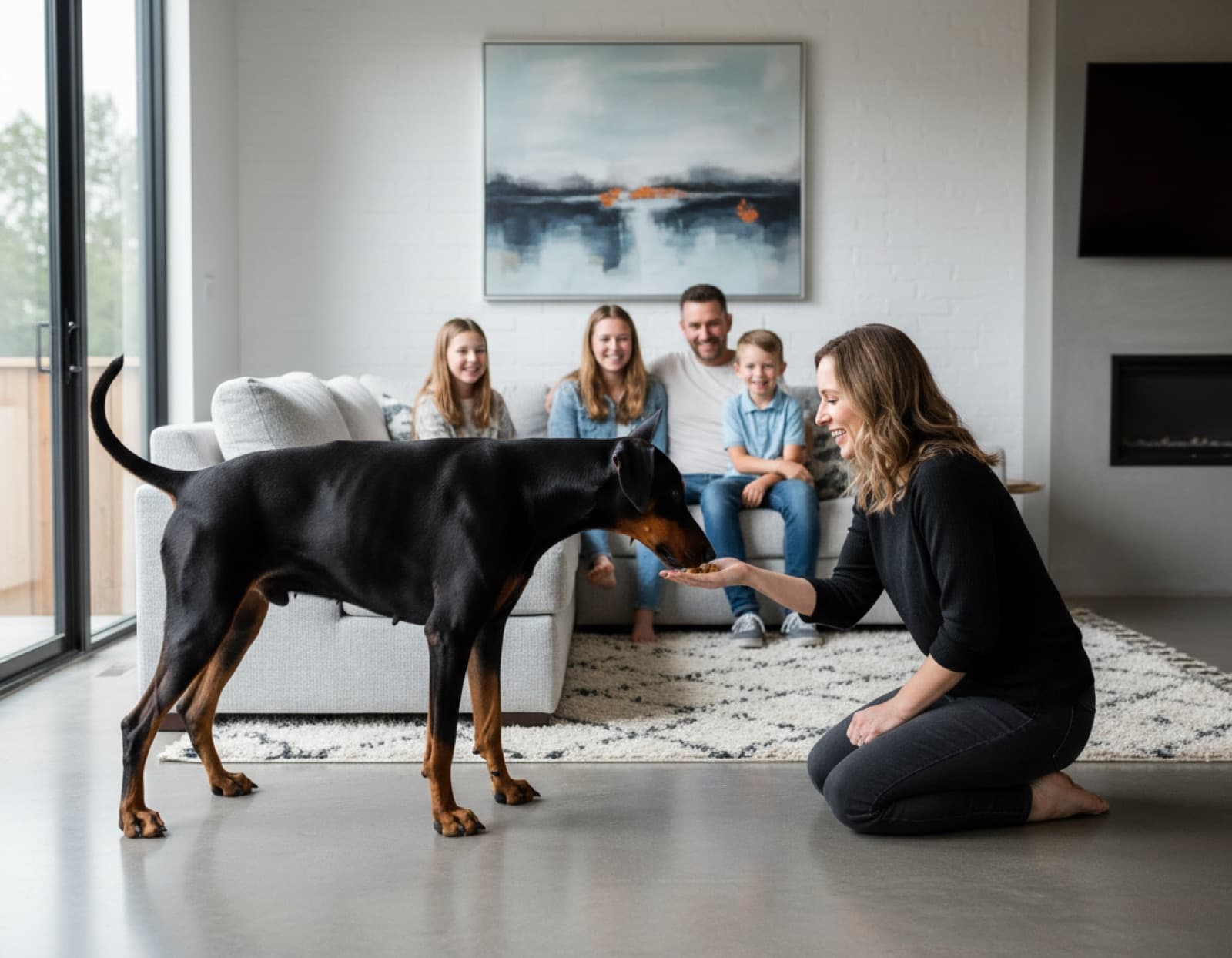
- Alberta: ear-cropping is legal but increasingly discouraged by the veterinary community. Most modern Calgary breeders and rescues no longer crop. Tail-docking is similarly discouraged but still practised by some show-focused breeders
- BC: ear-cropping banned (College of Veterinarians of BC), tail-docking restricted
- Nova Scotia: cosmetic procedures banned
Most Calgary Dobermans being adopted today have natural ears and tails. Cropped/docked dogs in rescue typically come from older breeder lines or out-of-province transfers. The natural look is becoming the new norm.
Ethical Calgary breeders increasingly offer non-cropped and non-docked options. The modern veterinary community position is that cosmetic procedures provide no health benefit and cause unnecessary pain.
Calgary breed perception + insurance considerations
Calgary has no Breed-Specific Legislation (BSL). Dobermans are legal city-wide. But practical considerations exist.
Home insurance: some Calgary insurance providers exclude or limit coverage for “dangerous breed” listed dogs. Dobermans sometimes appear on these lists (varies by insurer: RBC, TD, Intact, Aviva, others have varying policies).
- Call your insurer before adopting a Doberman to verify coverage
- Some require declaration; some exclude entirely; some require an additional rider
- Average premium impact: $200–$500/year additional or coverage limitation
- Specific dog liability insurance: $300–$800/year for additional protection. Recommended for all large dog owners
Condo and apartment bylaws: some Calgary condo boards restrict large breeds and specifically list Dobermans. Check bylaws before adopting.
Rental housing: landlord pet policies in Calgary increasingly restrict large breeds. Pet rent and breed restrictions are common.
Calgary Bylaw 23M2006 covers all dogs equally regarding behaviour and bite incidents. No breed restrictions in city bylaw. Calgary off-leash parks don't restrict by breed.
Practical: most Calgary Doberman owners report community acceptance with well-behaved, trained dogs. Investment in a basic obedience class with a force-free trainer pays off in neighbour relations, insurance pricing, and condo board acceptance.
What Calgary Dobermans get surrendered for, and why you should adopt anyway
Understanding why Calgary rescues see surrendered Dobermans helps adopters set realistic expectations and avoid the same outcomes.
Top 3 surrender reasons in Calgary (beyond DCM medical):
- Fear-period misdiagnosis (8–14 month adolescent surrenders). Doberman puppies experience predictable fear periods around 8–10 weeks (puppy fear) and 6–14 months (adolescent fear). During these phases, well-socialised Dobermans suddenly become reactive to strangers, sounds, and situations they previously handled fine. Many first-time owners interpret this as “the dog has become aggressive” and surrender. Reality: fear periods are normal developmental phases. With force-free management and patience, dogs emerge stronger. Calgary force-free trainers (Raising Canine, Pup City Pup Academy) handle adolescent Dobermans regularly. If you adopt a 1–2 year old Doberman, expect possible fear-period behaviours to emerge within weeks. Manage, don't panic
- Velcro overwhelm during return-to-office. The current Calgary Doberman crisis 2024–2026. WFH-adopted Dobermans cannot tolerate a sudden return to an 8–10 hour office schedule. See our velcro and separation anxiety guide for the full intervention protocol
- Prey-drive incidents with cats or small dogs. Some Dobermans have intense prey drive that doesn't reliably resolve with training. Cat-killing or small-dog-killing incidents happen periodically and often trigger surrender. Calgary rescues sometimes flag “not good with cats” or “dog-selective” in adoption listings. Respect these notes
The reality of rescue Doberman intake: most surrendered Calgary Dobermans are wonderful dogs in wrong households. First-time owners overwhelmed, lifestyle mismatches, financial constraints, return-to-office. The dogs aren't broken; the situation was wrong. Adopting a Calgary rescue Doberman with realistic expectations and commitment to breed-appropriate management produces a profound bond and transforms the dog's life. Adoption fees ($300–$800) save the dog from euthanasia or extended kennel time and give you a Doberman past adolescent volatility.
Doberman with cats or small dogs: prey drive reality
Critical Calgary multi-species household consideration. Some adult Dobermans have intense prey drive that doesn't reliably resolve with training.
Adopting a Doberman into a cat household requires explicit shelter assessment of good_with_cats status. Calgary rescues (Calgary Humane Society, AARCS) often flag this in listings. Respect the notes. A Doberman labelled “not good with cats” or “cat aggressive” or “predatory drift risk” means exactly what it says.
Predatory drift: even well-trained Dobermans who normally tolerate household cats can suddenly switch to predatory behaviour (chase, grab, kill) under high arousal (running cat, squealing cat, stressed cat). This is a real, documented risk. Some adult Dobermans never develop predatory drift toward cats; some adult Dobermans do. The risk varies by individual.
Safe multi-species protocol if attempting:
- Foster home assessment with cats first (rescue should disclose foster experience)
- Slow introduction with cat retreat options and barriers
- Never unsupervised in the early months
- Watch body language. Stiff staring, intense focus are warning signs
- Calgary force-free trainer assessment if uncertain
- Some Dobermans and cats coexist beautifully for life. Some never can. Individual assessment is essential
Small dogs (Calgary off-leash parks): similar prey-drive consideration. Some Dobermans never harm small dogs; some attack small dogs at off-leash parks. Calgary off-leash incidents involving Dobermans and small dogs occur periodically. Off-leash decisions for any Doberman around small dogs require careful individual assessment.
If you have cats and want a Doberman: adopt a cat-tested adult Doberman (foster home with cats), not a puppy. Calgary rescues sometimes specifically flag “cat-friendly” Dobermans. Choose these.
Calgary Doberman cost breakdown
| Source | Fee | Notes |
|---|---|---|
| Calgary Humane Society | $135–$400 | Often the lowest, basic medical included |
| AARCS, BARCS, Pawsitive Match | $400–$700 | Foster-based, detailed temperament evaluation |
| Senior Dobermans (8+) | $200–$500 | Underrated but plan for cardiac care commitment |
| CKC-registered Alberta breeder | $2,500–$5,000+ | Health-tested parents, full DCM/vWD/hip protocols |
| European import | $4,000–$8,000+ | Working/show lineage, transport costs |
Annual care for a Calgary Doberman: $2,000–$4,000/year for a healthy adult.
- Food: $80–$120/month for quality kibble (large dog)
- Vet: $500–$1,000/year baseline
- Pet insurance: $60–$100/month, strongly recommended for Doberman cardiac care reality
- Cardiac monitoring (annual Holter and echo): $500–$1,500/year from age 3 onward
- Pimobendan therapy if DCM diagnosed: $100–$250/month
- Joint supplements from age 4 onward: $25–$50/month
- Sport and training classes: $150–$300 per 8 weeks in Calgary
Total cardiac care over a Doberman lifetime: $15,000–$50,000+. Pet insurance pays for itself repeatedly for Dobermans, among the strongest pet insurance ROI of any breed. Trupanion (no payout limits, 90% coverage), Pets Plus Us, OVMA. Enrol before diagnosis. Cardiac conditions are excluded as pre-existing if diagnosed before enrolment.
Frequently Asked Questions
Where to adopt a Doberman in Calgary?
CHS, AARCS, BARCS, ARF Alberta, Pawsitive Match. No verifiable breed-specific Doberman rescue operates in Alberta; use the general rescues plus verified out-of-province options like Doberman Rescue Ontario. Most Calgary Dobermans are 1–5 years old at peak DCM diagnosis age and behaviour crisis. Apply within 24–48 hours. Dobermans fast-adopt to experienced households.
Is Doberman Rescue Alberta verified?
No. We cannot verify a real organization by this name. There are no Doberman-specific registered charities anywhere in Canada, and the name has no independent website, social presence, or adoptable listings. Treat it as unverified. Use the general Calgary rescues (CHS, AARCS, BARCS, Pawsitive Match); a verified breed-specific option in eastern Canada is Doberman Rescue Ontario (dobermanrescueontario.ca), though it rarely places directly in Alberta.
Steeldust + Valhalla?
Breeders, not rescues. Calgary and Alberta-area established CKC-registered breeders, $3,500–$5,500 puppies. Wait list 6–18 months. Demand documentation: hip OFA, DACVIM-Cardiology auscultation, echo, Holter, thyroid, CERF, vWD DNA, DCM-1/DCM-2, take-back, 2-year health guarantee. Avoid “rare colours”, non-specialist cardiac evaluation, or no take-back policy.
European vs American Doberman?
Same breed, two standards. European (FCI) 75–100+ lbs, blockier, working-temperament, natural ears and tail (Europe banned cropping). American (AKC/CKC) 60–90 lbs, sleeker, show and family-focused, historically cropped (decreasing). Both excellent companions. Calgary stock is mostly American CKC. Health concerns are similar. Choose based on individual breeder and dog temperament.
Free Dobermans?
Almost universally suspicious. Backyard breeders, owners dumping behaviour issues, owners dumping undisclosed DCM ($3K–$10K cardiac care), scams, theft, colour-dilute CDA dumps. Avoid Kijiji free Doberman listings. Owner-rehoming with a $300–$700 fee, cardiac history, and behaviour disclosure can be legitimate.
Cost reality?
$300–$800 rescue vs $2,500–$5,000 CKC breeder. Annual $2,000–$4,000. Pet insurance $60–$100/mo is essential. Cardiac monitoring $500–$1,500/yr from age 3. Pimobendan $100–$250/mo if DCM. Total cardiac care lifetime $15,000–$50,000+. Insurance pays for itself repeatedly for Dobermans, the strongest pet insurance ROI of any breed.
Why surrendered?
#1 DCM diagnosis ($3K–$10K cardiac costs). Exercise underestimated. Separation anxiety (extreme velcro breed). Breed perception (insurance and condo restrictions). Apartment mismatch. Adolescent regression 10–24 months. Lifestyle changes. Retired show dogs. Bite incidents. Bought as a guard dog expecting ferocity. Colour-dilute CDA emergence.
Calgary perception + insurance?
No Calgary BSL. Legal city-wide. But some insurance excludes or limits Dobermans. Call your insurer before adopting. Some condo boards restrict. Specific dog liability insurance $300–$800/yr recommended. Bylaw 23M2006 covers all dogs equally. Off-leash parks have no breed restriction. A well-trained Doberman earns community acceptance.
Puppy vs adult vs senior?
Adult (3–7) for roughly 85% of households. Puppy 8–30 month adolescence is intense. Cardiac status is uncertain regardless of age. Senior (8+) is underrated but DCM emergence is common; adopting a senior means adopting a cardiac care commitment. Retired show dogs (4–7 year CKC) are excellent placements. Adult adoption bypasses the activation phase.
UK searcher confusion?
“Dobermann” (double-n) is the UK and European spelling. “Doberman” (single-n) is North American. Same breed. UK rescues (Dobermann Rescue Ltd, Northern DPS, UKDR) are UK-only. Canadian options: general all-breed rescues plus verified breed rescues like Doberman Rescue Ontario. Cross-border adoption is possible but logistically complex (quarantine, transport $1.5K–$3.5K+).
Avoid rare-color Dobermans?
Yes. Blue/fawn means colour dilution alopecia (50–90% CDA prevalence, lifelong skincare). White/albino means severe health issues (skin cancer, vision, hearing); DPCA opposes. “Warlock/King” is not a real standard, often Great Dane outcross. Premium-priced “rare colours” are an unethical breeding red flag. Standard CKC black-rust and red-rust only.
Doberman mixes?
Doberdor (Doberman and Lab) is a Calgary regular, easier than purebred. Doberman-Shepherd is an intense working mix. Doberman-Pit is controversial. Doberman-Boxer is playful. Doberman-Greyhound is sleeker and athletic. The specific mix matters. Read foster temperament notes. For first-time owners: Doberman with a calmer breed (Lab, Golden, Greyhound). DCM is still possible in mixes; cardiac concerns carry.
Adoptable Dobermans in Calgary
Live listings of Dobermans and Doberman mixes from Calgary rescues, updated regularly.
Doberman Cardiac Monitoring
The differentiator: 50–60% DCM lifetime reality, annual Holter + echo screening, Calgary cardiology specialists, treatment options, sudden cardiac death prevention.
Doberman Health Issues
DCM cardiac, von Willebrand bleeding disorder (70%+ carrier rate), Wobbler syndrome, hip dysplasia, hypothyroidism, colour dilution alopecia, anesthesia profile.
Golden Cancer Awareness
Companion guide for breed-defining health concerns. Goldens have a 60% cancer rate; Dobermans have a 50–60% DCM rate. Similar pattern of breed-specific health monitoring requirements.
New dog? Start with these care guides
Everything a new adopter needs to set up a safe, happy home.