The short answer
Dobermans are arguably the most velcro breed of all dogs. Bred in 1890s Germany for close-quarters personal protection and companionship, the modern Doberman was selected to glue itself to one handler for 8+ hours daily. The typical adult Doberman tolerates 2 to 4 hours alone before stress accumulates, slightly less than an Aussie. The dominant Calgary Doberman surrender pattern in 2024 to 2026 is the WFH-to-office return: dogs adopted during the pandemic, used to a person home all day, hitting sudden 9 to 11 hour isolation when their owner returns to a downtown commute. Mitigation works (daycare 3 to 4 days a week, midday walker, gradual exposure, a vet behaviourist consult, sometimes medication) but the cost runs roughly $500 to $1,200 a month.
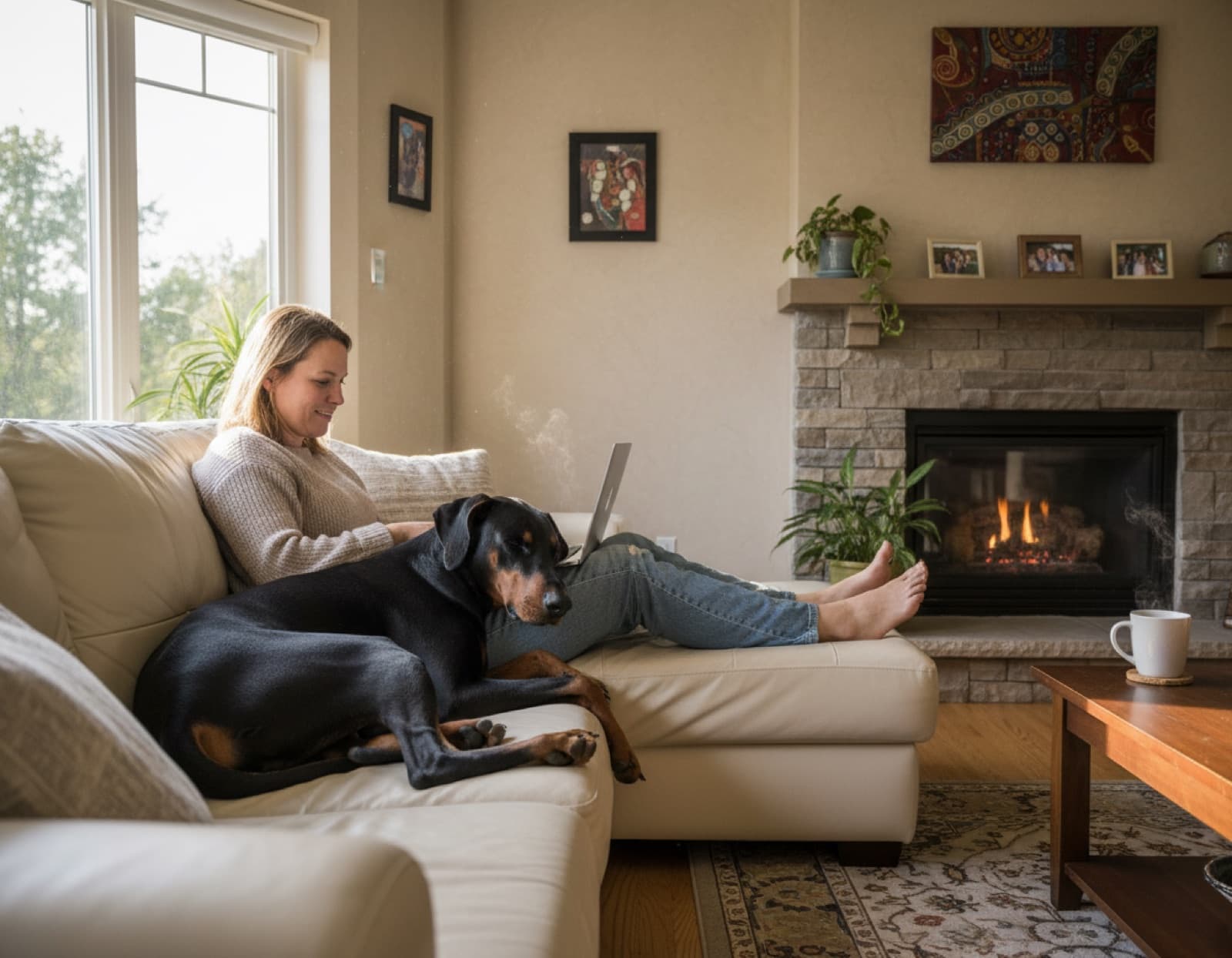
Why Dobermans are so velcro
Bred in 1890s Germany by tax collector Karl Friedrich Louis Dobermann specifically for personal protection + companionship. The breed was selected for: constant handler attention, intense single-handler bonding, 8+ hour shoulder-to-shoulder work, reading body language + emotional cues.
Adult Dobermans typically:
- Follow primary handler room-to-room intensely
- Want physical contact (touching, leaning, sleeping at feet)
- Watch family activities with intense focus
- Greet enthusiastically after even brief separations
- Actively distressed by closed bathroom doors
- Seek out primary handler over food, treats, toys when given choice
This is breed-typical healthy behaviour. Velcro behaviour alone is NOT separation anxiety.
What distinguishes Doberman velcro from other breeds: intensity. Dobermans bond more singularly to one primary handler and may show more extreme distress at separation. The “Velcro Dobie” trait is widely recognized in breed community.
The 2–4 hour alone-time ceiling
2–4 hours is the typical alone-time ceiling for adult Dobermans, slightly less than Aussies (3–4 hours) because of the extreme breed velcro nature.
- Adult Dobermans (3+ years, well-conditioned): 4–6 hours occasionally with training. Most uncomfortable beyond 4 hours daily
- Adolescent Dobermans (8 months – 3 years): 2–4 hours maximum. Most challenging age
- Puppies (under 8 months): 1–3 hours maximum
- Rescue Dobermans first 30–60 days: start with 30 min – 2 hours, build slowly
- Senior Dobermans (8+): often slightly LONGER tolerance (calmer baseline) but cardiac/medical considerations
Calgary downtown commute reality: 30–60 min commute + 9-hour office = effectively 9–11 hour alone-time. Most Dobermans cannot handle this.
Mitigation: most full-time-working Calgary Doberman owners use 2+ of:
- Doggy daycare 3–4 days/week (not optional for many Dobermans)
- Midday dog walker
- Work-from-home days
- Modified schedule
- Family/friend lunch break visits
- Second dog companion
Without mitigation, Calgary Dobermans surrendered within 6 months of full-time-office adoption.
The WFH-to-office return crisis: the #1 Calgary Doberman issue
Critical Calgary Doberman pattern 2024–2026. Alberta Doberman rescue networks report a significant increase in surrenders tied to this pattern.
The pattern:
- Doberman adopted during WFH (often 8 weeks – 2 years old, common 2020–2024)
- Spent 2–4 years with owner home most/all day
- Owner returns to office 5 days weekly
- Doberman experiences sudden 8–10 hour daily isolation
- Within 1–4 weeks: destruction, vocalization, soiling, severe distress, possible self-injury
- Within 2–6 months: many of these Dobermans surrendered to Calgary rescues
Why Dobermans particularly vulnerable: extreme velcro breed + intense single-handler bonding + separation distress propensity = highest-risk breed for return-to-office crisis.
Intervention (if facing return-to-office now):
- Gradual exposure 6–12 weeks before return: increase alone time slowly. Start with 1-hour absences, build to 8–9 hours over weeks
- Daycare 3–4 days weekly minimum (Dobermans need MORE daycare than Aussies)
- Dog walker midday on non-daycare days $20–$40 per visit
- Hybrid schedule if possible (3 office + 2 WFH preserves dog's well-being)
- Work-friend/neighbour lunch drop-ins at first
- Puppy cam monitoring during initial return
- Behaviourist consultation early if dog shows clinical SA signs
- Medication often appropriate during transition. Don't hesitate
- Second dog companion sometimes beneficial
Investment in mitigation ($500–$1,200+/month) significantly less than rehoming + emotional toll.
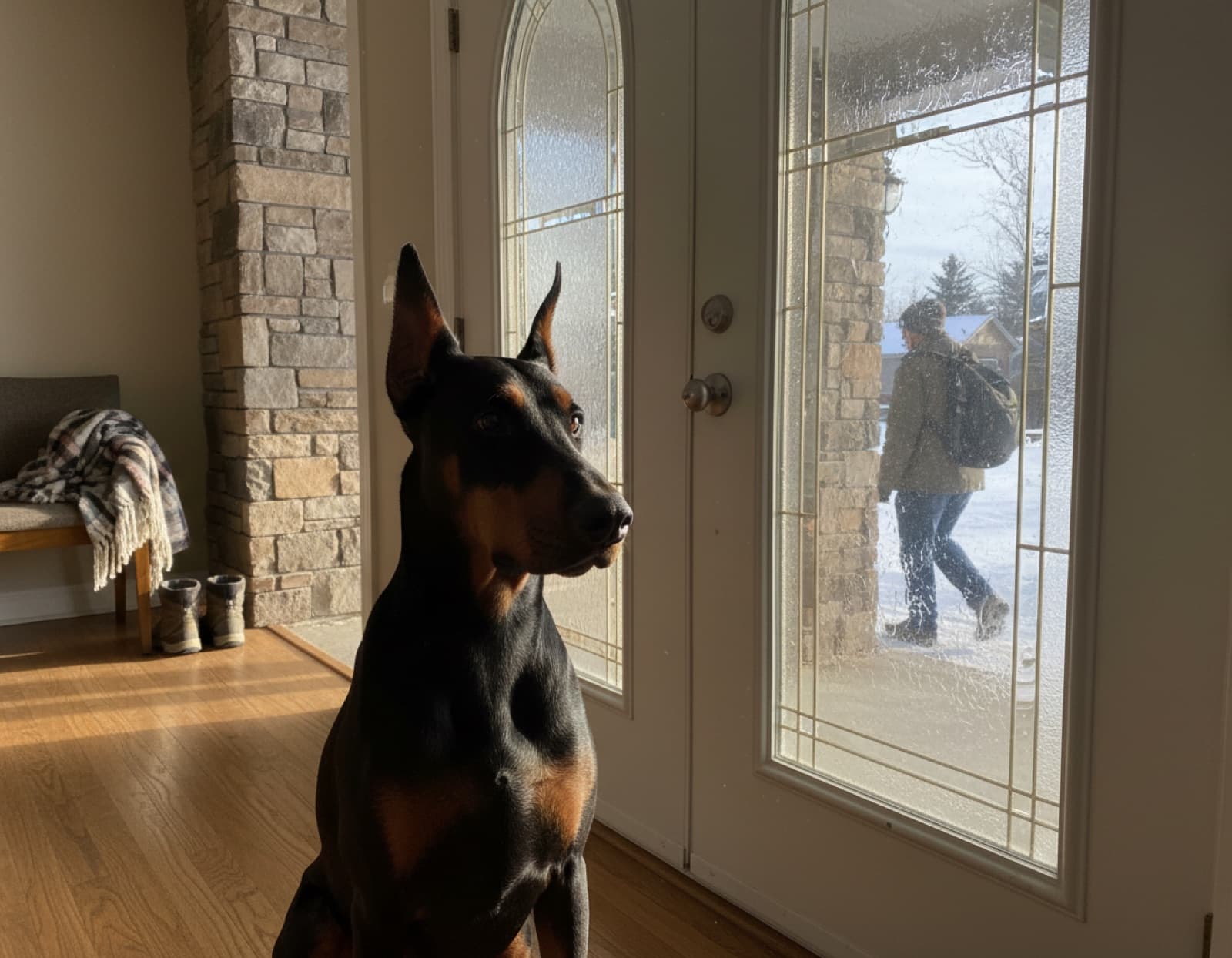
Crate training nightmare: a Doberman-specific protocol
Common Doberman issue. Many owners report crate training “nightmares”: screaming, broken teeth, self-injury attempting escape.
Doberman-specific crate protocol:
- Never force. Gradual desensitization is the protocol. Forcing the crate creates lasting trauma
- Foundation days 1–7: crate present and open in the main living area. Treats inside randomly. No confinement
- Feeding in crate: meals served inside, door open initially
- Close door briefly when dog is calmly eating, 30 seconds, then 1 minute, building
- Watch for distress. If panic, open immediately. Do not wait for “they'll calm down”: Dobermans escalate
- Reward calmness only. Never release when actively distressed
- Build duration over weeks while you're home first
- Departure cue desensitization (separate process)
- Medication sometimes required: trazodone or clomipramine before crating sessions can help break the panic cycle. Discuss with your vet
When crate training doesn't work, here are alternatives:
- Exercise pen with safe-room setup
- Single-room confinement (bedroom or laundry room with baby gate)
- Free-roam with dog-proofed home
- Two-dog household (companion dog reduces isolation)
Not all Dobermans need crate training for life. Many adult Dobermans free-roam comfortably. The crate is a tool, not a requirement.
Warning signs that crate is wrong tool: persistent self-injury attempts, broken teeth from chewing bars, urinary/fecal accidents, severe panic that doesn't reduce after 4–6 weeks training. Switch to alternatives. Some Dobermans are crate-negative for life. That's OK.
Some of the product links in this section are Amazon affiliate links — we may earn a small commission at no extra cost to you. It never changes which products we recommend.
Should I get a second Doberman as companion?
Common solution but with important caveats. NOT a guaranteed fix.
When a second dog HELPS:
- Primary dog enjoys other dogs (confirmed through socialization)
- First Doberman has worked through alone-time training (companion supplements, doesn't replace)
- Household can absorb costs ($4,000–$8,000+ annual additional)
- Sufficient space for both dogs
- Handler capacity for two Dobermans
When a second dog WORSENS things:
- First dog has resource guarding with dogs
- First dog has dog reactivity
- Domestic situation unstable (divorce, move planned)
- First dog's SA is primarily handler-focused (not all dogs)
- Financial strain
Pairing patterns: opposite-sex pairs typically harmonize better than same-sex. Doberman + calmer breed (Lab, Golden) often easier addition than Doberman + Doberman. Doberman + small dog risky (predatory drift potential).
Professional consultation: Calgary force-free trainer or behaviourist can assess if second dog appropriate. $90–$150 consultation worth investment before committing.
When to involve veterinary behaviourist + medication
Doberman SA often requires medication intervention. Don't hesitate.
Criteria to escalate:
- Self-injury during alone time (broken teeth, raw paws, mouth wounds)
- Continuous distress without calming for 30+ minutes
- Escape attempts
- Refusing food alone for 24+ hours
- Cannot be left for even 15–30 minutes without panic
- Behaviour worsening despite 6–12 weeks consistent training
Calgary veterinary behaviourists: limited locally. Virtual DACVB consultations run $300–$600, with Edmonton WCVM and US referrals available for complex cases. Working in parallel with a force-free trainer (the cluster recommends Raising Canine and Pup City Pup Academy) is the common Calgary model.
Medications used for Doberman separation anxiety are decided by your veterinarian, not by an internet article. Two reference points: the Doberman Pinscher Club of America and the American Veterinary Society of Animal Behaviour publish owner-friendly material on separation anxiety, force-free protocols, and when medication is warranted. SSRIs and TCAs (commonly used for canine SA) take roughly 4–6 weeks to reach effect; situational medications act faster. Always discuss with your vet, especially for Dobermans with any DCM concern, and coordinate the behaviourist with the cardiologist.
Medication framework: medication is a tool, not a fix. It is used alongside behaviour modification: it lowers the baseline so the dog can learn new responses. Dogs are typically maintained on it for 6–18 months and weaned slowly. The stigma is undeserved.
Calgary daycare + walker network
Essential infrastructure for full-time-working Calgary Doberman owners. The monthly investment of roughly $500–$1,200 is significantly less than the cost (and emotional toll) of rehoming.
What Calgary daycare day-rates look like: structured group daycare typically runs $30–$55 per day depending on neighbourhood, sport-focused versus general play, and group size. Sport-style daycares with structured active play tend to be the best Doberman fit. Independent neighbourhood daycares can be cheaper ($25–$40 per day) but vary widely on handling philosophy.
What to look for in a Calgary daycare: group size capped per handler, force-free handling (no shock collars or aversive methods), a real temperament evaluation before enrolment, Doberman-friendly intake (some daycares are hesitant on the basis of breed perception, so verify acceptance ahead of time), and camera or app monitoring where available.
Calgary dog walkers: Wag and Rover are widely available ($20–$35 per 30–45 minute visit); independent local walkers typically run $25–$40 per visit and often build a closer relationship with the dog. Pack walking services are cheaper per-dog ($15–$25) where they exist.
Investment math for a working Calgary Doberman owner: 3 daycare days ($120–$165) + 2 midday walks ($40–$80) = $160–$245 per week, $640–$980 per month. Annual: $7,680–$11,760.
Doberman-specific liability insurance: some Calgary services charge a premium for “guard breeds.” Doberman owners may need additional liability insurance ($300–$800 per year) for some daycare arrangements.
Frequently Asked Questions
Why are Dobermans so velcro?
Bred in 1890s Germany for personal protection and 8+ hour shoulder-to-shoulder companionship. The most velcro breed of all dogs. Adult Dobermans follow their primary handler intensely, want physical contact, and are distressed by closed bathroom doors. This is not separation anxiety on its own: it is breed nature. Distinguished from other velcro breeds (Aussies, Goldens) by intensity and singular bonding.
How long alone is OK?
2–4 hour ceiling (less than Aussies, 3–4hr). Adult well-conditioned 4–6hr occasional. Adolescent (8mo–3yr) 2–4hr max. Puppy under 8mo 1–3hr. Rescue first 30–60d, start 30min–2hr and build. Senior tolerance is longer but medical considerations apply. A Calgary downtown commute pencils out to 9–11hr alone, which most Dobermans cannot handle.
Velcro vs SA distinction?
Puppy cam test. Velcro = settles 5–15min, no destruction, normal eating. Clinical SA = panic at departure prep, destruction (especially of exits), self-injury (Doberman SA is often more severe than other breeds, including broken teeth, raw paws, and mouth wounds), 30+ min vocalization, refusing food, escape attempts. A Wyze or Ring camera ($30–$80) reveals the truth.
WFH-to-office return crisis?
The #1 Calgary Doberman crisis of 2024–2026. A dog adopted during WFH (2020–2024) suddenly facing 8–10 hours of daily isolation often shows severe distress and possible self-injury within 1–4 weeks. Alberta Doberman rescue networks report a significant surrender increase. Intervention: 6–12 weeks of gradual exposure before return + 3–4 daycare days a week + a midday walker + a hybrid schedule + early medication if clinical SA emerges.
Crate training nightmare?
A common Doberman issue. Never force. Gradual desensitization is the protocol: foundation week (no confinement) → feed in open crate → brief closed-door → build duration at home → brief departures. Watch distress signals; Dobermans escalate. Medication can help break the panic cycle. Alternatives include exercise pens, single-room confinement, free-roam in a dog-proofed home, or a two-dog household. Some Dobermans are crate-negative for life, and that is fine.
Second Doberman as companion?
Sometimes helps, not guaranteed. HELPS: primary dog enjoys other dogs + first dog SA-trained + financial capacity ($4K–$8K/yr additional) + handler capacity. WORSENS: resource guarding, dog reactivity, unstable household, handler-focused SA, financial strain. Pairing: opposite-sex preferred. Doberman + calmer breed easier than Doberman + Doberman. Behaviourist assessment $90–$150 worth it.
When to involve behaviourist + medication?
Self-injury, 30+min continuous distress, escape attempts, refusing food 24+hrs, can't leave 15–30min, behaviour worsening despite training. Calgary virtual DACVB or Edmonton WCVM $300–$600. Meds: clomipramine (often first-line $40–$80/mo), fluoxetine $30–$70/mo, trazodone situational. Coordinate cardiologist if DCM-affected Doberman.
Calgary daycare + walker?
Calgary group daycare typically runs $30–$55 per day; sport-style structured daycares tend to fit Dobermans best. Some daycares are hesitant on breed perception, so verify acceptance before commitment. Walkers (Wag, Rover, or independent locals) run $20–$40 per visit. Typical setup: 3 daycare days + 2 walker visits = $640–$980 per month, or $7.7K–$11.8K per year. Doberman liability insurance ($300–$800 per year) is sometimes required by daycare contracts.
Calgary 311 noise complaints?
A real risk for condo Doberman owners. Calgary's noise bylaw 5N2007 covers excessive barking. Repeated complaints can lead to fines, condo violation notices, and in extreme cases a dog-removal order. Prevention: soundproof where possible, run calming background sound, address any 311 complaint quickly, work behaviour modification, and use medication when warranted. Document your training efforts. Calgary Animal Bylaw mediation services are available.
Bottom line for Calgary working Doberman owners?
RIGHT IF: hybrid schedule + $500–$1,200+/mo daycare/walker + 6–16 weeks training + extreme velcro acceptance + suburban or condo-with-plan + adult rescue first + Calgary winter accommodation. WRONG IF: full-time office + apartment + first-time owner + want calm guard dog + budget inflexibility. Hybrid + 3–4 daycare + adult rescue + WFH bonding + sport class = Calgary Doberman success pattern.
How long to fix Doberman SA?
4–12+ months structured work typical. Stage 1 stabilization weeks 1–4. Stage 2 foundation training weeks 4–12. Stage 3 progressive separation months 3–6. Stage 4 real-world work months 6–12. Stage 5 maintenance year 1+. 60–80% improve significantly with structured work + force-free protocol + medication when appropriate.
Adopting rescue Doberman with existing SA?
Many Calgary rescue Dobermans have SA history. Ask the rescue about alone-time history, prior medication, crate experience, foster home observations, any self-injury history, and the recommended setup. Alberta Doberman rescue networks typically provide detailed disclosure. Take 2–4 weeks off work first. Build a slow alone-time foundation over 4–8 weeks. Camera monitoring is essential. Engage a Calgary force-free trainer and a vet evaluation immediately. Get the daycare/walker plan in place pre-adoption. Best fit: WFH, retired, or multi-adult households.
Adoptable Dobermans in Calgary
Live listings of Dobermans and Doberman mixes from Calgary rescues.
Doberman Calgary Winter Survival
-30°C reality, coats, boots, indoor exercise alternatives, paw protection. Calgary winter compounds SA management challenges.
Doberman Cardiac Monitoring
DCM 50–60% reality. Coordinate behaviourist + cardiologist for DCM-affected Dobermans on SA medications.
Aussie Velcro + Separation Anxiety
Sister velcro-breed companion guide. Aussies share many of the same patterns as Dobermans, with key differences in management.
New dog? Start with these care guides
Everything a new adopter needs to set up a safe, happy home.