Short answer
Shih Tzus were bred to sit on humans for a living. Velcro behaviour is the breed's default, not a defect. True separation anxiety is something different: persistent barking, drooling on arrival, urination despite housetraining, self-injury at doors. Most Calgary Shih Tzus learn alone-time as a skill over 6 to 12 weeks of gradual training. Apartment owners face an extra pressure layer (thin walls, shared-wall townhouses, condo board complaints) that makes early intervention important. The plan: four-phase desensitization from 5 seconds to 6 hours, boring departures, real enrichment during alone time, calming aids stacked for moderate cases, and a veterinary behaviourist when self-injury or persistent panic show up.
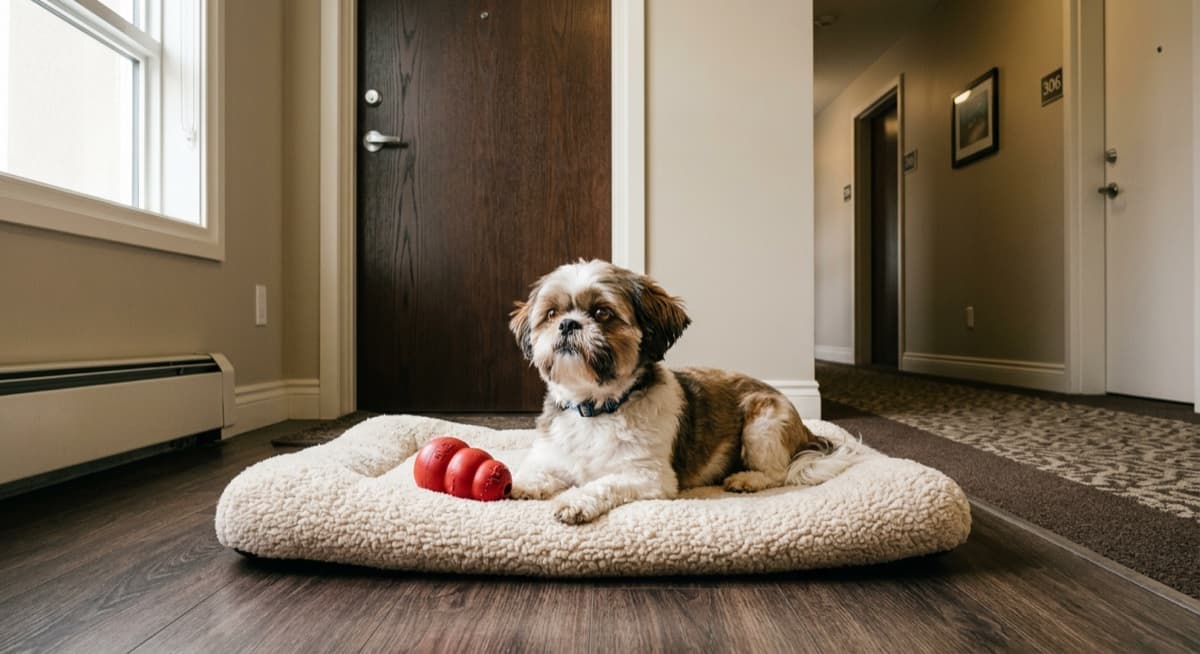
Why Shih Tzus are prone to separation anxiety
Shih Tzus were bred to be in human laps. Independence was never selected for. The breed expects close human contact as a default state, and many Calgary rescue Shih Tzus carry a second layer of bonded-then-broken history on top.
The breed history. According to the American Kennel Club, Shih Tzus spent centuries in Chinese imperial palaces as companion dogs. Their entire job was to sit on a human and look ornamental. That selection pressure created a breed that genuinely struggles in solitude. Independent breeds do not exist in the toy-companion group.
Velcro behaviour is the breed's baseline. Following you to the bathroom, lying on your feet during dinner, sleeping on the couch beside you, fussing briefly when you leave a room: all of this is normal Shih Tzu behaviour. The dog is doing the job it was selected for. Velcro is not yet separation anxiety. The two get conflated and treated identically, which causes problems.
Many Calgary rescues add a life-history layer. A common Shih Tzu surrender story in Calgary: the dog lived for 8 to 12 years as the constant companion of an elderly owner who passed away or went into care. Then the dog ends up in a foster home, surrendered to a shelter, or rehomed through Calgary Humane. The dog who had one human within arm's reach for a decade now has a stranger and no familiar smells. Separation anxiety on top of grief is common in this group.
Puppy-mill background dogs face a third layer. Shih Tzus are one of the most-trafficked puppy-mill breeds in Canada. Mill dogs often arrive at rescue having never learned to settle alone, having never been alone, or having been alone constantly in a barn. Both extremes produce anxious dogs. Many AARCS and rescue intakes share this profile.
Apartment life raises the stakes. A Shih Tzu barking for 30 minutes a day in a detached house in the suburbs is a private nuisance. The same barking in a Beltline or Mission condo carries through shared walls and triggers neighbour complaints and condo board letters. Calgary apartment owners need to address apartment barking earlier than detached-house owners; the social pressure is higher.
Normal velcro vs true separation anxiety
Most Shih Tzu owners worry about SA when they are watching normal velcro behaviour. Some Shih Tzu owners assume normal velcro behaviour is fine when they are actually missing the early signs of SA. The two patterns share surface features but diverge fast under camera review.
Normal velcro (breed standard)
- • Follows you room to room when home
- • Whining or single brief bark when you leave
- • Settles within 10 to 15 minutes of departure
- • Eats food and treats when alone
- • Some pacing on first few departures, then less
- • No house-soiling in a housetrained dog
- • Greets you happily on return without panic
- • Visible improvement week over week
True separation anxiety (escalate)
- • Drooling visible on chest, floor, or bedding on arrival
- • Self-injury: bloody paws, torn nails, broken teeth
- • Urination or defecation despite being housetrained
- • Sustained barking heard by neighbours
- • Destruction at doors, window sills, blinds
- • Escape attempts (scratching, chewing through barriers)
- • Refuses food and high-value treats when alone
- • No improvement after 8 to 12 weeks of work
Run a 30-minute departure recording on a phone propped on a shelf. The American Veterinary Medical Association notes that video evidence is the most reliable way to distinguish anxiety from normal adjustment behaviour. Most Calgary owners learn more from one recording than from a month of guessing.
Four-phase alone-time desensitization plan
Teach alone-time as a skill, in tiny increments, at the dog's pace. The four phases run from 5 seconds to 6 hours. Most Shih Tzus move through this in 6 to 12 weeks. Anxious dogs take longer. Setbacks are normal; the next session shrinks, not extends.
5 to 60 second departures
Step out the front door of your Calgary apartment for 5 seconds. Come back calmly. Repeat dozens of times across the day. Build to 60 seconds across the week. The dog learns that departures are routine and you always come back. Pair every absence with a frozen Kong or lick mat. Calm exits. Calm returns. No drama either way.
1 to 15 minute departures
Run to the mailbox in your condo lobby. Walk a quick loop of your Inglewood block. Sit on the patio with the door closed. Mix routine and non-routine departures so keys, shoes, and coats do not become anxiety cues. Pick up your keys 50 times across the day without leaving to break the trigger. Record the first 5 minutes on camera. If the dog panics, shorten the next session.
15 minutes to 2 hours
Build to short outings. Coffee at a Bridgeland cafe. A grocery trip. A workout at Eau Claire. Confirm on camera that the dog settles within 10 to 15 minutes and stays settled. If you see escalating signs (sustained barking, pacing, refusing the Kong), pause and repeat phase 2 for a few more weeks. Apartment owners especially: do not push to two-hour departures while the dog is still vocal at 30 minutes. Neighbours hear what you do not.
2 to 6 hour tolerance
Reach functional working-day tolerance, often with a midday walker or daycare day filling the gap. Many Shih Tzus reach 4 to 6 comfortable hours of alone time. A smaller number tolerate a full 8-hour workday without a midday break. Build the schedule around the dog you have, not the dog you wish you had. A walker on Tuesdays and Thursdays plus daycare on Mondays is a perfectly successful long-term plan, not a failure.
Never punish distress. Punishment raises cortisol and worsens anxiety. Bark collars, citronella collars, and shock collars are not training tools for SA; they suppress the symptom and intensify the underlying fear. If a session goes badly, the next one shrinks back down. This is teaching a nervous system, not winning an argument.
Make leaving routines boring
Long, tearful goodbyes feel kind. They signal danger. A dramatic five-minute farewell teaches a Shih Tzu that departures are emotionally enormous, and the dog rides that emotional spike straight into panic the second the door closes.
The fix is dull. Drop your goodbyes entirely. Put on your coat in silence. Walk past the dog without a glance. Step out the door. On return, ignore the dog for 60 to 90 seconds, even if they are excited. Greet them after they settle.
This feels rude to most owners. It works. Departures become a non-event. The nervous system stops bracing.
Pre-departure cue desensitization. Pick up your keys 50 times today without leaving. Put on your shoes and sit back down. Open and close the front door three times in a row. Each cue, repeated outside of an actual departure, loses its anxiety charge across a few weeks. The International Association of Animal Behaviour Consultants identifies pre-departure cue conditioning as one of the highest-impact training steps for SA.
Crate training: most Shih Tzus accept it, some do not
Most Shih Tzus do well with crate training when introduced patiently. The breed often genuinely enjoys a small den-like space, and a crate can become a settling spot rather than a stressor. Compared to large retired-racer breeds (where crates can spike anxiety), Shih Tzus generally take to a crate quickly.
How to introduce it. Use a small or medium crate sized for an adult Shih Tzu (roughly 24 to 30 inches long). Feed every meal inside with the door open for the first week. Toss high-value treats and chews inside throughout the day. Close the door for 10 seconds while you are sitting beside it. Build to 30 seconds, then minutes, then short departures. Never close the door if the dog shows panic.
The small group who do not accept a crate. Some adult Shih Tzus, especially those from puppy-mill or kennel backgrounds, panic in a crate even after weeks of patient conditioning. Signs the crate is not working: refusing to enter voluntarily after two to three weeks of meals inside, frantic scratching at the door even after short closures, drooling, broken teeth, or bloody paws from escape attempts. Stop. Do not push.
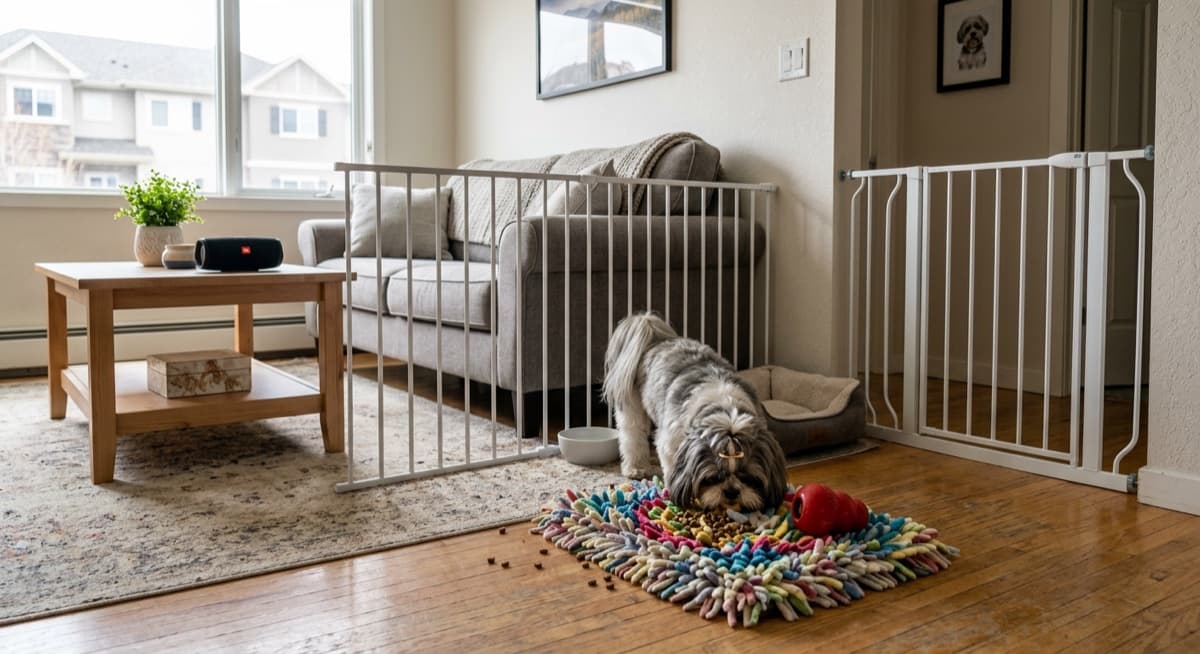
Alternatives that work just as well. A baby-gated kitchen, laundry room, or small dog-proofed bedroom gives the dog a contained safe space without the crate trigger. Use a soft thick bed, a frozen Kong on departure, and an Adaptil diffuser plugged in nearby. Many Calgary apartment owners use a baby-gated kitchen or den as their long-term alone-time setup, never a crate.
Brachycephalic note. Shih Tzus are a brachycephalic (flat-faced) breed and need good airflow during alone time. Avoid heavily covered crates in summer or in warm Calgary condos. The American Animal Hospital Association notes that brachycephalic breeds are more vulnerable to heat stress, and confined airless spaces compound the risk. If your apartment runs warm, a baby-gated open room is safer than a closed-in crate.
Apartment barking and Calgary condo boards
Calgary has no breed-specific bans, but every condo and apartment building has noise rules. Sustained barking is the most common complaint that lands in a building manager's inbox. Address it early and openly.
The three types of apartment barking, and the fix for each:
- Trigger barking (delivery sounds, hallway footsteps, neighbours' doors). Reactive, not anxiety. Apply window film for visual triggers, run white noise to mask hallway sounds, counter-condition specific cues with treats. Common in apartments because there is more ambient sound than a detached house.
- Boredom barking (sustained, escalates, stops on your return). Enrichment-deficit. Add frozen Kongs, snuffle mats, lick mats, a midday walker or family check-in, daycare twice a week. A Shih Tzu with no mental work during a 9-hour day will invent its own job, and the job is often barking.
- Separation-anxiety barking (starts within minutes, lasts 30+ minutes, paired with other SA signs). This is the focus of this article. Treat the underlying SA with desensitization, calming aids, and a vet behaviourist if needed.
Talking to your condo board. Most boards respond well to owners who acknowledge the problem and show a plan. Talk to neighbours first, share your training plan, and check in monthly on progress. Boards react badly to owners who deny the issue when neighbours complain. A short note saying “we're aware, we're working with a Calgary force-free trainer, we expect improvement over the next 6 to 12 weeks” goes a long way.
Soundproofing helps. Heavy curtains, area rugs, soft furnishings, white noise machines pointed at shared walls. None of this fixes the underlying anxiety, but it buys you and your neighbours time while training catches up.
Browse adoptable Shih Tzus in Calgary
Foster reports often include alone-time tolerance and apartment compatibility notes. Critical info if you are choosing between Shih Tzu candidates.
Enrichment during alone time
A bored Shih Tzu is a barking Shih Tzu. Enrichment is not optional; it is the second pillar of alone-time training, equal in weight to desensitization.
- Frozen Kong sized S or M. Stuff with peanut butter (xylitol-free), wet food, plain yogurt, or pumpkin and freeze overnight. 20 to 40 minutes of focused work on every departure. The single most-used enrichment tool for SA.
- Lick mats. Silicone mats with grooves, smeared with wet food, yogurt, or canned pumpkin. 10 to 20 minutes of soothing low-stress activity. The licking action itself is calming.
- Snuffle mat. Fleece mat with hidden kibble pockets. Shih Tzus are sniff-motivated and a 5-minute search burns more mental energy than a 30-minute walk.
- Food-dispensing toys. West Paw Toppl, Kong Wobbler, or similar. Rotate two or three to keep novelty.
- Long-lasting chews. Bully sticks sized small, yak cheese chews. Choose Shih Tzu-appropriate sizes; small dogs need supervision around hard chews. Skip rawhide.
- Calming music or low-volume TV. Through a Dog's Ear playlists, classical music stations, or a quiet TV channel. Background sound mimics the company the dog wants and masks startling hallway noises that trigger barking.
Some of the product links in this section are Amazon affiliate links — we may earn a small commission at no extra cost to you. It never changes which products we recommend.
Rotate enrichment so the same toy is not used every day. Novelty matters. A Shih Tzu who sees the same Kong every morning by week three has stopped finding it interesting.
Calming aids that actually help
None of these replace gradual desensitization. They reduce baseline anxiety enough that the dog can learn during sessions. For moderate cases, stack two or three.
- Adaptil (DAP) diffuser or collar. A synthetic copy of the dog appeasing pheromone mother dogs produce. Plug-in diffuser covers a small Calgary apartment well. Takes 1 to 2 weeks to show effect. Among the most-cited calming aids in veterinary behaviour research.
- Pressure wrap (Thundershirt or similar). Sized XS or S for Shih Tzus. Works for some dogs and is neutral for others. Inexpensive, worth a try.
- Calming music or white noise. Through a Dog's Ear playlists have measurable calming effects in shelter studies, and a low-volume TV or radio can mimic the background sound the dog associates with company. Free.
- Frozen Kongs and lick mats. Covered in enrichment above; they pull double duty as a calming aid because licking and chewing are inherently soothing behaviours.
- Calming supplements. Vet-supervised only. Any specific supplement or natural-remedy claim from a non-vet source should be ignored. Talk to your vet about whether one is appropriate for your dog.
Medications for moderate to severe SA exist and work well for many dogs, but they belong in a veterinary behaviourist's office, not a blog post. If your Shih Tzu has true SA, the medication conversation is the next escalation step, not a DIY project.
When to involve a veterinary behaviourist
Escalate to a veterinary behaviourist for any of the following:
- Self-injury attempting to escape (bloody paws, torn nails, broken teeth)
- Persistent barking or howling for 30+ minutes despite enrichment
- Urination or defecation during alone time despite being fully housetrained
- Refusing all food and high-value treats when alone
- No improvement after 8 to 12 weeks of consistent protocol work
- Worsening signs over weeks rather than improvement
- Neighbour or condo-board complaints have started and training alone is not catching up
A veterinary behaviourist is a vet with additional credentialing in behaviour medicine. They can diagnose true SA, rule out medical causes (urinary tract infection mimicking house-soiling, undiagnosed pain driving distress), and prescribe medications when appropriate. Referral from your regular Calgary vet is usually required. Initial consults typically run a few hundred dollars; follow-ups less.
Medication conversations belong in this room. Specific drug names, dosages, and protocols are not appropriate for a blog post. Different dogs respond to different combinations, and brachycephalic Shih Tzus have anesthesia and respiratory considerations that affect drug selection. Trust the vet behaviourist, not the internet.
For force-free trainer support short of a behaviourist, look for a Calgary force-free trainer with separation anxiety experience. The Certification Council for Professional Dog Trainers (CCPDT) and IAABC maintain searchable directories of credentialed trainers; filter for those in the Calgary area with behaviour experience.
Full-time work with a Shih Tzu: yes, with planning
Most Shih Tzu owners work full-time. The breed can settle into a working-day schedule once alone-time is a learned skill. The failed-adoption pattern is consistent: adopt on a Saturday, take two days off, return to a 9-hour workday by the following Friday, dog spirals into SA, condo board complaints arrive by week three.
The successful pattern looks different. Take a week or two off if possible. Start 5 to 60 second departures on day one even when the dog seems fine. Book a midday walker or family member starting week two. Add a daycare day or two by month two. Build to a partial workday over 8 to 12 weeks.
Many Calgary Shih Tzu owners settle into a long-term hybrid: walker on Tuesdays and Thursdays, daycare on Mondays, work-from-home on Wednesday and Friday. That schedule keeps the dog under 5 hours alone at a stretch and is sustainable for years. It is not a failure mode; it is a working plan.
The infrastructure has to exist before the dog needs it. Build it in week one, not month two when the SA has already crystallized.
Quick reference: signs the plan is working
| Week | Expected behaviour | Action if you see worse |
|---|---|---|
| Week 1 | Settles within 5 to 10 minutes of 60-second departures, eats the Kong | Shorten to 5-second departures, repeat 50 times a day |
| Week 3 | Tolerates 15-minute departures on camera with no sustained barking | Drop back to phase 1 for 4 to 7 days, then reattempt slowly |
| Week 6 | Settles for 1 to 2 hour departures with a walker midday | Add Adaptil diffuser, book a force-free trainer consultation |
| Week 10 | 4 to 5 hours of comfortable alone time with one midday break | Veterinary behaviourist referral, rule out medical contributors |
| Week 12+ | Working-day schedule, walker or daycare as needed | If no progress at all, the SA is severe; behaviourist + medication discussion |
Progress is non-linear. A bad week does not erase three good months. Owners who succeed measure in months and zoom out when discouraged.
Frequently asked questions
Why does my Shih Tzu have separation anxiety?
Shih Tzus were bred as palace companion dogs whose job was to sit on a human. Velcro behaviour is the breed's default. Many Calgary rescue Shih Tzus also carry life-history risk factors: rehomed after an elderly owner passed away, surrendered from a puppy-mill background, or pulled from a home where they were a constant companion who is no longer present.
How do I tell the difference between true SA and velcro behaviour?
Velcro: brief whining on departure, settles in 10 to 15 minutes, eats alone, no soiling, no injury. True SA: 30+ minute barking, drooling on arrival, urination despite housetraining, destruction at doors, refusing food, no improvement after 8 to 12 weeks. Confirm with a 30-minute camera recording.
Can I leave a Shih Tzu alone while I work full time?
Yes, with planning. Start desensitization on day one, take time off if possible, add a midday walker or daycare day by week two or three. Many Calgary Shih Tzu owners run a long-term hybrid schedule (walker some days, daycare others, work-from-home others) that keeps the dog under 5 hours alone at a stretch.
How do I stop my Shih Tzu from barking in my apartment?
Identify which of the three types it is. Trigger barking responds to white noise and window film. Boredom barking responds to enrichment and a walker. Separation-anxiety barking needs underlying SA treatment. Bark collars are not a fix and worsen anxiety. Talk to your condo board openly with a plan.
Should I crate a Shih Tzu with separation anxiety?
Most Shih Tzus accept crates well when introduced patiently. Some adults, especially from puppy-mill backgrounds, panic in a crate; stop and use a baby-gated room instead. Avoid heavily covered crates for brachycephalic Shih Tzus in warm Calgary apartments. Never crate a dog showing escape panic.
Do calming aids help Shih Tzu SA?
They reduce baseline anxiety enough for training to work. Adaptil diffuser, calming music, pressure wrap, frozen Kongs, lick mats. None replace gradual desensitization, but stacking two or three helps moderate cases. Any supplement or natural-remedy recommendation should come from your vet, not the internet.
When should I see a veterinary behaviourist?
Self-injury, 30+ minute persistent barking, urination despite housetraining, refusing food, no improvement after 8 to 12 weeks, or worsening signs over weeks. Referral from your regular Calgary vet is usually required. Medication conversations belong in this room, not in a blog post.
Does getting a second Shih Tzu help with SA?
Sometimes. Less often than adopters hope. True SA is about the human bond, not the absence of any companion. Many owners adopt a second dog as a fix and end up with two anxious dogs and double the vet bills. Talk to your rescue or vet behaviourist before deciding, and do not adopt a second purely as a fix.
More Shih Tzu guides
Shih Tzu Adoption Calgary →
Where to adopt Shih Tzus in Calgary and Alberta, real costs, rescue verification, free-puppy scam warning.
Shih Tzu Training Calgary →
Force-free training for stubborn small dogs. Housetraining, leash work, recall, and what to skip.
Shih Tzu Health Issues Calgary →
Brachycephalic Obstructive Airway Syndrome, eye conditions, dental disease, IVDD. Calgary vet costs.
Adoptable Shih Tzus in Calgary →
Live list of Shih Tzus and Shih Tzu mixes available from Calgary rescues, refreshed every few hours.
Sources and further reading
- American Kennel Club: Shih Tzu breed profile. Breed history, temperament, companion-dog origins.
- International Association of Animal Behaviour Consultants (IAABC). Credentialed trainer and behaviour consultant directory, separation anxiety resources.
- American Veterinary Medical Association: behaviour and training. Owner-facing guidance on canine anxiety and behaviour change.
- American Animal Hospital Association (AAHA). Fear-free handling guidelines and brachycephalic-breed considerations.
- Certification Council for Professional Dog Trainers (CCPDT). Searchable directory of credentialed force-free trainers.
New dog? Start with these care guides
Everything a new adopter needs to set up a safe, happy home.