Short answer
Shih Tzus are trainable. They are not stubborn so much as independent, calm, and unimpressed by repetition. Use force-free positive reinforcement, very short sessions (2 to 5 minutes), high-value rewards, and a Y-front harness instead of a collar. Aversive tools and dominance methods damage this breed and damage your relationship with the dog. Most house manners and basic obedience come together in 8 to 16 weeks of patient practice. Potty training in a Calgary winter is the hardest piece; everything else is easier than the reputation suggests.
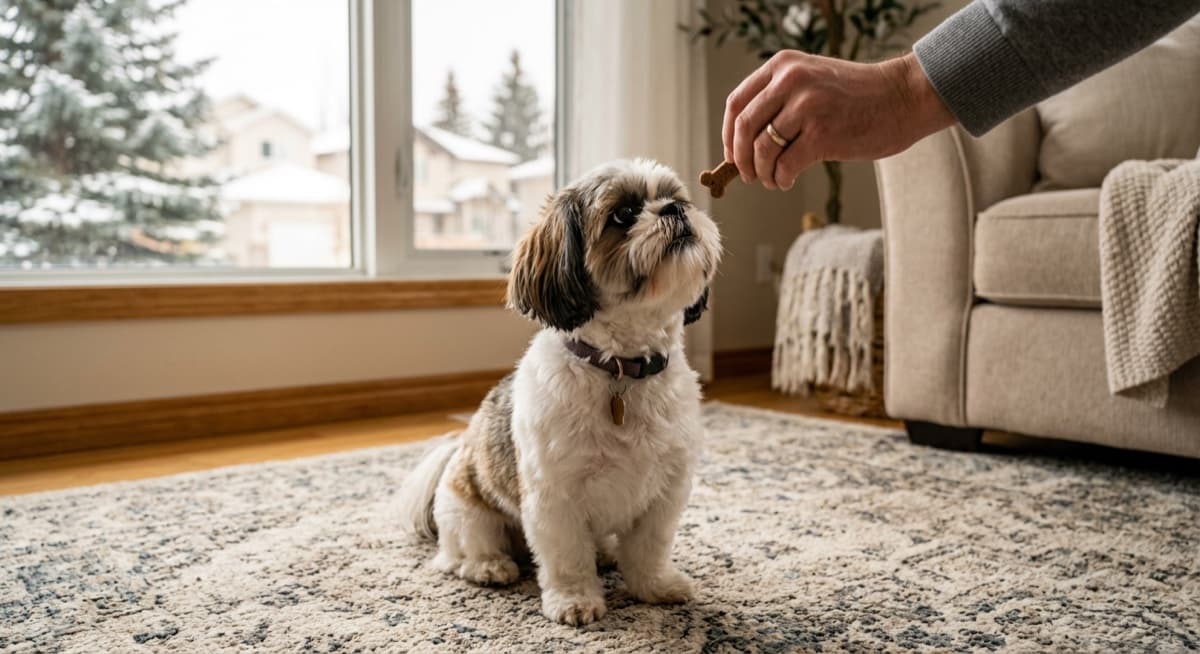
Why the “Stubborn” Label Is Misleading
The Shih Tzu turns up on every “hardest breeds to train” listicle on the internet, often near the top. That ranking comes from people training the dog the wrong way, not from any real deficit in the breed's intelligence. The AKC breed profile describes them as affectionate, alert, and playful companions, originally developed inside Chinese and Tibetan palaces as lap dogs and watchdogs for royal households. They were never working dogs taking direction at a distance. That history shows up in how they train.
Three things get filed under stubborn that are really something else:
- Independence. Shih Tzus think before they act. A Border Collie offers a behaviour 12 times in a minute, looking for the one that earns a reward. A Shih Tzu stands and considers the situation. Calmness gets read as defiance by owners used to high-drive breeds.
- Food motivation that varies. Some Shih Tzus will work for kibble; many will not. If your dog ignores cues during training, the first question is not whether the dog is stubborn but whether the reward is actually rewarding. Chicken, cheese, hot dog, freeze-dried liver. Up the value and the behaviour usually follows.
- Repetition fatigue. Drilling the same cue 30 times in a row teaches a Shih Tzu the cue is meaningless. Three reps, then a break, then three more reps, distributed across the day, works far better than long sessions.
None of this is a deficit. It is a different operating system. The owners who say their Shih Tzu trained easily are the ones who matched the method to the dog from day one.
Force-Free Is the Only Method That Holds
Modern dog training has split into two camps. Force-free or positive reinforcement is one. Balanced, dominance-based, or aversive is the other. The credentialing bodies that govern professional training in Canada and North America are now firmly in the force-free camp. The Certification Council for Professional Dog Trainers (CCPDT) and the International Association of Animal Behaviour Consultants (IAABC) both require the use of the Least Intrusive, Minimally Aversive (LIMA) approach, prioritising positive reinforcement and management over correction and force.
For Shih Tzus specifically, aversive methods damage the breed in three ways:
- Physical risk. Prong collars and choke chains apply pressure to a small, brachycephalic neck. The breed is prone to tracheal compromise, and neck pressure makes that worse. A leash pop on a Shih Tzu is not the same as a leash pop on a Labrador.
- Shutdown behaviour. Shih Tzus go quiet under pressure. They stop offering behaviour, avoid eye contact, and freeze. Owners read this as the dog “listening” or “learning respect.” In behaviour science, it is learned helplessness, and it is a worse training outcome than the original problem.
- Trust erosion. Because the breed bonds closely to its people, aversive methods damage the relationship faster than they would in a more independent breed. Recovery from a single bad training experience can take weeks.
Positive reinforcement works the opposite way. Mark the moment the dog gets it right with a clicker or a verbal cue (yes, good). Pay immediately with a high-value treat. Remove reinforcement from behaviour you do not want by turning away or ending the session. The Karen Pryor Academy publishes excellent free intro material on clicker training that translates directly to small companion breeds.
If any Calgary trainer recommends a prong collar, e-collar, choke chain, scruff shake, or alpha roll for a Shih Tzu, leave the session. The method does not match the breed.
Basic Commands: The Sequence That Works
1. Name recognition
Say the dog's name once. The instant the dog looks at you, mark and reward. Aim for 15 to 20 reps a day in the first week. Name recognition is the foundation every other cue rests on. If the dog never looks at you when you say their name, nothing else gets a chance.
2. Sit
Hold a treat just above the dog's nose, slowly move it back over the head. As the head tilts up, the rear drops. Mark the moment the rear touches the floor, reward. Three to five reps, then move on. Do not push down on the back. Most Shih Tzus get sit within a few sessions.
3. Down
From a sit, lure the treat to the floor between the front paws, then slowly outward along the floor. The dog lies down to follow the treat. Mark the elbows touching the floor, reward. Many Shih Tzus prefer down to sit because it is more comfortable for a small, low-built dog.
4. Stay
Start with the dog in a down on a mat. Mark and reward calm for one second. Build to two, three, five seconds before adding distance. Distractions come last. A 2-minute settle on a mat is realistic by week 4 to 6 with daily practice.
5. Come (recall, indoor first)
In the living room, with the dog a few feet away, say “come” once in a happy voice. The moment the dog moves toward you, mark and reward generously. Build distance gradually. Practise inside for weeks before adding the yard. Never call the dog to you for something they hate (nail trim, bath, leaving the park); always pay the recall.
6. Leave it
Critical safety cue. Hold a low-value treat in a closed fist. The dog sniffs, paws, gives up. The moment the dog disengages and looks up at you, mark and reward with a higher-value treat from your other hand. Build to dropped food on the floor, then real-world distractions like sidewalk chicken bones (a real Calgary alley problem).
Browse adoptable Shih Tzus in Calgary
Shih Tzus and Shih Tzu mixes turn up across Calgary Humane, AARCS, Pawsitive Match, and the smaller rescues every week. Adults often come housetrained and crate-comfortable.
See Available Shih Tzus →Potty Training (and the Calgary Winter Problem)
Shih Tzus have small bladders and a small dog's tolerance for cold, wet, and snowy outdoor conditions. Both factors complicate potty training in a way large breeds do not deal with.
The basic protocol is the same as any breed:
- Outside every 1 to 2 hours when awake, especially for a puppy
- First thing in the morning
- After every meal
- After every nap
- After every play session
- Right before bed
- Pick one specific outdoor spot, use a consistent cue (“go potty”)
- Reward heavily and immediately the moment the dog finishes outside
What makes the Calgary version harder is the weather. From November through April, mornings can sit well below minus 20 Celsius. A Shih Tzu standing on a snow-buried lawn at minus 25 with a Chinook wind blowing through the Beltline will not relieve themselves; they will turn around and ask to come back in. That looks like stubbornness. It is not. It is a small, short-coated dog with no body fat refusing to do something physically uncomfortable.
Calgary-specific adjustments that work:
- Shovel a small bare patch in the yard or balcony for winter potty trips. The dog is far more likely to use grass or concrete than deep snow.
- A real winter coat and booties for sub-minus-15 weather. Not a fashion sweater; an insulated, water-resistant coat.
- An indoor pee pad station as a winter backup in a balcony-only or condo setup, especially for puppies under 6 months and seniors. This is not a training failure; it is realistic management for a brachycephalic toy breed in a sub-arctic city.
- Reward outdoor success in winter even more heavily. Going in minus 20 is a real ask. Pay accordingly.
Never punish indoor accidents in any season. Punishment teaches the dog to hide bathroom behaviour, not to stop having it. Clean with an enzyme cleaner so the scent does not linger and pull the dog back to the same spot.
Most Shih Tzus are reliably housetrained between 6 and 9 months with consistent management. Adults from rescue can be fully housetrained in 2 to 4 weeks once they understand the new schedule. If accidents continue past 4 weeks in an adult, see a vet to rule out a urinary tract infection or stress incontinence; it is common and easily treated.
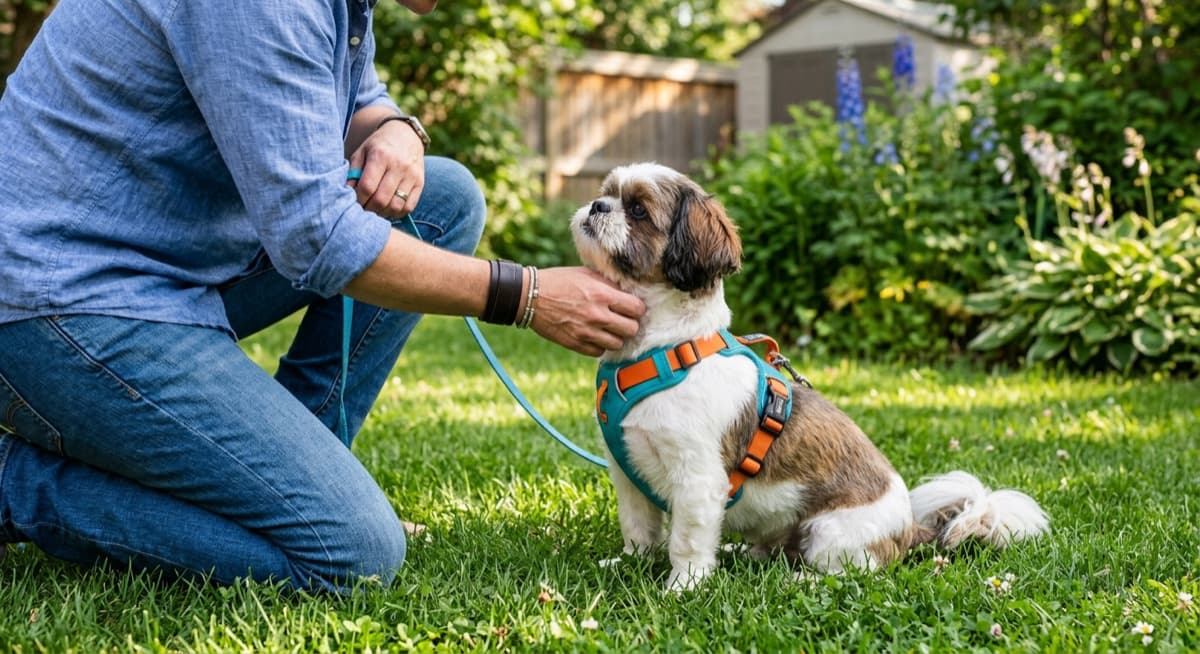
Leash Walking: Harness First, Always
The single most important equipment choice for a Shih Tzu is the harness. The breed is brachycephalic (flat-faced) and many also have some degree of tracheal narrowing. Pressure on the throat from a flat collar, choke chain, prong collar, or slip lead can trigger collapsed-trachea symptoms (honking cough, gagging, blue gums in severe cases). The American Veterinary Medical Association brachycephalic statement flags this category of breeds as needing additional care around airway pressure, heat, and exercise intensity.
A Y-front harness sits across the chest and shoulders, not on the throat. The leash clip is at the chest, redirecting forward momentum to the side without applying force to the neck. Avoid:
- Step-in harnesses with one thin throat strap. Same problem as a collar.
- No-pull harnesses that tighten under the front legs. They restrict gait and create armpit chafing on a small breed.
- Retractable leashes. Sudden full-extension snaps the dog backward, which is hard on the neck and trachea even with a harness.
For loose-leash walking, the protocol is the same as any breed: reward the dog for walking near you with frequent small treats, stop walking when the leash tightens, resume only when it loosens. With a Shih Tzu, do this in short bursts. A 15-minute training walk followed by a 20-minute sniff-and-stroll is far more effective than a 45-minute structured heel that exhausts both of you.
Calgary summer is a separate caution. Sidewalks at noon in July can hit 50 Celsius surface temperature, which burns paw pads on any breed and overwhelms a brachycephalic dog's ability to cool down. Walk early morning or after sundown when the temperature is above 22 Celsius. If the back of your hand cannot rest on the sidewalk for 5 seconds, it is too hot for the dog.
Brachycephalic Training Considerations
Shih Tzus are flat-faced. That fact shapes every physical aspect of training in ways that do not apply to long-snouted breeds. Three caveats matter for every session:
Heat sensitivity
Brachycephalic breeds cannot pant efficiently. Their soft palate, narrowed nostrils, and short airway make heat dissipation slow. Outdoor training above 22 Celsius needs to be brief and shaded. Above 27 Celsius, move sessions indoors entirely. Heatstroke in a Shih Tzu can kill in under an hour and is the most common preventable cause of brachycephalic emergency vet visits.
Breathing pauses and recovery time
Watch the dog's breathing during and after any active training. If panting becomes loud, raspy, or honks; if the tongue turns dark purple; if the dog wants to lie down and not move; end the session immediately. Carry water on every walk. Plan sessions around recovery, not around hitting a duration target.
Do not overdo physical training
A Border Collie can train for 45 minutes and ask for more. A Shih Tzu trained at the same pace overheats and shuts down. Cap sessions at 2 to 5 minutes for puppies and 10 minutes for adults. Mental enrichment (puzzle feeders, snuffle mats, name recognition games) is far better suited to the breed than long obedience drills.
If your Shih Tzu shows signs of breathing distress beyond normal exertion (noise at rest, blue gums, collapse), this is a veterinary issue, not a training issue. Talk to your vet about BOAS (brachycephalic obstructive airway syndrome) evaluation. Articles cannot diagnose or recommend treatment; that conversation belongs in the vet's office.
The Adolescent Regression (6 to 12 Months)
Around 6 months of age, a Shih Tzu puppy who has been sailing through training will suddenly forget every cue they ever knew. The sit they offered easily at 4 months is gone. They blow off recall. They have accidents in spots they have never had accidents before. Owners panic.
This is adolescent regression and it is normal across every breed. In Shih Tzus it usually lasts from 6 to 12 months, sometimes stretching to 18 months. Hormones, brain development, and a more independent worldview all collide at the same time. The dog has not forgotten anything. They are testing whether the rules still apply.
The protocol during adolescent regression:
- Do not escalate. Aversive correction during adolescence does long-lasting damage to a Shih Tzu's relationship with you. Stay force-free.
- Go back to basics. Re-pay every cue you thought was solid. Reward sit, down, recall as if the dog has never heard them before.
- Tighten management. A long line in fenced areas. Baby gates between rooms. Crate when unsupervised. Make it harder for the dog to practise the wrong behaviour.
- Shorten sessions further. Adolescent Shih Tzus have less attention span, not more. 60-second sessions multiple times a day.
- Wait it out. Most dogs come back to themselves around 12 to 14 months. The behaviour you trained is still there; it just goes underground for a while.
If adolescent regression is paired with reactivity (lunging, barking, fear behaviours toward other dogs or people), a force-free behaviour consultant with IAABC or CDBC credentials is worth the consult. That kind of help is far easier in adolescence than after the behaviour has set in adulthood.
Common Shih Tzu Training Problems
Resource guarding food or toys. Common in small breeds because the resource itself is small and easy to defend. Feed in a quiet space, do not reach into the bowl, trade up for higher-value items rather than taking objects away. If guarding escalates to growling or snapping, call a force-free behaviour consultant (CDBC, IAABC credentials).
Reactivity on leash. Small dogs often bark and lunge at larger dogs from a place of fear, not aggression. Increase distance from the trigger. Reward calm. Avoid head-on greetings on sidewalks. The Beltline at peak walking hours is the worst environment for a reactive Shih Tzu; pick quieter routes through Bridgeland or along the Bow River pathway.
Demand barking. Shih Tzus learn fast that barking gets attention. The fix is to ignore the barking, reward silence the moment it happens, and use management (crate, gate) when you cannot follow through.
Refusing the leash. Some Shih Tzus plant their feet and refuse to walk on a leash, especially in winter. Drop the pressure. Stand still, reward any forward step, build duration. Carry the dog home if you must; the walk is supposed to be fun, not a battle.
Separation anxiety. The breed bonds closely and can struggle with alone time. Build alone-time gradually from week 1. Pair short absences with a frozen Kong or a puzzle feeder. If the dog vocalises, paces, or destroys the home for the first 5 to 30 minutes of every absence, see our Shih Tzu separation anxiety guide for the longer protocol.
Finding a Force-Free Trainer in Calgary
For a Shih Tzu, the right trainer is a Calgary force-free professional with experience working with toy or small breeds. Credentials worth looking for:
- CCPDT (CPDT-KA, CPDT-KSA): the Certification Council for Professional Dog Trainers. Requires LIMA-based methods and ongoing continuing education.
- KPA-CTP: Karen Pryor Academy Certified Training Partner. Strong clicker-training foundation.
- CDBC and IAABC: Certified Dog Behaviour Consultant and the International Association of Animal Behaviour Consultants. Best fit for reactivity, separation anxiety, and resource guarding.
- PMCT: Pat Miller Certified Trainer. Force-free, well respected.
Four questions to ask any prospective trainer before signing up:
- What method do you use? (Want to hear: positive reinforcement, force-free, LIMA, science-based)
- What equipment do you use? (Want to hear: harness, flat collar, long line. Do NOT want to hear: prong, e-collar, choke, slip lead.)
- What happens when a dog gets it right? (Want to hear: marker + reward)
- What happens when a dog gets it wrong? (Want to hear: ignore, redirect, manage. Do NOT want to hear: correction, leash pop, time-out with pressure.)
Walk away from anyone who describes themselves as “balanced,” or who recommends prong, e-collar, or choke chains for a Shih Tzu. The method does not match the breed and the equipment will hurt the dog.
Class costs in Calgary: $200 to $450 for a 6-week group class. $80 to $200 an hour for private sessions. Most reputable Calgary trainers offer a free or low-cost intro consult so you can vet them before committing.
Frequently Asked Questions
Are Shih Tzus hard to train?
Not hard, but different. The breed is independent and calm, which gets read as stubborn by owners used to high-drive breeds. Match the method to the breed (positive reinforcement, short sessions, high-value rewards) and Shih Tzus train beautifully. Most house manners and basic obedience consolidate in the first 8 to 16 weeks.
Why is my Shih Tzu so stubborn?
Usually three things, none of which are real defiance: the breed is independent (not handler-focussed like a Border Collie), food motivation varies dog to dog (some need real chicken or cheese to engage), and repetition fatigue sets in fast. Up the reward value, shorten the session, and the “stubbornness” usually disappears.
What training method works best for Shih Tzus?
Force-free positive reinforcement. Mark the right behaviour, pay with a high-value treat, manage the environment so the wrong behaviour cannot practise. Aversive tools (prong, e-collar, choke, scruff shakes, alpha rolls) actively damage this breed. The dog shuts down, loses trust, and develops fear-based behaviour.
How do I potty train a Shih Tzu?
Outside every 1 to 2 hours when awake, after meals, after naps, after play. Reward outdoor success heavily and immediately. Never punish indoor accidents. Calgary winter is the hardest part: shovel a bare patch, use a real coat, and consider an indoor pee pad backup below minus 20 Celsius. Most Shih Tzus are reliable by 6 to 9 months.
How do I stop my Shih Tzu from pulling on the leash?
Switch to a Y-front harness immediately. Brachycephalic breeds cannot tolerate any pressure on the throat. Reward walking near you with frequent small treats, stop when the leash tightens, resume when it loosens. Most Shih Tzus learn loose-leash walking in 4 to 8 weeks with consistent practice.
When can I start training a Shih Tzu puppy?
The day they come home, around 8 to 12 weeks. Puppy training sessions are 60 to 90 seconds and reward any glance, any tiny moment of attention, any sit that happens to occur. Force-free group puppy class through a Calgary CCPDT or KPA-credentialed trainer is worth the cost.
Should I use a harness or collar?
Harness, always, for any walking or training. The collar is for the ID tag only. Brachycephalic breeds are at high risk for tracheal collapse from any throat pressure; a Y-front harness clips at the chest, not the neck.
How do I find a force-free trainer in Calgary?
Look for CCPDT, KPA-CTP, CDBC, or IAABC credentials. Ask the four screening questions (method, equipment, reward, correction). Avoid anyone who calls themselves “balanced” or recommends prong, e-collar, or choke equipment. Group classes run $200 to $450 for 6 weeks; private sessions $80 to $200 an hour.
More Shih Tzu guides
Shih Tzu Adoption Calgary →
Where to find Shih Tzus and Shih Tzu mixes in Calgary rescues, real adoption costs, what to ask.
Shih Tzu Separation Anxiety →
The companion-breed alone-time problem, prevention from day 1, when to call a behaviour consultant.
Shih Tzus Available Now →
Live listings of Shih Tzus and Shih Tzu mixes across 15+ Calgary-area rescues.
Shih Tzu Health Issues →
BOAS, eye proptosis, dental, IVDD, renal dysplasia. What every Shih Tzu owner needs to know.
New dog? Start with these care guides
Everything a new adopter needs to set up a safe, happy home.