
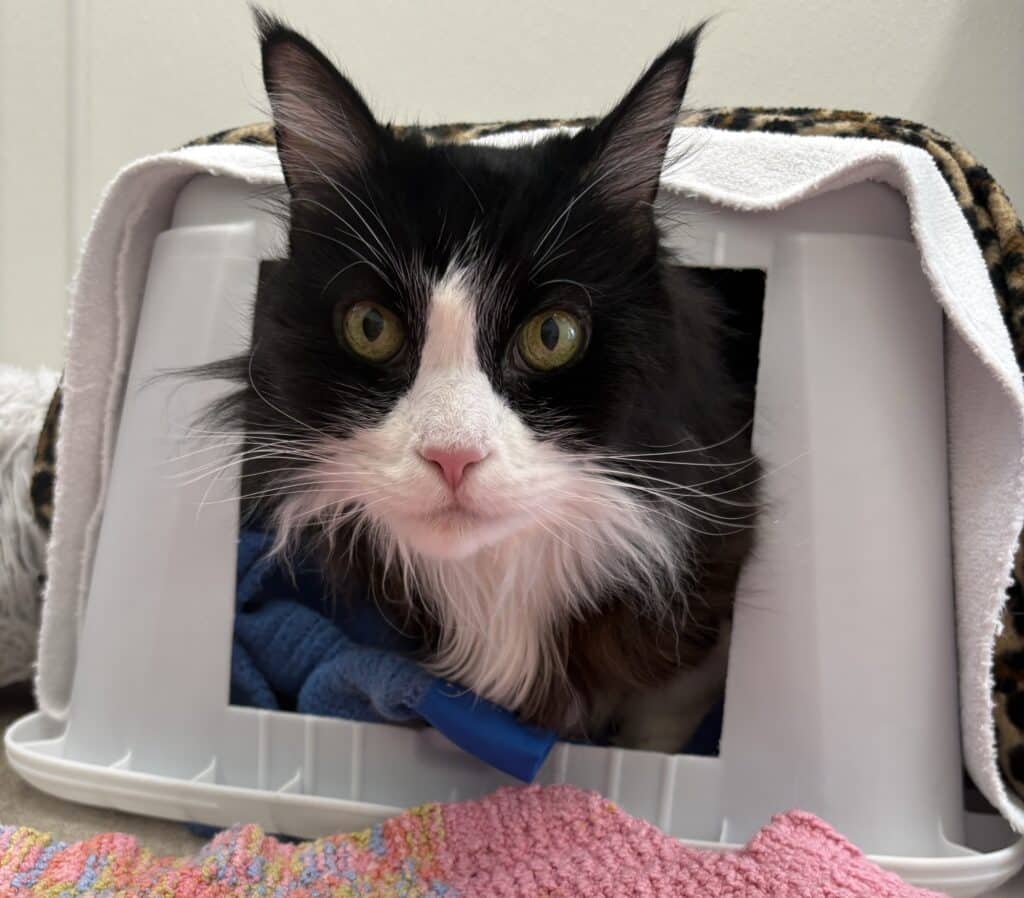
Special needs cats are some of the longest-waiting rescues in Vancouver. The category covers FIV+ and FeLV+ cats, blind and deaf cats, three-legged tripods, cats with diabetes or hyperthyroidism, asthmatic cats, cats with cerebellar hypoplasia (“wobbly cats”), cats with chronic kidney disease, and senior cats with managed medical conditions. VOKRA, the BC SPCA in Vancouver, and Heart and Soul Dog and Cat Rescue regularly list medically-sponsored cats whose adoption fee is reduced or waived because of an ongoing condition.
Most special needs cats adapt to indoor life beautifully and are no harder to live with than any other cat once you understand the basics. FIV+ cats live full normal lifespans in indoor-only homes. Blind and deaf cats map a familiar layout in one to two weeks. Tripod cats jump and run like four-legged cats. Asthmatic cats stabilize on inhalers. The biggest barrier is usually the adopter's hesitation, not the cat's condition.
Vancouver has an unusually strong veterinary specialty ecosystem — Canada West Veterinary Specialists in Vancouver and VCA Canada West offer board-certified internal medicine, cardiology, and oncology referrals, and the UBC area has multiple feline-focused general practices. That depth of specialist support means chronic-condition cats are easier to manage in Vancouver than in most Canadian cities. For a fuller breakdown of what to expect, costs, and how to prepare, read our complete special needs cat adoption guide.
Why adopt a special needs cat
Special needs cats wait two to four times longer than typical cats in Vancouver rescues, often months past their healthy littermates. The conditions sound scarier in a profile than they look in a living room. Reduced fees, sponsor coverage, and ongoing vet relationships from VOKRA, the BC SPCA, and Heart and Soul mean the lifetime cost gap to a typical cat is often smaller than adopters expect.
The FIV+ / FeLV+ reality
FIV+ cats live full normal lifespans (12 to 15+ years) in indoor-only homes. FIV is only spread through deep bite wounds, not food bowls or grooming, so an FIV+ cat can safely live with FIV-negative cats once introduced. FeLV+ is more contagious cat-to-cat, so FeLV+ cats are adopted either as the only cat or into FeLV+ homes. Neither virus passes to humans or dogs. Many Vancouver FIV+ and FeLV+ cats are listed with sponsor-covered or reduced fees through VOKRA and the BC SPCA.
BC specialty vet ecosystem is a real advantage
Vancouver has one of the strongest veterinary specialty networks in Canada. Canada West Veterinary Specialists in Vancouver offers board-certified internal medicine, cardiology, oncology, and surgery. VCA Canada West has multiple Lower Mainland locations with specialty referrals. For chronic-condition cats — kidney disease, refractory diabetes, advanced hyperthyroidism, asthma — that depth of local specialist coverage makes day-to-day management noticeably easier than in smaller cities. Indoor-only Vancouver life also suits special needs cats well: VOKRA, the BC SPCA, and Heart and Soul all require indoor-only or supervised-outdoor (catio, leash-walked) homes, which keeps FIV+/FeLV+ cats virus-contained, blind and tripod cats safe from coyotes in Stanley Park and Pacific Spirit Park, and diabetic and asthmatic cats on stable routines.
Vancouver Special Needs Cat Adoption FAQ
Where can I adopt a special needs cat in Vancouver?▼
LocalPetFinder lists special needs rescue cats from Vancouver-area cat shelters including VOKRA (Vancouver Orphan Kitten Rescue Association), the BC SPCA in Vancouver, and Heart and Soul Dog and Cat Rescue. The category covers FIV+ and FeLV+ cats, blind and deaf cats, tripods, diabetic cats, asthmatic cats, cerebellar hypoplasia (wobbly) cats, and senior cats with managed medical conditions. Most BC rescues offer reduced fees and ongoing vet support.
How much does a special needs cat cost to care for in Vancouver?▼
Depends on the condition. FIV+, FeLV+, blind, deaf, and tripod cats cost about the same as any rescue cat (around $900–$1,700 a year in Vancouver given Lower Mainland vet pricing). Diabetic cats add $90–$160 a month for insulin and supplies. Asthmatic cats add $30–$80 a month for inhalers. Hyperthyroid cats add $30–$60 a month for medication, or $1,800–$2,800 one-time for radioactive iodine treatment at a BC specialty clinic. Most Vancouver rescues offer reduced adoption fees ($25–$150 vs $150–$300) and many include ongoing vet support for the condition the cat arrived with.
Is FIV contagious to other cats or to humans?▼
FIV is only spread cat-to-cat through deep bite wounds, not casual contact, food bowls, or grooming. FIV+ cats can live with FIV-negative cats safely if introductions are managed. Most FIV+ cats live full normal lifespans (12–15+ years) in indoor-only Vancouver homes. FIV does NOT pass to humans, dogs, or any other species. See our FIV+ cats guide for full details.
What about FeLV+ cats?▼
FeLV is more contagious cat-to-cat than FIV (spread through saliva, shared water, grooming) so FeLV+ cats are usually adopted as the only cat or into existing FeLV+ households. FeLV+ cats often live 3–6 years, sometimes longer with good care, and live comfortably in indoor-only homes with immune-supportive care. FeLV does NOT pass to humans or dogs. VOKRA and the BC SPCA in Vancouver sometimes sponsor FeLV+ cat adoptions to offset the harder placement.
Are special needs cat adoption fees waived in Vancouver?▼
Often, yes. VOKRA routinely reduces or waives fees for FIV+, FeLV+, senior, and medical-needs cats. The BC SPCA in Vancouver runs sponsored-cat programs where donors cover the adoption fee for cats with medical needs or long shelter stays, plus a seniors-for-seniors program for adopters 60+. Heart and Soul Dog and Cat Rescue occasionally waives fees for hard-to-place specials. Look for a sponsored, waived-fee, or reduced-fee tag on the listing — or ask the rescue directly, since many waivers are not advertised publicly.
Can blind or deaf cats live in a Vancouver apartment alone during the day?▼
Yes, in a familiar home. Blind cats map a home through scent and memory and navigate confidently after 1–2 weeks. Deaf cats sleep through the day like any other cat. The two main precautions: keep furniture in fixed positions and approach a deaf cat from the front rather than startling them awake. Vancouver condos and apartments in the West End, Yaletown, Kitsilano, and on the North Shore work well for blind cats because the layout is small and stable.
What is cerebellar hypoplasia (CH) in cats?▼
Cerebellar hypoplasia is a non-progressive neurological condition where the kitten's cerebellum did not develop fully in utero (typically due to feline panleukopenia exposure during pregnancy). CH cats wobble, have tremors, and may struggle with balance — but they live normal lifespans, are not in pain, and adapt well to indoor Vancouver homes with low furniture, rugs for traction, and shallow litter boxes. Often called “wobbly cats.” Indoor-only Vancouver is an especially good fit because they are not safe outside.
Do I need a specific vet for a special needs cat in Vancouver?▼
For most conditions, no — any Vancouver general-practice vet can manage FIV+/FeLV+, blind/deaf/tripod cats, and uncomplicated diabetes or hyperthyroidism. For more complex cases (advanced kidney disease, refractory diabetes, radioactive iodine for hyperthyroidism, cardiology), Vancouver has one of the strongest specialty referral networks in Canada including Canada West Veterinary Specialists in Vancouver and VCA Canada West across the Lower Mainland. VOKRA, the BC SPCA, and Heart and Soul usually pair the adopter with a vet relationship at handover, and several Vancouver clinics offer first-visit-free for newly-adopted rescue cats.
New to special needs cat adoption?
Read our complete guide covering FIV+, FeLV+, blind, deaf, tripod, diabetic, asthmatic, and CH cats — what to expect, real cost ranges, and how to set up your home.
Read the full special needs cat adoption guide →Explore more Vancouver cats
Adults, kittens, seniors, bonded pairs — everything currently available.
Cats aged 10 and up. Often the calmest, most affectionate adoptions.
Cats already adjusted to indoor living — the BC standard given urban coyote risk.
Two cats adopted together. Many bonded pairs include a special needs cat paired with a companion.