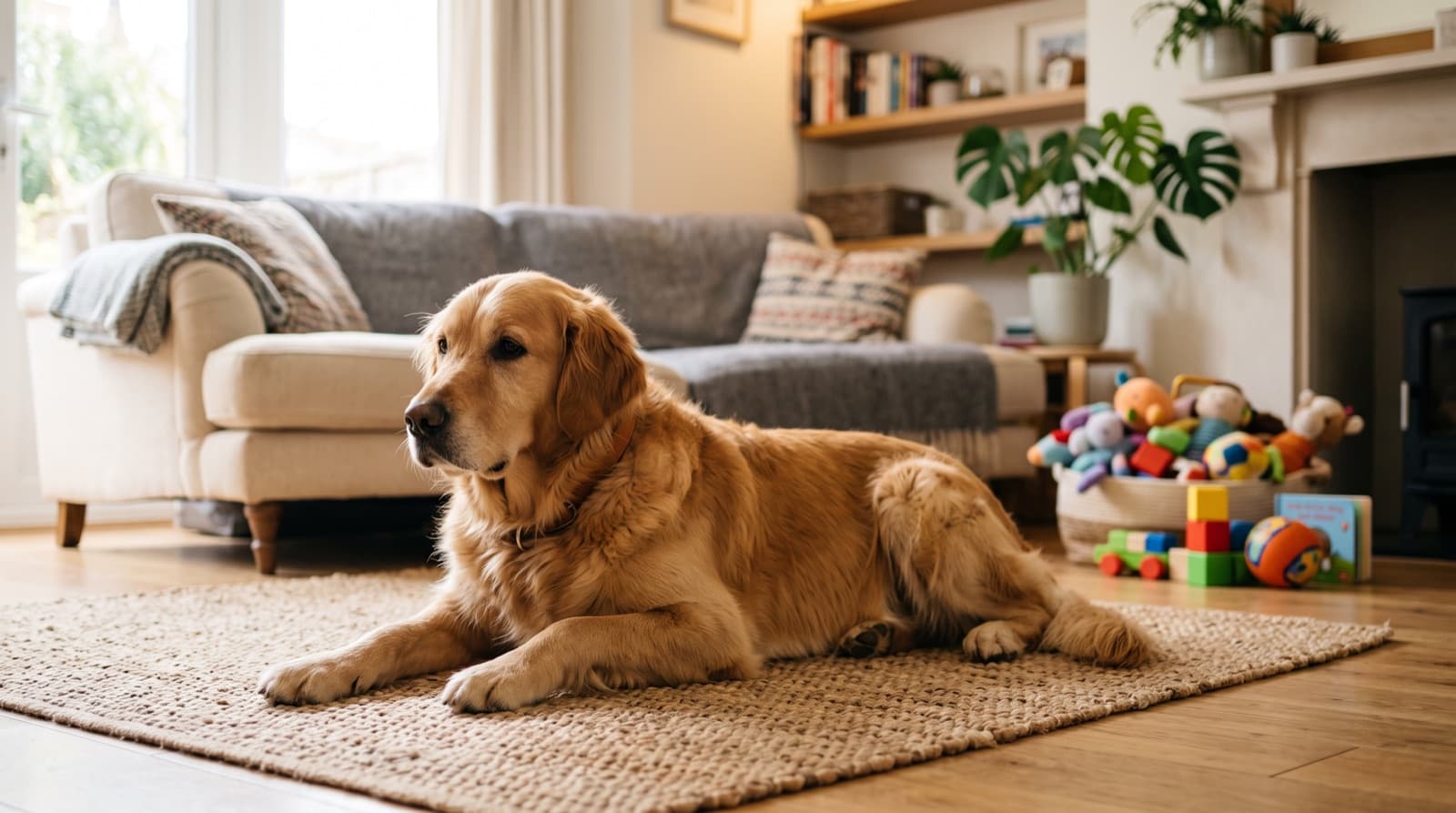
The short answer
The best family dog is an adult that someone has watched around children and can describe honestly. Breed narrows the field slightly; assessment settles it. Two things most families get backwards: puppies are harder with young children, not easier, and large dogs are frequently better with kids than small ones because they are patient and hard to hurt by accident. Of the 766 dogs currently assessed as good with children across Canada, 319 are large or giant and only 129 are small.
The family dog question gets answered with a breed list because a breed list is easy to write. It is also the least useful answer available, and following it is how families end up with a dog that has an excellent reputation and does not suit them at all.
Why breed predicts less than you think
Breed sets a rough range for size, coat and energy. It says much less about temperament, and temperament is the thing that matters around children. The variation between two individuals of the same breed is routinely wider than the average gap between two breeds.
The practical consequence: choosing a Labrador does not get you a good family dog. It gets you a dog that is probably large, probably shedding, and probably energetic for the first two to three years. Whether it is patient with a toddler pulling its ear is a question about that specific animal.
This is also why the standard list quietly misleads. Labradors and Golden Retrievers deserve their reputation, but they are big, strong adolescents for a long time, and a family that pictured the calm adult from the advert is often unprepared for the eighteen months before it arrives.
Big dogs are underrated with children
The instinct that a small dog is safer for small children is understandable and mostly wrong. Small dogs are fragile. A toddler can injure one by falling on it, and a dog that has been hurt or frightened by a child learns that children are dangerous. Many small breeds were also developed as alert watchdogs, which is a reactive temperament rather than a tolerant one.
Large breeds are frequently the opposite: patient, tolerant, and robust enough that ordinary childhood clumsiness does not hurt them. Of the dogs currently assessed as good with children on our listings, 319 are large or giant against 129 small ones, which reflects what rescues actually observe rather than any editorial preference.
The honest caveat is that size determines consequence. A large dog that does bite causes more damage, so the bar for temperament should be high either way and supervision is non-negotiable regardless of weight. But choosing small because it feels safer is optimising for the wrong variable.
Puppies are the harder choice, not the easier one
Families gravitate to puppies believing a dog raised alongside the children will bond better and be safer. In practice a puppy mouths, jumps and has no impulse control, which pairs badly with toddlers who move fast and grab. Two small creatures learning self-control simultaneously is harder than it sounds.
Adolescence then arrives around six months and runs to roughly two years, bringing the arousal and selective deafness that surprises everyone. It lands precisely when the novelty has faded and the family is tired, which is why so many dogs are surrendered between one and two years old.
An adult dog skips all of it and, more importantly, is a known quantity. Our first-time owner guide makes the same argument for the same reason: predictability is worth more than potential.
The questions that actually tell you something
“Is this dog good with kids?” gets a yes almost every time. These get you real information:
- What does the dog do when a child runs past? Chasing and herding are normal behaviours that are frightening at toddler height.
- How is it around food when someone approaches? Resource guarding is manageable in an adult-only home and a serious problem with small children.
- Has it lived with children, or just met some? Very different answers.
- Has it been assessed for pain? A dog with arthritis or an ear infection is far more likely to react, and pain is badly under-recognized.
- What does the foster find hardest about this dog? The most useful question available, and a good rescue answers it honestly.
A uniformly positive answer to all of the above is itself information: either nobody has lived with the dog, or you are being sold to.
Be honest about your own household
The half of the match nobody assesses is the family. A house with three children under eight, regular playdates and a lot of noise is a genuinely demanding environment for a dog. A sensitive dog that would thrive with a quiet couple will struggle there, and that is a mismatch rather than a bad dog.
Tell the rescue what your home is actually like rather than what you would like it to be. They are trying to make the placement work, and an accurate picture is the most useful thing you can give them.
Also worth planning: who walks the dog on a wet Tuesday. Family dogs are frequently acquired for the children and cared for by one adult, and that adult should agree to it in advance.
The practical filters that do matter
Coat, because busy families underestimate grooming. A doodle looks like the low-effort choice and needs a professional groom every four to eight weeks for life. Our guide to dogs that do not shed covers which low-shedding breeds are genuinely low effort.
Energy, honestly assessed. A high-drive working breed needs 75 to 90 minutes daily plus mental work, and school runs do not count. The calm dog breeds guide covers the difference between calm, low energy and quiet, which families routinely conflate.
Space, less than you think. If you are in a flat, temperament matters far more than square footage. See apartment dog breeds.
Browse family dogs across Canada
766 rescue dogs individually assessed as good with children, rather than filtered by breed reputation.
See family dogs for adoption →Frequently Asked Questions
What is the best family dog?
An adult dog that someone has actually watched around children and can describe honestly. That is not the answer people want, but it is the accurate one: temperament varies more between two Labradors than it does between the average Labrador and the average Beagle. Breed narrows the field a little. An assessment settles it.
What are the best family dog breeds?
Labradors, Golden Retrievers, Beagles, Cavalier King Charles Spaniels and Newfoundlands have all earned their reputations, and they are sensible starting points. The caveat matters more than the list: Labs and Goldens are large, strong and genuinely high energy for their first two to three years, which catches out families who chose them for the friendly reputation and did not plan for the adolescence.
Are big dogs good with kids?
Frequently better than small ones, which surprises people. Many large breeds are patient and tolerant, and a big dog is harder for a child to hurt accidentally. Small dogs are fragile, easily frightened by fast-moving toddlers, and more likely to snap when cornered. Size predicts damage if a bite happens; it does not predict whether one will. Supervision matters more than weight either way.
Should a family with young children get a puppy?
Usually not, and it is the most common family mistake. Puppies mouth, jump and have no impulse control, which is a poor mix with toddlers who move fast and grab. Adolescence then arrives at six months and runs to two years, landing exactly when the novelty has worn off and the family is tired. An adult dog with a known temperament is more predictable, and predictability is what keeps children safe.
What should I ask a rescue about a dog and my kids?
Ask what the dog does when a child runs past, how it behaves around food when someone approaches, and whether it has actually lived with children rather than simply met some. Ask about pain too, because a dog with arthritis or an untreated ear infection is far more likely to react. A foster home will answer all of that. A dog nobody can describe is a dog to be cautious about.
What family dogs do not shed?
Low-shedding family options split into two groups with very different upkeep. Short-coated dogs like Beagles and Boston Terriers shed a little and need almost no grooming. Coat-holding breeds like Poodles, Bichons and doodles shed almost nothing but need professional grooming every four to eight weeks for life. For a busy family, the short-coated group is usually the more realistic choice.
How do I introduce a rescue dog to my children?
Slowly, and on the dog terms. Give the dog a space the children cannot follow it into, and teach them that a dog in its bed is left alone. Let the dog approach rather than having children approach it. Supervise every interaction for the first several weeks, and never leave young children and any dog together unsupervised regardless of how good the dog is. Most bites happen in familiar homes with familiar dogs.
Are rescue dogs safe for families?
Often safer than a puppy, because you get information rather than a prediction. A rescue that fosters in homes can tell you how a specific dog behaves around children, noise and chaos. That is a far stronger basis for a decision than choosing an eight-week-old puppy of a breed with a good reputation and hoping. Look for rescues that foster rather than kennel.
Dogs for First-Time Owners
Why age and assessment beat breed for a first dog too.
Calm Dog Breeds
Calm, low energy and quiet are three different traits.
Dogs That Don't Shed
Which low-shedding breeds are genuinely low effort for a busy home.
Family Dogs for Adoption
Live listings of dogs assessed as good with children.