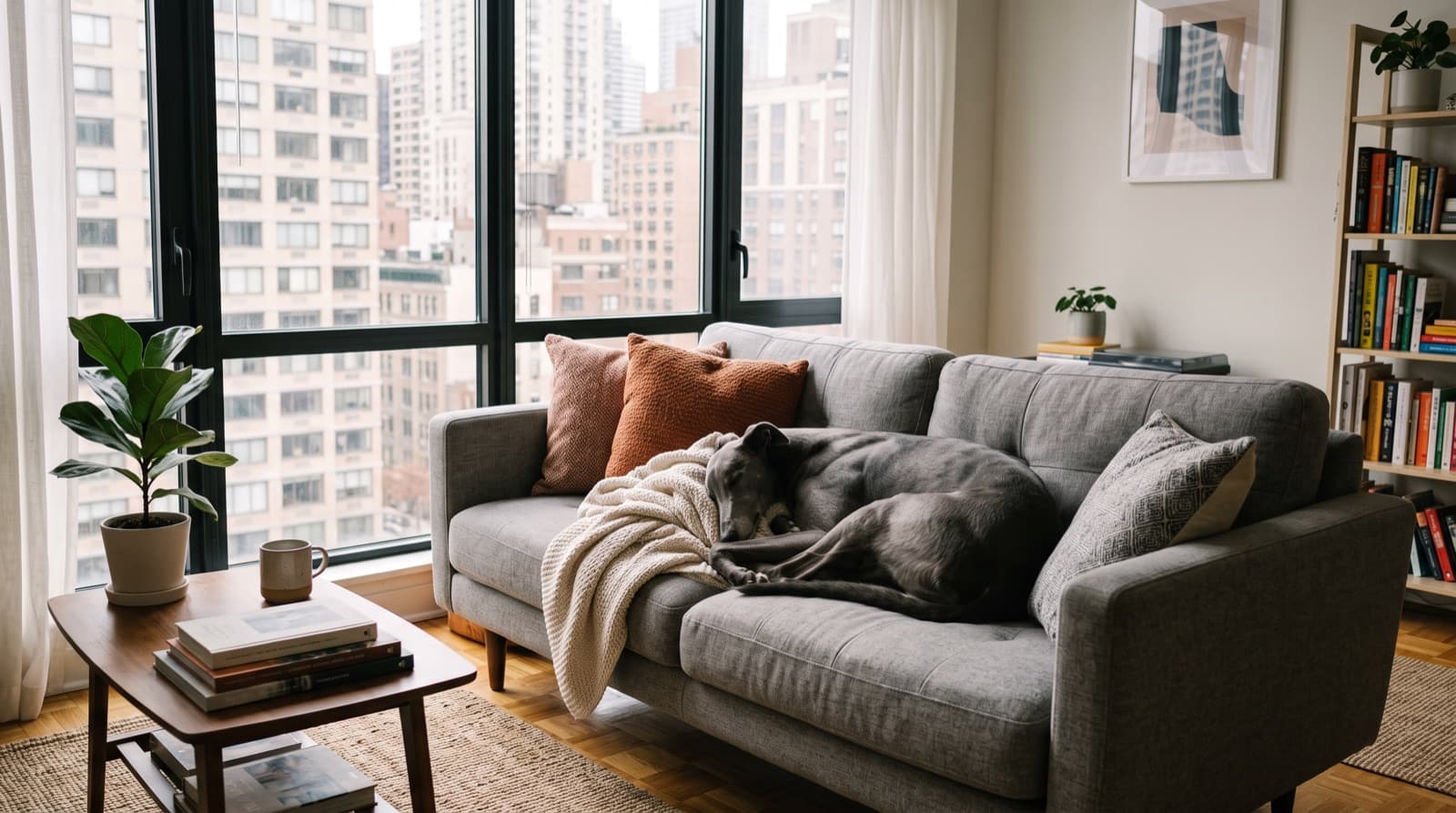
The short answer
Filter on noise and settledness, not size. A dog that barks at hallway sounds will cause friction with neighbours whatever it weighs, and a dog that paces will be unhappy in a small space. By that measure the Greyhound is one of the best apartment dogs in existence at 60 to 70 pounds, and several popular small breeds are among the worst. The one place size genuinely matters is your lease: many Canadian buildings set weight limits regardless of temperament, so check the rules before you fall for a dog.
Almost every apartment dog list is a small dog list. That is not because small dogs are better suited to buildings; it is because size is easy to measure and temperament is not. The result is a filter that is simple, popular, and only loosely related to whether a given dog will actually work where you live.
What actually determines whether a dog suits a building
Barking comes first. It is the thing that generates complaints, strains relationships with neighbours and, in the worst case, gets a dog surrendered. It is also the trait least correlated with size. Several small breeds were developed specifically to alert their owners to anything approaching, and a shared hallway supplies a great deal to alert about.
Settledness comes second. A dog that can do nothing for an afternoon is comfortable in a small space. A dog that paces needs somewhere to pace. This is temperament rather than size, and it is exactly what a foster home can report on.
Exercise comes third, and it is solvable. Every dog needs walking, and in an apartment every toilet trip is a scheduled event including at 6am and in February. That is a routine question rather than a suitability question, but it is why house-training matters far more in an apartment than in a house with a back door.
Floor space, the thing size actually predicts, comes a distant fourth. Dogs sleep for most of the day and do not use square footage the way people imagine.
The Greyhound case, and why it keeps surprising people
A retired racing Greyhound weighs 60 to 70 pounds and is, by most practical measures, an excellent apartment dog. They sleep for the majority of the day, are notably quiet, have a short coat that sheds little, and are satisfied with two moderate walks plus the occasional sprint. On our breed scoring they reach 87 out of 100 for overall workload, ahead of most of the toy group.
The instinct that a big dog needs a big space is intuitive and mostly wrong. What a dog needs is somewhere to lie down and a reason to settle. Sighthounds are the clearest illustration, and Whippets offer the same profile in a medium frame at 87 out of 100.
The genuine trade-offs are worth naming. Sighthounds have a strong prey drive, so off-leash decisions need care in an urban setting. They also carry almost no body fat or coat and need a proper insulated coat through a Canadian winter, which is a real consideration when every toilet trip means going outside.
Why some small dogs are the worst apartment dogs
Small and quiet are unrelated traits. A number of popular small breeds were bred as watchdogs and alert readily, which in a house is mildly annoying and in a building with shared walls is a genuine problem.
It is not only small dogs. Among the low-energy breeds in our registry, Basset Hound and Great Pyrenees are both flagged as vocal, and the Great Pyrenees is the clearest example of the trap: a calm, low-energy dog that was specifically bred to bark at anything approaching through the night. Physically undemanding and close to unworkable in a condo.
Breed is also only half the story. A great deal of problem barking is boredom or distress rather than temperament, and as the ASPCA notes, dogs denied an outlet for their natural behaviours will find their own. In a building that matters twice over, because a bored dog is a loud dog and your neighbours are on the other side of the wall.
None of this means avoid small dogs. It means judge the individual rather than the size band, and ask the rescue the one question that matters: what does this dog do when it is left alone? Our calm dog breeds guide covers the calm-versus-quiet distinction in more depth.
The breeds that genuinely struggle in apartments
High-drive working breeds are the real mismatch, and they sit at the bottom of our overall workload scoring for the same reasons: Alaskan Malamute, Husky, Samoyed, Border Collie, Newfoundland. They need 75 to 90 minutes of genuine daily exercise plus mental work, and without it they become destructive and noisy. That is difficult in a house and unfair in a one-bedroom.
Livestock guardians are the other group to think carefully about. Their exercise needs are modest, which makes them look suitable, but they were bred to announce anything that approaches. In a building, that instinct fires constantly.
If you want a steer by size
Small. Plenty of good options, with the caveat above about alert barking. Prioritise a dog described as quiet over one described as small, and be honest about whether you want a lap dog or a watchdog, because several breeds are firmly the latter.
Medium. Underserved and worth considering. The Whippet is the standout, offering the Greyhound profile in a smaller frame. Medium dogs are frequently overlooked by adopters filtering to extremes, which means they wait longer in rescue.
Large and giant. Better than their reputation, provided your building permits it. Greyhounds, Mastiffs and Saint Bernards are all quiet and settled indoors. The binding constraint here is almost always the lease rather than the dog.
The Great Dane question comes up often enough to answer directly. On temperament they are a reasonable apartment dog: calm indoors, low to moderate exercise needs, and notably quiet for their size. On practicality they are harder work than a Greyhound. A hundred-plus pounds of dog needs floor space to lie down and a lift rather than four flights of stairs, weight limits rule them out of most buildings that have one, and giant breeds are prone to bloat, which means feeding routines matter more than in a smaller dog. Workable, but check the lease before falling for one.
Puppies in apartments: the hardest version of this
Search interest in getting a puppy for apartment living has risen sharply, which is worth flagging precisely because it is the most difficult route available. A puppy makes worse exactly the two things an apartment already makes hard.
House training without a yard. A young puppy needs to go out every couple of hours, including overnight. In a house that means opening a door. On the fourth floor it means getting dressed, carrying the puppy to a lift, crossing a lobby, and doing it again three hours later. Accidents in a carpeted flat are also harder to resolve than on a lawn.
Noise through shared walls. Puppies cry when separated, and crate training normally involves a stretch of protest barking. In a house that is unpleasant. In a building it generates complaints, sometimes within the first week, and complaints are how apartment dogs end up back in rescue.
None of that makes it impossible. If you are set on a puppy, plan the toilet route before the puppy arrives, pick a ground-floor or lift-served unit if you have the choice, and speak to your immediate neighbours in advance rather than after the first complaint. Most people are tolerant of a temporary problem they were warned about.
The alternative is simply better though, and it is the same argument as everywhere else on this site: an adult dog that is already house-trained and settled removes both problems on day one. Our first-time owner guide covers why age predicts your experience more reliably than breed does.
Check the lease before you fall for a dog
This is the one place size genuinely decides the outcome. Many Canadian buildings and condo boards impose weight limits, and some restrict specific breeds. Those rules are typically written around size and reputation rather than behaviour, which is how a quiet 65-pound Greyhound gets excluded while a vocal terrier is welcome.
Get your building rules in writing before you apply for a dog rather than after. Rescues will ask about your housing situation during the application, and a clear answer moves things along. Rules vary by province and by building, so confirm yours specifically rather than assuming.
Browse apartment-suited rescue dogs across Canada
Filtered on settledness, no yard requirement and house-training rather than on size, so large calm dogs are included instead of hidden.
See apartment dogs for adoption →Frequently Asked Questions
What is the best dog breed for an apartment?
The Greyhound has the strongest claim, which surprises people because of the size. Retired racers sleep most of the day, are near-silent, and are satisfied with two moderate walks. What matters in a building is whether a dog settles and whether it barks, and a Greyhound scores well on both. Beyond breed, an assessed adult beats any breed shortlist, because the rescue can tell you what the specific dog does when left alone.
Can you have a large dog in an apartment?
Yes, and often more comfortably than a small one. Large calm breeds like Greyhounds, Mastiffs and Saint Bernards are quiet and settled indoors, while many small breeds are alert barkers bred as watchdogs. The real constraint is usually your building rather than the dog: many Canadian condo boards set weight limits regardless of temperament, so check the rules before you fall for a specific dog.
Are small dogs better for apartments?
Not automatically, and this is the assumption worth questioning. Small dogs take up less floor space, which matters least of the factors involved. Several popular small breeds were developed as watchdogs and bark readily at hallway noise, which is exactly what causes friction with neighbours. Size is easy to measure, so it became the default filter, but noise and settledness predict success far better.
What medium-sized dogs are good for apartments?
Medium is an underserved size for this question and worth considering. Whippets are the standout: quiet, calm indoors, short-coated and content with moderate exercise, essentially a smaller Greyhound. Beyond breed, look for a medium adult that a foster home describes as settled, since medium dogs are often overlooked by adopters filtering to extremes.
Do apartment dogs need more exercise?
They need reliable exercise rather than more of it, because there is no yard to take the edge off. The practical difference is that every toilet trip and every bit of activity has to be scheduled by you, including at 6am and in bad weather. A house-trained adult makes that dramatically easier, which is why house-training matters more in an apartment than anywhere else.
Which dogs are worst for apartment living?
High-drive working breeds and vocal guardians. Border Collies, Malinois, Huskies and Australian Shepherds need 75 to 90 minutes of real exercise plus mental work, and they get destructive without it. Great Pyrenees and other livestock guardians were bred to bark at anything approaching overnight, which is close to unworkable with shared walls. Neither group is a bad dog; both are badly matched to a building.
Are puppies a good idea in an apartment?
They are the hardest version of an already harder setup. House training without a yard means carrying a puppy down several floors every couple of hours through the night, and adolescent noise carries through walls. An adult dog that is already house-trained and settled removes the two problems apartments make worst. Search interest in puppies for apartment living has risen sharply, which is worth flagging precisely because it is the harder path.
What should I ask a rescue before adopting for an apartment?
Ask what the dog does when left alone, and how it reacts to hallway noise, the doorbell and strangers passing the door. Those are the questions a building makes urgent and a house lets you ignore. A foster home can answer all of them from experience. If the answer to every question is uniformly positive, that is itself information about how well the dog is actually known.
Best Pets for Apartments
Still deciding between a dog and a cat for a small space? Start here.
Calm Dog Breeds
Calm, low energy and quiet are three different traits. Which breeds are which.
Dogs for First-Time Owners
Why breed matters less than age, house-training and assessment.
Low-Maintenance Dog Breeds
Every breed scored on grooming, shedding, exercise, energy and cost.
Apartment Dogs for Adoption
Live listings filtered on temperament rather than size.