The short answer
Daily brushing with a dog-safe toothpaste is the only home step proven to keep plaque off the teeth. VOHC-accepted dental chews and water additives are useful extras, not replacements, and they cannot remove tartar that has already hardened on. Only a professional cleaning under anesthesia removes tartar below the gumline, where the disease that matters lives. Never use human toothpaste, because many contain xylitol, which is toxic to dogs. Some links here are Amazon affiliate links; we may earn a small commission at no extra cost to you, and it never changes what we recommend.
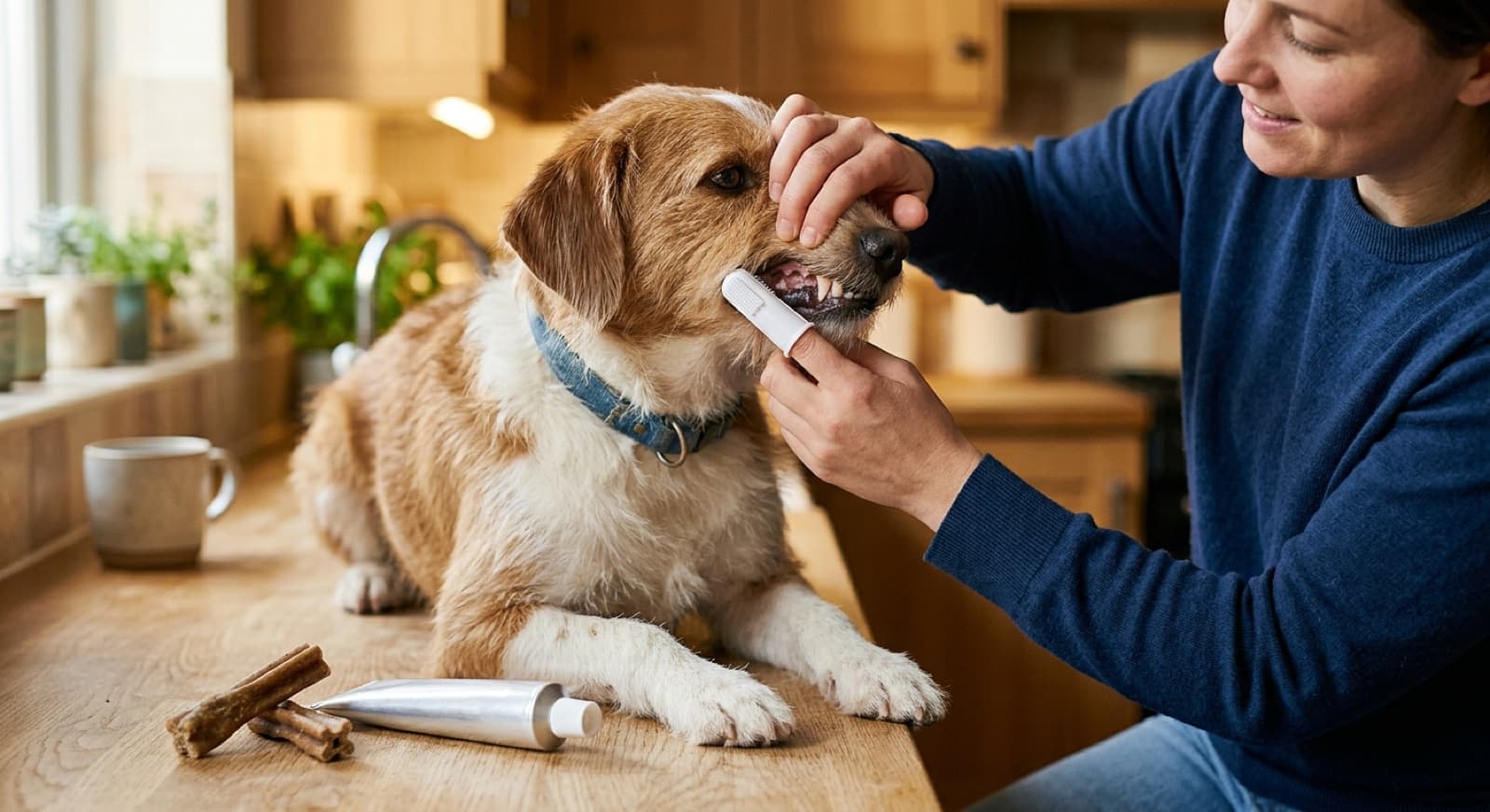
Dental disease is one of the most common health problems vets see, and one of the most under-treated, because the early stages are invisible and painless to the owner. The American Veterinary Medical Association notes that most dogs show some evidence of periodontal disease by age three, and that advanced disease can affect the kidneys, liver, and heart. The good news is that the home routine that prevents it is cheap and simple. The hard part is doing it consistently, and cutting through a wall of products that promise to do the work for you.
Why it matters: gingivitis is reversible, periodontitis is not
Plaque is a soft bacterial film that forms on teeth constantly. Within a couple of days it mineralises into hard tartar that brushing can no longer remove. Tartar at the gumline inflames the gums (gingivitis), and at this stage the damage is still reversible with cleaning and good home care. Left alone, it progresses to periodontitis, where the bacteria destroy the bone and tissue anchoring the tooth. Per the Merck Veterinary Manual, that bone loss does not grow back. The entire goal of home care is to keep the mouth in the reversible stage.
This is also why “his breath smells fine and he is still eating” is not reassurance. Dogs hide oral pain well and keep eating through significant disease, and a large share of it sits below the gumline where you cannot see it. Bad breath is usually the first thing an owner notices, and it is a signal to act, not a cosmetic nuisance to spray away.
The home-care hierarchy
Owners ask which product is best. The more useful question is what order to spend effort in. From most to least effective:
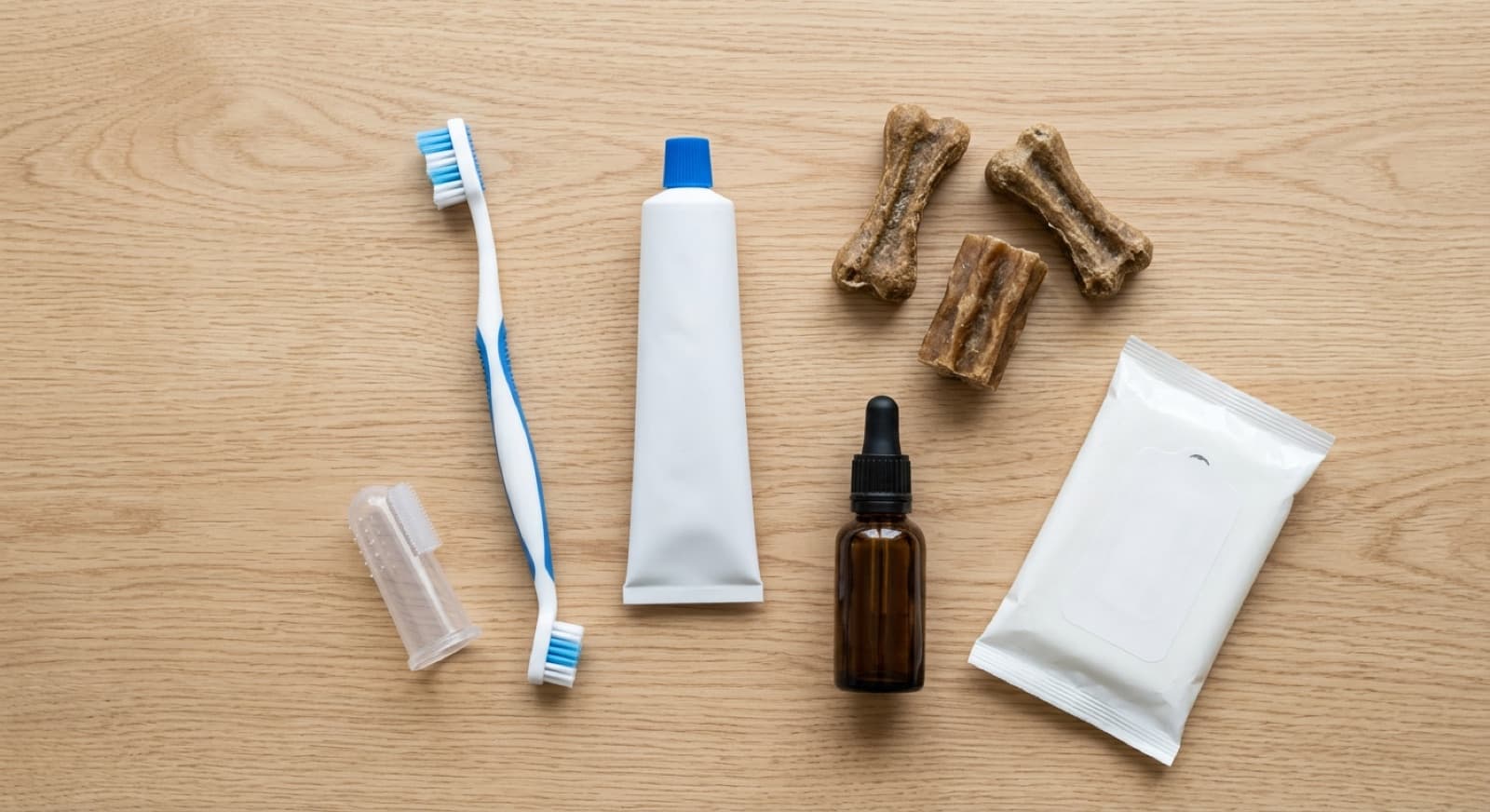
1. Brushing (the one that actually works)
Brushing is the gold standard because it physically disrupts plaque before it hardens. The catch, and the number-one complaint from owners, is a dog that fights it. The fix is to build the habit slowly over weeks rather than forcing it. Let the dog lick a poultry-flavoured enzymatic toothpaste off your finger first, so the taste becomes a treat. Then introduce a finger brush or soft dog toothbrush on a few teeth at a time, rewarding after each short session.
- You only need the outer (cheek-side) surfaces. That is where most tartar forms, and the tongue keeps the inner surfaces cleaner.
- The upper back molars are the highest-priority teeth and the easiest to skip. Prioritise them.
- Aim for daily; three to five times a week still helps a lot. Once a week alone is not enough to stay ahead of plaque.
- Never use human toothpaste. The foaming agents upset a dog’s stomach, and many contain xylitol (see the warning below).
2. VOHC-accepted dental chews and diets
This is the most argued-about category, so use one filter to cut through it: the VOHC Seal of Acceptance. The Veterinary Oral Health Council reviews submitted clinical data and awards its seal only to products shown to reduce plaque or tartar, which is the closest thing to an evidence filter a shopper has. A VOHC-accepted dental chew given daily is a legitimate add-on to brushing. Just remember what a chew cannot do: it will not remove hardened tartar, and it does nothing below the gumline.
On the popular brands owners debate: the big-name chews that carry the VOHC seal have real data behind them; the budget “dental sticks” that do not carry it are mostly breath-fresheners. Whatever you choose, the two rules that prevent the genuine risks are: size the chew to your dog’s weight, and supervise. A dog that gulps a chew whole gets no dental benefit and a real choking and obstruction risk, so for fast eaters, lean on brushing instead. A true veterinary dental diet with a VOHC seal is the one type of food engineered to wipe the tooth as the dog bites; ordinary kibble is not.
3. Water additives, wipes, and gels
Dental water additives are the lowest-effort option, and the evidence matches that: they reduce the build-up of new plaque and tartar, mainly after a cleaning, but they do not remove what is already there. As a maintenance extra alongside brushing, fine; as a standalone program, not enough. Read the label and reject any additive containing xylitol. For dogs that refuse a brush entirely, dental wipes or gauze rubbed over the teeth every couple of days are a lower-effort, lower-effectiveness fallback that still beats doing nothing.
What does not work (the myths)
- Dry kibble does not clean teeth. It shatters and is too brittle to scrape plaque, and dogs barely chew it. Only an engineered dental diet does this.
- Dental chews do not replace brushing. They are an adjunct. A nightly chew on its own is not a dental program.
- Fresh-smelling breath is not an all-clear. Disease advances below the gumline where you cannot smell or see it.
- Breath sprays and mints mask odour, they do not treat plaque.
- Natural does not mean tooth-safe. Antlers and bones are natural and still crack teeth (see the next section).
A warning on antlers, bones, and very hard chews
One of the most common ways a dog ends up needing an expensive extraction is a fractured tooth from a chew that is too hard. Veterinary dentists at institutions like the Cornell Riney Canine Health Center warn that hard chews are a leading cause of broken teeth and painful mouth injuries. Two quick tests from board-certified veterinary dentists: if you cannot dent it with your fingernail, or you would not want it whacked against your kneecap, it is too hard for your dog’s teeth. Antlers, hooves, hard nylon bones, and real bones generally fail both. Choose softer rubber chews and VOHC-accepted dental chews instead.
Start the habit on day one
A newly-adopted dog is the easiest time to build a tooth-brushing routine. Browse adoptable rescue dogs across Canada and start fresh.
Browse Adoptable Dogs →Professional cleanings: cost, anesthesia, and what is included
Home care slows disease; it cannot reverse tartar that has already built up or treat disease below the gumline. For that you need a professional cleaning, and a proper one requires general anesthesia. That is not an upsell. Anesthesia is what lets the vet clean beneath the gumline, take dental X-rays to see the roots and bone, probe each tooth for pockets, and do it all without a frightened dog moving onto sharp instruments.
Cost is where the sticker shock lands. Canadian owners commonly report somewhere around 500 to 1,100 dollars for a cleaning under anesthesia with no extractions, with the bill rising sharply when teeth must be pulled, often charged per tooth. Those are owner-reported figures, not a fixed price, and they swing widely by region, clinic, and how much work the mouth needs. Two pieces of advice come up in nearly every owner discussion: ask for an itemised estimate so you can compare clinics on the same terms, and get a second opinion before agreeing to a large extraction bill. Pre-anesthetic bloodwork to check organ function is standard screening, especially for older dogs, and worth saying yes to.
The anesthesia-free cleaning debate
This is the question that drives the most worry, usually from a good place: fear of anesthesia, especially for a small or senior dog, often after a previous loss, plus the appeal of an 85-dollar groomer scrape over a four-figure vet bill. The fear deserves empathy. The answer, unfortunately, is clear.
Every major veterinary dental authority advises against anesthesia-free (“awake”) scaling as a substitute for a real cleaning. The American Veterinary Dental College, the American Animal Hospital Association, and the American Veterinary Medical Association all take the same position. The reasons are consistent:
- It only scrapes the visible crown above the gumline. The disease that matters lives below the gumline, which an awake procedure cannot reach.
- It allows no real diagnosis. No X-rays, no probing, so abscesses, bone loss, and broken teeth are missed.
- It restrains an awake dog near sharp instruments for a long time, which carries its own stress and injury risk.
- Worst of all, it creates a false sense of security. The teeth look white, the owner relaxes, and periodontal disease keeps advancing out of sight.
The reframe vets push is the one worth holding onto: in capable hands with proper screening, the risk of modern anesthesia is lower than the risk of leaving periodontal disease untreated. And on senior dogs specifically, the veterinary refrain is that old age is not a disease. Vets manage the added risk with bloodwork, IV fluids, careful drug choices, and monitoring. If you are anxious, that is a conversation to have with your vet, or a board-certified veterinary dentist, not a reason to settle for a cosmetic scrape. This is general information and not a substitute for your veterinarian’s advice about your individual dog.
Xylitol warning: never use human toothpaste
Human toothpaste, and some dog water additives, sugar-free peanut butters, and gums, can contain xylitol, which is highly toxic to dogs. Even small amounts can cause a rapid, dangerous drop in blood sugar and liver damage. Always use a toothpaste made for dogs, and read the label on any additive. If you suspect your dog ate something with xylitol, call your vet or a pet poison line immediately. See the VCA guide to xylitol toxicity for the full picture.
Frequently asked questions
Do dental chews actually work, or are they a waste of money?
They help, but only as a supplement to brushing, not a replacement. A chew that carries the VOHC (Veterinary Oral Health Council) Seal of Acceptance has clinical data showing it reduces plaque or tartar. A chew cannot remove tartar that has already hardened onto the tooth, and it does nothing below the gumline, where the disease that matters actually lives. Treat chews as a useful daily habit on top of brushing, size them correctly for your dog, and always supervise, because a gulped chew gives zero dental benefit and a real choking risk.
My dog will not let me brush his teeth. How do I actually do it?
Go slow and build it over weeks, not days. Start by letting the dog lick a dog toothpaste off your finger so the taste becomes a reward (poultry-flavoured enzymatic pastes work because dogs like them). Next, rub a finger or a finger-brush along the outer surface of a few teeth, then stop and reward. Add a couple of teeth each session. You only need the outer surfaces, where most tartar forms, and the back upper molars matter most. If the dog truly will not tolerate a brush, a dental wipe or gauze over your finger every couple of days is a lower-effort fallback. Never wrestle or force it, because a bad experience sets you back.
How often do I really need to brush my dog’s teeth?
Daily is the gold standard, because plaque starts hardening into tartar within about 24 to 72 hours. Realistically, most owners manage three to five times a week, and that still makes a real difference. Once a week is better than nothing but not enough to keep ahead of plaque on its own. Pick a consistent time, like before a nightly walk or after dinner, so it becomes a routine you actually keep.
Are Greenies safe? Can they cause choking or a blockage?
Greenies were reformulated years ago to be more digestible, and they carry the VOHC seal, but the choking and obstruction concern is real for any chew if it is the wrong size or your dog gulps. The safe approach is the same for every dental chew: buy the size made for your dog’s weight, give it sparingly rather than constantly, take it away when it gets small enough to swallow whole, and never leave a gulper alone with one. Dogs that bolt chews instead of chewing them get no dental benefit and carry the highest risk, so for those dogs, brushing is the better tool.
Do water additives like TropiClean actually work?
They can modestly help, with an important limit. The evidence is that dental water additives reduce the build-up of new plaque and tartar, mainly after the teeth have already been cleaned. They do not remove deposits that are already on the teeth, so an additive is a maintenance tool, not a fix. Check the label for xylitol and avoid any product that contains it, because xylitol is toxic to dogs. Used alongside brushing, an additive is a reasonable low-effort extra; used alone, it will not keep a mouth healthy.
Does dry kibble clean my dog’s teeth?
Mostly no, and this is the single most common dental myth. Standard dry kibble shatters when bitten and is too brittle to scrape plaque off the tooth surface, and most dogs swallow it with little chewing anyway. The exception is a true veterinary dental diet (such as Hill’s t/d) with a special kibble structure and a VOHC seal, which is engineered to wipe the tooth as the dog bites. Ordinary kibble, grain-free or not, is not a dental program.
My dog’s breath is awful. What does that mean?
Persistent bad breath is the most common early sign of dental disease, usually plaque, tartar, and gum inflammation releasing odour-causing bacteria. Start a real home-care routine, but if the breath does not improve within a week or two of consistent care, see your vet. Bad breath that will not budge can also point to problems beyond the mouth, including kidney, liver, or gastrointestinal issues, so it is worth a professional look rather than just masking it with a breath spray.
Are antlers, bones, and hard chews safe for teeth?
They are a leading cause of fractured teeth, which is why many veterinary dentists advise against them. The U.S. Food and Drug Administration has warned about bones causing broken teeth, mouth injuries, and blockages. Two field tests from veterinary dentists help: if you cannot make a dent in the chew with your fingernail, or it would hurt to be hit on the knee with it, it is too hard and can crack a tooth. Antlers, hooves, hard nylon bones, and real bones generally fail both tests. Softer rubber chews and VOHC-accepted dental chews are safer choices.
How much does a professional dog dental cleaning cost in Canada?
It varies widely by region, by your dog’s size, and above all by whether extractions are needed, so treat any single number with caution. Canadian owners commonly report roughly 500 to 1,100 dollars for a cleaning under anesthesia with no extractions, and the bill climbs substantially when teeth must be pulled, since extractions are often charged per tooth (owners have reported figures in the 25 to 85 dollar per tooth range, with full bills reaching a few thousand dollars for a mouth that needs major work). These are owner-reported ranges, not a fixed price. The practical advice that comes up again and again is to ask for an itemized estimate and to get a second opinion before a big extraction bill.
Is the anesthesia worth the risk just to clean teeth?
For a properly screened dog, the veterinary consensus is yes, because untreated periodontal disease is itself a real health risk. A proper cleaning requires anesthesia so the vet can clean below the gumline, take dental X-rays, and probe each tooth, none of which is possible on an awake dog. Modern veterinary anesthesia with pre-anesthetic bloodwork, an IV catheter, and monitoring is considered low risk in healthy patients. The fear is understandable, especially after a past loss, so talk through your specific dog’s health and the clinic’s monitoring protocol with your vet rather than avoiding the procedure outright.
My dog is a senior. Is anesthesia too dangerous?
Age alone is not a reason to refuse anesthesia. As veterinary teams put it, old age is not a disease. Vets manage the added risk in older dogs with pre-anesthetic bloodwork to check organ function, IV fluids and a catheter, careful drug selection, and continuous monitoring. A painful, infected mouth is hard on a senior dog too. The right move is a frank conversation with your vet about your dog’s bloodwork and heart and organ health, and if you are uneasy, a referral to a board-certified veterinary dentist who handles higher-risk patients.
Is anesthesia-free or “awake” teeth cleaning a real alternative?
No major veterinary dental authority supports it as a substitute for a real cleaning. Anesthesia-free scaling only polishes the visible part of the tooth above the gumline, where disease is not the main problem, and it cannot clean below the gumline, take X-rays, or diagnose anything. The American Veterinary Dental College, the American Animal Hospital Association, and the American Veterinary Medical Association all advise against it. The biggest danger is a false sense of security: the teeth look white, so the owner assumes the mouth is healthy while periodontal disease quietly advances underneath. If cost or anesthesia fear is the driver, talk to your vet rather than choosing a cosmetic scrape.