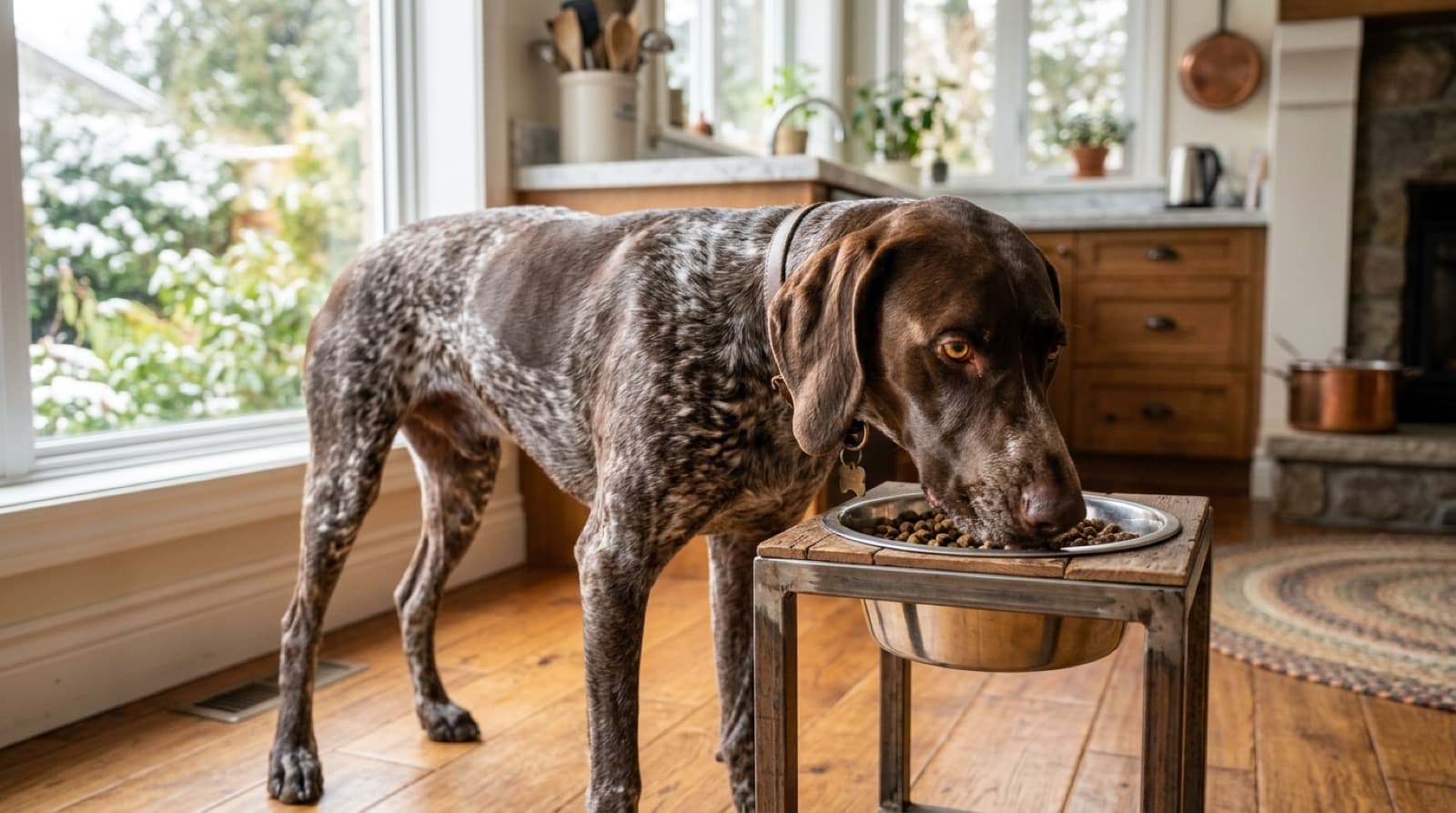
The short answer
Feed a GSP a complete diet matched to its workload, and keep it lean. This is a high-drive athlete: a working or sport dog does well on a higher-fat performance formula, while a pet GSP is fine on a standard adult food. The two things most owners get wrong are believing a lean, ribby dog is too skinny (it is not, that build is healthy) and underrating bloat risk (the deep chest makes it real, so feed smaller meals from a floor-level slow feeder). Feed to body condition, scale calories to the season, and skip grain-free.
Fueling the canine athlete
The German Shorthaired Pointer is one of the hardest-driving sporting breeds there is, and feeding it well means thinking like you would for an athlete, not a pet.
Fat is the fuel. For sustained, aerobic work like a day in the field, a dog burns fat as its main energy source, which is why performance and sport formulas run higher in fat than standard maintenance foods. Cornell's Riney Canine Health Center covers performance-dog feeding, and the WSAVA nutrition guidelines cover how to pick the brand behind it.
Match the food to the workload, and the season. A GSP that hunts or trials needs more calories during the working season and fewer in the off-season, and many owners switch up to a higher-fat working food a few weeks before the season so the dog acclimates. A pet GSP that gets a good run and some training does not need a performance food at all. The mistake is feeding either dog as if it were the other.
A lean, ribby GSP is a healthy GSP
This is the panic that fills GSP forums: the dog looks skinny, the ribs show, and the owner starts piling on food. In almost every case, the dog was fine.
A fit German Shorthaired Pointer is built lean and athletic. A visible waist, a tucked-up belly, and faintly visible ribs are normal and healthy for the breed, the same way a marathon runner looks lean. Trying to fill the dog out turns a healthy athlete into an overweight one, which is harder on the joints and the heart. Judge by body condition, the standard body-condition approach the AKC describes: you want to feel the ribs easily under a thin layer, with a clear waist. A GSP with good energy and a glossy coat at that build does not need more food, no matter how lean it looks to a stranger.

Feeding to lower bloat risk
The GSP is deep-chested and at real risk of bloat (gastric dilatation-volvulus), a true emergency. A swollen belly, unproductive retching, or sudden distress means go to an emergency vet immediately.
For such an active breed, the meal-and-exercise timing matters more than usual. Feed two or more smaller meals a day instead of one big one, slow a fast eater with a slow-feeder bowl, and keep hard exercise away from meals by about an hour on each side, which is easy to forget with a dog this eager to run.
Skip raised bowls. They are linked to higher bloat risk in larger breeds, not lower, so feed from the floor. The AKC bloat overview is a good primer, and because many GSPs are already under anesthetic for a spay or neuter, that is a natural time to ask your vet about a preventive stomach-tacking surgery (gastropexy).
Puppies, grain-free, and foods to avoid
For a puppy, use a large-breed or all-life-stages puppy formula that controls calcium and calories for steady growth, keep the puppy lean, and never add a calcium supplement on top of a complete food. Confirm the timing of the switch to adult food with your vet.
Skip grain-free unless your vet diagnoses a grain allergy. There is no performance benefit, and the FDA grain-free investigation is a real concern for an athletic breed whose heart works hard.
Keep these away from a GSP completely: chocolate, grapes and raisins, xylitol, onions and garlic, macadamia nuts, alcohol, caffeine, and cooked bones. If your dog eats something toxic, call your vet or a pet poison helpline right away.
Looking to adopt a German Shorthaired Pointer?
Plan for a lot of exercise and a slow-feeder bowl before day one. Browse GSPs and pointer mixes available now from the rescues we track.
See Available GSPs →Where to buy GSP food
Every brand worth feeding a GSP is easy to find in store and online:
- Pet specialty chains (Pet Planet, Tail Blazers, Tisol, and similar). Carry Pro Plan including Sport, Royal Canin, and large-breed lines.
- Pet Valu and PetSmart. National chains that stock the major performance and adult formulas.
- Your vet clinic. The place for therapeutic diets and tailored advice for a working dog.
- Online. The same brands ship to your door, easy to set on a recurring delivery and to scale up before the season.
For a working GSP, a higher-fat performance food is the right tool. The major sport and performance formulas are all available online.
Frequently Asked Questions
What is the best food for a German Shorthaired Pointer?
A complete formula from a brand that employs a board-certified veterinary nutritionist and runs feeding trials, like Purina Pro Plan, Royal Canin, or Hill’s Science Diet. For an active or working GSP, a performance or sport formula with a higher fat content is a common and reasonable choice, because fat is the main fuel for endurance. For a pet GSP that gets normal exercise, a standard adult formula is fine. Match the food to what the dog actually does, transition over seven to ten days, and judge it by stool, energy, and a lean body.
My GSP looks too skinny and I can see ribs. Should I feed more?
Almost certainly not, and this is the single most common GSP feeding mistake. A fit German Shorthaired Pointer is built lean and athletic: a visible waist, a tucked-up belly, and faintly visible ribs are normal and healthy for the breed, not a sign of underfeeding. Owners often try to fill the dog out and end up creating an overweight athlete, which is worse for the joints and the heart. Judge by body condition: you want to feel the ribs easily with a thin cover and see a clear waist. If the dog has good energy and a shiny coat at that build, it does not need more food.
How much should I feed a GSP, and does it change with the season?
A typical adult GSP weighs roughly 45 to 70 pounds and eats somewhere around two to three and a half cups of quality food a day split into two meals, but a hard-working hunting or sport dog can need substantially more, and a couch GSP needs less. Yes, it changes with the season: a dog that hunts or trials heavily needs more calories during the working season and less in the off-season, and many owners step up to a higher-fat working food a few weeks before the season starts. Always feed to body condition rather than a fixed number.
Do German Shorthaired Pointers get bloat?
Yes, the GSP is a deep-chested breed and carries a real risk of bloat (gastric dilatation-volvulus), a life-threatening emergency. Feed two or more smaller meals a day instead of one big one, slow a fast eater with a slow-feeder bowl, and avoid hard exercise for about an hour before and after meals, which matters a lot for such an active breed. Skip raised bowls, since they are linked to higher bloat risk in larger breeds, not lower. A swollen belly, unproductive retching, or sudden distress means go to an emergency vet immediately, and ask whether a preventive stomach-tacking surgery is worth it.
Does my high-energy GSP need extra protein for more drive?
No. The energy that fuels a long day in the field comes mainly from fat, not from extra protein, so loading up on a very high-protein food does not give a GSP more drive. Protein matters for muscle repair and recovery, and a quality performance food already provides plenty. If you have a hard-working dog, the lever to pull is a complete sport or performance formula with adequate fat, not a protein pile-on. For a pet GSP, a standard complete adult food covers everything.
Should I feed my GSP grain-free?
Not unless your vet diagnoses a grain allergy, and there is no performance benefit to going grain-free. The FDA has been investigating a possible link between grain-free diets built on peas, lentils, and potatoes and a heart condition called dilated cardiomyopathy, which is a particular concern for an athletic breed whose heart works hard. A complete diet from a feeding-trial brand, in a sport formula if the dog works, is the safer and better-fueled choice.
GSP Exercise & Training
How much a high-drive GSP needs to burn, which drives how much it eats.
GSP Health Issues
Bloat, hip dysplasia, and the conditions to plan for in the breed.
Adopting a GSP
Rescue sources, real costs, and what to expect from the breed in Calgary.
GSPs for Adoption
Live listings of German Shorthaired Pointers and pointer mixes from the rescues we track.