The short answer
GSPs typically weigh 45 to 70 lbs and live 12 to 14 years with proactive care. The breed has several distinct elevated risks. From the top of the list: bloat / GDV is the medical emergency every GSP owner must recognise (deep chest, athletic build, high-drive eating). Hip and elbow dysplasia are documented orthopaedic conditions. Progressive retinal atrophy and the GSP-specific cone degeneration are DNA-testable eye conditions ethical breeders screen for. Von Willebrand disease is a DNA-testable bleeding disorder. Hypothyroidism turns up in middle age. GSPs are at elevated risk for haemangiosarcoma (spleen, heart) and mast-cell tumours, especially in seniors. Lupoid dermatosis is rare but breed-associated. The protective levers are early pet insurance, bloat-aware feeding and exercise patterns, prophylactic gastropexy for at-risk dogs, lean body condition, and a planned Calgary vet schedule.
This article is informational only and is not veterinary advice. Always consult your Calgary veterinarian for individualised health guidance for your specific dog.
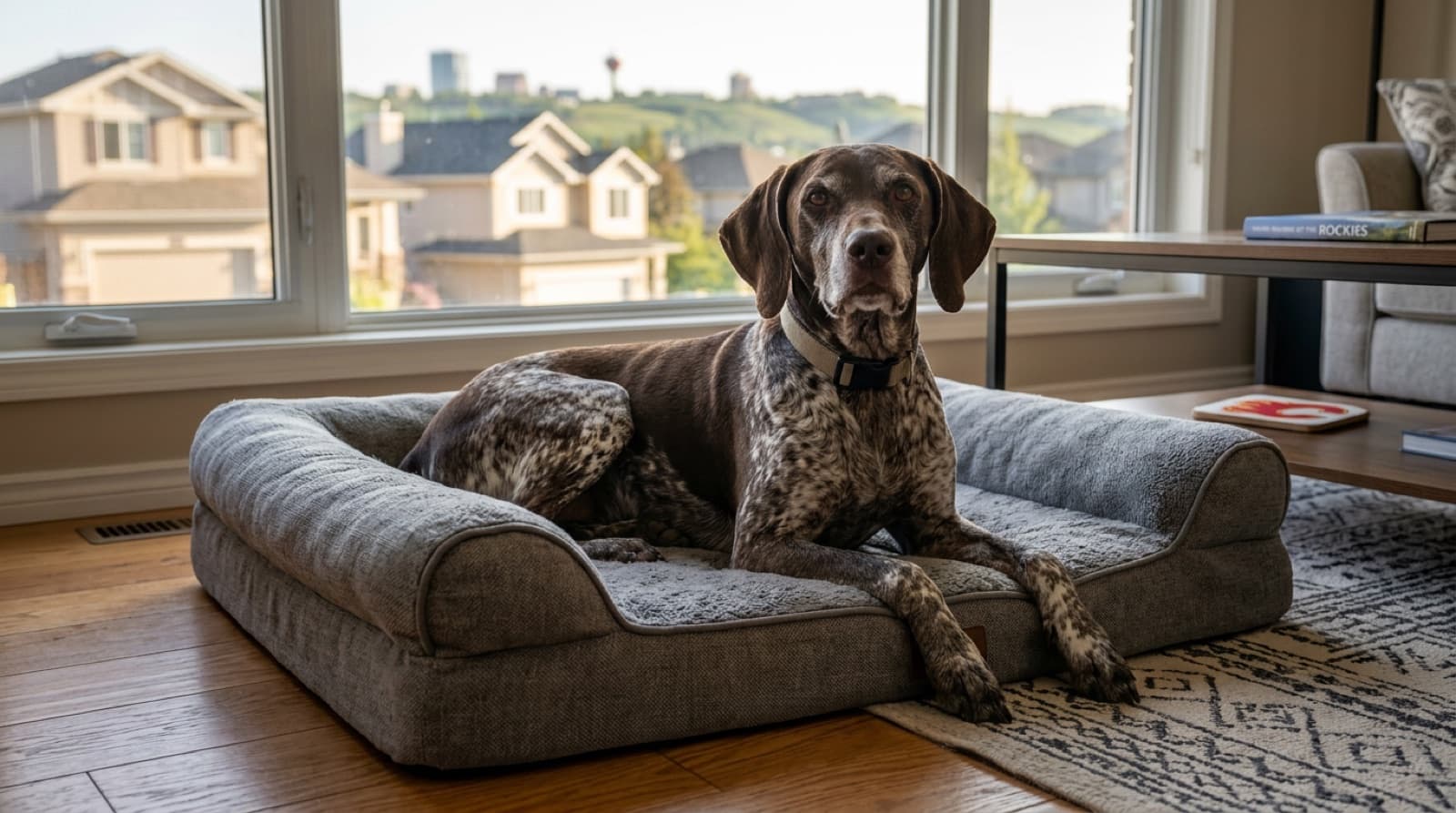
The German Shorthaired Pointer is a versatile hunting breed developed in 19th-century Germany to point, retrieve, and track on land and in water. The breed is athletic, lean, deep-chested, and built to run hard for hours. That body plan and that work ethic are part of why GSPs are wonderful dogs for active homes. They are also part of why several of the breed's health concerns matter more than they would in a couch-potato breed. This article walks Calgary owners through the conditions to discuss with your vet at adoption and at every annual exam after that, what to watch for at home, and what belongs in the hands of a veterinarian rather than the internet. Sources include the American Kennel Club, the Orthopedic Foundation for Animals (OFA), the AKC Canine Health Foundation, the Cornell University College of Veterinary Medicine, the American Animal Hospital Association, the Canadian Kennel Club, the German Shorthaired Pointer Club of America health pages, and NAVHDA.
Why GSPs have a distinct health profile
Two facts shape almost everything on this page. First, the GSP is a deep-chested athletic breed. The deep-chest body plan is the single biggest anatomical risk factor for bloat / GDV, the leading same-day medical emergency in the breed. Second, the GSP was bred to do a job for hours at a stretch, which means hunting-line breeders have historically tested for orthopaedic soundness, eye disease, and bleeding disorders because an unhealthy GSP cannot do the work. The breed's ethical breeders therefore have a well-developed screening culture; the breed's backyard breeders do not.
For a rescue GSP without breeder records (which is most rescue GSPs), the practical implication is simple: manage proactively. Build a Calgary vet schedule, plan a week-1 baseline workup, and learn the bloat red flags before you bring the dog home. The rest of this article walks through what to ask the vet about and when.
Bloat / GDV (the lead medical emergency)
Gastric dilatation-volvulus (GDV), commonly called bloat, is a life-threatening same-day emergency in which the stomach distends with gas and may twist. GSPs are a textbook deep-chested at-risk breed. Suspected bloat is an immediate Calgary 24-hour emergency vet trip. Do not wait, do not Google, do not ask a Facebook group. Drive and call ahead.
Bloat is one of the leading causes of death in deep-chested medium and large breeds. The condition can progress from initial signs to shock and death within hours. Speed of recognition and response is what saves the dog. The risk peaks around Calgary holiday meals, the Stampede period when households are louder and feeding routines slip, and any time a hungry GSP gulps a big meal followed by exercise.
Emergency signs that warrant an immediate 24-hour Calgary vet visit:
- A visibly distended or bloated abdomen, especially behind the ribs
- Unproductive retching: the dog tries to vomit but nothing comes up
- Restlessness, pacing, inability to settle, repeated lying down and getting up
- Excessive drooling
- Pale gums, weakness, or collapse
- Rapid shallow breathing
Prevention conversation with your Calgary vet: The evidence on individual risk-reduction strategies has shifted over the years, but several reasonable practices appear in current discussions and your vet's recommendation is what should drive your routine.
- Feed two or three smaller meals across the day rather than one large meal.
- Avoid vigorous exercise for at least one hour before and one hour after eating.
- Avoid elevated food bowls (older studies suggest they may increase risk; defer to your vet's current recommendation).
- Stay vigilant around Stampede, Thanksgiving, Christmas, and other Calgary household-disruption events when feeding routines slip.
- Consider prophylactic gastropexy at the time of spay or neuter. This surgical procedure tacks the stomach to the body wall, dramatically reducing the risk of the stomach twisting. For most adult GSPs, it is a worthwhile conversation with your vet.
Bloat surgery in Calgary commonly runs $4,000 to $8,000 depending on severity and after-care. Insurance enrolled before any symptoms is the lever that makes that bill survivable.
Hip and elbow dysplasia
Hip dysplasia is documented in GSPs, and is included in OFA hip dysplasia breed statistics. Ethical hunting-line breeders evaluate both parents with OFA or PennHIP scoring before breeding. Elbow dysplasia is a separate orthopaedic condition and warrants screening too.
Hip dysplasia is a developmental malformation of the hip joint where the ball and socket do not fit together correctly. Over time, the joint develops painful arthritis. The condition is influenced by genetics, growth rate, body weight, and exercise pattern during growth. Elbow dysplasia refers to a group of developmental abnormalities of the elbow joint that lead to forelimb lameness.
Symptoms to discuss with your Calgary vet:
- Bunny-hopping gait when running, where both rear legs push off together rather than alternating
- Reluctance to climb stairs, jump into the car, or get up onto the couch
- Hindlimb stiffness after rest that improves with movement
- Forelimb lameness, especially after exercise (elbow dysplasia)
- Visible muscle wasting in the hindquarters
- A drop in willingness to run hard on Calgary off-leash trails such as Nose Hill Park, Fish Creek Provincial Park, or Bowmont Park
Diagnosis is by X-ray imaging scored against OFA or PennHIP standards, read by your Calgary vet or a referral radiologist. Management ranges from conservative care (weight control, joint support recommended by your vet, physiotherapy, and pain control your vet selects) through to surgical options for severe cases. Surgical decisions and rehabilitation plans belong with a Calgary specialty centre.
Body weight is the most important owner-controllable factor. An overweight GSP puts more load through hips and elbows than a lean one of the same height. Body condition scoring on the 1 to 9 scale at every Calgary vet visit is more useful than the bathroom scale alone. Lean GSPs do better on every orthopaedic measure across their lifespan, and the breed is built to be lean by design.
Progressive Retinal Atrophy (PRA, DNA testable)
PRA is an inherited retinal disease that causes gradual vision loss and eventual blindness. DNA testing is available through commercial veterinary genetics labs. Ethical breeders screen both parents. For a rescue GSP, your Calgary vet can order the test if there is any clinical suspicion.
PRA in GSPs is autosomal recessive (two affected copies needed for clinical disease). Affected dogs typically show first signs in middle age, starting with reduced night vision and gradually progressing to complete blindness over months to years.
Early signs to discuss with your Calgary vet:
- Reluctance to navigate in dim light, especially evening walks during Calgary winter darkness
- Hesitation on stairs or curbs
- Bumping into furniture in familiar rooms
- A change in the appearance of the eye (sometimes the tapetum reflects light more strongly as the retina thins)
Diagnosis is by veterinary ophthalmology examination and DNA testing through commercial labs. There is no cure for PRA, but GSPs adapt well to gradual vision loss in familiar home environments. Furniture stays put, routines stay consistent, and verbal cues replace visual ones.
Cone degeneration (CD, GSP-specific, DNA testable)
Cone degeneration is a GSP-specific inherited eye condition affecting the cone photoreceptors in the retina, which are responsible for colour vision and bright-light vision. Affected GSPs develop day blindness while typically retaining night vision. The condition is autosomal recessive and is DNA testable. Ethical breeders screen both parents.
Signs to discuss with your Calgary vet:
- Reluctance to move in bright sunlight while moving normally in dim light
- Squinting or avoidance in brightly lit Calgary summer conditions
- Bumping into objects on sunny walks but navigating normally indoors
- Onset typically in young dogs (often under 12 months)
Diagnosis is by veterinary ophthalmology examination and DNA testing. There is no cure, but affected dogs typically have stable vision after the initial onset and adapt well. Specific testing and management belong with your vet team.
Von Willebrand disease (vWD, DNA testable)
Von Willebrand disease (vWD) is an inherited bleeding disorder caused by a deficiency in von Willebrand factor, a protein involved in blood clotting. GSPs are among the breeds for which the vWD mutation has been documented and is DNA testable through commercial labs. Ethical breeders screen both parents.
vWD is typically silent until the dog has surgery, a significant injury, or another event that requires normal clotting. Affected GSPs may experience prolonged bleeding from minor wounds, excessive bleeding after surgery, nosebleeds, or bloody urine or stool. Diagnosis is by DNA testing combined with additional clotting tests ordered by your vet.
The practical implication for Calgary GSP owners is that vWD screening should be discussed with your vet before any planned surgery, especially spay or neuter or a planned gastropexy. For a GSP from a breeder, the vWD test result for both parents should be in writing.
Hypothyroidism (common in middle age)
Hypothyroidism is a common endocrine condition in middle-aged GSPs (typically 4 to 10 years old) in which the thyroid gland produces inadequate thyroid hormone. The condition is well-recognised in the breed and is straightforward to manage once diagnosed.
Symptoms to discuss with your Calgary vet:
- Unexplained weight gain despite consistent feeding and exercise
- Lethargy and reduced exercise tolerance
- Dull, thinning, or coarse coat
- Recurrent skin or ear infections
- Cold intolerance (more noticeable through a Calgary winter)
- Slow heart rate on physical examination
Diagnosis is by bloodwork ordered and interpreted by your vet, often a thyroid panel that includes total T4, free T4, and TSH. Borderline results sometimes warrant additional testing. Management is daily lifelong thyroid supplementation chosen and dosed by your vet, with periodic bloodwork rechecks to confirm the dog is on the right level. Specific medication and dosing belong entirely with your vet team.
Lupoid dermatosis (rare GSP-specific skin disease)
Hereditary lupoid dermatosis is a rare GSP-specific autoimmune skin condition. It is uncommon overall but is well-documented in the breed and unusual outside it. The condition typically appears in young GSPs (often under 12 months).
Signs to discuss with your Calgary vet:
- Excessive scaling and crusting, particularly on the head, ears, and back
- Hair loss in patches
- Visible skin lesions and inflammation
- Secondary bacterial infections
- Onset in a young GSP
Diagnosis is by skin biopsy at your Calgary vet, typically with referral to a veterinary dermatologist for evaluation. Management is lifelong and individualized; treatment selection belongs entirely with the dermatology team. Over-the-counter human products and home remedies are not a substitute.
Cancers (haemangiosarcoma and mast-cell tumours)
GSPs are at elevated risk for several cancers as seniors, particularly haemangiosarcoma (spleen, heart) and mast-cell tumours. Annual senior wellness exams from age 7 onward matter. Sudden collapse in a senior GSP is a same-day Calgary emergency.
Haemangiosarcoma is an aggressive cancer of the blood-vessel lining. The two most common GSP presentations are splenic haemangiosarcoma (a tumour on the spleen that can rupture and bleed into the abdomen) and cardiac haemangiosarcoma (a tumour on the heart). Both present as sudden collapse in an apparently healthy senior dog. Early warning signs are often subtle: episodic weakness, pale gums, distended abdomen, exercise intolerance over a short window. Any sudden collapse is a same-day Calgary 24-hour emergency vet event. Diagnosis is by physical exam, bloodwork, abdominal ultrasound, and echocardiography ordered by your vet. Treatment is surgical (splenectomy) and often chemotherapy; specific options and prognosis belong with a Calgary specialty oncology team.
Mast-cell tumours are skin and subcutaneous tumours that can range from low-grade and curable to aggressive and metastatic. The breed sits in an elevated-risk group. Practical home practice: document every new lump on a senior GSP, including approximate size and location, and bring the documentation to every Calgary vet visit. Any new lump in a senior dog warrants a vet conversation; a fine-needle aspirate is a quick diagnostic that your vet can do in clinic. Treatment is typically surgical excision with margins, sometimes with adjuvant chemotherapy for higher-grade tumours; the plan belongs entirely with your veterinary team.
Annual senior wellness exams from age 7 onward, including abdominal palpation and full bloodwork, are the single biggest lever for early cancer detection in GSPs. Cancer treatment in Calgary commonly runs $5,000 to $15,000 or more depending on the diagnosis and treatment plan, which is the reason early pet insurance matters so much for this breed.
Cherry eye and entropion (less common)
A subset of GSPs from certain lines develop additional eye conditions. Cherry eye is a prolapse of the third eyelid gland that appears as a red lump in the corner of the eye. Entropion is an inward rolling of the eyelid that causes the lashes to rub the cornea. Both are surgically correctable, and decisions belong with your Calgary vet or a referral ophthalmology team. Any new visible eye change is a vet visit, not a wait-and-see.
Calgary GSP health checklist by life stage
The breed-specific conditions above each have a typical onset window, which gives a reasonable framework for what to ask your Calgary vet about and when. The specific tests, the timing, and any modifications based on your individual dog's history are decisions for your veterinarian.
Puppy (under 12 months):
- Standard vaccination series, parasite prevention, spay or neuter conversation
- Prophylactic gastropexy conversation at the time of spay or neuter
- Confirm PRA, cone degeneration, and vWD DNA status from breeder paperwork (or testing through your vet)
- Cardiac auscultation at every visit
- Body condition scoring established as a baseline; food intake planning
- Early bloat-aware feeding habits (small frequent meals, no exercise around mealtimes)
Young adult (1 to 4 years):
- Annual wellness exam with full physical and dental check
- Annual cardiac auscultation
- Baseline bloodwork
- Annual eye exam, OFA Eye Certification where available
- Hip radiograph conversation if any gait irregularity appears
- Continued bloat-awareness routine
Middle-aged (5 to 7 years):
- Annual wellness exam, escalating toward twice-yearly
- Annual full bloodwork including thyroid panel
- Annual eye exam (PRA often becomes apparent in this window)
- Cardiac auscultation; further imaging if any new murmur is detected
- Lump and bump documentation begins
Senior (8+ years):
- Twice-yearly wellness exams
- Full senior bloodwork twice yearly
- Abdominal palpation for splenic masses at every visit
- Annual eye exam
- Cancer screening conversations; new lumps or sudden weakness warrant prompt vet visits
- Joint support and mobility aids: orthopaedic bed, traction rugs on hardwood, ramps for stairs and the car
- Body condition scoring at every visit (lean is gentler on hips, elbows, and the heart)
- Quality-of-life conversations started long before they feel needed
Calgary veterinary access for a GSP
The single most useful thing a new GSP owner can do in the first week is build a Calgary veterinary plan before the dog has a problem. That means a regular vet you trust, a 24-hour emergency clinic identified and saved in your phone, and a short list of specialty referral options for the breed-specific conditions that may come up.
Calgary planning checklist:
- Regular vet: Choose a Calgary clinic with experience in deep-chested athletic breeds. Ask whether the practice has worked with GSPs and is familiar with breed-predisposed conditions, particularly bloat awareness and prophylactic gastropexy. Use the Canadian Veterinary Medical Association directory if you need a starting point.
- 24-hour emergency clinic: Calgary has several distributed across NW, NE, SW, and SE. Identify the closest one to your home, save the address in your phone, and drive the route once in daylight so the path is in your head. Speed matters for bloat.
- Specialty referral options: Western Veterinary Specialist Centre and VCA Canada West Veterinary Specialists handle internal medicine, cardiology, ophthalmology, dermatology, neurology, oncology, and orthopaedic surgery. Your regular vet refers when needed.
- Low-cost spay and neuter access: Calgary Pet Wellness and Spay/Neuter Clinic offers lower-cost spay and neuter; gastropexy can sometimes be added as a same-anaesthesia procedure depending on the clinic. Confirm with the clinic and your regular vet.
- Pet insurance: Enrol while the GSP is young and symptom-free. Compare Canadian providers on deductible, reimbursement, per-condition limits, and whether hereditary and bilateral conditions are covered.
- Microchip and licence: Calgary requires dog licensing under the Responsible Pet Ownership Bylaw, and microchipping is a standard recommendation.
- Calgary-specific seasonal preparation: Winter paw protection for ice melt, lean body condition through winter slippage on hardwood floors, and a warmup-cooldown habit before hard runs in cold weather.
Pet insurance ROI for a GSP
Pet insurance is generally a strong consideration for GSPs because the conditions on this page have meaningful lifetime cost potential. Bloat surgery in Calgary commonly runs $4,000 to $8,000. Cancer treatment for a senior GSP (staging, surgery, and oncology care) commonly runs $5,000 to $15,000 or more depending on the diagnosis and treatment plan. Bilateral hip surgery can run into five figures. Lifelong hypothyroidism management is modest but steady. Any single one of these can change the household budget calculation.
The lever that matters most is enrolling early. Every Canadian provider excludes pre-existing conditions. A GSP enrolled at 8 weeks old with no symptoms qualifies for the broadest coverage; one enrolled at age 5 after a diagnosis of hypothyroidism will have hypothyroidism excluded from coverage indefinitely. Calgary premiums vary by provider, age, and breed, so request real quotes from several Canadian insurers and compare deductible, reimbursement (typically 70 to 90 percent), and per-condition versus annual limits side by side.
Questions to ask any insurer before enrolling a GSP:
- Are hereditary and congenital conditions covered, or excluded?
- Are bilateral conditions (both eyes for cataracts, both hips for dysplasia) treated as one claim or two?
- Is there a per-condition lifetime cap or only an annual cap?
- How are pre-existing conditions defined, and what counts as evidence of pre-existence?
- Are diagnostics (bloodwork, urinalysis, imaging, echocardiography, DNA testing) covered, or only treatments?
- Is prophylactic gastropexy covered?
- Is cancer treatment (surgery, chemotherapy, radiation) covered without sub-limit caps?
Considering a GSP in Calgary?
Health-aware adoption is the single biggest thing you can do for a GSP. Bloat awareness, an early Calgary vet plan, and pet insurance enrolled before any symptoms turn a 12 to 14 year active companion into the dog the breed is supposed to be. Browse adoptable GSPs in Calgary and read the matching breed-fit guides before you bring the dog home.
See Calgary GSPs available now →Adopting a rescue GSP with unknown history
Most rescue GSPs in Calgary come with limited paperwork. That is normal. The practical implication is that the week-1 vet visit is more important than it would be for a dog with breeder documentation, and the questions you ask the rescue before adopting matter.
What to ask the rescue:
- What is the dog's known history? Any prior owners, any returns, any reason for surrender?
- Any prior bloat or near-bloat events, even if the dog was treated and recovered?
- Any episodes of weakness, exercise intolerance, or collapse?
- Any seizures?
- Any limping, stiffness, or reluctance to exercise?
- Any prior vet records, transferred X-rays, or eye exam results?
- Has the dog been spayed or neutered? If so, was gastropexy discussed or performed at the same time?
- Any known bleeding events (prolonged bleeding from a wound, excessive bleeding after surgery)?
- Any known lumps, current or historical?
- What food has the dog been eating, and at what schedule?
Plan a week-1 Calgary vet workup that covers:
- Thorough physical exam including cardiac auscultation and abdominal palpation
- Baseline bloodwork: complete blood count, chemistry panel, electrolytes, and a thyroid panel
- Conversation about hip and eye screening at the appropriate age
- Conversation about prophylactic gastropexy if the dog has not been spayed or neutered
- Lump and bump baseline documentation
- Pet insurance enrolment before any new diagnoses appear in the chart
Budget framing. Plan for a week-1 vet workup of several hundred dollars. Plan to enrol pet insurance immediately, before any new diagnosis. Plan to set aside funds for prophylactic gastropexy if it is the right call. The conditions that matter most in a GSP's lifespan are largely manageable when caught early; the budget for catching them early is the actual lever.
Senior GSP care (8 years and up)
GSPs are an athletic working breed, and seniors do best when their owners adjust the routine rather than dropping it. The dog who ran hard at age 4 still wants to move at age 11; the question is how to keep that going safely.
Mobility and orthopaedics:
- Orthopaedic bed with good support; rotate position to avoid pressure sores in dogs with reduced mobility
- Traction rugs on hardwood and tile to prevent slipping
- Ramps for getting into the car and up onto the couch
- Body condition scoring at every visit; lean is gentler on every joint
- Daily moderate exercise rather than weekend-warrior intensity
- Pain management decisions belong with your vet
Cancer monitoring:
- Twice-yearly wellness exams with abdominal palpation
- Full senior bloodwork twice yearly
- Document every new lump (size, location, date noted)
- Sudden collapse, pale gums, or visible weakness is a same-day Calgary 24-hour emergency event
Dental and oral health:
- Annual or semi-annual dental check; professional cleaning when your vet recommends
- Oral masses are a common finding in seniors; any new growth in the mouth is a vet visit
Dietary refinement and cognitive support:
- Senior diet conversation with your vet; caloric needs typically drop in seniors
- Cognitive dysfunction signs (disorientation, altered sleep, house-soiling, reduced engagement) are vet conversations, not assume-it-is-just-age conversations
End-of-life framing:
Quality-of-life conversations should start years before they feel needed. Your Calgary vet team has the experience to help you read the trajectory and to discuss palliative options, in-home euthanasia, and aftercare when the time comes. Planning ahead is a kindness to the dog and to yourself; it is not a betrayal of an animal you love.
Anaesthesia considerations
GSPs generally tolerate standard anaesthesia protocols well, but the breed's health profile means a few specific pre-operative conversations are worth having with your Calgary veterinary team.
- Bleeding screen. Given the documented vWD risk in the breed, vWD DNA testing or clotting screen before any planned surgery is worth a conversation, especially for a rescue GSP without breeder paperwork.
- Deep-chest positioning. The deep-chest body plan that contributes to bloat risk also affects intraoperative positioning, ventilation, and chest-cavity dynamics during surgery. Your veterinary team handles this routinely; the message for owners is that GSP-experienced clinics are valuable.
- Cardiac auscultation at the pre-operative exam is standard and especially worthwhile in seniors.
- Gastropexy at the same anaesthesia event. For a GSP being spayed or neutered, a prophylactic gastropexy conversation is worth raising. Doing it at the same time limits the added cost and recovery.
- Analgesia for orthopaedic procedures. Pain control planning around hip or elbow surgery in seniors is a specialty conversation; orthopaedic surgical centres in Calgary handle this routinely.
Anaesthesia planning, drug selection, monitoring intensity, and any modifications to standard protocols belong entirely with your Calgary veterinary team and any specialty cardiology, internal medicine, or orthopaedic consultants they involve.
The ethical GSP breeder screening checklist
If you are considering a GSP from a breeder, the documentation below should be available in writing for both parents. The German Shorthaired Pointer Club of America and NAVHDA publish parent-club versions of this guidance. Without these documents, walk away.
Required documentation for both parents:
- OFA or PennHIP hip evaluation. OFA scores of Fair, Good, or Excellent are acceptable starting points.
- OFA elbow evaluation. Normal is the target.
- PRA DNA test result. Clear, Carrier, or Affected. Pair Clear-to-Clear or Clear-to-Carrier.
- Cone degeneration (CD) DNA test result. Clear, Carrier, or Affected.
- von Willebrand disease (vWD) DNA test result. Clear, Carrier, or Affected.
- CERF or OFA annual eye certification.
- Cardiac evaluation. Auscultation at minimum, echocardiogram for older breeding dogs.
- Discussion of thyroid disease, lupoid dermatosis, and cancer history in the breeding lines.
Beyond paperwork. An ethical GSP breeder will want to meet you, ask about your home, ask about your previous dogs and your hunting or sport plans, and answer your questions in detail. They will offer a written contract that requires the dog to come back to them if it ever cannot stay with you. They will offer ongoing support. Puppies will have been socialised to many sights, sounds, surfaces, and handling experiences before they leave.
The walk-away test. If a GSP breeder cannot or will not produce written OFA hip evaluations and PRA, CD, and vWD DNA results for both parents, walk away. These are the bare minimum. A GSP from a backyard breeder with untested parents carries the full untested breed-risk profile.
Emergency signs that warrant immediate vet attention
These signs are same-day Calgary emergency vet visits. Do not wait, do not Google, do not ask a Facebook group. Drive to your nearest 24-hour clinic and call ahead so they are ready.
Suspected bloat / GDV:
- A visibly distended or bloated abdomen
- Unproductive retching (trying to vomit but nothing comes up)
- Restlessness, pacing, inability to settle
- Excessive drooling, pale gums, weakness, or collapse
- This is an immediate drive-to-the-emergency-vet event; speed matters more than anything else
Sudden collapse in a senior GSP (suspect haemangiosarcoma):
- Apparent fainting or collapse with rapid recovery, especially in a senior GSP
- Pale gums
- Distended abdomen
- Profound weakness
Excessive bleeding (suspect vWD):
- Prolonged bleeding from a minor wound
- Persistent nosebleed
- Bloody urine or stool
- Excessive bruising
- Any unexpected bleeding after a planned procedure
Eye emergencies:
- Sudden cloudiness, blue-grey corneal change, or a film over the eye
- Persistent squinting, especially with redness or swelling
- A visibly enlarged or painful eye
- Sudden vision loss in an apparently healthy dog
Seizures:
- Any generalized convulsion with loss of consciousness
- Cluster seizures (more than one within 24 hours) or prolonged seizures (over 5 minutes) are particular emergencies
- Time the seizure if you can do so safely; the duration helps your vet team
Frequently Asked Questions
What is the typical lifespan of a German Shorthaired Pointer?↓
What are the bloat red flags in a GSP?↓
Is prophylactic gastropexy worth it for a GSP?↓
Does hip screening really matter for a GSP?↓
What should I ask a GSP rescue about a dog's health history?↓
When should I enrol a GSP in pet insurance?↓
What is the single biggest cost worry for a GSP owner?↓
How often should an adult GSP see the vet?↓
How often should a GSP have an eye exam?↓
When should a GSP be screened for thyroid problems?↓
When should I escalate to a Calgary specialty vet?↓
Does GSP exercise increase injury risk?↓
Continue reading
German Shorthaired Pointers in Calgary
Browse adoptable GSPs in Calgary right now, with live rescue listings and breed-fit context for each dog.
GSP adoption Calgary
The full Calgary GSP adoption guide: rescue sources, real costs, surrender patterns, and the ethical-breeder vs rescue conversation.
Is a GSP right for you?
Honest Calgary self-assessment: exercise needs, training commitment, climate fit, and who the breed is really for.
GSP exercise and training Calgary
How to meet a GSP's exercise needs across Calgary seasons, plus the recall and impulse-control work the breed needs from day one.
New dog? Start with these care guides
Everything a new adopter needs to set up a safe, happy home.