The short answer
A GSP needs 90+ minutes of structured daily exercise that includes off-leash running, bike-joring, swimming, or hunt-style retrieve drills. A 60-minute leashed walk is not enough. Calgary winter (short coat, deep cold) requires a fitted coat, booties, and an indoor enrichment plan below -10 Celsius. Recall takes 6 to 12 months on a long line before reliable off-leash. Continuous training through adolescence (8 to 24 months) prevents most surrenders. Skip any of these and the dog redirects energy into destruction.
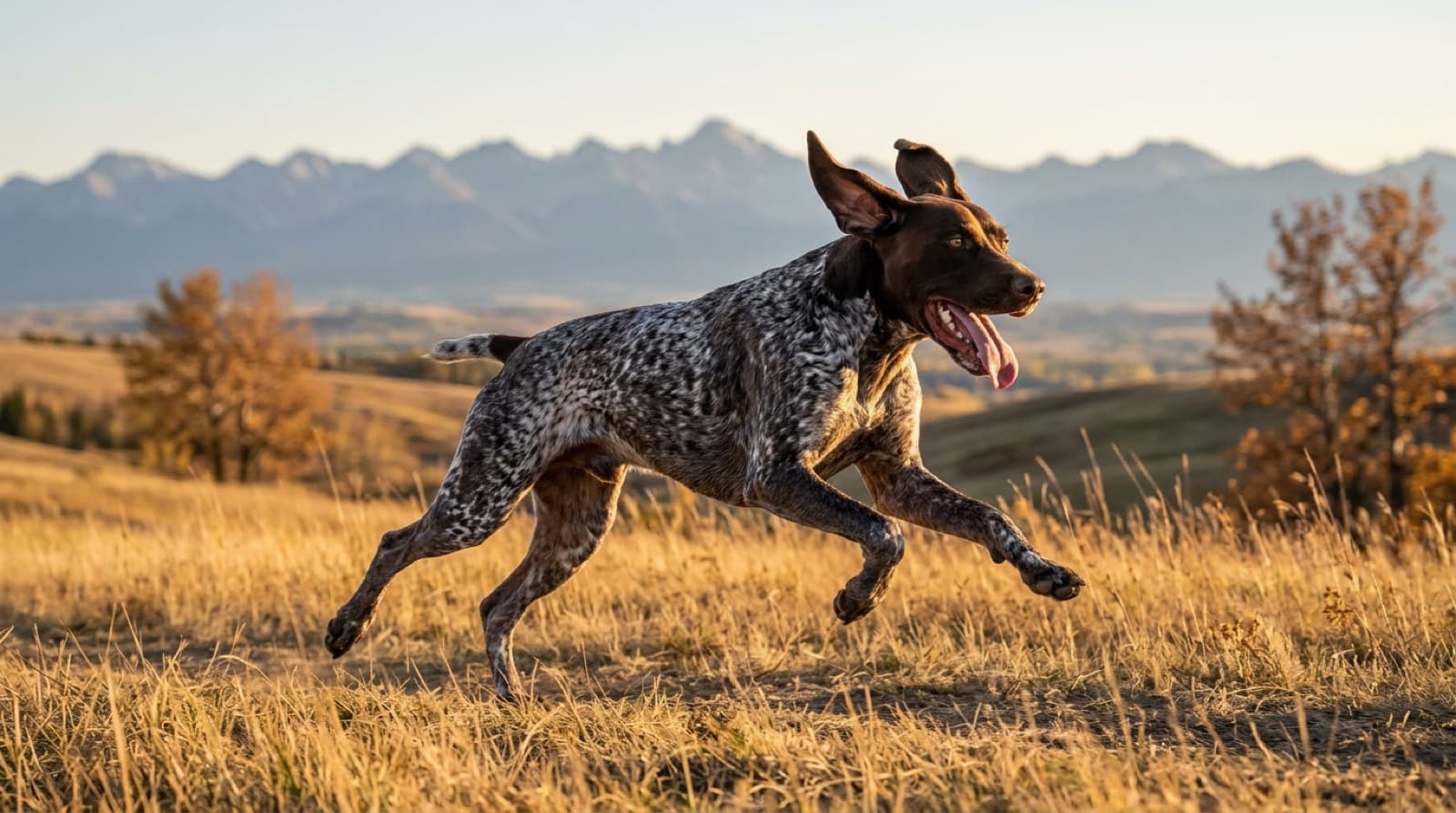
The 90-minute daily minimum and what counts
Most generic breed sources say a GSP needs 1 to 2 hours of exercise. That phrasing hides the real issue. The minutes do not matter as much as the intensity and type. A two-hour leashed walk at a human pace produces a frustrated GSP. A 60-minute off-leash romp at Nose Hill produces a tired GSP. The Calgary owners we work with who consistently raise calm GSPs run the following weekly pattern.
What counts toward the 90-minute target:
- Off-leash running on safe terrain. Nose Hill, Bowmont, Fish Creek, Sandy Beach, Edworthy, or Tom Campbell's Hill, depending on which is closest. The dog runs at full stride for sustained 5 to 10 minute bursts, recovers, then runs again.
- Bike-joring or owner-paced running. A bike along the Bow River pathway or Glenmore Reservoir loop at a moderate pace lets the dog trot or canter for 30 to 45 minutes. Use a proper bike-jor harness, not a flat collar. Distance-build slowly. Avoid pavement-only runs in summer heat.
- Fetch in long repeated sets. Three sets of 10 to 15 minutes with rest between, using a Chuckit or similar thrower for distance. A GSP will fetch until physically exhausted, which is often longer than the owner's arm holds out.
- Swimming. Sandy Beach and the off-leash river-access points on the Bow and Elbow are GSP heaven in summer. Swimming is the gentlest joint-loading exercise that still genuinely tires the dog.
- Hunt-style retrieve drills. Throw a dummy or training bumper into long grass, let the dog use nose and eyes to find it, retrieve to hand. Stack 10 to 20 reps. This combines physical work with the mental focus the breed was bred for.
- Structured agility, dock diving, or sport class. Calgary K9 sports facilities run agility, dock diving, and rally classes that absorb GSP drive in a structured outlet.
What does NOT count:
- Leashed neighbourhood walks alone. Useful for socialization and bathroom breaks, but not exercise.
- Dog park standing around. Most dog-park time is mutual sniffing and watching, not running. A GSP needs running.
- Backyard wandering. A GSP alone in a backyard finds something to dig, chew, or escape from. It is not exercise.
- Two short potty walks per day. The total time may add up to 60 minutes, but the intensity profile is wrong.
The test for whether the exercise session counted is simple. After 45 to 60 minutes of cool-down at home, the dog should be panting deeply, choose to drink water, find a spot, lay down, and sleep. A GSP that is still bouncing 2 hours after the outing did not get enough exercise. A GSP that is settled and napping for the rest of the afternoon did.
The Calgary off-leash park strategy
Off-leash access is the single biggest predictor of GSP-owner satisfaction in Calgary. The City of Calgary maintains over 150 designated off-leash areas, and a few of them are particularly well suited to GSPs. Pick the park by your goal for the session, not just by proximity.
Nose Hill Park (northwest): 11 square kilometres of prairie grassland on a hilltop, with rolling terrain that lets a GSP gallop in long stretches. This is the closest Calgary gets to GSP-native habitat. Watch the leash-required zones near the park edges and the wildlife disturbances (Nose Hill has ground-nesting birds in spring, and Calgary bylaw protects them). Squirrels and rabbits are everywhere. Recall fails here without significant training.
Bowmont Park (northwest): river-valley off-leash with mixed grassland and trail running. Lower wildlife density than Nose Hill, slightly more controlled environment, and the river is accessible for swimming in summer. A good intermediate venue while building recall.
Fish Creek Provincial Park (south): multiple designated off-leash zones with grass, trees, and creek access. Sikome Lake area in summer has water access. The longer trail loops let a GSP run sustained distance without crossing populated zones. Watch for posted seasonal closures.
Sandy Beach Park (south-central): river-access off-leash on the Elbow River. The swimming is excellent. Smaller footprint than Fish Creek, but enough open ground for fetch and recovery sets. Crowded in summer.
Edworthy Park (west): Bow River pathway access with off-leash zones, mixed terrain, and consistent year-round usage. A solid Calgary GSP standard.
Tom Campbell's Hill (north-central inner-city): smaller urban off-leash on a hill with city views. Useful for short weekday sessions if you live in the Beltline, Bridgeland, or Inglewood. The footprint is too small for a primary off-leash routine but works as a top-up session.
Sibbald Flats and Kananaskis day-use (1 hour west of Calgary): for weekend big-distance days. Foothills terrain, low human density, and the kind of open running that genuinely tires a GSP. Watch for wildlife (deer, coyotes, occasionally bears in spring). Recall must be reliable before bringing a GSP out here.
The realistic Calgary GSP routine pairs a daily local park (Bowmont, Edworthy, Sandy Beach depending on neighbourhood) with a weekly bigger-day session (Nose Hill, Fish Creek, or Kananaskis). One without the other tends to under-exercise the dog.
Recall training: the long-line protocol
Recall is the single hardest training task for a GSP and the most important. The breed was developed to range 100 to 300 metres ahead of a hunter while hunting birds, with high prey drive and an ability to ignore weak handler cues at distance. Calgary park wildlife (rabbits, squirrels, ground-nesting birds, deer, coyotes) is exactly the stimulus the breed was bred to chase. A GSP without trained recall is a GSP that disappears into a coulee on the first squirrel.
The protocol most Calgary force-free trainers recommend looks like this:
Phase 1 (weeks 1 to 4): foundation in low-distraction environments. Start indoors, then in a fenced yard. Use a cue word (“here” works well because it is shorter than “come” and less likely to be poisoned by frustration). Pair the cue with a high-value food reward every time. Build up to 100% response rate with no distractions before adding any.
Phase 2 (months 2 to 4): long-line work in moderate distractions. Use a 30 to 50 foot biothane long line attached to a back-clip harness (not a flat collar, which risks neck injury on a hard recall). Walk in a park or large field. When the dog ranges out, cue recall, and reward with food or a brief game of tug. If the dog ignores the cue, calmly walk to the end of the line, pick up the line, and use it to gently redirect the dog back toward you (never yank). Repeat 20 to 30 times per session.
Phase 3 (months 4 to 6): long-line work in high-distraction environments. Move to Bowmont, Edworthy, or Sandy Beach. The dog is still on the long line. Practice recall under genuine distractions: other dogs, squirrels, kids, mountain bikers. Reward heavily. Accept that recall response rate will drop initially in new environments and rebuild.
Phase 4 (months 6+): off-line in low-distraction venues, gradually adding distractions. Drop the line in a fenced area or large quiet field. Run 3 to 5 minute off-leash sets, recall, leash back. Build up the off-leash duration as the recall holds. Carry high-value treats every single time for the first year. Reinforce the recall behaviour heavily long after the dog seems reliable.
A common Calgary mistake is rushing this protocol. An owner who drops the line at 8 weeks of work and then has the dog chase a deer is going to spend the next month walking that progress back. Force-free recall is slow and boring in the middle and worth every week.
On e-collars: a small number of Calgary trainers use a force-free conditioned-signal protocol where the e-collar tap is paired with food rewards for weeks before any directional cue, used at the lowest perceptible level, and never as a correction. This is technical work. If your trainer cannot explain the conditioning protocol in detail or is using the e-collar as a punishment tool, walk away and find a different trainer. Raising Canine and Pup City Pup Academy can both refer to qualified trainers who handle e-collars properly. The American Veterinary Society of Animal Behaviour has a clear position statement on punishment-based training that is worth reading before adding any aversive tool to the protocol.
Bike-joring and running with your GSP
GSPs are built to trot or canter for long distances, and a Calgary owner who runs or bikes can absorb a meaningful share of the daily exercise load that way. The Bow River pathway, Elbow River pathway, and Glenmore Reservoir loop are all GSP-friendly. The 24 kilometre Glenmore loop is one of the better long-distance routes in the city.
The rules are about joint protection and breed-specific safety:
- Wait until 18 months for sustained running on hard surfaces. Growth plates do not close until 14 to 18 months, and forced repetitive impact on concrete or asphalt before that can cause lasting joint damage. Free-play off-leash is fine before 18 months. Bike-paced trotting for 30+ minutes is not.
- Use a bike-jor harness and a shock-absorbing lead. A flat collar attached to a bike handle is a recipe for a broken-neck injury when the dog sees a squirrel.
- Build distance gradually. Start with 10 to 15 minute sessions and add 5 minutes per week up to a goal of 30 to 45 minutes.
- Avoid running in heat over 22 Celsius. GSPs cool by panting and a hot Calgary day plus sustained exercise is a real heat-stroke risk. Run early morning or evening in summer.
- Watch paw pads on pavement. Hot asphalt in July burns paw pads. The back-of-hand test (hold the back of your hand against the pavement for 5 seconds) is the standard check.
- Carry water on any session over 20 minutes. Collapsible water bowls in a small backpack solve this. GSPs will run themselves into dehydration before pulling up voluntarily.
For adopted adult GSPs of unknown joint history, ask your vet for a hip and elbow assessment before starting any structured running program. Pet insurance ROI is covered in the GSP health issues guide.
Mental enrichment: not a replacement, but critical
A GSP brain that has done 45 minutes of scent work is in a different state than one that has done nothing. Mental enrichment supplements the physical side, especially on deep-cold Calgary days when outdoor time is limited. The mistake owners make is treating enrichment as a substitute. It is not. A GSP body needs to run. But a well-enriched GSP body is also a calmer GSP indoors.
Daily enrichment toolkit:
- Snuffle mat with kibble. 10 to 15 minutes of nose-down work. Most GSPs love this because it activates the scenting drive.
- Food-dispensing toys. Kong Wobbler, Kong Classic stuffed and frozen, West Paw Toppl. Rotate 2 to 3 daily so the novelty stays.
- Scent-hide games. Hide treats around the house and cue the dog to find them. Start easy (one room, treats in plain sight) and build to multi-room searches with treats hidden in furniture and toy boxes.
- Hide-and-seek with humans. Have a family member hide while the dog stays. Release the dog to find them. Reward with food and a brief game on the find.
- Puzzle feeders for one meal per day. Replaces a bowl-eaten meal with 15 minutes of problem-solving.
- Training sessions. 5 to 10 minutes of clicker work or trick training is genuinely mentally tiring for the breed.
- Chew rotation. Bully sticks, Yak chews, frozen carrots. Long-duration chew time is calming.
The Cornell Vet College's Riney Canine Health Centre has published useful general guidance on canine enrichment principles. The Calgary application of the same principles is just choosing the right activities for a versatile hunting breed.
Calgary winter: the short-coat reality
GSPs have short single coats and a lean build. Cold tolerance is genuinely poor. Calgary winter requires a fitted insulated coat, paw protection, and a shift toward indoor exercise below -10 Celsius. Under-exercise in winter is the leading driver of GSP surrenders in February and March.
The Calgary GSP winter problem is not theoretical. Most GSP rescue surrenders we see cluster in late winter, and the pattern is the same: owner buys or adopts a GSP in summer when daily Bow River walks tire the dog. Winter arrives, the routine collapses, the dog redirects under-exercise energy into destruction, and the family surrenders by March. The fix is a deliberate winter plan, not heroic outdoor effort.
Above -10 Celsius: normal outdoor routine with a fitted coat for warmth retention. Most GSPs tolerate this range fine. Paw booties are optional but reduce ice-ball buildup between toes.
Below -10 Celsius (typical Calgary January): shorten outdoor sessions to 15 to 25 minutes. Use a fitted insulated coat (Hurtta, Ruffwear, or Voyagers K9 Apparel are commonly used by Calgary GSP owners). Paw booties become necessary because road salt and ice damage paws. Shift the bulk of the daily exercise load indoors.
Below -20 Celsius: outdoor time is bathroom breaks only. Even short exposures can cause frostbite on ear tips, tail tips, and paw pads. Indoor enrichment carries 100% of the load.
Indoor exercise strategies for deep cold:
- Hallway fetch (rolling balls down a long hallway, retrieve, repeat).
- Stair work in controlled 5 to 10 rep sets for dogs over 18 months with healthy joints. Skip if your dog has hip or elbow issues.
- Tug games with a structured drop cue.
- Treadmill conditioning if you have a dog-specific treadmill.
- Scent-hide games stretched across multiple rooms.
- Training sessions with high engagement and food rewards.
For working owners, 2 to 3 daycare days per week during deep cold spells is the realistic plan. The cost runs roughly $35 to $55 per day in Calgary. A reputable daycare with structured play and rest periods absorbs a meaningful share of the exercise load that outdoor winter simply cannot. Avoid daycares that allow rough free-for-all play; the over-arousal does not produce a calmer GSP at home.
Chinooks complicate the picture further. A Calgary chinook can swing temperatures 30 degrees in 12 hours, and the rapid pressure change affects sensitive dogs (some GSPs get joint discomfort or mood changes during chinook arrivals). Plan exercise around the warm windows when they appear.
Training the GSP: leveraging the eager-to-please temperament
GSPs are highly biddable, intelligent, and food-motivated. Force-free protocols work exceptionally well with the breed because GSPs offer behaviours readily, learn fast, and bond strongly to consistent handlers. The core training challenges are not about willingness; they are about managing high drive, off-switch development, and the velcro tendency to follow the owner everywhere indoors.
Priority training targets for a Calgary GSP:
- Recall. Covered above. The single most important behaviour.
- Polite leash walking. A GSP that pulls is a 50-pound athlete dragging a human down a Bow River pathway. Front-clip harnesses (Ruffwear Front Range, Balance Harness) plus reward-based loose-leash training fix this in 4 to 8 weeks of consistent work.
- Settle / off-switch. GSPs without a learned off-switch follow their owner room to room indoors, never relax, and develop velcro-driven separation anxiety. Train a mat-settle cue: dog goes to a designated mat, lays down, stays. Start with 30 second durations, build up over weeks to 30 minutes. Reward heavily.
- Crate skills. A GSP that crate-trains well has a calm-down space that protects the home from destruction and gives the dog a clear off-time cue. Pair the crate with frozen Kong stuffing and short positive sessions.
- Place-cue and impulse control. Wait at doorways, wait before meals, wait before getting out of the car. Builds the impulse control the breed needs.
- Reliable leave-it. Calgary parks have plenty of distractions GSPs should not interact with (other dogs' food bowls at picnics, wildlife scat, road-kill on rural trails). A trained leave-it prevents most of these.
For adopted adult GSPs, the training curve is faster than puppy training in some ways. Adults have longer focus, learn complex behaviours faster, and bond quickly to a consistent handler. The trade-off is unlearning whatever the dog learned before adoption (which may include destructive or fearful patterns). Most Calgary rescues will share what is known about the dog's history so you can plan training accordingly.
The American Kennel Club's German Shorthaired Pointer breed profile and the Canadian Kennel Club's CKC breed standard both reinforce the trainability characterization. The breed is a good fit for owners who enjoy the daily work and a poor fit for owners who hoped a high-energy dog would calm down on its own.
Adolescence (8 to 24 months): the surrender window
The 8 to 24 month adolescent window is when most Calgary GSP surrenders happen. Puppy class graduated, the dog reached most of its adult size, the recall the owner thought was solid starts to fail under distraction, destruction escalates, and the family runs out of patience. Understanding the window and planning for it is the difference between keeping the dog and surrendering.
What changes during adolescence:
- Sex hormones (in unaltered dogs) and growth hormones reshape the brain. Previously learned behaviours become inconsistent.
- Drive matures. The squirrel that was a mild interest at 6 months becomes a full chase target at 14 months.
- Energy peaks. An adolescent GSP at 14 to 18 months has more energy than at any other life stage.
- The bond may seem to break temporarily. The dog tests boundaries. Owners often mistake this for the dog “not loving them anymore.”
- Destruction escalates. Chew preferences shift to higher-value targets (furniture legs, drywall, shoes) if the dog is under-exercised.
The plan that works:
- Enrol in a continuous group training class through adolescence, not just one puppy class. Most owners stop after puppy class graduation. Calgary force-free trainers (Raising Canine, Pup City Pup Academy) run intermediate and advanced classes that take dogs through the adolescent window with structure.
- Increase exercise during adolescence, not decrease. A 16 month old GSP needs more exercise than an 8 month old.
- Reinforce recall heavily during this window. Use the highest-value food rewards you have. Carry treats every single outing for the first 18 months minimum.
- Manage the environment. If recall is breaking down in a specific park, switch to a different venue for a few weeks rather than letting failed recalls compound.
- Use a long line as a safety net during adolescence even if you had previously moved off-leash. Many Calgary GSP owners return to the long line at 12 to 14 months when adolescent drive shifts the calculus.
- Talk to your trainer. Most behaviour problems in the adolescent window are solvable with training adjustments, not with surrender.
The trade-off worth naming: families who push through adolescence with structured training and continued exercise end up with a settled, recall-reliable, family-bonded adult GSP at 24 to 30 months. Families who surrender during adolescence give up on what is usually the last 6 to 8 months of difficulty before the dog becomes the partner they signed up for.
Browse adoptable GSPs in Calgary
Calgary rescues see GSP surrenders most often in late winter (under-exercise) and during adolescence (8 to 24 months). If you have the exercise commitment and a recall-training plan, an adopted adult GSP is one of the most rewarding athletic partners in the city.
See Available GSPs →Hunt tests and dog sports: structured outlets
Even Calgary GSP owners who never hunt benefit from running structured tests and sports with their dogs. The activities match the breed's biological needs in ways that ordinary exercise cannot. A GSP that runs Natural Ability or competes in dock diving is a GSP whose drive has a defined outlet, and the indoor calm at home improves measurably.
NAVHDA Natural Ability (9 to 16 months entry): The North American Versatile Hunting Dog Association runs Natural Ability tests evaluating innate hunting instinct. Tracking a bird, pointing on found game, retrieving to hand, water work, and cooperation with the handler are all scored. The test does not require formal training or that the owner hunt. Two NAVHDA chapters operate in Alberta and run spring and fall tests. The NAVHDA national site has chapter information and test schedules.
NAVHDA Utility Preparatory and Utility Tests: for owners who want to develop more polished training. Typically attempted by 2 to 3 years of age. Calgary GSP owners working toward these tests often connect with NAVHDA mentors in the Alberta chapters.
Dock diving: Calgary K9 sports facilities run dock diving in summer at the Spruce Meadows area and along the Bow River. GSPs love water and love retrieving. The combination is a strong fit. Competitive dock diving has multiple skill levels.
Field trials and retriever tests: for owners who want to compete. The Canadian Kennel Club sanctions field trials for pointing breeds. Less common in Calgary than in Saskatchewan and Manitoba, but accessible with travel.
Rally obedience, agility, and nose work: structured group classes that match GSP drive. Calgary force-free trainers run all three. Even a GSP that competes at a low level gets meaningful structured outlet from the practice sessions.
For Calgary owners new to the sports, the practical entry point is a Natural Ability prep clinic with one of the Alberta NAVHDA chapters, followed by entry into a spring or fall test. The community is welcoming and most GSP owners benefit from the introduction even if they never advance past Natural Ability.
Injury risks and joint protection
Bloat (gastric dilatation-volvulus) is a true emergency in deep-chested breeds like GSPs. Never exercise within 60 minutes before or after a meal. Restless behaviour, unproductive retching, or a distended abdomen requires immediate emergency vet care at Western Veterinary Specialist Centre or VCA Canada West.
GSPs are athletic dogs and injury patterns reflect the activity profile. The most common Calgary GSP exercise injuries are:
Soft tissue injuries. Cruciate ligament tears, iliopsoas strains, shoulder injuries. Common when a young or out-of-shape dog goes from sedentary to high-intensity in one session. Build conditioning gradually. Warm-up walks before fetch sessions. Cool-down walks after.
Growth-plate injuries. Under 18 months, growth plates are open and vulnerable. Forced repetitive impact (jogging on hard surfaces, long bike runs, jumping out of vehicles, stair workouts) can cause lifelong joint problems. Limit structured running to off-leash self-paced sessions until 18 months. Free-play on grass is fine at any age.
Bloat (GDV). Deep-chested breeds including GSPs have elevated bloat risk. Never exercise intensely within 60 minutes before or after eating. Feed 2 to 3 smaller meals daily. Use a slow-feeder bowl if the dog eats fast. Bloat is rapidly fatal without emergency surgery. Calgary 24-hour emergency vet hospitals (Western Veterinary Specialist Centre, VCA Canada West) handle GDV cases regularly.
Heat stroke. Summer days over 22 Celsius plus sustained exercise plus short coat plus willingness to keep running past exhaustion equals heat-stroke risk. Run early morning or evening in summer. Carry water. Watch for excessive panting, drooling, weakness, or vomiting.
Paw injuries. Hot asphalt in summer (back-of-hand test), road salt and ice in winter (booties), and sharp rocks on backcountry trails (paw checks after sessions) cover the main risks.
Pet insurance ROI for GSPs is covered in the GSP health issues guide. For most Calgary owners running an active GSP through hunt tests, agility, or sustained bike-joring, insurance pays for itself within 2 to 3 years given the elevated injury risk profile.
The American Animal Hospital Association publishes general exercise and nutrition guidelines for sporting breeds that are worth reading before starting any structured conditioning program.
The cost of under-exercise
Calgary GSP owners often arrive at adoption with a confident plan to exercise more. Within 6 months, the plan compresses. Work travel returns. Calgary winter arrives. The 5 AM run becomes a 5 AM scroll. The under-exercised GSP fills the gap with behaviour.
What under-exercise actually costs:
- Destroyed property. Couches, baseboards, drywall, shoes, kids' toys. Most Calgary GSP owners we work with report $500 to $3,000 in household damage over the first 12 to 18 months.
- Vet costs for ingested foreign bodies. A GSP that chews drywall, towels, or stuffed toys can swallow material that requires endoscopy or surgery to remove. Costs run $2,000 to $6,000 per episode.
- Anxiety medication. Under-exercised GSPs often develop separation anxiety. Veterinary behaviourists prescribe medications (fluoxetine, trazodone, others) that help when paired with behaviour modification. Discuss any medication path with your vet; this is not a do-it-yourself area. Annual cost runs $300 to $900 for the meds alone, more with behaviour-modification sessions.
- Surrender. The final cost. Family invested 1 to 2 years and several thousand dollars into the dog, then surrenders to AARCS, BARCS, Pawsitive Match, or directly to a rescue specializing in pointers. The dog goes through more transition. Adopter often regrets the decision long after.
- Neighbourhood complaints. Barking, escape attempts, jumping over fences, garbage-day destruction. Calgary bylaw 311 complaints can result in fines and forced rehoming in extreme cases.
Every one of these costs is preventable. The 90+ minute daily exercise commitment plus 30 minutes of indoor enrichment is the dose that prevents most behaviour escalation. Calgary owners who hit the commitment consistently raise GSPs that are some of the most rewarding family dogs in the city. Owners who do not, almost always, surrender.
If you are reading this and recognizing your own situation, the path is rarely surrender. It is more often: hire a Calgary force-free trainer for a private behaviour-and-exercise consult, restructure the daily routine, add 2 to 3 daycare days during the working week, and rebuild the recall on a long line. Most Calgary GSPs that go from under-exercised to well-exercised turn around within 4 to 8 weeks.
Frequently Asked Questions
How much exercise does a GSP actually need?
A healthy adult German Shorthaired Pointer needs a minimum of 90 minutes of structured, high-intensity daily exercise. That means off-leash running on safe terrain, bike-joring, swimming, fetch in long repeated sets, or hunt-style retrieve drills. A 60-minute leashed neighbourhood walk does not count toward the 90-minute target. Calgary GSP owners who hit the bare minimum still have a dog that looks satisfied but slightly under-stimulated. Owners who hit 2 hours of mixed physical and mental work consistently raise the calmest indoor GSPs. Puppies under 18 months need shorter sessions to protect growing joints (the “five minutes per month of age” guideline is a reasonable rule of thumb for sustained running), but the mental enrichment side scales up regardless of age.
Can a GSP live in a Calgary apartment with enough exercise?
Mostly no. A small number of dedicated owners make it work, but the math is hard. A GSP needs 90+ minutes outdoors twice a day in mostly off-leash environments, plus 30 to 60 minutes of indoor enrichment, plus a separation-tolerant temperament. Apartment-living GSPs without a backyard tend to develop barking, destruction, or escape behaviours within weeks of an under-exercise pattern setting in. Calgary suburbs with fenced yards near Nose Hill, Bowmont, Fish Creek, or Sandy Beach are the realistic GSP environment. If you are committed to apartment GSP ownership, plan for two structured daily outings, weekday daycare, and aggressive scent-work routines at home. Most Calgary GSP rescue surrenders we see come from apartment owners who underestimated this.
How long does GSP recall training take?
Reliable off-leash recall around Calgary park wildlife (rabbits, ground-nesting birds, deer, coyotes) is a 6 to 12 month investment for most GSPs, and a small percentage of high-drive lines will never be 100% reliable. The protocol most Calgary force-free trainers recommend is: 4 to 6 months on a 30 to 50 foot long line in increasingly distracting environments, paired with daily recall games using high-value food rewards. Only after the dog reliably recalls under heavy distraction on the long line do you drop the line and start short off-leash sessions in fenced or low-stimulus areas. Skipping the long-line phase is the most common reason Calgary GSP owners give up on off-leash. Raising Canine and Pup City Pup Academy both run recall foundation classes that work well for the breed.
Should I use an e-collar on my GSP?
Only in the hands of a trainer who knows force-free e-collar conditioning, and only as a low-level conditioned signal rather than a correction tool. The Pet Professional Guild position and the American Veterinary Society of Animal Behaviour position both discourage aversive shock-collar usage. A small number of skilled trainers use e-collars at the lowest perceptible level as a tap signal, conditioned through pairing with food rewards over weeks, to add a remote attention cue at distance. This is a technical skill, not a shortcut. If you cannot work with a trainer who can teach the conditioning protocol properly, do not pick up an e-collar. The long-line plus food-reward protocol gets the same recall reliability with no risk of fallout. Discuss the choice with a qualified Calgary trainer before buying any equipment.
How do I exercise a GSP in Calgary winter?
GSPs have short single coats and a lean build, so cold tolerance is genuinely poor. Below -10 Celsius, switch to 15 to 25 minute outings with a fitted coat and protective booties for paws. Below -20 Celsius, keep outdoor time to bathroom breaks only and shift the exercise load indoors. Indoor strategies that actually tire a GSP include: long fetch sessions in an unfinished basement or hallway, stair work in 5 to 10 rep sets (only for dogs over 18 months with healthy joints), tug games, treadmill conditioning if you have one, and structured scent-work routines hiding treats throughout the home. Daycare 2 to 3 days a week during deep cold spells is the realistic Calgary winter plan for working owners.
Can mental enrichment replace physical exercise?
No. Mental enrichment supplements physical exercise but does not replace it. A GSP brain that has done 45 minutes of scent work still has a body that needs to run. The structure most Calgary GSP owners find works is roughly 70% physical and 30% mental, with both happening daily. On a -25 Celsius day when the physical side is limited to 20 minutes outdoors, the mental side carries more of the load (snuffle mats, food puzzles, scent hides, training sessions, chew rotations). On a +15 Celsius spring day with a 2 hour Nose Hill outing, the mental side is a 10 minute puzzle feeder at supper. Balance varies by day. The mistake is doing only one side.
Which Calgary force-free trainers work well with GSPs?
Raising Canine and Pup City Pup Academy both have trainers who handle high-drive sporting breeds well. Look for trainers certified through the Karen Pryor Academy, the Academy for Dog Trainers, or the Pet Professional Guild Canada, with explicit experience handling pointers, setters, or other versatile hunting breeds. Avoid balanced trainers who lead with prong collars or aversive corrections for a GSP; the breed responds far better to high-rate food reinforcement and clear marker-cue work. Many Calgary GSP owners enrol in continuous group classes through adolescence (8 to 24 months) rather than just one puppy class, because the adolescent window is when most recall and impulse-control regressions happen.
When can I start hunt tests with a young GSP?
Most NAVHDA chapters allow young GSPs to enter the Natural Ability test between 9 and 16 months of age. The test evaluates innate hunting instinct (tracking, pointing, retrieving, water work, cooperation) without requiring formal training. Even Calgary GSP owners who never plan to hunt benefit from running Natural Ability because the structured outlet matches the breed's biological needs. Beyond Natural Ability, the Utility Preparatory Test and Utility Test require more polished training and are typically attempted by 2 to 3 years of age. The NAVHDA Alberta chapters run tests in spring and fall, and Calgary GSP rescue groups often have members who can introduce new owners to the testing community.
How do I protect a GSP puppy's joints during exercise?
Growth plates in large-breed dogs do not fully close until 14 to 18 months, and GSP hip dysplasia is hereditary in many lines. Protect growing joints by limiting forced repetitive impact (jogging on hard surfaces, long bike runs, jumping out of vehicles) until 18 months. Free play on grass, swimming, controlled fetch on soft ground, and unstructured off-leash exploration are appropriate at any age. Stairs in moderation are fine; rep-counting stair workouts are not. A useful Calgary guideline: until 18 months, exercise should be off-leash and self-paced more than human-paced. Pet Professional Guild and OFA both publish growth-plate exercise guidance worth reading before starting a GSP puppy on any structured running program.
Is dog daycare worth it for a Calgary GSP?
For working owners, yes. Two to three daycare days per week during the working week is a common Calgary GSP routine. A well-run daycare with a structured play-rest-play schedule and breed-appropriate groupings delivers 4 to 6 hours of social and physical exercise that translates into a calmer evening at home. Vet your daycare carefully: look for trainer-on-staff supervision, group sizes under 15 dogs per handler, dedicated rest periods (not 8 hours of unbroken play, which over-arouses the breed), and a refusal policy for dogs that show inappropriate play. Avoid daycares that allow rough play with no intervention. The cost ($35 to $55 per day in Calgary) is meaningful but typically lower than the destruction costs of an under-exercised GSP.
Should I get a treadmill for my GSP?
For Calgary winter and rainy spring days, a dog treadmill (different from a human treadmill) can be a useful supplement, not a replacement, for outdoor exercise. Used 2 to 3 times per week for 15 to 25 minute sessions, it adds aerobic conditioning that is otherwise hard to maintain through deep cold spells. The conditioning takes weeks (start with 5 minutes at a walk, build up gradually). Never tie a dog to a treadmill or use a human treadmill at full speed for a dog. Dog-specific treadmills with side rails and an emergency stop are designed for the use case. For most Calgary households, the cost ($400 to $1,500) is justifiable only if winter under-exercise is a recurring problem.
When can a GSP exercise around mealtime?
GSPs are a deep-chested breed at elevated risk of gastric dilatation-volvulus (bloat). Avoid intense exercise within 60 minutes before or after a meal. Feed 2 to 3 smaller meals daily rather than one large meal, use a slow-feeder bowl if your GSP eats quickly, and let the dog rest after eating. Bloat is a true emergency and a leading cause of preventable death in GSPs. If your dog is restless, retching unproductively, or has a distended abdomen, drive immediately to Western Veterinary Specialist Centre or VCA Canada West for emergency surgery. The narrow exercise window matters and the rule is easy to follow once it becomes habit.
Adoptable GSPs in Calgary
Live listings of German Shorthaired Pointers from the Calgary rescue network, updated regularly.
GSP Adoption Calgary
The Calgary GSP adoption hub. Rescue sources, real costs, surrender patterns, and breeder verification.
Is a GSP Right for You?
Honest lifestyle-fit guide. Exercise demand, family compatibility, Calgary climate, and the velcro temperament reality.
GSP Health Issues Calgary
Inherited conditions, Calgary specialty vet contacts, and pet insurance ROI for German Shorthaired Pointers.
New dog? Start with these care guides
Everything a new adopter needs to set up a safe, happy home.