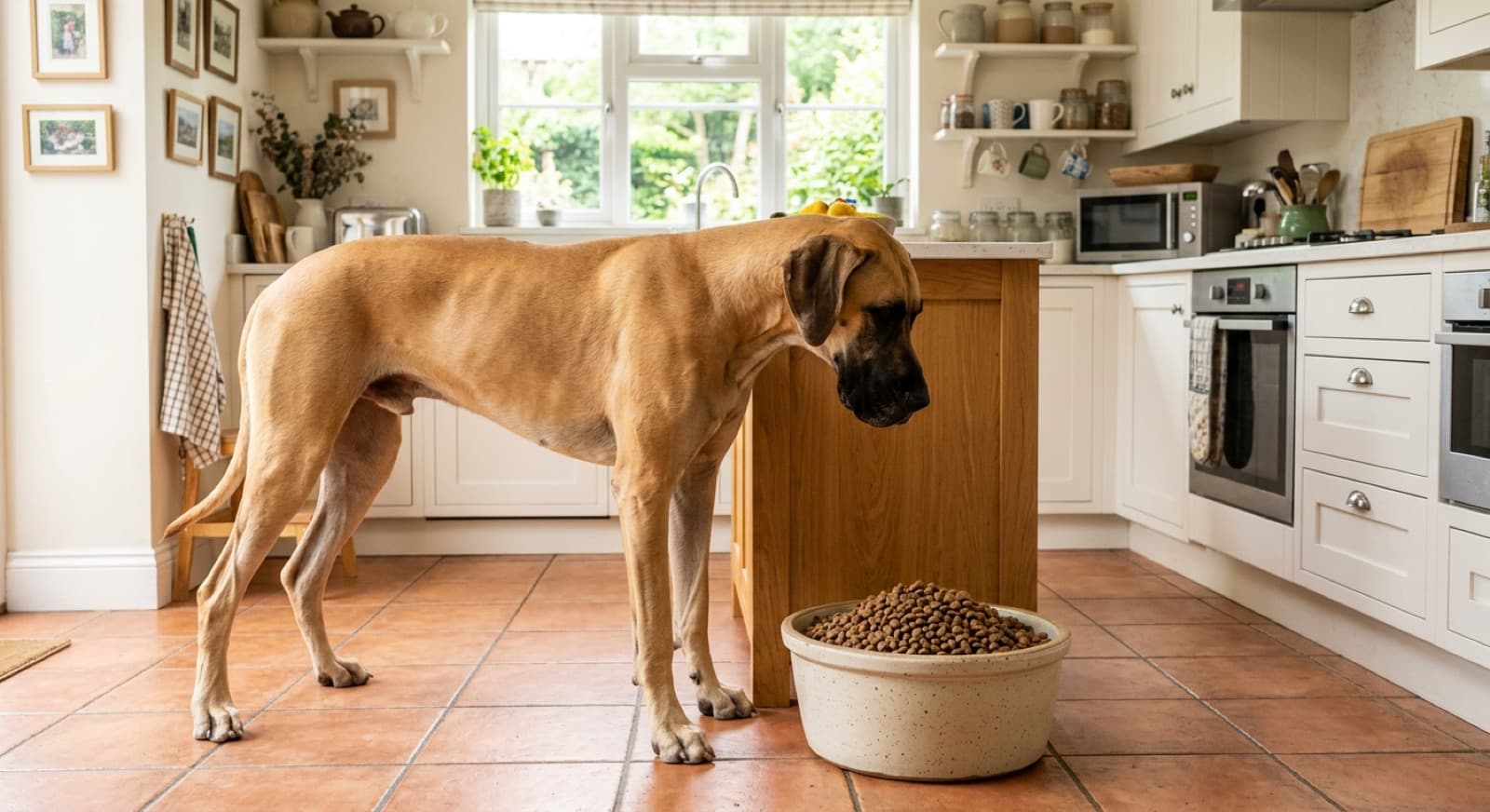
The short answer
Feed a Great Dane puppy a controlled-calcium large-breed (or giant-breed) puppy food, and grow the dog slowly and lean. Calcium, not protein, is the thing that breaks a giant puppy, so the calcium number on the bag matters more than the word “puppy” or “adult.” Keep the adult on a complete large-breed food from a nutritionist-backed brand and feed to body condition. Feed two or more smaller meals a day, use a slow feeder, and feed from the floor, because raised bowls increase bloat risk, they do not prevent it. Danes self-limit, so they cost less to feed than you would guess.
What is the best food for a Great Dane?
There is no single best bag, and any site that names one is selling something. The standard most vets point to comes from the WSAVA global nutrition guidelines.
Pick a brand that does the science. Ask whether the company employs a full-time, board-certified veterinary nutritionist and runs feeding trials. For an adult Dane the safe defaults are Purina Pro Plan Large Breed, Royal Canin (which makes a giant line), Hill's Science Diet, and Eukanuba.
For a giant breed, the nutrient profile beats the brand, and the number that matters most is calcium. That is the thread running through the whole rest of this guide, so it is worth saying plainly up front: get the puppy's calcium right and you have done the most important thing feeding can do for a Great Dane.
Calcium, not protein: the puppy-food question settled
Two myths tangle together in Great Dane forums, and clearing them up is the most useful thing this article can do.
Myth one: protein makes a Dane puppy grow too fast. It does not. Research has found protein in the roughly 23 to 31 percent range does not harm growth. The real driver of growth disorders is excess calcium and too many calories. A Great Dane puppy cannot down-regulate the calcium it absorbs the way other dogs can, so whatever is in the bowl goes into the body.
Myth two: never feed a Great Dane puppy any puppy food. That advice is outdated. It made sense when puppy foods were uniformly too calorie- and calcium-dense, but modern large-breed and giant-breed puppy formulas are built specifically for controlled growth. The real rule is the nutrient profile: aim for calcium around 1.2 to 1.5 percent or less and a calcium-to-phosphorus ratio near 1:1 up to about 1.3:1. The Purina Institute explains why excess calcium is the giant-breed danger. A well-formulated large-breed puppy food usually hits these targets. The label matters less than the number, and the safest move is to confirm the food with your vet.
One more rule that follows: do not add a calcium supplement to a complete puppy food. For a giant-breed puppy it is not helpful, it is harmful.
Grow it slowly, keep it lean
The most damaging instinct with a Great Dane puppy is to feed it big to grow it big and strong. Fast growth is exactly what causes the knuckling, panosteitis, and joint problems giant-breed puppies are prone to, and the most sensitive window is roughly two to six months of age.
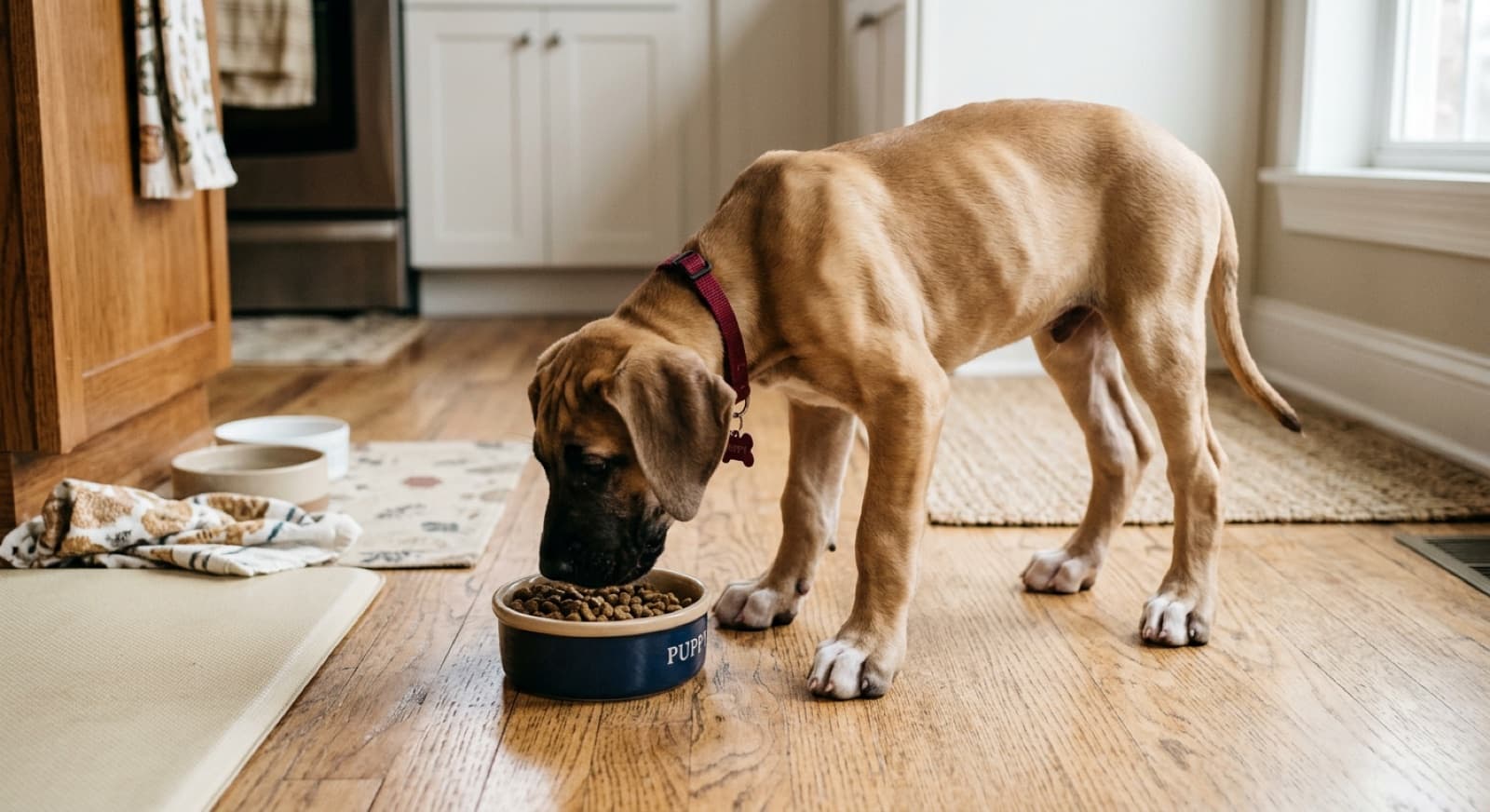
A healthy Great Dane puppy should look lean, lean enough that you can just see the last rib, which strikes most new owners as too thin. It is not. Feed three to four meals a day as a young puppy, dropping to two as it grows, and adjust portions to hold that lean condition rather than to a chart. Filling out a Dane comes later and on its own; rushing it with food only damages the frame.
Bloat, and the raised-bowl myth
Raised or elevated bowls do not prevent bloat in Great Danes. A large study found they were associated with a substantially increased risk. Feed a Great Dane from the floor.
Bloat (gastric dilatation-volvulus) is a leading killer of Great Danes, which carry a high lifetime risk. The raised-bowl myth is so widespread that many owners buy elevated feeders believing they help, when the best available research points the other way, likely because dogs eat faster from a raised bowl.
The feeding habits that genuinely lower risk: feed two or more smaller meals a day instead of one big one, slow a fast eater with a slow-feeder bowl, and avoid hard exercise for about an hour around meals. The single most reliable protection is not a feeding trick at all but a preventive gastropexy. Because bloat is such a defining risk for this breed, we cover the emergency signs and prevention in depth in our Great Dane bloat and GDV guide. The short version: a swollen belly, unproductive retching, or sudden distress is a go-to-the-emergency-vet-now situation.
How much should I feed a Great Dane?
Less than you would guess. Despite the size, Great Danes tend to self-limit and are not the bottomless eaters their frame suggests. Adults often land somewhere in the 6 to 10 cup range a day depending on the food and the dog, with growing puppies eating more across three to four meals.
Feed to body condition, not the chart. A Great Dane should look lean, and you should just be able to see the last rib. Because they self-limit, the monthly food bill is moderate for a giant breed, which surprises people who assume a dog this big eats a fortune. The real budgeting goes into getting the puppy nutrition right and planning for giant-breed veterinary care, which our Great Dane cost-of-ownership guide breaks down.
Should I feed my Great Dane grain-free?
Not unless your vet diagnoses a grain allergy, and the breed's heart vulnerability makes the caution stronger than usual.
The FDA has been investigating a possible link between grain-free diets built on peas, lentils, and potatoes and dilated cardiomyopathy, a heart condition Great Danes are already genetically prone to. Most vets steer Dane owners toward established, feeding-trial brands over boutique grain-free for exactly this reason.
Foods to avoid
Keep these away from a Great Dane completely:
- Chocolate (darker is worse)
- Grapes and raisins (can cause kidney failure, even a few)
- Xylitol (in sugar-free gum, some peanut butters, and baking), which is rapidly fatal to dogs
- Onions, garlic, leeks, and chives
- Macadamia nuts
- Alcohol and caffeine
- Cooked bones (they splinter)
A Great Dane can clear a countertop without trying, so keep food and bins out of reach. If your dog does eat something on this list, call your vet, the nearest emergency clinic, or a pet poison helpline right away.
Should I feed my Great Dane a raw diet?
Only with a vet or veterinary nutritionist involved, and be especially careful with a growing puppy. Some Danes do well on a properly built raw diet, but raw meat carries a pathogen risk for the dog and the household, and balancing calcium in a homemade raw diet is genuinely hard, which is exactly the nutrient a giant-breed puppy cannot afford to get wrong.
For most Danes, a complete cooked or kibble diet from a nutritionist-backed brand matches raw on outcomes. If you go raw, especially for a puppy, work with a veterinary nutritionist on a complete, calcium-correct recipe rather than guessing.
Looking to adopt a Great Dane?
Plan the puppy growth and calcium plan before day one. Browse Great Danes and Dane mixes available now from the rescues we track.
See Available Great Danes →Where to buy Great Dane food
Every brand worth feeding a Dane is easy to find in store and online:
- Pet specialty chains (Pet Planet, Tail Blazers, Tisol, and similar). Carry Pro Plan, Royal Canin, and giant-breed lines.
- Pet Valu and PetSmart. National chains that stock the major large-breed puppy and adult formulas.
- Your vet clinic. The best source for giant-breed puppy feeding guidance and prescription diets.
- Costco. Kirkland Signature large-breed is a cheaper everyday adult option.
Buying the largest bag your Dane finishes before it goes stale, stored sealed, keeps the per-meal cost down. The major large-breed formulas are easy to set on a recurring delivery.
Frequently Asked Questions
What is the best food for a Great Dane?
For a puppy, a food with controlled calcium built for large or giant breeds is the priority, not the brand on the bag. For an adult, a complete large-breed formula from a brand that employs a veterinary nutritionist and runs feeding trials, like Purina Pro Plan, Royal Canin, Hill’s Science Diet, or Eukanuba. With a giant breed the nutrient profile, especially calcium, matters more than the label. Start with whatever the breeder or rescue was feeding, then transition over seven to ten days.
Do I feed a Great Dane puppy "large-breed puppy" food or adult food?
This is the most argued-about Great Dane feeding question, and the old "never feed puppy food" rule is outdated. The thing that actually matters is controlled calcium: aim for a food with calcium around 1.2 to 1.5 percent or less and a calcium-to-phosphorus ratio near 1:1 up to about 1.3:1. Modern large-breed or giant-breed puppy formulas are built for exactly this, so a well-formulated large-breed puppy food is a fine and often better choice than guessing with adult food. The label (puppy vs adult) matters less than the calcium number. Confirm with your vet.
Is high protein bad for a Great Dane puppy?
No, this is a long-standing myth. The villain in giant-breed growth problems is excess calcium and too many calories, not protein. Studies have found protein in the range of about 23 to 31 percent does not harm growth. What does harm growth is overfeeding and too much calcium, which a giant-breed puppy cannot regulate. So choose a controlled-calcium large-breed puppy food and do not avoid a quality food just because the protein looks high.
Do raised or elevated bowls prevent bloat in a Great Dane?
No, and this is the single most important feeding myth to correct for the breed. A large study found elevated feeders were associated with a substantially increased risk of bloat (gastric dilatation-volvulus) in large and giant breeds, not a reduced one, likely because dogs eat faster from them. Feed a Great Dane from the floor. The feeding habits that actually help are smaller, more frequent meals, a slow-feeder bowl, and no hard exercise around mealtimes. The most reliable protection is a preventive gastropexy, which is worth discussing with your vet.
How much should I feed a Great Dane?
Less than people expect, because despite their size Great Danes tend to self-limit and are not the bottomless eaters their frame suggests. Adults often eat in the range of 6 to 10 cups a day depending on the food and the dog, and growing puppies eat more, split across three to four meals. Feed to body condition: a Great Dane should look lean, and you should just be able to see the last rib. Overfeeding to fill out a giant dog is exactly what damages its joints.
Should I feed my Great Dane grain-free?
Not unless your vet diagnoses a grain allergy. The FDA has been investigating a possible link between grain-free diets built on peas, lentils, and potatoes and a heart condition called dilated cardiomyopathy, and Great Danes are a genetically heart-vulnerable giant breed, so most vets steer toward established, nutritionist-backed brands over boutique grain-free. A complete diet from a feeding-trial brand is the safer default.
Do Great Danes cost a fortune to feed?
Less than the size suggests, which surprises people. Because Great Danes self-limit and are not big eaters relative to their frame, monthly food cost is moderate for a giant breed, often in the range of a couple of large bags of quality kibble a month. The bigger cost is getting the puppy nutrition right and budgeting for giant-breed veterinary care. Buying the largest bag your Dane finishes before it goes stale, stored sealed, keeps the per-meal cost down.
Great Dane Bloat & GDV
The emergency signs, prevention, and the gastropexy decision for the breed's biggest killer.
Great Dane Cost of Ownership
Food, vet care, and the real budget for a giant breed before you adopt.
Great Dane Adoption
Where to find Danes and Dane mixes, real costs, and what to expect from the breed.
Great Danes for Adoption
Live listings of Great Danes and Dane mixes from the rescues we track.