The short answer
Bloat (Gastric Dilatation and Volvulus, or GDV) is a medical emergency where a Great Dane's stomach fills with gas and can twist. Without ER surgery within hours, it is usually fatal. Recognize these signs on sight:
- Unproductive retching: the dog tries to vomit but nothing comes up
- Distended, swollen, or drum-tight belly
- Restlessness or pacing, unable to lie down
- Excessive drooling, hunched posture, whining
- Pale gums, weak pulse, collapse (late shock signs)
If you see these signs, go directly to a Calgary 24-hour emergency veterinary clinic. Do not wait. Do not try home remedies. Do not give food or water. Talk to your regular vet about gastropexy (preventive stomach-tacking surgery) and a pet insurance plan before your dog ever has a problem.
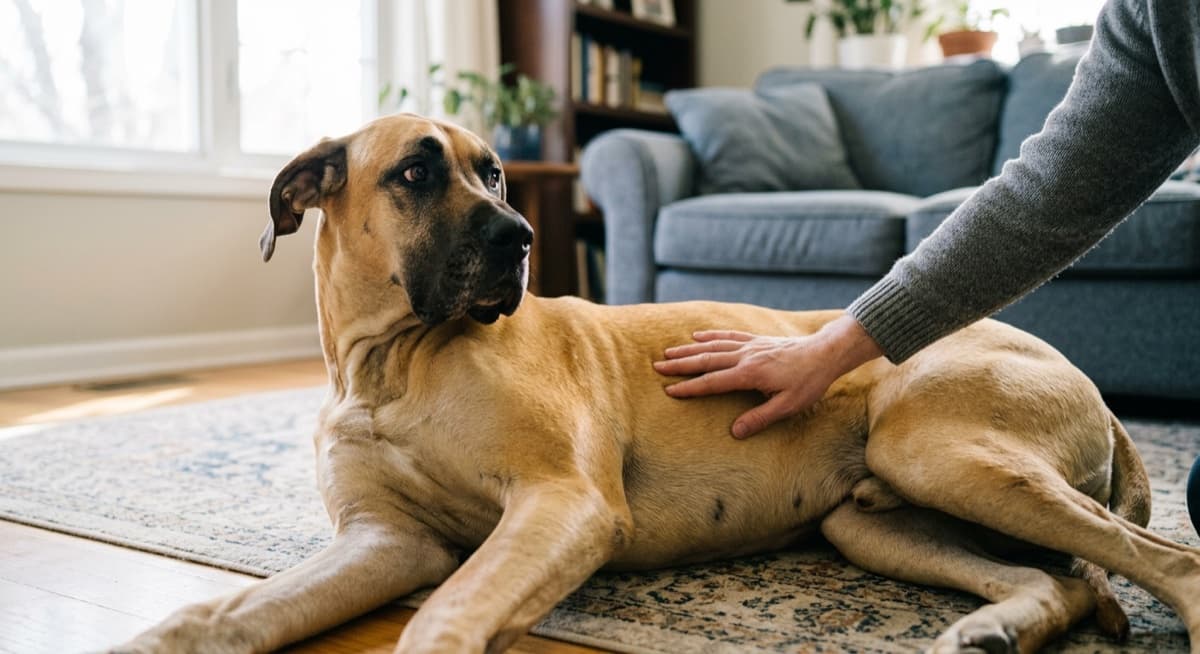
Great Danes are gentle, affectionate, surprisingly low-energy giants. They are also the breed at the highest lifetime risk of bloat. The American Kennel Club and the Great Dane Club of America both flag bloat as the single biggest medical concern in the breed. The reason recognition matters so much is timing: GDV moves from first symptom to life-threatening shock within hours, not days. The Calgary households that lose Danes to bloat are usually the ones who waited overnight or tried to treat it at home. The households that save them go straight to ER on the first round of unproductive retching. This article is the recognition guide. The treatment guide belongs to your vet.
What is bloat (GDV) in Great Danes?
Bloat has two stages, and the names matter. Gastric Dilatation is the first stage: the stomach fills with gas, food, and fluid, expanding beyond its normal size. On its own, dilatation is dangerous but sometimes resolvable with veterinary decompression. Volvulus is the second stage and the deadly one: the swollen stomach rotates or twists on its long axis, sealing off both ends. Gas cannot escape, blood flow to the stomach and spleen is cut off, and the surrounding tissue starts to die.
From the dog's perspective, the experience is rapid and visible. The belly visibly swells. The dog tries to vomit and cannot. Pain builds. Without surgical intervention to untwist the stomach and assess tissue damage, GDV is usually fatal. The American Veterinary Medical Association describes GDV as one of the top medical emergencies in large and giant breeds for exactly this reason: the window between symptom onset and irreversible damage is measured in hours.
Bloat is the centre of the Great Dane health conversation because it is both common in the breed and fast. Heart disease, joint disease, and cancer are also serious in Danes, but they progress over months or years. Bloat is the one that turns a normal evening into an emergency.
Why Great Danes are at the highest risk
Bloat risk follows body shape, not personality. The Great Dane has the deepest, narrowest chest of any common breed: tall, narrow ribcage, long abdomen, lots of room for the stomach to rotate inside the body cavity. Veterinary research, including the well-known Purdue bloat studies that ran from the late 1990s into the 2000s, has consistently identified the depth-to-width ratio of the chest as the single biggest anatomical risk factor.
Other deep-chested giant breeds carry elevated risk for the same reason: Saint Bernards, Mastiffs, Weimaraners, Standard Poodles, Irish Setters, Gordon Setters, German Shepherds, and Boxers all show higher bloat rates than the average dog. Great Danes consistently land at the top of those lists. Estimates of lifetime risk in the breed vary across published sources; this article uses directional phrasing (“highest of any breed,” “elevated lifetime risk”) rather than a fabricated percentage, because the exact number depends on the study population and the year.
Other factors discussed in the veterinary literature include older age, having a first-degree relative who experienced GDV, eating one large meal a day rather than multiple smaller ones, eating quickly, and a nervous or stressed temperament. None of these is a single cause; bloat is multifactorial. The conservative reading is: if you have a Great Dane, treat it as a lifetime high-risk dog and prepare accordingly.
Symptoms to recognize on sight
Recognition is the part of bloat care that owners actually control. Vets handle the rest, but only if the dog arrives in time. Memorize the following short list. Read it to anyone else who shares the household with your Dane: partner, kids over twelve, dog sitter, regular dog walker.
- Unproductive retching. The dog tries to vomit, you hear the heaving, but nothing comes up. This is the single most specific early warning sign of GDV. A Dane retching repeatedly with nothing coming up is an ER trip, not a wait-and-see.
- Distended abdomen. The belly is visibly larger than normal, often noticeably swollen behind the ribcage. To the touch it can feel tight, drum-like, or firm. Compare to what your dog's belly looks like on a normal evening; you want the comparison in your head before anything goes wrong.
- Restlessness and pacing. The dog cannot settle. It paces, tries to lie down, gets back up, circles, lies down again. This is one of the earliest behavioural signs, sometimes appearing before the belly is visibly distended.
- Excessive drooling. Often paired with the retching. Long ropes of saliva are common.
- Hunched posture, whining, looking at the abdomen. Signs of abdominal pain. The dog may stand with its back arched, head down, or turn and look back at its belly.
- Pale gums, weak pulse, collapse. Late signs of shock. By the time these appear, the situation is already critical. The earlier symptoms are what give you the window to act.
Symptoms typically come on fast, over minutes to an hour or two. They do not improve on their own. If anything, they accelerate. A Dane that started unproductively retching twenty minutes ago is a different dog than the one you petted before dinner. Treat any combination of unproductive retching plus a swollen belly as a confirmed bloat situation until a vet says otherwise.
When to go to the ER (now, not in the morning)
The hardest part of bloat care for new Dane owners is the urgency. There is no wait-and-see for GDV. There is no over-the-counter remedy. There is no safe home protocol. The behaviour Calgary emergency vets see most often in survivors’ families is exactly the same one they see least often in the dogs that did not make it: a fast decision to leave the house.
The rule is:
- Unproductive retching plus a swollen belly? Go now.
- Unproductive retching alone? Go now.
- Restlessness plus drooling plus hunched posture? Go now.
- It is 3 a.m.? Go now.
- The regular clinic opens in two hours? Go to the 24-hour emergency clinic now, not the regular clinic in two hours.
Calgary has several 24-hour emergency veterinary hospitals across the city. Know which one is closest to your home before you ever need it. Save the address, drive there once in daylight if you can, and program it into your phone the day you bring the Dane home. The favourite ER is the one closest to you with the route already in your head. For specific clinic options, consult your regular vet or the Canadian Veterinary Medical Association directory, then verify hours and intake practices directly with the clinic.
Calling ahead to the ER on the drive in is helpful when possible: it lets the clinic prepare for a possible GDV intake. But do not delay leaving the house to find a phone number. Drive first, call second.
What happens at the emergency vet (concept-level)
This section is descriptive, not prescriptive. Treatment decisions, medication choices, and surgical protocols belong to the veterinary team. What follows is what Calgary owners typically witness from the waiting-room side, so the experience feels less unfamiliar in the moment.
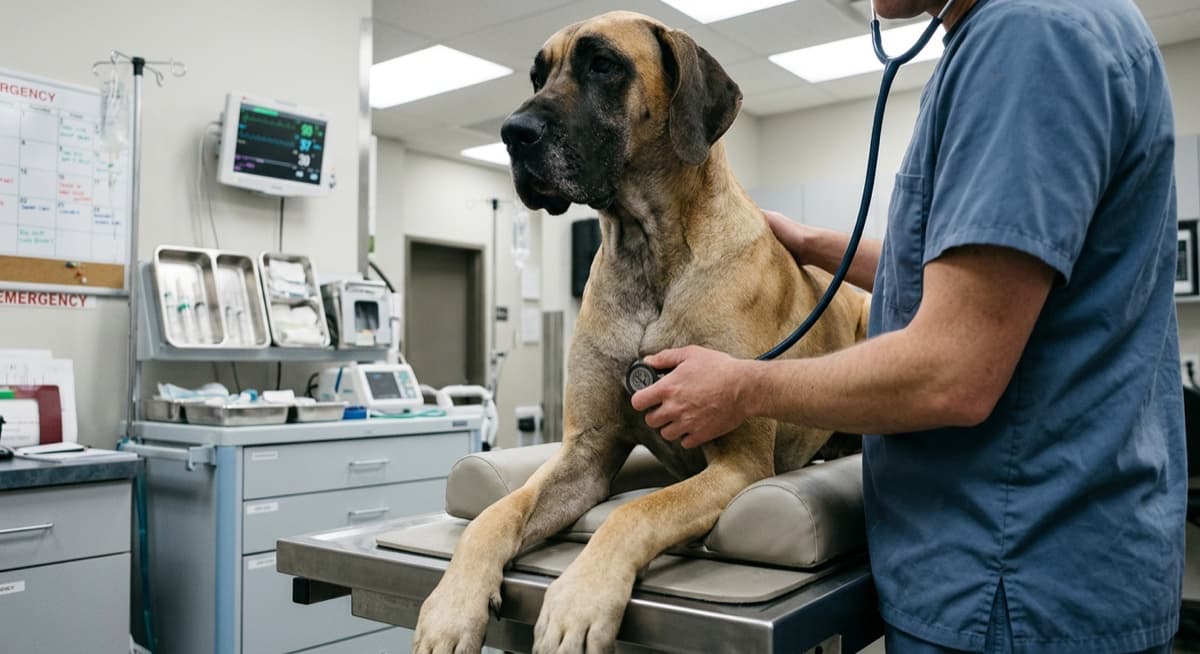
On arrival, the ER team will assess vital signs and confirm whether bloat is the working diagnosis. Imaging (typically X-rays) helps distinguish simple gastric dilatation from full volvulus, the difference matters because volvulus changes the urgency and the surgical plan. The team will work to stabilize the dog: intravenous fluids for shock, pain management, sometimes oxygen support.
If the stomach is dilated but not twisted, the team may decompress it (release gas pressure) to buy time and reduce damage. If volvulus is present or develops, surgery is the only definitive treatment. Surgery untwists the stomach, assesses tissue health, and almost always includes gastropexy at the same time (anchoring the stomach to the abdominal wall to prevent future twists). Spleen damage is common and may require partial or full splenectomy. Post-operative care typically involves hospitalization for several days for monitoring, fluids, and pain control.
This article does not include specific medications, doses, anesthesia plans, or surgical techniques because that information belongs in the veterinary team's hands, not on the internet. What an informed owner contributes is fast recognition, fast transport, and clear answers to the vet's questions about onset time, symptoms, and recent meals.
Gastropexy: preventive stomach-tacking explained
Gastropexy is a surgical procedure that anchors the stomach to the abdominal wall so it cannot rotate on its long axis. It does not stop the stomach from filling with gas (the “dilatation” part of GDV can still happen), but it dramatically reduces the risk of the life-threatening twist (the “volvulus” part). For a breed at the highest lifetime bloat risk, that is a meaningful intervention.
Gastropexy comes up in three contexts:
- Prophylactic (preventive) gastropexy. Discussed by vets at the time of spay or neuter, often when the Dane is six to eighteen months old. Combining it with an already-planned surgery means one anesthesia event instead of two. Many giant-breed-experienced Calgary vets recommend this conversation early.
- Gastropexy at the time of bloat surgery. Once a Dane has survived a GDV episode, gastropexy is essentially standard during the emergency operation, because the recurrence rate without it is high.
- Stand-alone gastropexy in an older dog. Less common, but discussed when a Dane is identified as elevated risk later in life (for example, after a relative experienced bloat).
The decision to pursue prophylactic gastropexy belongs between the owner and the vet. Factors that typically come up in that conversation: the dog's age, overall health, family history if known, the owner's tolerance for surgical recovery, and whether it can be combined with an already-planned spay or neuter. There is no single right answer for every Dane, but there is a right conversation: bring it up at your first or second vet visit, not after a scare.
Feeding practices and risk reduction (directional only)
No feeding plan prevents bloat. Anyone who tells you otherwise is overstating the evidence. What veterinary research suggests is that several practices may reduce risk modestly, none of them in a guaranteed way. The honest framing is: these are reasonable defaults to discuss with your vet, not a protocol that protects the dog.
Commonly discussed risk-reduction practices:
- Healthy weight management. Lean body condition is associated with lower overall bloat risk and better outcomes if bloat occurs. Discuss your Dane's target weight with your vet.
- Multiple smaller meals per day. Two or three smaller meals rather than one large daily feeding is commonly recommended. The reasoning is mechanical: a less-distended stomach has less room to twist.
- Slow-feeder bowls or puzzle feeders. Reducing the speed of eating reduces air-swallowing, which may reduce gas buildup. Slow-feeder bowls are inexpensive and a low-risk practice.
- Calm at mealtimes. Stress and high arousal during eating are sometimes flagged as risk factors. A quiet feeding area helps.
- Avoid heavy exercise immediately before or after meals. The conventional guidance is to wait at least one to two hours after a meal before strenuous activity, and to avoid a large meal immediately after intense exercise. There is debate about the strength of this evidence, but the practice has low cost and is widely repeated.
- Raised food bowls: disputed. Older guidance favoured raised bowls. The Purdue bloat studies and later analyses suggested raised bowls may actually increase risk in deep-chested breeds. The evidence on bowl height has been revised multiple times since the early 2000s, and the current conservative recommendation is to feed at floor level unless your vet says otherwise for a different reason. Do not assume a raised bowl protects your dog; current consensus runs the other way.
The most important sentence in this section is the one your vet will reinforce: no feeding practice replaces recognition and ER access. The strongest protection your Dane has against GDV is an owner who knows the symptoms and a 24-hour Calgary emergency clinic identified in advance.
Cost reality and the case for pet insurance
Bloat surgery is one of the most expensive single emergencies in giant-breed ownership. The total bill depends on the clinic, the surgical complexity, the length of hospitalization, whether splenectomy is needed, and whether post-operative complications develop. Specific dollar figures vary too much to publish here as a single number; consult the Calgary emergency clinic directly when planning a budget.
What is consistent across rescues and vets is the message: the bill can land in the thousands of dollars. For Calgary households, this is the single strongest case for pet insurance on a Great Dane. A bloat episode in an uninsured Dane is the kind of financial event that decides whether the dog gets surgery at all. An insured Dane brings the same urgency without the same financial cliff.
Pet insurance for giant breeds is its own conversation: premiums run higher than for medium breeds, deductibles and reimbursement rates vary by plan, and several breed health concerns can be plan exclusions if not added before they appear. The right time to look at insurance is at the time of adoption, not after a scare. See our dedicated Great Dane pet insurance guide for the Calgary-specific breakdown of premium ranges, coverage tiers, and the bloat-specific math that makes insurance worthwhile.
For a broader view of giant-breed cost of ownership in Calgary, food, vet visits, gear, insurance, grooming, daycare, and end-of-life costs, see our Great Dane cost of ownership guide.
Calgary 24-hour emergency vet planning: have a plan before you need one
The single most useful thing a new Dane owner can do in the first week is identify a 24-hour Calgary emergency veterinary clinic and save the address. The day a Dane bloats is not the day to start searching. The dog is showing symptoms in your living room, your neighbour is asking if the dog is okay, and Google Maps is open on your phone trying to find the closest after-hours clinic. The household that already has the address mapped saves minutes that matter.
A simple Calgary planning checklist for any Great Dane household:
- Identify the closest 24-hour emergency clinic. Ask your regular vet for a recommendation, or use the Canadian Veterinary Medical Association directory. Verify the clinic accepts walk-in emergencies and is genuinely open overnight, not just “extended hours.”
- Save the address in your phone with the name “DOG ER.” So you find it instantly. Save the clinic phone number under the same name.
- Drive the route once in daylight. Know where to park, where the entrance is, and which door is the after-hours intake. This is five minutes that pays off enormously if you ever need it.
- Tell your partner, kids over twelve, dog sitter, and dog walker. Anyone who might be alone with the dog should know the symptoms and the destination. Print a one-pager and stick it to the fridge if needed.
- Keep a backup plan for night or weather. Calgary winters and the occasional -30°C cold snap mean a car that does not start. Know a second clinic, or know who you would call for a ride. Chinook windstorms can also close certain routes; have one alternate route in mind.
- Know what to bring. Wallet, phone, leash, and the dog. That is it. Do not pack a bag, do not bring food, do not detour. The ER provides everything else.
Calgary's emergency veterinary capacity is real and reasonably distributed across the city, from the deep northwest near Bowness through the north centre, the downtown core near Beltline and Inglewood, and the south as far as Sue Higgins Park. Whichever neighbourhood you live in, there is a 24-hour option within a reasonable drive. Identify yours now.
Recovery and quality of life after bloat surgery
A Great Dane that survives bloat surgery and the immediate post-operative period generally returns to normal life, often with gastropexy completed at the same time. Recovery typically involves several days of hospitalization, a course of medication, restricted activity for several weeks, and a gradual return to normal exercise. Calgary vets handle the specifics of post-op care; the owner's role is following the discharge instructions exactly, watching the incision site, and recognizing if anything looks wrong on follow-up.
The good news with gastropexy is that the dog's lifetime risk of another twist drops sharply. The dog can still experience gastric dilatation (gas buildup), so symptom recognition remains useful for life, but the volvulus component, the deadly one, is largely off the table. Many post-bloat Danes go on to live the rest of their natural lifespan with normal quality of life.
The harder truth is that some Danes do not survive a GDV episode, particularly if presentation to the ER was delayed or if tissue damage was extensive by the time of surgery. This is the reason this article exists: minutes from symptom recognition to ER walk-in are the single biggest factor in outcome.
Browse Great Danes in Calgary
See current Great Danes and Dane mixes across 15+ Calgary rescues, refreshed regularly. If you are considering the breed, read the bloat warning above first, then plan the ER route and the insurance conversation before you bring the dog home.
See Calgary Great Danes available now →Frequently Asked Questions
What is bloat (GDV) in Great Danes?↓
What are the symptoms of bloat in a Great Dane?↓
How fast can bloat kill a Great Dane?↓
Should I get gastropexy surgery for my Great Dane?↓
Can I prevent bloat with food bowl height?↓
How much does emergency bloat surgery cost in Calgary?↓
What should I do if I think my Great Dane is bloating?↓
Are Great Dane mixes at risk for bloat too?↓
Continue reading
Great Dane adoption Calgary
The full Calgary Great Dane adoption guide: rescues, cost, lifespan, family fit, and the breed-defining bloat warning summarized.
Great Dane cost of ownership
What it actually costs to own a Great Dane in Calgary: food, vet, gear, insurance, daycare, and the long-tail medical reality.
Pet insurance for Great Danes
Calgary-specific pet insurance breakdown for Great Danes: premium ranges, coverage tiers, and the bloat math that makes insurance worthwhile.
Browse Calgary Great Danes
Currently available Great Danes and Dane mixes across Calgary rescues, refreshed regularly.
New dog? Start with these care guides
Everything a new adopter needs to set up a safe, happy home.