The short answer
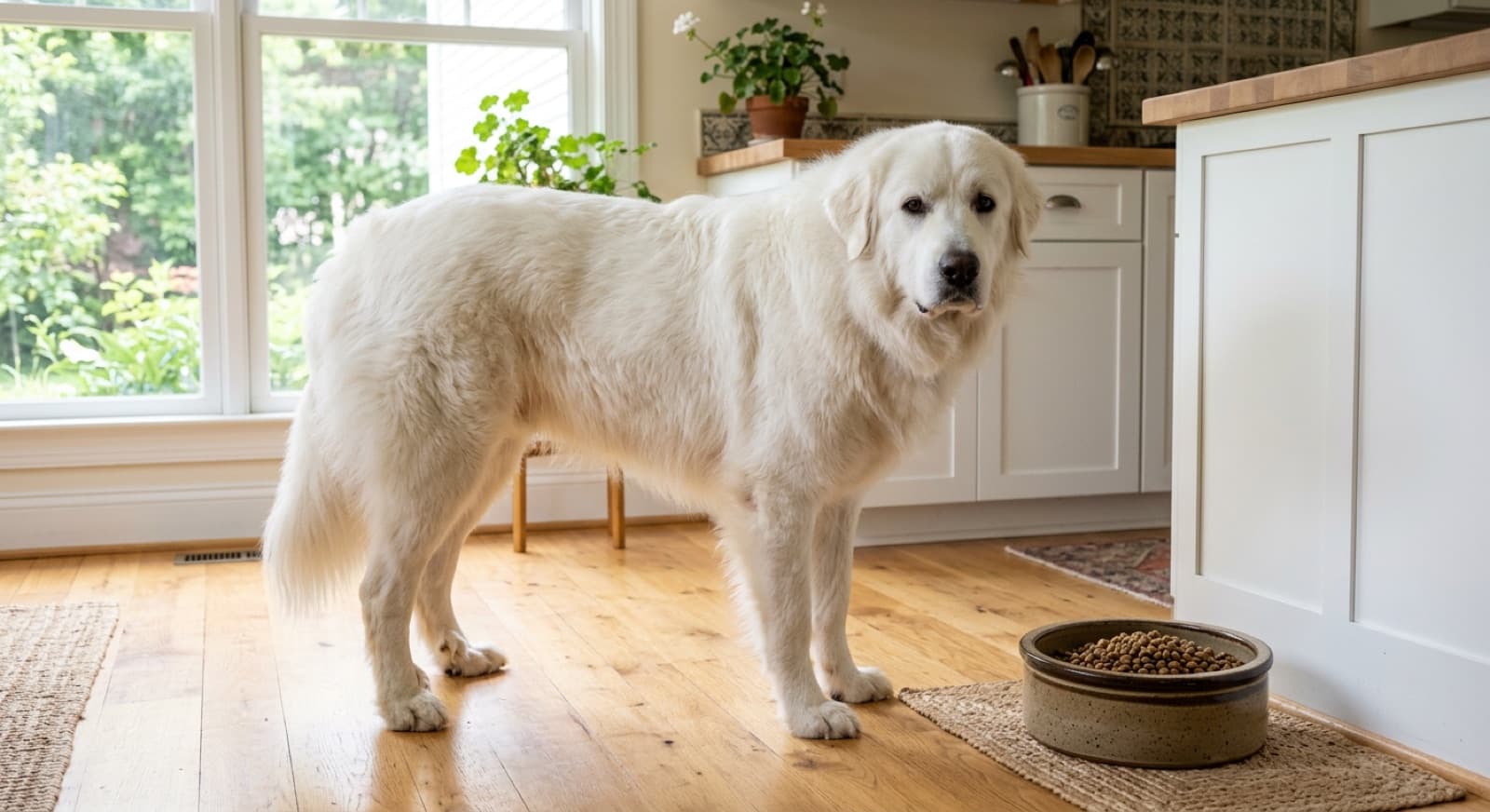
Feed a Great Pyrenees a complete diet, feed it less than its size suggests, and judge weight by feel under the coat. Pyrs are efficient eaters that self-regulate, so feed to body condition, not the bag. Grow the puppy slowly on a controlled-calcium large or giant-breed formula to 18 to 24 months, and do not free-feed a giant puppy or add calcium. Feed two or three smaller meals a day from the floor, never raised, because elevated bowls increase bloat risk. Keep the dog lean to protect its joints, and take comfort that the food bill is moderate for a giant.
The surprisingly small appetite
Almost every new Pyr owner has the same shock: their 100-pound dog eats less than a friend's Labrador. It is the most common observation in the owner community, where the stock line is “they eat when they eat, they're Pyrs.” And it is real, for two reasons worth getting right.
First, the metabolism math. A dog's calorie needs scale with body weight at roughly the three-quarter power, not in a straight line, so a giant breed genuinely burns fewer calories per pound than a small dog. A 100-pound Pyr needs far less per pound than a 15-pound terrier; this is true of all giant breeds, not a special Pyr trait. Second, temperament: Pyrenees are famously self-regulating, content to graze and skip a meal without drama. One piece of folklore to set aside is the romantic notion that Pyrs have a uniquely slow metabolism bred from guarding on mountain scraps. The honest version is giant-breed metabolic scaling plus a laid-back eater. The practical takeaway is the same either way: feed to the dog, not to the bag's generous chart.
Judge weight by feel, not sight
The second feeding challenge is that the dense white double coat hides the body completely, which is why Pyr forums fill with both “is my dog too skinny?” and “my vet called him fat” threads. You cannot eyeball a Pyr's condition. You have to use your hands.
Run your palms over the rib cage: you should feel the ribs easily under a thin layer of fat, feel a waist behind them, and feel a tuck at the belly, aiming for a lean 4 to 5 on the 9-point body condition scale. If you have to press to find the ribs, the dog is overweight. Experienced owners and breed-savvy vets deliberately keep Pyrs on the lean side, because keeping a giant lean protects the hips and joints. The landmark Purina lifespan study found lean dogs lived a median of nearly two years longer than overweight ones, so with a giant breed the lean rule genuinely buys time.
Growing a giant puppy slowly
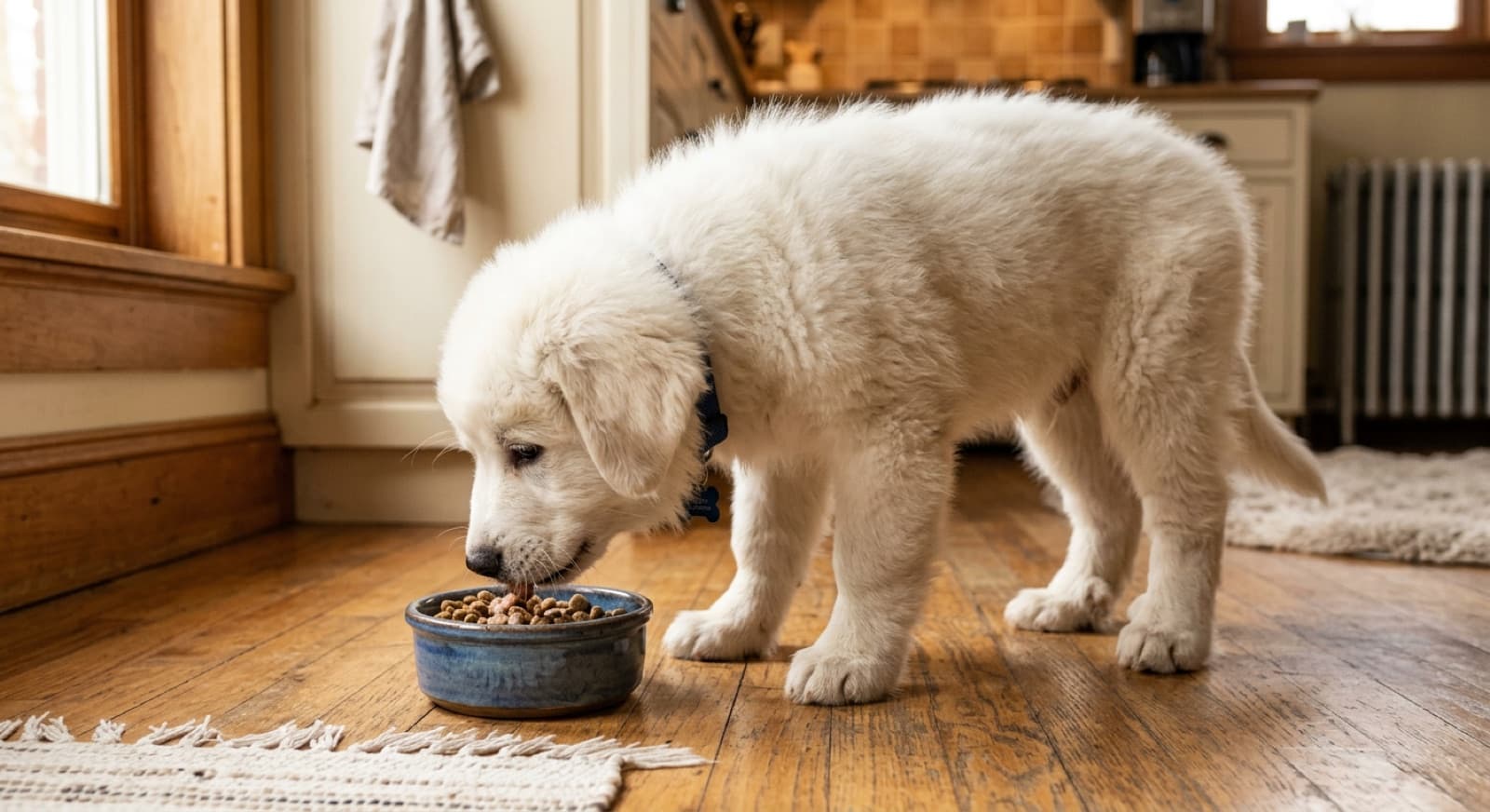
Do not free-feed a Pyr puppy or “let it eat all it wants” during a growth spurt, and never add a calcium supplement to a complete food. Overfeeding and excess calcium both cause permanent skeletal disease in a giant puppy.
This is the section where a mistake costs the dog for life. A Great Pyrenees is a giant breed, so the puppy needs a large or giant-breed puppy formula that controls calcium and calories to keep growth slow and steady, kept on it to roughly 18 to 24 months. As VCA explains, a giant puppy passively absorbs the calcium it eats and cannot down-regulate the excess, so too much calcium directly causes developmental orthopedic disease.
Two rules follow. Do not add a calcium supplement, cottage cheese, or bone meal to a complete puppy food, and do not free-feed or push fast growth. You may hear advice, even from a vet, to let a giant puppy eat all it wants during a growth spurt; that runs against the controlled-growth consensus, because overfeeding is itself a primary cause of joint disease. The breed guidance puts it bluntly: with a growing Pyr, better a little thin than a little fat. Keep the puppy lean and let the size come slowly.
Bloat, and the raised-bowl myth
Raised or elevated bowls do not prevent bloat. The large Purdue study found a raised feeder roughly doubled the risk in large and giant breeds. Feed a Great Pyrenees from the floor.
Bloat, or gastric dilatation-volvulus, is when the stomach fills with gas and twists, and it is a rapidly fatal emergency, with around a third of affected dogs dying even with treatment. As a deep-chested giant, the Pyr carries a real risk, though the owner community is notably measured about it, with long-time owners reporting decades without a case. The key correction is the raised bowl: the Glickman study found elevated feeders roughly doubled the risk, so feed from the floor, not a raised stand.
The habits that genuinely lower risk, per the AKC: feed two or three smaller meals a day instead of one large one, since one daily meal roughly doubles the risk, slow a fast eater, and keep the dog calm and rested for about an hour after eating. The most reliable protection is a preventive gastropexy, which tacks the stomach so it cannot twist; as owners correctly note, it prevents the deadly twist rather than the gas itself, and it is often bundled with spay or neuter. A swollen, drum-tight belly with unproductive retching is a go-to-the-emergency-vet-now situation.
Picky eaters and sensitive stomachs
Picky, intermittent eating is one of the most reported Pyr feeding quirks, and for a healthy adult the community's “they eat when they eat” is mostly right. The tactics owners lean on are a wet-food topper, warming the food to release its smell, feeding on a schedule rather than leaving the bowl down all day, and a spoon of plain canned pumpkin to settle a sensitive stomach. Avoiding constant food-switching helps too, since it can both upset the stomach and train a holdout.
The caveat that matters: do not write off every appetite change as fussiness. A sudden refusal in a normally good eater, or one paired with vomiting, diarrhea, or lethargy, deserves a vet visit, because real illness can hide behind apparent pickiness. And transition any new food gradually over seven to ten days to avoid the loose stools a Pyr can get from an abrupt switch.
Foods to avoid
Keep these away from a Great Pyrenees completely:
- Chocolate (darker is worse)
- Grapes and raisins (can cause kidney failure, even a few)
- Xylitol (in sugar-free gum, some peanut butters, and baking), which is rapidly fatal to dogs
- Onions, garlic, leeks, and chives
- Macadamia nuts
- Alcohol and caffeine
- Cooked bones (they splinter)
A Pyr can reach a counter without effort, so keep food and bins secured. If your dog eats something on this list, call your vet, the nearest emergency clinic, or a pet poison helpline right away.
Should I feed my Great Pyrenees a raw diet?
Only with a vet or veterinary nutritionist involved, and be especially careful with a growing puppy. Some Pyrs do well on a properly built raw diet, but the FDA warns raw meat carries a pathogen risk for the dog and the household, and balancing calcium in a homemade raw diet is genuinely hard, which is exactly the nutrient a giant-breed puppy cannot afford to get wrong.
For most Pyrs, a complete cooked or kibble diet from a nutritionist-backed brand matches raw on outcomes. If you go raw, especially for a puppy, work with a veterinary nutritionist on a complete, calcium-correct recipe rather than guessing.
Looking to adopt a Great Pyrenees?
Plan the lean-feeding and slow-growth routine before day one. Browse Great Pyrenees and Pyr mixes available now from the rescues we track across Canada.
See Available Great Pyrenees →Where to buy Great Pyrenees food
Every brand worth feeding a Pyr is easy to find in store and online:
- Pet specialty chains (Pet Planet, Tail Blazers, Tisol, and similar). Carry Pro Plan, Royal Canin (which makes a giant line), and large-breed formulas.
- Pet Valu and PetSmart. Stock the major large and giant-breed puppy and adult formulas.
- Your vet clinic. The best source for giant-breed puppy feeding guidance and prescription diets.
- Costco. Kirkland Signature large-breed is a cheaper everyday adult option, and a big bag lasts a long time with a modest eater.
Because a Pyr eats modestly for its size, buying the largest bag it finishes before the food goes stale, stored sealed, keeps the per-meal cost down. The major large-breed formulas are easy to set on a recurring delivery.
Frequently Asked Questions
How much should I feed a Great Pyrenees?
Far less than the size suggests, which surprises almost every new owner. Adults commonly eat somewhere in the range of four to six cups a day split into two meals, and many Pyrs eat even less, because giant breeds burn fewer calories per pound than smaller dogs and Pyrenees tend to self-regulate. Feed to body condition rather than the bag, which over-recommends, and because the thick coat hides the body, judge weight with your hands. Many owners are startled that a 100-pound dog eats less than a friend's Labrador, and a Pyr that picks at food or skips a meal is usually just being a Pyr.
Why does my Great Pyrenees eat so little?
Two real reasons. First, the metabolism math: a dog's calorie needs scale with body weight at roughly the three-quarter power, not in a straight line, so a giant breed genuinely needs fewer calories per pound than a small dog. A 100-pound Pyr eats far less per pound than a 15-pound terrier. Second, temperament: Pyrenees are famously self-regulating, unbothered grazers that eat when hungry and ignore the bowl when not. The popular idea that Pyrs have a uniquely slow metabolism from guarding on mountain scraps is folklore. The plain truth is giant-breed metabolism plus a laid-back eater.
Do I feed a Great Pyrenees puppy giant-breed puppy food?
Yes. A Great Pyrenees is a giant breed, so feed a large or giant-breed puppy formula, which controls calcium and calories to slow growth and protect developing joints, and keep the puppy on it until roughly 18 to 24 months. The danger is excess calcium and overfeeding, both established causes of developmental bone disease, because a giant puppy cannot regulate the calcium it absorbs. Do not free-feed a giant puppy or let it eat all it wants during a growth spurt, and never add a calcium supplement to a complete food. The breed guidance is blunt: better a little thin than a little fat.
Do raised or elevated bowls prevent bloat in a Great Pyrenees?
No, the opposite, and many Pyr owners have already learned this. The large Purdue study found a raised feeder roughly doubled the risk of bloat in large and giant breeds, reversing the old advice to elevate a tall dog's bowl. So feed a Great Pyrenees from the floor. The habits that genuinely help are feeding two or three smaller meals a day rather than one large one, slowing a fast eater, and keeping the dog calm and rested for about an hour after eating. A preventive gastropexy, which tacks the stomach so it cannot twist, is the most reliable protection and is often bundled with spay or neuter.
How do I tell if my Great Pyrenees is overweight under all that coat?
By feel, never by sight, because the dense double coat hides the body completely. Run your hands over the rib cage: you should feel the ribs easily under a thin layer of fat, feel a waist behind them, and feel a tuck at the belly. If you have to press to find the ribs, the dog is overweight no matter how it looks. Vets familiar with the breed keep Pyrs on the lean side, around a 4 to 5 on the 9-point scale, because keeping a giant lean protects the hips and joints and is linked to a longer, healthier life. Do this check monthly.
My Great Pyrenees is a picky eater. Is something wrong?
Usually not. Picky, intermittent eating is one of the most common things Pyr owners report, and the community's stock reassurance, "they eat when they eat," is mostly right for a healthy adult. Tactics that help include a wet-food topper, warming the food, feeding on a schedule rather than leaving the bowl down, and a spoon of plain canned pumpkin for a sensitive stomach. That said, a sudden change in a normally good eater, or refusal paired with vomiting, diarrhea, or lethargy, is a reason to see the vet rather than wait it out, because true illness can hide behind apparent fussiness.
Do Great Pyrenees cost a fortune to feed?
Less than people fear, which is the happy surprise of the breed. Because a Pyr eats modestly for its size, a large bag of food lasts a long time, and owners often report a giant-breed food bill that is moderate rather than huge. The real costs of the breed are veterinary, especially planning for giant-breed care, not the monthly food. Buying the largest bag your Pyr finishes before it goes stale, stored sealed, keeps the per-meal cost down. So budget seriously for vet care and insurance, but do not expect the food bill to match the dog's size.
What to Feed a Newfoundland
Another gentle giant that eats less than its size suggests.
What to Feed a Great Dane
The calcium-and-bloat playbook for the top bloat-risk giant.
What to Feed a St. Bernard
Controlled-calcium growth and bloat care for another giant.
Great Pyrenees for Adoption
Live listings of Great Pyrenees and Pyr mixes from the rescues we track.