The short answer
Feed a Newfoundland puppy a controlled-calcium large or giant-breed puppy food, grow it slowly, and keep it lean. Calcium, not protein, is what breaks a giant puppy, so the calcium number on the bag matters more than anything else. An adult Newf eats less than you would guess, around four cups a day of a complete large-breed food, fed in two meals from the floor. Feed two or more smaller meals, use a slow feeder, and never raise the bowl, because elevated feeders increase bloat risk rather than prevent it. Skip calcium supplements entirely.
How much should I feed a Newfoundland?
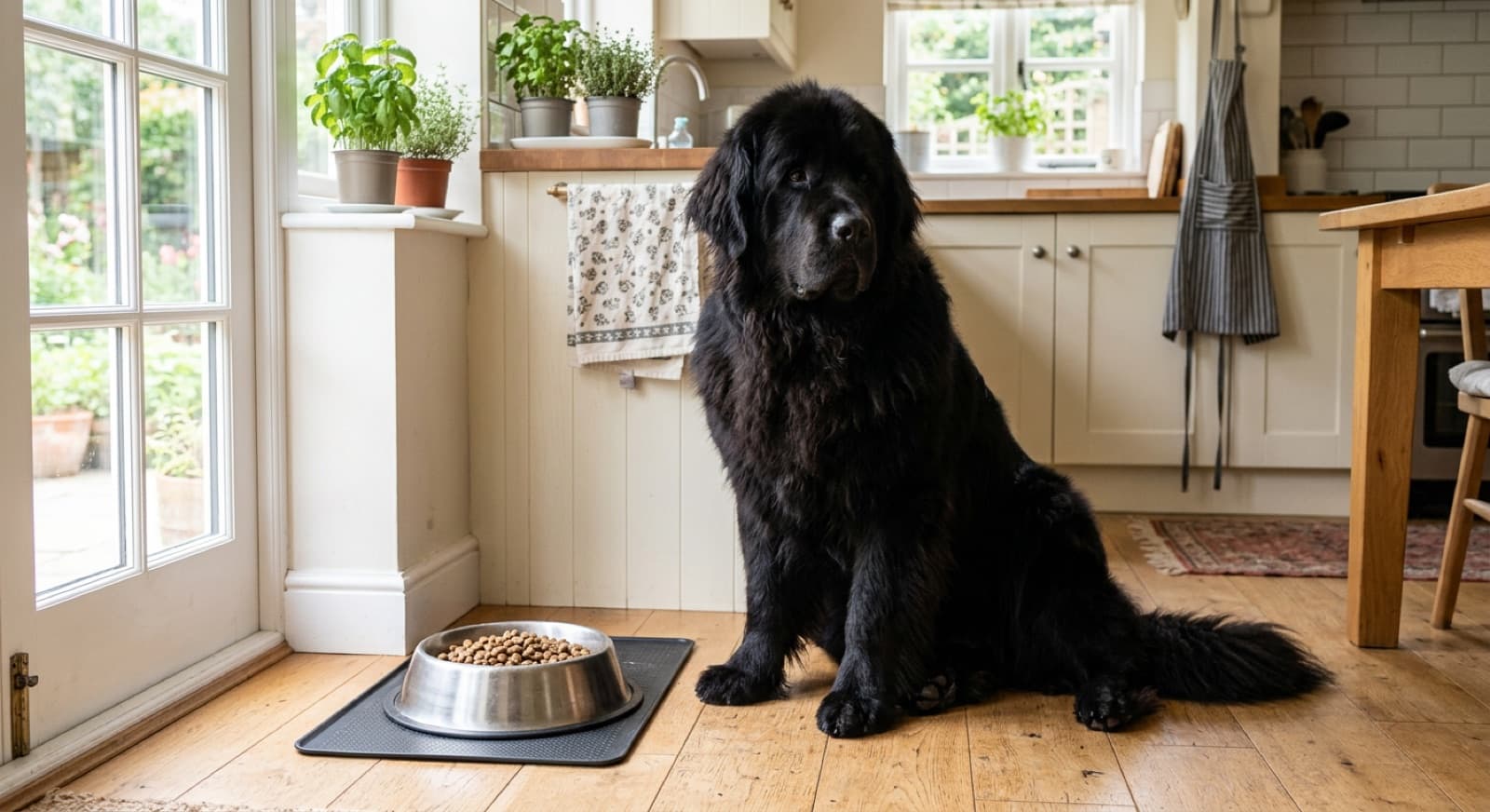
Far less than the frame suggests. The single most common surprise new Newf owners hit is that a 130-pound dog does not eat a 130-pound dog's worth of food. The Newfoundland Club of America puts it plainly: contrary to their size, Newfoundlands do not need a lot of food. A typical adult eats roughly four cups of a quality food a day split across two meals, which works out to about one large bag a month.
The reason is metabolic. Calories scale with body weight at roughly the three-quarter power, not in a straight line, so a giant breed burns fewer calories per pound than a small one. A naive “one cup per 25 pounds” rule over-predicts what a Newf actually needs. Use the four-cup figure as a starting point, then adjust to body condition rather than to a chart. You should be able to feel the ribs under that thick coat without pressing hard.
What is the best food for a Newfoundland?
There is no single best bag, and any site that names one is selling something. The standard most vets point to comes from the WSAVA global nutrition guidelines: pick a brand that employs a full-time, board-certified veterinary nutritionist and runs feeding trials.
For an adult Newf the safe defaults are Purina Pro Plan Large Breed, Royal Canin (which makes a giant line), Hill's Science Diet, and Eukanuba.
For a giant breed, the nutrient profile beats the brand, and the number that matters most is calcium. That thread runs through the rest of this guide, so it is worth saying up front: get the puppy's calcium right and you have done the most important thing feeding can do for a Newfoundland.
Calcium, not protein: growing a giant puppy right
This is the section that matters most, because a feeding mistake in the first two years shows up as joint disease for the rest of the dog's life.
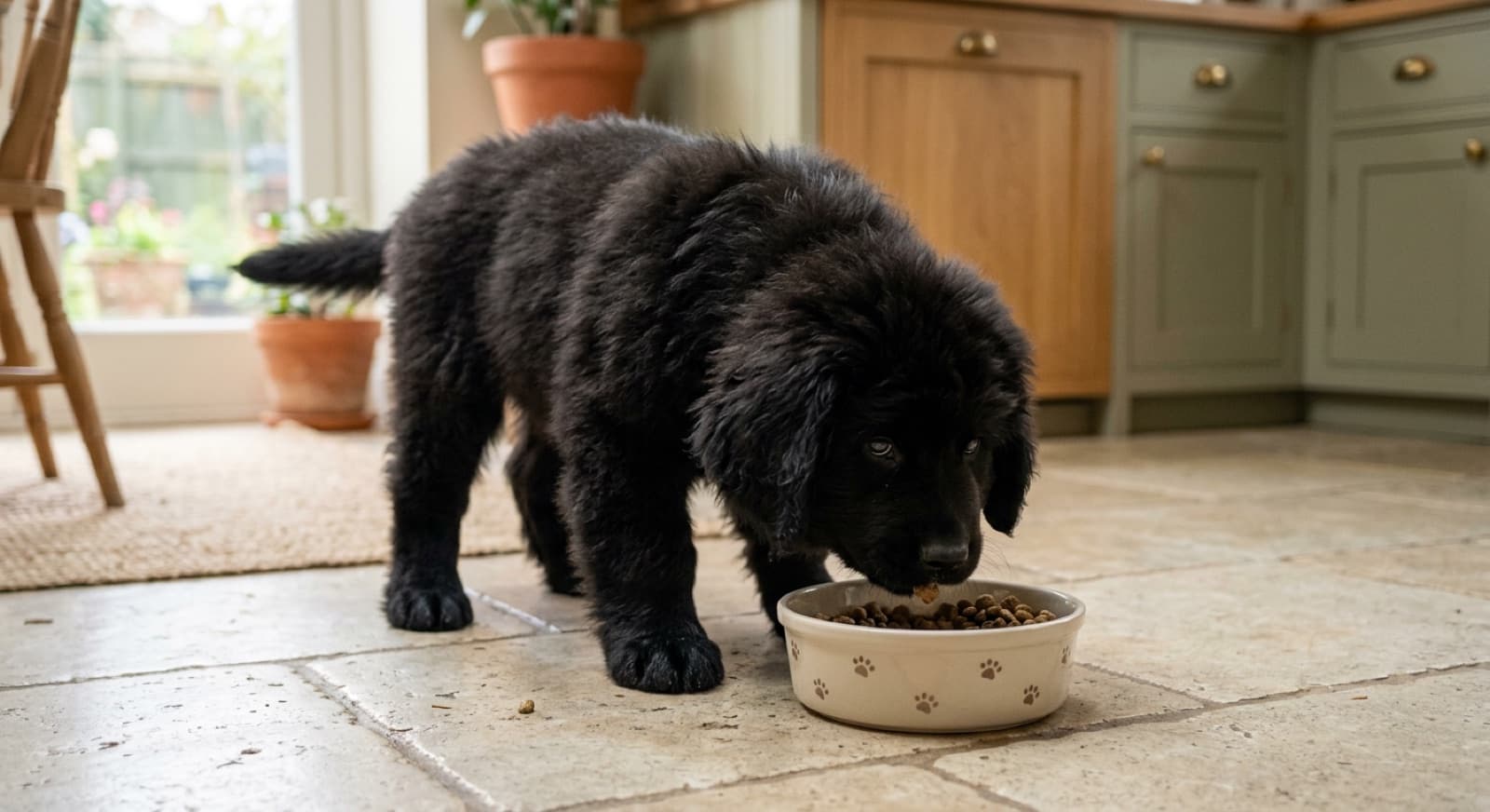
A Newfoundland puppy cannot regulate the calcium it absorbs. The Merck Veterinary Manual notes that giant-breed dogs fed excess calcium are more likely to develop osteochondrosis and other developmental bone disease. Whatever calcium is in the bowl goes into the body, so the food has to set the limit for you. That is exactly what a large or giant-breed puppy formula is built to do.
The AAFCO statement on the bag is your checkable test. As VCA Hospitals explains, growth foods must state whether they are formulated for the growth of large-size dogs, defined as 70 pounds or more as an adult. A Newf puppy needs a food whose statement includes large-size growth. Protein is not the villain here; the old fear that high protein speeds growth has not held up. Excess calcium and too many calories are what do the damage.
Two rules follow from this: do not free-feed a Newf puppy, and do not add a calcium supplement to a complete food. Both raise the risk of the orthopedic disease you are trying to avoid.
Grow it slowly, keep it lean
A Newfoundland grows for around 18 to 24 months, far longer than a medium-sized dog, and the most damaging instinct is to feed it big to grow it big. Fast growth on a heavy frame is what stresses developing hips and elbows.
Keep the puppy lean throughout, around a 4 on the 9-point body condition scale, which looks slightly too thin to most new owners. It is not. Experienced giant-breed people put it well: if you have to choose, choose slightly underweight every time. Feed three meals a day as a young puppy, dropping to two as it grows, and adjust portions to hold that lean condition. Filling out a Newf happens on its own and late; rushing it with food only costs the joints.
Bloat, and the raised-bowl myth
Raised or elevated bowls do not prevent bloat in a Newfoundland. The large Purdue study found they were associated with an increased risk. Feed a Newf from the floor.
Bloat, or gastric dilatation-volvulus, is when the stomach fills with gas and twists on itself, cutting off blood flow. Cornell's Riney Canine Health Center describes it as rapidly life-threatening, and the Newfoundland is a named at-risk deep-chested breed.
The raised-bowl myth is so widespread that many owners buy elevated feeders believing they help. The best available research points the other way. The feeding habits that genuinely lower risk: feed two or more smaller meals a day instead of one large one, slow a fast eater with a slow-feeder bowl, and avoid hard exercise for about an hour around meals. The AKC notes dogs fed one meal a day are twice as likely to bloat as those fed two. The single most reliable protection is a preventive gastropexy, which tacks the stomach so it cannot twist. A swollen belly, unproductive retching, or sudden distress is a go-to-the-emergency-vet-now situation.
Which Newfoundland health issues are actually about diet?
Newf owners often lump every health worry into “what should I feed,” so it helps to separate what diet really controls from what it does not.
Cystinuria is the one true diet link. The Newfoundland carries an inherited form of cystinuria, a kidney defect that lets cystine build up in the urine and form stones. It is genetic in origin, but management is dietary and medical: a vet-prescribed lower-protein, alkalinizing diet plus high water intake to keep the urine dilute. The Merck Veterinary Manual covers this kind of urinary stone management. This is not a do-it-yourself project; if your Newf is diagnosed, the diet comes from your vet.
Hip and elbow dysplasia are partly diet-influenced. The genes set the risk, but keeping the puppy lean during growth and the adult at a healthy weight reduces how badly it shows up.
Subvalvular aortic stenosis and hypothyroidism are not diet problems. SAS is a congenital heart defect, and hypothyroidism is an autoimmune condition treated with daily medication. Diet does not cause or fix either, though a Newf that is suddenly gaining weight on a normal portion is worth a thyroid test rather than a food change.
Drool, water, and the mealtime mess
This is the part nobody warns you about. A Newfoundland's loose jowls hold and fling saliva, and the anticipation of food turns the kitchen floor into a slip hazard at every meal. They are also famously messy drinkers who leave a trail of water across the room.
The water matters beyond the mess. Steady hydration supports kidney and urinary health, which ties straight back to the cystinuria point above, so a big, heavy, always-full water bowl is part of the feeding setup, not an afterthought. Most owners give up trying to train the drool away, because you cannot, and manage it with a bowl mat, a nearby towel, and a bib for the worst droolers. A wide-muzzled Newf also struggles with some slow-feeder designs, so choose one with broad, shallow channels rather than tight maze patterns.
Foods to avoid
Keep these away from a Newfoundland completely:
- Chocolate (darker is worse)
- Grapes and raisins (can cause kidney failure, even a few)
- Xylitol (in sugar-free gum, some peanut butters, and baking), which is rapidly fatal to dogs
- Onions, garlic, leeks, and chives
- Macadamia nuts
- Alcohol and caffeine
- Cooked bones (they splinter)
A Newf can clear a counter without standing up, so keep food and bins out of reach. If your dog does eat something on this list, call your vet, the nearest emergency clinic, or a pet poison helpline right away.
Should I feed my Newfoundland a raw diet?
Only with a vet or veterinary nutritionist involved, and be especially careful with a growing puppy. Some Newfs do well on a properly built raw diet, but the FDA warns that raw meat carries a pathogen risk for the dog and the household. Balancing calcium in a homemade raw diet is also genuinely hard, which is exactly the nutrient a giant-breed puppy cannot afford to get wrong.
For most Newfs, a complete cooked or kibble diet from a nutritionist-backed brand matches raw on outcomes. If you go raw, especially for a puppy, work with a veterinary nutritionist on a complete, calcium-correct recipe rather than guessing.
Looking to adopt a Newfoundland?
Plan the puppy growth and calcium plan before day one. Browse Newfoundlands and Newf mixes available now from the rescues we track.
See Available Newfoundlands →Where to buy Newfoundland food
Every brand worth feeding a Newf is easy to find in store and online:
- Pet specialty chains (Pet Planet, Tail Blazers, Tisol, and similar). Carry Pro Plan, Royal Canin, and giant-breed lines.
- Pet Valu and PetSmart. National chains that stock the major large-breed puppy and adult formulas.
- Your vet clinic. The best source for giant-breed puppy feeding guidance and the prescription diet if cystinuria is ever diagnosed.
- Costco. Kirkland Signature large-breed is a cheaper everyday adult option.
Because a Newf eats about a bag a month, buying the largest bag it finishes before the food goes stale, stored sealed, keeps the per-meal cost down. The major large-breed formulas are easy to set on a recurring delivery.
Frequently Asked Questions
How much should I feed a Newfoundland?
Less than the size suggests, which surprises almost everyone. The Newfoundland Club of America notes that despite their bulk Newfs are not big eaters for their size, and a typical adult eats around four cups of a quality food a day split into two meals. That works out to roughly one large bag a month. Feed to body condition rather than a chart: you should be able to feel the ribs under the coat without pressing hard. Growing puppies eat more, split across three meals.
What is the best food for a Newfoundland?
For a puppy, a food with controlled calcium built for large or giant breeds is the priority, not the brand on the bag. For an adult, a complete large-breed formula from a brand that employs a board-certified veterinary nutritionist and runs feeding trials, such as Purina Pro Plan, Royal Canin, Hill's Science Diet, or Eukanuba. With a giant breed the nutrient profile, especially calcium, matters more than the label. Start with whatever the breeder or rescue was feeding and transition over seven to ten days.
Do I feed a Newfoundland puppy large-breed puppy food?
Yes. A Newfoundland is a giant breed, and AAFCO requires growth foods to state whether they are formulated for the growth of large-size dogs, meaning 70 pounds or more as an adult. A Newf puppy must be on a food whose statement includes large-size growth. These formulas control calcium and calories to force slow, steady growth that protects developing joints. The single biggest mistake is feeding a regular puppy food, free-feeding, or adding a calcium supplement, all of which speed growth and raise the risk of orthopedic disease.
Do raised or elevated bowls prevent bloat in a Newfoundland?
No, and this is the most important feeding myth to correct for the breed. The large Purdue study on bloat found elevated feeders were associated with an increased risk of gastric dilatation-volvulus in large and giant breeds, not a reduced one, likely because dogs eat faster from them. Feed a Newfoundland from the floor. The habits that genuinely help are smaller, more frequent meals, a slow-feeder bowl, and no hard exercise around mealtimes. The most reliable protection is a preventive gastropexy, worth discussing with your vet.
How long does a Newfoundland stay on puppy food?
Longer than a medium-sized dog. Giant breeds grow for about 18 to 24 months, and most vets keep a Newf on a large or giant-breed puppy formula until somewhere in that window, then transition to an adult large-breed food. The aim through the whole growth period is to keep the puppy lean, around a 4 on the 9-point body condition scale, because slow growth on a lean frame is what protects the hips and elbows a Newf depends on for a long life. Confirm the switch timing with your vet.
Why does my Newfoundland make such a mess at meals and water?
Drool and water everywhere are part of owning a Newfoundland, not a feeding problem. Their loose jowls hold and fling saliva, and food anticipation triggers it, so a wet floor at mealtimes is normal. They are also famously messy drinkers and go through a lot of water, which matters because steady hydration supports kidney and urinary health. Most owners manage it with a large, heavy water bowl, a mat underneath, and a towel nearby rather than trying to train it out, because you cannot.
Should I feed my Newfoundland grain-free?
Not unless your vet diagnoses a grain allergy. The FDA has been investigating a possible link between grain-free diets built on peas, lentils, and potatoes and a heart condition called dilated cardiomyopathy. Most vets steer giant-breed owners toward established, nutritionist-backed brands over boutique grain-free. A complete diet from a feeding-trial brand is the safer default. If your Newf has genuine food sensitivities, work the problem out with your vet rather than guessing with a boutique recipe.
What to Feed a Great Dane
The same giant-breed calcium and bloat rules, for the other gentle giant.
What to Feed a Bernese Mountain Dog
Controlled growth and portions for another big, double-coated working breed.
What to Feed a Mastiff
Giant-breed feeding from puppyhood through a big, slow-growing adult.
Newfoundlands for Adoption
Live listings of Newfoundlands and Newf mixes from the rescues we track.