The short answer
Give your cat outlets for its natural behaviours: daily interactive wand play that ends in a real catch, food puzzles that turn meals into a hunt, vertical space to climb and survey, sturdy scratching posts, and sensory extras like catnip and a window view. Vets call enrichment preventative health care, not pampering. Some links here are Amazon affiliate links; we may earn a small commission at no extra cost to you, and it never changes what we recommend.
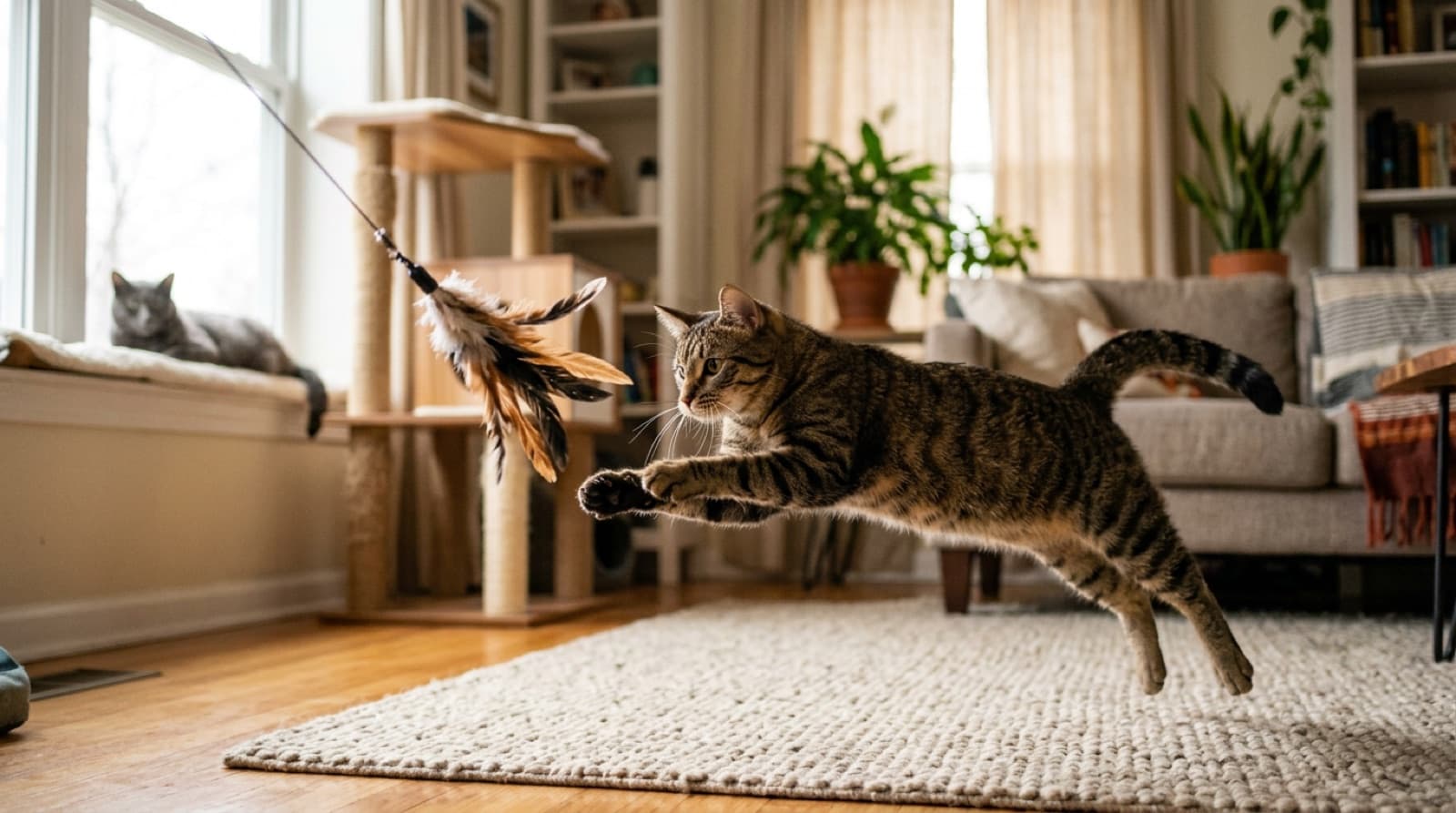
Indoor living protects a cat from cars, predators, fights, and most infectious disease, which is why nearly every rescue places cats as indoor-only. But that safety comes with a responsibility: a cat kept inside still has every instinct of a hunter, and a barren home gives those instincts nowhere to go. The Ohio State University Indoor Pet Initiative frames environmental enrichment as preventative health care for cats, on the same footing as vaccination and good nutrition, not as an optional extra. Get it right and you have a calm, engaged, well-adjusted cat. Get it wrong and the drive to hunt, climb, and scratch does not disappear, it redirects.
That redirection is what most “behaviour problems” actually are. An under-stimulated cat is prone to boredom and low-grade stress, and downstream of that come weight gain from inactivity, over-grooming, scratching the furniture, ankle-attacks and inter-cat tension, and inappropriate elimination, which is one of the most common reasons cats are surrendered in the first place. For a newly adopted cat, setting up enrichment before they arrive is one of the highest-leverage things you can do for a smooth transition, alongside the settling-in timeline in our first week with a rescue cat guide.
The five pillars of a healthy feline environment
The clearest framework comes from the AAFP and ISFM Feline Environmental Needs Guidelines, which describe meeting a cat's environmental needs as essential, not optional, for its wellbeing. Everything else in this guide hangs off these five:
- A safe place. Every cat needs a private, secure retreat where it can withdraw and feel unobserved, ideally elevated, since cats feel safest looking down on their territory. Provide at least one per cat, and in multi-cat homes use hideaways with more than one exit so a cat can never be cornered.
- Multiple, separated key resources. Food, water, litter, scratching, play, and resting spots should exist in several locations and be physically separated, food away from water, both well away from the litter box, so cats are not forced into competition or ambush.
- Opportunity for play and predatory behaviour. The drive to stalk, chase, pounce and catch is a hardwired need. Support it with interactive play and with feeding that makes the cat work for its food.
- Positive, consistent, predictable human interaction. Cats generally prefer frequent, low-intensity contact on their own terms. Let the cat initiate and end the interaction rather than forcing it.
- Respect for the cat's sense of smell. Cats navigate and feel secure through scent. Avoid overwhelming them with strong cleaners, scented litter and air fresheners, let their own scent persist on bedding, and let them scent-mark by scratching.
Enrichment, category by category
Play and the hunt sequence
A cat's hunt runs in a sequence: stalk, chase, pounce, catch, kill, then eat. The single most important rule of play is to let the cat complete that sequence rather than chasing endlessly with no payoff. In practice that means short, frequent, interactive sessions where you animate the “prey.” Move a wand or teaser toy like a real animal, away from and hiding from the cat rather than toward it, and let the cat actually catch and “kill” it at the end. Time sessions just before meals so the whole arc mirrors hunt-then-eat, which is also the fix for the cat that wakes you at 3 a.m. For solo hours, interactive or motorized toys and kicker toys the cat can grab and bunny-kick help, and rotating which toys are out keeps them from going invisible through familiarity.
On laser pointers: they are not banned, but laser-only play is a real problem. The cat can never physically catch light, and that unfinished hunt causes frustration that research has linked to abnormal repetitive behaviours. If you use one, always end the game by landing the dot on a real toy or a treat the cat can actually pounce on and catch.
Vertical space and climbing
Height means both safety and surveillance to a cat, which is why vertical space serves the first two pillars at once. Elevated perches let a cat monitor its territory and rest undisturbed, and in a small home they multiply the usable space, while in a multi-cat home more vertical real estate is one of the best ways to defuse tension. Give a mix of heights and a way to climb between them: a cat tree, a set of wall-mounted shelves, and a window perch for watching the world. And do not overlook the free option: a plain cardboard box is genuinely enriching, a hideaway and a toy in one.
Scratching
Scratching is a need, not misbehaviour. It conditions the claws, stretches the body, and leaves scent and visual marks that make a cat feel the territory is its own. A cat with no acceptable surface will use your sofa, so shredded furniture is a provisioning failure rather than spite. Offer both vertical and horizontal options: a tall, sturdy sisal post that lets the cat stretch fully and will not wobble, plus a flat cardboard scratcher. Place them in socially important, high-traffic spots and near where the cat sleeps, since cats love to stretch and scratch on waking. For redirecting a cat that has already claimed the furniture, our full stop-scratching-the-furniture guide walks through it.
Foraging and food puzzles
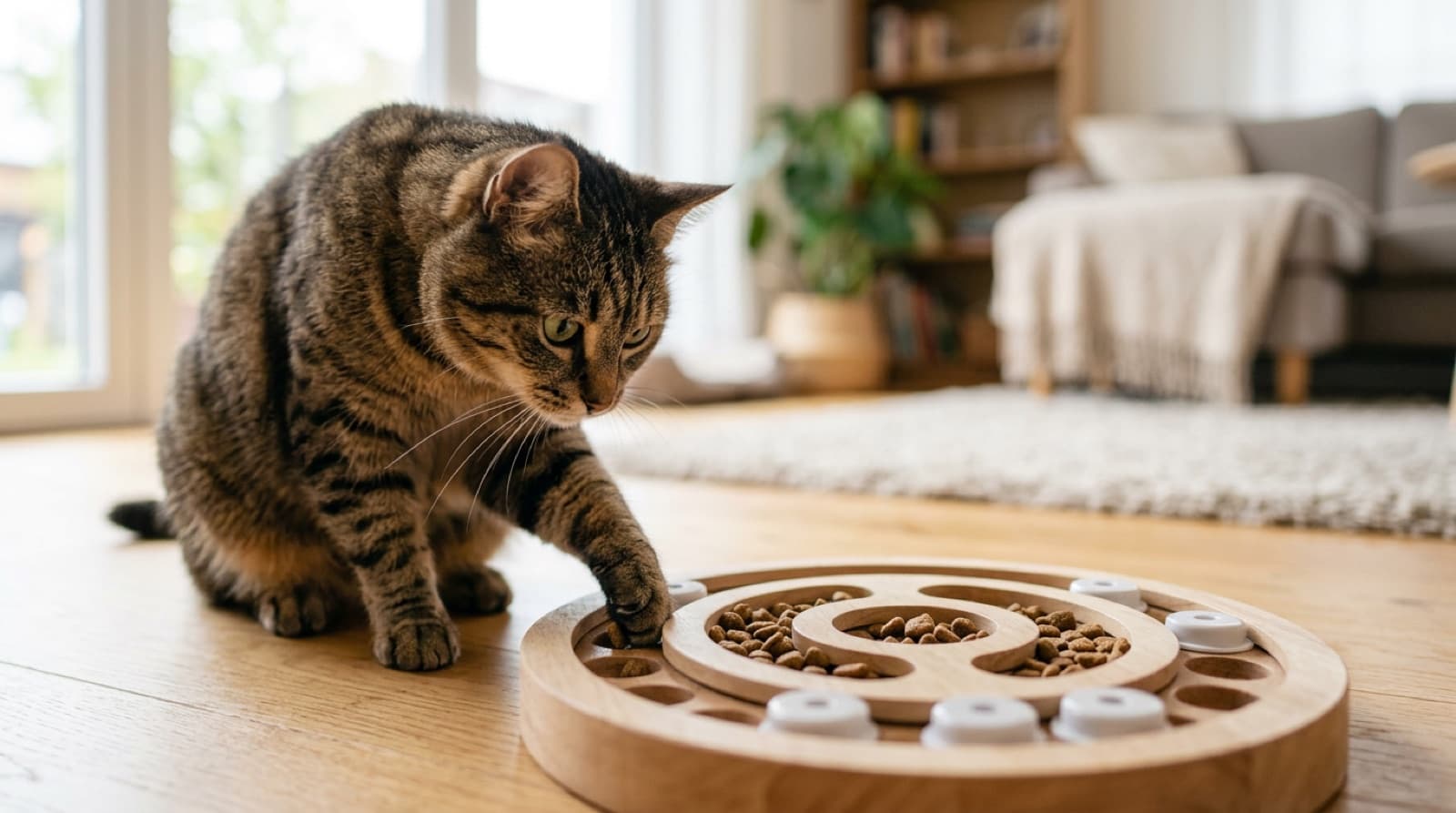
In the wild a cat makes ten to twenty small kills a day and works for every one. A bowl of free-fed food removes all of that effort at once, which is a recipe for boredom and weight gain. Making the cat forage restores the mental work and slows down fast eaters. Start easy with a simple puzzle feeder the cat can win quickly, then raise the difficulty as its skill grows, and add a rolling treat-dispensing ball or a slow feeder for gulpers. Scattering or hiding portions of the daily ration around the home spreads the activity across the day, which is especially useful for the hours you are out.
Sensory enrichment
Scent and safe watching are enrichment a cat can enjoy passively, even alone. Catnip gives responders a pleasant buzz, but around a third of cats do not react to it, since the response is inherited and kittens rarely show it before a few months old. For those cats, silvervine is the strong alternative: a 2017 study found about 80 percent of cats responded to silvervine, and importantly around three-quarters of the cats that ignored catnip did respond to it. A pot of cat grass satisfies the urge to graze and steers a cat away from your (often toxic) houseplants. And a window perch beside an active bird feeder is some of the best passive enrichment there is, hours of “cat TV” for free.
Safe access to the outdoors
The outdoors is the richest sensory environment there is, and the goal is to deliver some of it without the mortality risk of free-roaming. A catio or a secured window box gives filtered air, sun and sights in complete safety. Some cats also take to harness-and-leash outings, introduced slowly indoors with treats and plenty of patience, though not every cat is a candidate and it should never be forced. For the full case on why indoor-with-enrichment beats free-roaming, see our guide on indoor versus outdoor cats.
Building it into a routine
Enrichment works when it is a habit, not a one-off shopping spree. Anchor the day with one or two interactive play sessions of about ten to fifteen minutes, and put one right before a meal so the cat completes the hunt-then-eat cycle. Rotate the toys on a weekly cycle: keep two or three out, stash the rest, and swap them, which gets you novelty from the same toys at no cost. For the hours you are away, lean on the passive layer, food puzzles and scattered forage, a window perch with a view, safe solo toys, and a fresh hit of catnip, silvervine or cat grass, all set up before you leave rather than after the cat is already bored.
In a multi-cat home, the quiet key is the n+1 rule: provide one more of each key resource than you have cats, so three cats means four litter boxes, four feeding stations, and plenty of separated resting, scratching and climbing spots, spread apart so no cat can guard another's access. This is the second pillar in action, and it is the single biggest lever against inter-cat tension, resource competition, and the litter-box avoidance that so often follows.
Enrichment is prevention, not a cure. A sudden change needs a vet.
Enrichment lowers the risk of stress and boredom behaviours, but it is not a treatment for an established problem. A sudden change, new hiding, over-grooming to bald patches, new aggression, appetite loss, or litter-box avoidance, can be medical (pain, urinary disease, thyroid trouble) or a sign of significant stress. The right order is: notice the change, rule out a medical cause with your vet first, then address the environment, often with enrichment as part of the support plan. A gadget is never the answer to a cat that has suddenly changed.
Find your match
Set the enrichment up first, then bring home your cat. Browse adoptable cats from rescues across Canada.
Browse Adoptable Cats →Frequently asked questions
How do I keep my indoor cat entertained?
Give the hunting instinct real outlets: daily interactive wand play that ends in a catch, food puzzles that turn mealtime into a hunt, vertical space and window perches to climb and survey, sturdy scratching posts, and rotated toys so novelty does not fade. The trick is matching the enrichment to what your individual cat actually chases and enjoys, then keeping it consistent.
Are indoor cats bored, and can they be happy?
Indoor cats can be perfectly happy, but only if the home gives their natural behaviours somewhere to go. A barren environment leaves a cat safe but under-stimulated, which is where boredom and stress-related problems start. Ohio State's Indoor Pet Initiative stresses that indoor cats need just as much mental and physical stimulation as outdoor cats, delivered through enrichment.
How much playtime does a cat need?
Aim for one or two interactive sessions a day of roughly ten to fifteen minutes each, ideally right before meals so play flows into eating like a real hunt. Consistency and letting the cat actually catch the toy matter more than one long marathon session. Many behaviour problems ease once a cat gets a reliable daily hunt.
Do indoor cats need a cat tree?
Vertical space is a core feline need, not a luxury. Height lets a cat feel safe, survey its territory and rest undisturbed, and it defuses tension in multi-cat homes. A cat tree, a set of wall shelves, or a simple window perch all provide it, so the form matters less than giving the cat somewhere to climb and look down from.
How do I exercise an indoor cat?
Interactive wand play that makes the cat chase, pounce and leap is the best exercise, backed up by food puzzles and treat balls that get it moving for meals, plus vertical space to climb. Playing before feeding and rotating toys keeps a cat engaged enough to actually burn energy, which is one of the best defences against the weight gain common in sedentary indoor cats.
Are laser pointers bad for cats?
Lasers are not inherently bad, but laser-only play is a problem, because the cat can never catch the light and that unfinished hunt causes frustration, which research has linked to abnormal repetitive behaviours. Use one safely by always ending the game with the dot landing on a physical toy or a treat the cat can really pounce on and catch, so the hunt gets to finish.
What is cat enrichment?
Enrichment means shaping a cat's environment and routine so it can perform its natural behaviours: hunting, climbing, scratching, foraging, exploring and retreating to safety. Vets frame it as preventative health care, on par with vaccination and good nutrition, rather than as an optional extra, because meeting those behavioural needs is what keeps an indoor cat physically and mentally well.
How do I entertain a cat while I am at work?
Set up passive enrichment before you leave rather than after the cat is already bored: food puzzles and scattered forage, a window perch with a view (a bird feeder outside makes excellent cat TV), safe solo toys, and a refresh of catnip, silvervine or cat grass. Rotate what is out so the same items keep their novelty through the week.
Do indoor cats get depressed, and when should I worry?
Cats do not experience depression exactly as people do, but chronic boredom and stress in an under-enriched home can cause withdrawal, over-grooming, appetite changes and other signs of poor welfare. Because those signs overlap with illness, a sudden change in behaviour should be checked by a vet first, before it is assumed to be boredom, and enrichment then supports recovery rather than replacing a diagnosis.