The short answer
Feed an Old English Sheepdog a complete large-breed food, keep it lean, and judge its weight with your hands. The coat hides everything, so a monthly hands-on rib check is the only reliable way to catch weight gain, and a lean OES gets less hip arthritis and lives longer. Puppies need a controlled-calcium large-breed formula until about 12 to 15 months, with no added supplements. Feed two meals a day from the floor, never raised, since elevated bowls raise bloat risk. And know that omega-3 helps the skin, but the coat itself is genetics and grooming.
Judge the dog by feel, not by sight
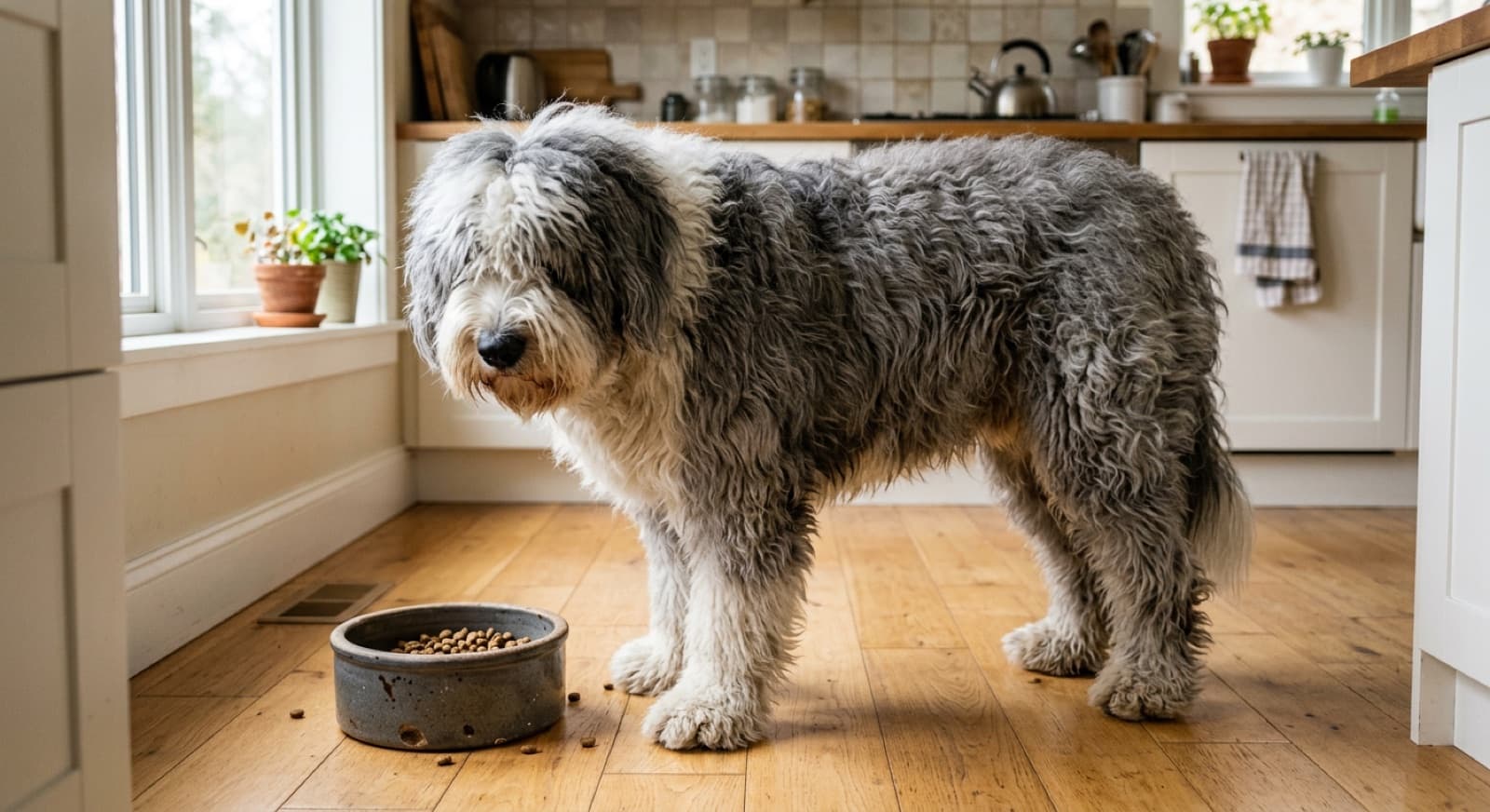
This is the rule that matters most for the breed, because the Old English Sheepdog's thick double coat completely obscures its body shape. You simply cannot see whether an OES is getting fat, which is exactly how a coated dog gains a lot of weight before anyone notices.
So you assess by hand. Run your palms over the rib cage: you should feel the ribs easily under a light layer of fat, feel a waist behind them, and feel a tuck up at the belly. If you have to press to find the ribs, the dog is overweight, whatever the fluff suggests. Do this monthly against a standard body condition score. The payoff is real: the landmark Purina lifespan study found dogs kept lean had far less hip arthritis and lived a median of nearly two years longer than their overweight littermates. For a breed already prone to hip dysplasia, keeping the dog lean is the highest-value feeding decision you make.
Growing an OES puppy
Do not add a calcium or vitamin supplement to a complete large-breed puppy food. Excess calcium during growth raises the risk of permanent skeletal disease in a large-breed puppy.
An Old English Sheepdog is a large breed, so the puppy needs a food formulated for large-breed growth. These foods deliberately control calcium and calories to keep growth slow and steady, which is what protects the developing hips and elbows. Look for the AAFCO statement that the food is for growth, ideally noting it includes the growth of large-size dogs.
The danger is excess calcium, which a large-breed puppy absorbs and cannot regulate, so the firm rule is to feed a complete large-breed puppy food and add nothing to it. Keep the puppy on that formula until roughly 12 to 15 months, then transition to an adult large-breed food, and keep it lean the whole way, since fast growth on a heavy frame is what stresses the joints. Confirm the switch timing with your vet.
Bloat, and the raised-bowl myth
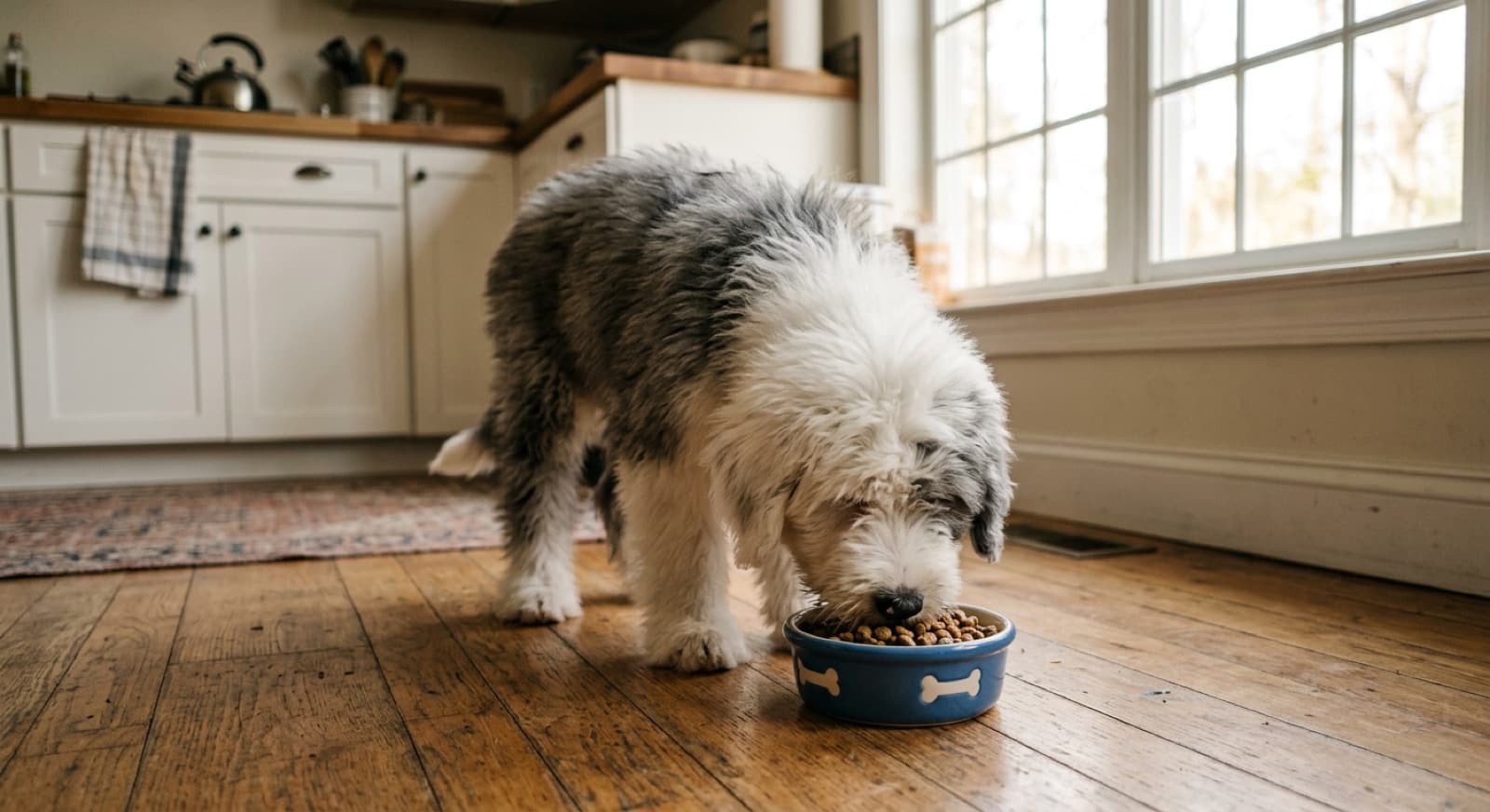
Raised or elevated bowls do not prevent bloat. The large Purdue study found they were associated with an increased risk. Feed an OES from the floor.
Bloat, or gastric dilatation-volvulus, is when the stomach fills with gas and twists, and it is rapidly fatal without emergency surgery. The Old English Sheepdog is a deep-chested large breed, so it carries an elevated risk worth knowing about, but it is fair to be honest about the tier: the OES does not appear on the highest-risk lists alongside the Great Dane, St. Bernard, and Weimaraner, and has no published high lifetime-risk figure. Treat it as a moderate, above-average risk, not a giant-breed emergency.
The prevention is still worth doing. The AKC notes that dogs fed one large meal a day are twice as likely to bloat as those fed two, and fast eaters are at roughly five times the risk, so feed two meals and slow a gulper with a slow-feeder bowl on the floor. The old raised-bowl advice has been reversed: the research found elevated feeders increased risk. A preventive gastropexy, which tacks the stomach so it cannot twist, is a reasonable thing to discuss with your vet, though for a moderate-risk breed it is a choice rather than a default. A swollen, drum-tight belly with unproductive retching is an emergency.
What diet does, and does not, do for the coat
People buy an OES for the coat, so it is worth being clear about what food can and cannot do. Diet affects skin health and coat condition, not the coat's volume, length, or texture, which come from genetics and grooming. The most evidence-backed nutrient here is omega-3 (EPA and DHA), which reduces inflammation and itch and improves shine, usually over about four to six weeks, as the AKC covers. A complete, quality diet plus omega-3 supports a healthy skin barrier under all that hair. But no food grows the show coat, so do not expect a diet change to create one.
There is also a practical, breed-specific reality: an OES is a messy eater and drinker, and food and water catch in the beard and face furnishings, where they trap crumbs, stain, smell, and mat. Wipe the beard after meals, consider a snood at mealtimes, use a narrower or deeper bowl that the face fits into more cleanly, and keep the muzzle furnishings trimmed. None of that is a health issue, but it makes daily feeding far less of a mess.
Which OES health issues are about diet?
Owners tend to file every health worry under feeding, so it helps to separate what diet controls from what it does not.
- Obesity and joint strain (diet): the everyday issue, and the reason the feel-not-look rule matters so much for a coated breed.
- Hip dysplasia (diet modifies it): the genes set the risk, but keeping the puppy growing slowly and the adult lean reduces how badly it shows. The OES has notably high hip dysplasia rates, so weight is the lever you control.
- Bloat (feeding practices): not caused by a food, but meal frequency, eating speed, and bowl height are all within your control.
- Hypothyroidism (not caused by diet): common in the breed, it causes weight gain with a dull coat and low energy, so owners blame food. The Merck Veterinary Manual describes it; it is treated with daily medication. Unexplained weight gain deserves a thyroid test, not just a smaller bowl.
- Cerebellar ataxia, eye disease, and immune-mediated conditions (not diet): these are genetic or immune problems with no dietary cause or cure.
Foods to avoid
Keep these away from an Old English Sheepdog completely:
- Chocolate (darker is worse)
- Grapes and raisins (can cause kidney failure, even a few)
- Xylitol (in sugar-free gum, some peanut butters, and baking), which is rapidly fatal to dogs
- Onions, garlic, leeks, and chives
- Macadamia nuts
- Alcohol and caffeine
- Cooked bones (they splinter)
A big dog can reach counters and bins easily, so keep food secured. If your OES eats something on this list, call your vet, the nearest emergency clinic, or a pet poison helpline right away.
Should I feed my OES a raw diet?
Only with a vet or veterinary nutritionist involved, and be careful with a growing puppy. Some dogs do well on a properly built raw diet, but the FDA warns that raw meat carries a pathogen risk for the dog and the household, and home-built raw diets are commonly unbalanced, which matters most for a large-breed puppy whose calcium has to be right.
For most OES, a complete cooked or kibble diet from a nutritionist-backed brand matches raw on outcomes. If you go raw, work with a veterinary nutritionist on a complete recipe rather than improvising.
Looking to adopt an Old English Sheepdog?
Plan the lean-feeding and grooming routine before day one. Browse Old English Sheepdogs and OES mixes available now from the rescues we track across Canada.
See Available Old English Sheepdogs →Where to buy Old English Sheepdog food
Every brand worth feeding an OES is easy to find in store and online:
- Pet specialty chains (Pet Planet, Tail Blazers, Tisol, and similar). Carry Pro Plan, Royal Canin, and large-breed formulas.
- Pet Valu and PetSmart. Stock the major large-breed puppy and adult formulas.
- Your vet clinic. The best source for large-breed puppy guidance and weight-management diets.
- Costco. Kirkland Signature large-breed is a cheaper everyday adult option.
Buying the largest bag your OES finishes before the food goes stale, stored sealed, keeps the per-meal cost down. The major large-breed formulas are easy to set on a recurring delivery. A quality omega-3 supplement is a sensible add for the skin under that coat.
Frequently Asked Questions
How do I tell if my Old English Sheepdog is overweight under all that coat?
By feel, not by sight, because the double coat completely hides the body. Run your hands over the rib cage: you should be able to feel the ribs easily under a light layer of fat, feel a waist behind them, and feel an abdominal tuck. If you have to press to find the ribs, the dog is overweight no matter how it looks. Do this hands-on body condition check monthly, since a coated breed can gain a lot before it shows. Keeping an OES lean is the single most valuable thing its diet does, because lean dogs get less hip arthritis and live longer.
How much should I feed an Old English Sheepdog?
Less than the bag usually says. OES are large but moderate-energy dogs with a tendency to gain weight easily, so they often need less than a busy sporting dog of the same size, and bag charts tend to over-recommend. Feed adults twice a day and adjust the amount to hold a lean body condition you confirm with your hands, not to a chart. Growing puppies eat more, split across more meals. The exact cups depend heavily on the food's calorie density, so read the calories per cup and tune from there.
Do I feed an Old English Sheepdog puppy large-breed puppy food?
Yes. An OES is a large breed, so use a food formulated for large-breed growth, which controls calcium and calories to keep growth slow and steady and protect the developing joints. Look for the AAFCO statement that the food is for growth, ideally including large-size dogs. Keep the puppy on it until roughly 12 to 15 months, then transition to adult. The key mistake to avoid is adding a calcium or vitamin supplement to a complete puppy food, which speeds growth and raises the risk of developmental bone disease rather than helping.
Do raised or elevated bowls prevent bloat in an Old English Sheepdog?
No, the opposite. Older advice recommended raised bowls, but the large Purdue study found elevated feeders were associated with an increased risk of bloat, so feed an OES from the floor. The OES is a deep-chested large breed, so bloat is worth knowing about, though its risk is moderate, well below giant breeds like the Great Dane. The habits that genuinely lower risk are feeding two meals a day instead of one, slowing a fast eater with a slow-feeder bowl, and avoiding hard exercise around meals. A preventive gastropexy is a reasonable thing to discuss with your vet.
Does diet make an Old English Sheepdog's coat better?
It affects skin health and coat condition, but not the volume or texture of that famous coat, which come from genetics and grooming. The most evidence-backed nutrient for the skin and coat is omega-3 (EPA and DHA), which reduces inflammation and itch and improves shine, usually over about four to six weeks. A complete, quality diet plus omega-3 supports a healthy skin barrier. But no food grows the show coat, so think of diet as supporting healthy skin under the coat, not creating the coat itself.
My Old English Sheepdog is gaining weight and seems sluggish. Is it the food?
Maybe, but in this breed think of the thyroid first. Hypothyroidism is one of the most common OES health problems, and it causes weight gain without an increase in appetite, along with lethargy and a dull, thinning coat. Owners often blame the food and cut portions when the real issue is the thyroid gland, which is treated with daily medication, not diet. If your OES is gaining weight on a normal amount of food, especially with low energy and a flat coat, ask your vet for a thyroid panel rather than just feeding less.
Should I feed my Old English Sheepdog grain-free for itchy skin?
Not as a first move. Most itchy skin is environmental allergy, not food allergy, and even true food allergies are usually to proteins like chicken or beef, not grains. The FDA has also been investigating a possible link between grain-free diets built on peas, lentils, and potatoes and a heart condition called dilated cardiomyopathy. If you genuinely suspect a food allergy, the reliable approach is a vet-supervised elimination diet, not an over-the-counter grain-free switch. Work an itchy OES up with your vet, who will usually look at fleas and environmental causes first.
What to Feed a Bernese Mountain Dog
Controlled growth and portions for another big, double-coated breed.
What to Feed a Great Dane
The calcium and bloat rules in depth, for a top-tier-risk giant breed.
What to Feed a Golden Retriever
Body condition and coat-supporting nutrition for another coated breed.
Old English Sheepdogs for Adoption
Live listings of OES and OES mixes from the rescues we track.