The short answer
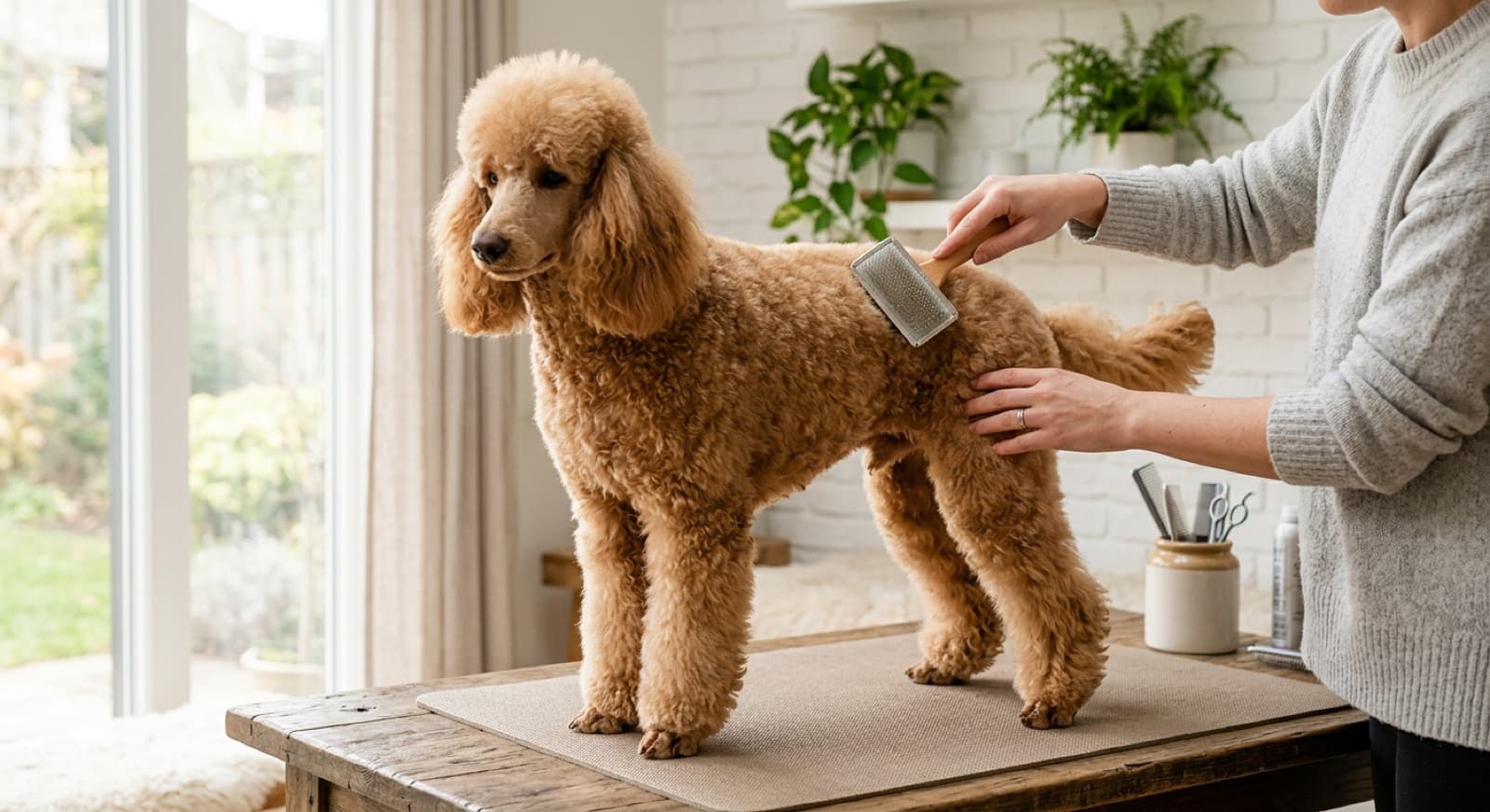
A full Poodle coat is either a near-daily brushing habit or a professional groom every 4 to 6 weeks. There is no low-effort middle. The coat is single-layer, continuously growing hair that holds shed hair instead of dropping it, so it mats fast without upkeep. The one skill that actually prevents mats is line brushing, brushing down to the skin and checking with a metal comb, on a dry coat only. Expect a matting crisis during the coat change between 9 and 18 months. And if you want the lowest-maintenance option, keep the dog in a short kennel clip.
It is hair, not fur, and that explains everything
Almost everything about grooming a Poodle comes back to one fact: the coat is continuously growing hair, much like human hair, rather than fur. It does not shed out and stop at a set length. It keeps growing until you cut it, and it is a single coat with no downy undercoat, which is a fundamental difference from double-coated breeds like a Husky or Golden.
That single trait is the source of the Poodle's whole reputation. It is why they shed so little, why they are marketed as a good match for allergy sufferers, and, in the very same breath, why they mat and demand so much maintenance. When a Poodle sheds a hair, that hair does not fall to the floor. It stays tangled in the surrounding curl until you brush it out, which is exactly the mechanism that forms mats. The American Kennel Club covers the fundamentals of the coat well.
One honest note on the allergy question. Low shedding and low airborne dander are real, but no dog is truly hypoallergenic, and grooming is what keeps the dander down in the first place. If allergies are the reason you are considering a Poodle, spend real time with an individual dog before you commit.
The one skill that matters: line brushing
The single biggest mistake Poodle owners make is surface brushing. You run a brush over the top of the coat, it looks fluffy and finished, and a felt mat is quietly forming at the skin underneath where the brush never reached. Weeks later the groomer finds it, and the dog gets a shave-down.
The fix is a technique called line brushing. You part the coat in a line, hold the hair above the part out of the way, and brush the exposed section from the skin outward with a slicker brush, then move the part down a little and repeat. Work in sections until you have covered the whole dog. The confirmation step is non-negotiable: run a metal comb through each section down to the skin. If the comb glides root to tip, that section is done. If it snags, it is not brushed out, no matter how good the top looks. A light mist of detangling spray helps the comb move through tougher spots.
Some of the product links in this section are Amazon affiliate links — we may earn a small commission at no extra cost to you. It never changes which products we recommend.
Two rules save most owners. First, brush a dry coat, never a wet or damp one, because water tightens tangles into mats. Second, hit the friction zones every day even when you skip a full brush: behind the ears, under the collar or harness, the armpits, the groin and sanitary area, the tail base, and the hocks. Owners repeatedly call the ears the very worst spot. A 60-second daily check of those places prevents the large majority of mats.
The coat change nobody warns you about
Between 9 and 18 months, a Poodle's coat mats relentlessly no matter how carefully you brush. This is the coat change, it is normal, and it is not your fault. Many owners clip short to get through it.
This is the part first-time owners are never warned about, and it is the most valuable thing in this guide. Somewhere between about 9 and 18 months of age, a Poodle transitions from its soft puppy coat to its coarser adult coat. For a few months the two textures grow in together, and they wrap around each other and mat constantly, regardless of how diligent you are. Owners who were brushing every day suddenly feel like they are failing. They are not.
The honest advice is to stop fighting it. A short clip through the coat change is not giving up, it is the sensible move that experienced owners make. Once the adult coat is fully in, the matting eases dramatically, and a well-maintained adult Poodle rarely mats unless it is genuinely neglected. If you know this is coming, you get through it with a short-haired dog and your sanity intact instead of a pelted dog at an emergency groom.
Bathing and drying: the dryer is half the job
Bathing a Poodle is straightforward, but the drying is where the coat is won or lost. Always brush the coat out completely before the bath, because you cannot wash a knot out, you can only wash it tighter. Use a dog shampoo and a conditioner, since conditioner improves how the coat combs afterward, and rinse thoroughly, since residue itself can irritate the skin.
Then comes the step home groomers underestimate: drying. If you let a Poodle air-dry, the curl re-forms around any remaining tangle and sets it into a mat. The tool that solves this is a high-velocity dryer, which blows the water out of the coat and straightens the curl as you brush along with it, leaving a coat that is dramatically easier to work with and far less likely to mat. This one tool is the difference between a home groomer's flat, tangly finish and the straight, brushable coat a professional produces.
Clipping at home: clippers, blades, and the face-feet-tail
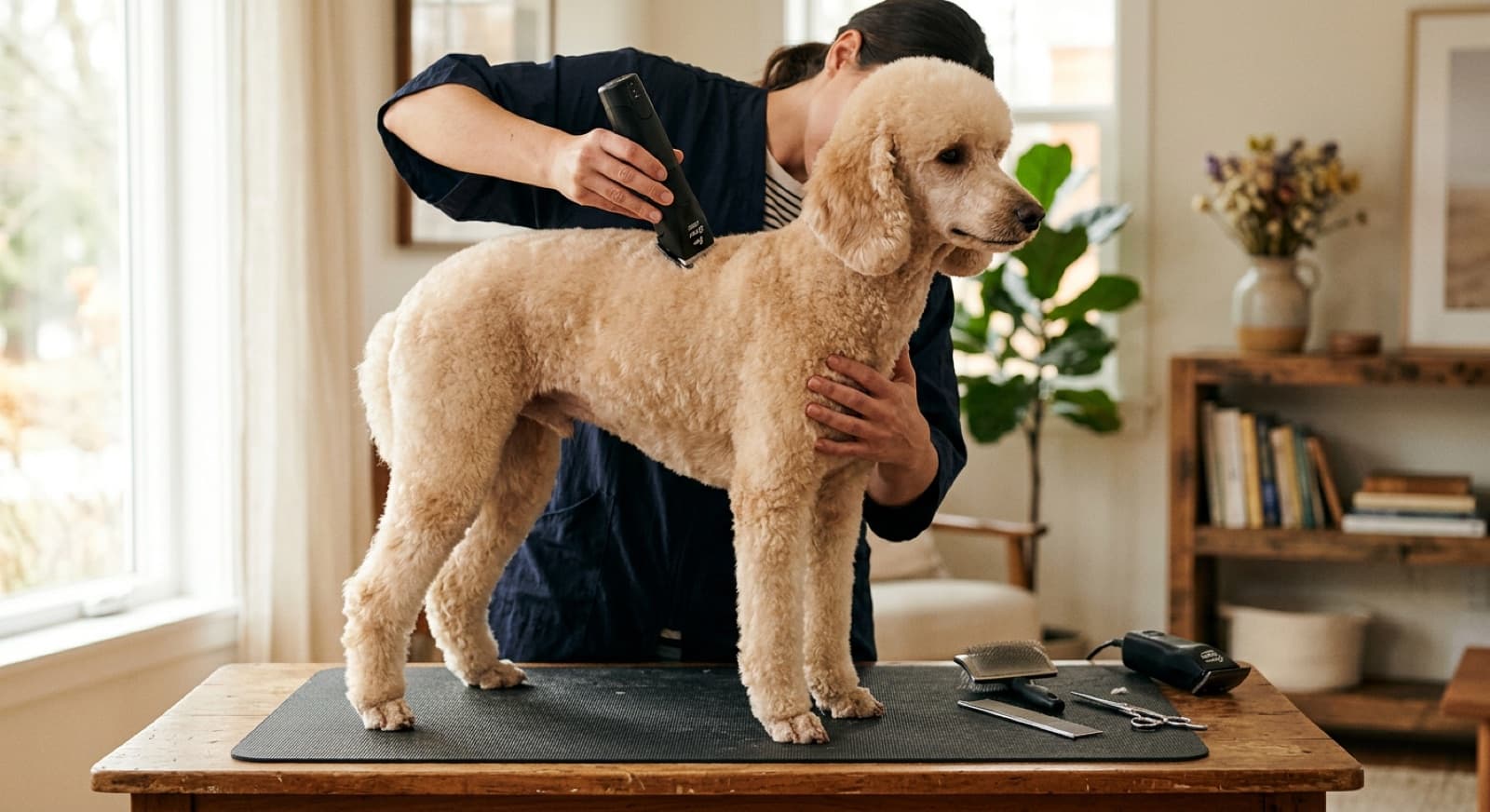
Plenty of owners learn to clip their own Poodle, and for a short pet cut it is realistic. The tool that matters is a decent set of clippers. For a Standard's dense coat, owners overwhelmingly recommend a corded professional clipper from Andis, Wahl, or Oster, because a standard's coat bogs down and overheats a cheap cordless motor. A cordless adjustable clipper is a fine starter and a handy second tool for touch-ups on the face, feet, and tail. Cheap no-name clippers are the false economy everyone warns against.
Blade and guard length is where beginners go wrong by leaving the coat too long to maintain. A shorter kennel clip is far more forgiving at home. As a rough guide, owners use a close blade around a #15 or #30 on the face, feet, and tail base, and a longer setting or snap-on guard comb on the body, where a higher blade number means a shorter cut. Buy into one brand's snap-on blade or guard system so the lengths are consistent. The clean face, feet, and tail, what groomers call the FFT, is the detail that separates a pet-quality clip from a scruffy one, and it is worth practising slowly with a calm dog.
Poodle clip styles, decoded
Poodle haircut names confuse everyone. Here is what the common ones actually mean, from lowest to highest maintenance:
- Kennel or utility clip. Short and even all over, with a shaved face, feet, and tail base. The lowest-maintenance pet cut and the most forgiving for a home groomer. Not show-legal, and the sensible default for most pet Poodles.
- Lamb clip. Short body with fuller, cylindrical legs, and a shaved face, feet, and tail base. A popular middle ground that keeps some Poodle look with manageable upkeep.
- Teddy bear or puppy clip. A soft, rounded, longer, fluffier look. Cute, and the most work, since all that length has to be brushed to the skin constantly.
- Continental and English saddle. The dramatic show clips, with pom-poms on the legs and tail, a shaved hindquarter, and a topknot. Historically these were functional for a water-retrieving breed, insulating the joints and organs while cutting drag in cold water. For a pet, they are pure commitment.
If your honest answer to “how much brushing will I really do” is “not much,” choose a kennel clip and keep it short. A dog in a short clip that is comfortable and mat-free beats a dog in a fancy clip that ends up shaved anyway.
Ears, nails, and the sanitary trim
Poodles grow hair inside the ear canal and have drop ears that trap moisture, and the old grooming default was to pluck that hair for airflow. This is genuinely contested now. Many veterinarians advise plucking only if the dog has recurring ear problems, because the plucking itself can inflame the canal and sometimes triggers the very infection it was meant to prevent. The reasonable position is to keep the ears clean and dry, watch for the signs of an ear infection like head-shaking, odour, or redness, and let your own vet decide whether plucking makes sense for your individual dog rather than doing it on autopilot. Ear care that crosses into infection territory is a veterinary question, not a grooming one.
Nails should be kept short enough that you do not hear them clicking on the floor. A nail grinder is gentler and more forgiving than clippers for owners nervous about the quick, and keeping a little styptic powder on hand stops a bleed fast if you go too short. The sanitary trim, a quick tidy of the hair around the groin and under the tail, keeps the dog clean between grooms and takes seconds once the dog is used to it.
The honest cost: groomer versus doing it yourself
A Poodle is one of the more expensive breeds to keep groomed, and it is worth pricing in before you adopt. In Canada, a full professional groom typically runs somewhere around $85 to $260 depending on size, coat condition, and city, with Standards at the higher end and mobile grooming in a similar range, according to Canadian grooming cost surveys like Dogster's. Vancouver and Toronto sit at the top, Atlantic Canada tends to be cheaper.
Poodles cost more than the average breed for a concrete reason: the continuously growing coat needs a full clip or scissor every single visit, not just a bath and tidy, plus the detailed face, feet, and tail work, and a Standard can take two to three hours of labour. A matted coat also draws a de-matting surcharge, or forces a shave-down. At a groom every 6 weeks, that is roughly 8 or 9 visits a year, which lands most Standard owners somewhere around $800 to $1,300 a year, a real ownership cost that surprises people.
Grooming at home changes that math, but only if you commit. A reasonable home kit, a corded clipper with blades, a quality slicker, a metal comb, and above all a high-velocity dryer, plus shampoo and styptic powder, runs somewhere in the low-to-mid hundreds up front and pays for itself within about a year. The catch is the honest one this whole guide keeps returning to: those tools only save money if you actually do the near-daily brushing. Buy the kit and skip the routine, and you end up at the groomer for a shave-down anyway.
Thinking about adopting a Poodle?
Go in knowing the coat is a real commitment, and you will be a great Poodle owner. Browse Poodles and Poodle mixes available now from the rescues we track across Canada.
See Available Poodles →Frequently Asked Questions
How often should I brush a Poodle?
Daily or every other day for a full-length coat, and weekly at the absolute minimum, plus a 60-second daily check of the ears, armpits, collar line, and tail base where mats start. A short kennel clip needs far less. The frequency is not really negotiable with a full coat, because Poodle hair grows continuously and traps every shed hair instead of dropping it, so a skipped week shows up as felt at the skin.
Can I brush the mats out or do I have to shave?
Small, loose mats can usually be worked out with a slicker brush, a metal comb, and a detangling spray, taking them apart from the edges rather than dragging through the middle. Once matting is tight to the skin or spread across the body, shaving is the kinder choice. Prolonged de-matting of a pelted coat hurts and can damage the skin, so groomers and welfare guidance favour a fresh start over fighting it. That is a decision to make with your groomer.
How often does a Poodle need professional grooming?
Every 4 to 6 weeks for a Standard, and every 3 to 4 weeks for a Toy or Miniature, whose finer coats sit closer to the ground and mat faster. The alternative is a genuine at-home routine with near-daily brushing and periodic clipping. There is no low-effort middle: a full Poodle coat is either a standing grooming commitment or a standing grooming bill.
Are Poodles really hypoallergenic?
They shed very little and release less airborne dander than most breeds, so many allergy sufferers tolerate a Poodle better, but no dog is truly hypoallergenic. The same trait that makes them low-shedding, a continuously growing single coat that holds onto hair and dander instead of dropping it, is exactly why they mat and why regular grooming is what keeps dander down. Spend time with an individual dog before assuming your allergies will be fine.
What is the easiest low-maintenance Poodle haircut?
A kennel clip, sometimes called a utility clip, which is short and even all over with a shaved face, feet, and tail base. It needs the least brushing and is the most forgiving cut for an owner grooming at home, because there is simply less hair to mat. It is not a show-legal clip, but for a pet it is the sensible default, especially through the coat change or during shedding-into-the-coat season.
Why does my Poodle suddenly mat everywhere around a year old?
That is the coat change, and it catches almost every first-time owner. Somewhere between 9 and 18 months the soft puppy coat gives way to the coarser adult coat, and for a few months the two textures grow together and wrap around each other, matting relentlessly no matter how diligent you are. It is not a failure on your part. Many experienced owners simply clip short to get through it, and once the adult coat is fully in, a well-kept Poodle rarely mats.
Do I have to pluck my Poodle's ears?
It is genuinely debated. Poodles grow hair inside the ear canal and have drop ears that trap moisture, and the traditional grooming practice is to pluck that hair for airflow. A growing number of veterinarians now advise plucking only if the dog has recurring ear problems, because plucking itself can irritate the canal and sometimes triggers the infection it was meant to prevent. Ask your own vet what is right for your dog rather than plucking on a schedule out of habit.
Do I brush a Poodle wet or dry?
Dry. Brushing a wet or damp coat tightens any tangles into tighter mats, and letting a Poodle air-dry after a bath locks the curl in and sets knots. The correct order is bathe, then force-dry the coat straight with a high-velocity dryer while brushing, then do your line brushing on the dry, straightened coat. Skipping the dryer is the mistake most home groomers make.
What to Feed a Standard Poodle
The other half of Poodle care: bloat, large-breed growth, and judging weight under the coat.
Standard vs Mini vs Toy Poodle
How the three Poodle sizes differ in grooming, care, and health.
Doodle & Poodle-Mix Care
Poodle-cross coats mat the same way. The brushing rules carry straight over.
Poodles for Adoption
Live listings of Poodles and Poodle mixes from the rescues we track.