The short answer
Feed a Rhodesian Ridgeback a complete large-breed food and keep it lean. A healthy Ridgeback shows ribs and a waist, so resist the urge to feed it fuller. Puppies need a large-breed puppy formula with controlled calcium until about 12 to 18 months. Match an adult's calories to its real activity, feed two meals a day from the floor, and never raise the bowl, because elevated feeders increase bloat risk. Most itchy Ridgebacks have environmental allergies, not food allergies, so do not chase the itch with endless food swaps.
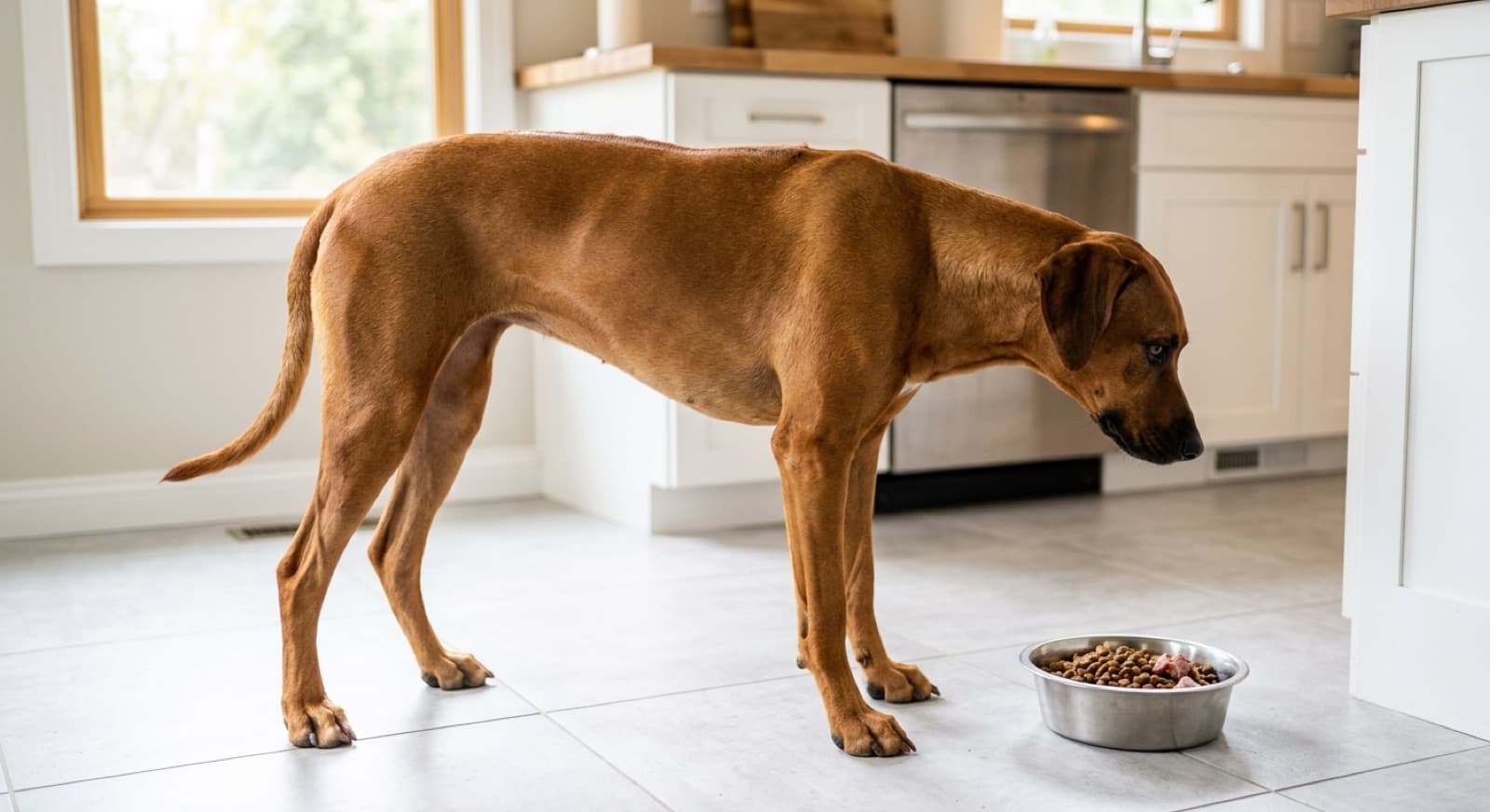
Lean and ribby is the healthy look
This is the single most important thing to get right with a Ridgeback, because the breed's natural build fools people. A Rhodesian Ridgeback is an athletic hound built for endurance, so a fit one looks lean: a clear waist behind the ribs when you look down, an abdominal tuck from the side, and ribs you can feel under a thin layer of fat without pressing hard. That is a textbook 4 or 5 on the WSAVA 9-point body condition scale.
To eyes used to heavier dogs that reads as underfed, and so the most common Ridgeback feeding mistake is overfeeding to fill the dog out. Owners panic at the ribs and add food, and a lean athlete slowly becomes an overweight one. The breed club even runs an owner education piece on whether your Ridgeback is overweight, which tells you how common the misjudgment is.
Lean is not just cosmetic, it buys years. The landmark Purina lifespan study found dogs kept lean lived a median of about 1.8 years longer than their overweight littermates, and showed delayed signs of chronic disease. With a Ridgeback, keeping the dog lean is the highest-value feeding decision you make.
What is the best food for a Rhodesian Ridgeback?
There is no single best bag, and any site that names one is selling something. The standard most vets point to is the brand-quality test from the WSAVA guidelines: does the company employ a full-time, board-certified veterinary nutritionist, and does it run feeding trials?
For an adult Ridgeback the safe defaults are Purina Pro Plan Large Breed, Royal Canin, Hill's Science Diet, and Eukanuba. Ridgebacks can get loose stools when switched abruptly, so move to a new food over seven to ten days, mixing in a little more of the new each day.
Growing a Ridgeback puppy
A Rhodesian Ridgeback is a large breed, so the puppy needs a large-breed puppy formula, not a regular one. As PetMD notes, that is a real distinction: large-breed puppy foods control calcium and energy density to slow growth and protect developing joints.
The danger to avoid is excess calcium. A large-breed puppy cannot down-regulate the calcium it absorbs well, and too much is linked to developmental orthopedic disease. That leads to one firm rule: do not add calcium, bone meal, or supplements on top of a complete large-breed puppy food. It is a classic owner mistake that causes harm, not benefit. Keep the puppy on its large-breed formula until roughly 12 to 18 months, keep it lean throughout, and confirm the switch to adult food with your vet rather than the 5-to-6-month timing some old breeder pages still repeat.

Bloat, and the raised-bowl myth
Raised or elevated bowls do not prevent bloat in a Ridgeback. The large Purdue study found they were associated with an increased risk. Feed from the floor.
Bloat, or gastric dilatation-volvulus, is when the stomach fills with gas and twists, cutting off blood flow. It is rapidly fatal without emergency surgery, and the deep-chested Rhodesian Ridgeback is an at-risk breed. The Glickman study from Purdue identified the real risk factors: increasing age, a first-degree relative with a history of bloat, fast eating, and, counterintuitively, raised feeders.
So the feeding habits that lower risk are: feed two or more smaller meals a day rather than one large one, slow a fast eater with a slow-feeder bowl, keep the bowl on the floor, and avoid hard exercise for about an hour around meals. Because Ridgebacks are at-risk, many owners discuss a preventive gastropexy with their vet, which tacks the stomach so it cannot twist and is often done during spay or neuter. Learn the emergency signs now, per the Merck Veterinary Manual: a distended belly, unproductive retching, drooling, restlessness, or collapse means the emergency vet immediately.
Is the itch really the food?
A large share of Ridgeback feeding questions are actually allergy questions, and the honest answer disappoints people who want to fix it at the bowl. Most chronic itch in dogs is environmental allergy, not food. Food allergy is real but a minority cause, and chasing it with endless bag swaps usually wastes months.
If a food allergy is genuinely suspected, the only reliable diagnosis is a strict elimination diet: a hydrolyzed or truly novel protein, fed exclusively for eight to twelve weeks with zero other foods, treats, or flavored chews, then a deliberate re-challenge. As PetMD explains, that trial is the test, and the popular blood and saliva “allergy panels” are not reliable for diagnosing food allergy. Grain-free is not the fix either, because most food allergens are proteins like chicken, beef, or dairy, not grains. The right move is to work the itch up with your vet, who will usually look at fleas and environmental atopy first.
Which Ridgeback health issues are about diet?
Owners often file every health worry under feeding, so it helps to separate what diet controls from what it does not.
- Obesity and joint strain (diet): the one truly diet-driven issue, and the reason the lean rule matters so much.
- Bloat (feeding practices): not caused by a specific food, but meal frequency, eating speed, and bowl height are all things you control.
- Dermoid sinus (not diet): a congenital defect present at birth, found along the spine and corrected surgically. Nothing you feed an adult prevents or treats it.
- Hypothyroidism (not caused by diet): this is the breed's most reported genetic health problem, and it causes weight gain, so owners blame food. It is treated with cheap daily medication. If a lean breed starts gaining on a normal portion, test the thyroid rather than just cutting food.
- Degenerative myelopathy (not diet): a genetic spinal disease with a DNA test; no diet prevents or treats it, and clinical cases are uncommon.
Foods to avoid
Keep these away from a Ridgeback completely:
- Chocolate (darker is worse)
- Grapes and raisins (can cause kidney failure, even a few)
- Xylitol (in sugar-free gum, some peanut butters, and baking), which is rapidly fatal to dogs
- Onions, garlic, leeks, and chives
- Macadamia nuts
- Alcohol and caffeine
- Cooked bones (they splinter)
Ridgebacks are clever counter-surfers, so the bigger everyday risk is food theft, which can mean GI upset, pancreatitis, or worse. Keep food and bins out of reach. If your dog does eat something on this list, call your vet, the nearest emergency clinic, or a pet poison helpline right away.
Should I feed my Ridgeback a raw diet?
Only with a vet or veterinary nutritionist involved. Ridgeback owners run the full spectrum from kibble to raw, and some dogs do well on a properly built raw diet, but the FDA warns that raw meat carries a pathogen risk for the dog and the household. Homemade raw diets are also commonly unbalanced, which matters most for a growing large-breed puppy.
For most Ridgebacks, a complete cooked or kibble diet from a nutritionist-backed brand matches raw on outcomes. If you go raw, work with a veterinary nutritionist on a complete recipe rather than improvising.
Looking to adopt a Rhodesian Ridgeback?
Plan to feed lean and grow the puppy slowly before day one. Browse Ridgebacks and Ridgeback mixes available now from the rescues we track.
See Available Ridgebacks →How much, and where to buy it
Skip the cup numbers you see online. Portion depends on the food's calorie density, which varies widely, plus the dog's age and activity. Start from the label guideline for your dog's target weight, then adjust every couple of weeks to hold a lean body condition. A kitchen scale beats a measuring cup for accuracy, and treats should stay under 10 percent of daily calories.
Every brand worth feeding a Ridgeback is easy to find:
- Pet specialty chains (Pet Planet, Tail Blazers, Tisol). Carry Pro Plan, Royal Canin, and large-breed lines.
- Pet Valu and PetSmart. Stock the major large-breed puppy and adult formulas.
- Your vet clinic. The best source for puppy feeding guidance and any prescription diet.
- Costco. Kirkland Signature large-breed is a cheaper everyday adult option.
The major large-breed formulas are easy to set on a recurring delivery so you never run out mid-week.
Frequently Asked Questions
How much should I feed a Rhodesian Ridgeback?
There is no fixed cup number, because it depends on the food's calorie density and the dog's activity. The right method is to start from the food label's guideline for your dog's target adult weight, then adjust to maintain a lean body condition. Feed adults twice a day, puppies more often. A working or field-active Ridgeback eats noticeably more than a couch-and-walks companion of the same weight. Weigh the food with a kitchen scale rather than guessing with a scoop, and feed to the dog in front of you, not to a chart.
My Rhodesian Ridgeback looks too thin. Is that normal?
Almost certainly yes. Ridgebacks are built lean and athletic, so a healthy one shows a visible waist, an abdominal tuck, and ribs you can feel easily under a thin layer of fat. To eyes used to heavier dogs that reads as too thin, and the most common feeding mistake owners make is overfeeding to fill the dog out. On the 9-point body condition scale the target is a 4 or 5. Lean dogs also live longer: a landmark Purina lifespan study found lean-fed dogs lived close to two years longer than their overweight littermates.
What is the best food for a Rhodesian Ridgeback?
A complete large-breed formula from a brand that employs a board-certified veterinary nutritionist and runs feeding trials, such as Purina Pro Plan, Royal Canin, Hill's Science Diet, or Eukanuba. Ridgeback puppies need a large-breed puppy food specifically, to control calcium and growth. For adults, match the calorie level to the dog's real workload. Start with whatever the breeder or rescue was feeding and transition over seven to ten days to avoid the loose stools Ridgebacks are prone to when switched too fast.
Do raised or elevated bowls prevent bloat in a Rhodesian Ridgeback?
No. The large Purdue study on bloat found elevated feeders were associated with an increased risk of gastric dilatation-volvulus in large breeds, not a reduced one. Feed a Ridgeback from the floor. The habits that genuinely help are smaller, more frequent meals, a slow-feeder bowl for a fast eater, and avoiding hard exercise for about an hour around meals. Because Ridgebacks are a deep-chested at-risk breed, many owners also discuss a preventive gastropexy with their vet, often done at the same time as spay or neuter.
Is my Ridgeback's itchy skin caused by its food?
Usually not. Most chronic itch in dogs is environmental allergy (atopy), not food allergy, which is a real but smaller cause. The only reliable way to diagnose a food allergy is a strict elimination diet using a hydrolyzed or genuinely novel protein, fed exclusively for eight to twelve weeks with zero other foods or treats, then re-challenged. Blood and saliva "allergy tests" are not reliable for diagnosing food allergy. Grain-free is not an allergy fix either, because most food allergens are proteins like chicken or beef, not grains. Work the itch up with your vet rather than guessing.
How long does a Rhodesian Ridgeback stay on puppy food?
A Ridgeback is a large breed, so plan to keep it on a large-breed puppy formula until somewhere around 12 to 18 months, when it is near skeletal maturity, then transition to an adult large-breed food. The point of a large-breed puppy formula is controlled calcium and energy to slow growth and protect the joints. Do not add a calcium supplement on top of a complete food: for a large-breed puppy it raises the risk of developmental orthopedic disease rather than helping. Confirm the switch timing with your vet.
Do Rhodesian Ridgebacks need more fat for endurance?
It depends entirely on the dog's real activity. Fat is the primary endurance fuel for a genuinely working canine athlete, so a Ridgeback that runs, hikes long distances, or does sport may do well on a higher-fat large-breed formula. But most pet Ridgebacks are companions whose exercise is walks and play, and over-fatting a couch-and-walks dog just causes obesity, which is the opposite of what the breed needs. Match the fuel to the workload, and let body condition tell you whether you have it right.
What to Feed a German Shorthaired Pointer
Fueling another lean, athletic, deep-chested working breed.
What to Feed a Doberman
Lean body condition and bloat care for another deep-chested athlete.
What to Feed a Labrador
The body-condition and treat-discipline playbook for an easy-to-overfeed breed.
Rhodesian Ridgebacks for Adoption
Live listings of Ridgebacks and Ridgeback mixes from the rescues we track.