The short answer
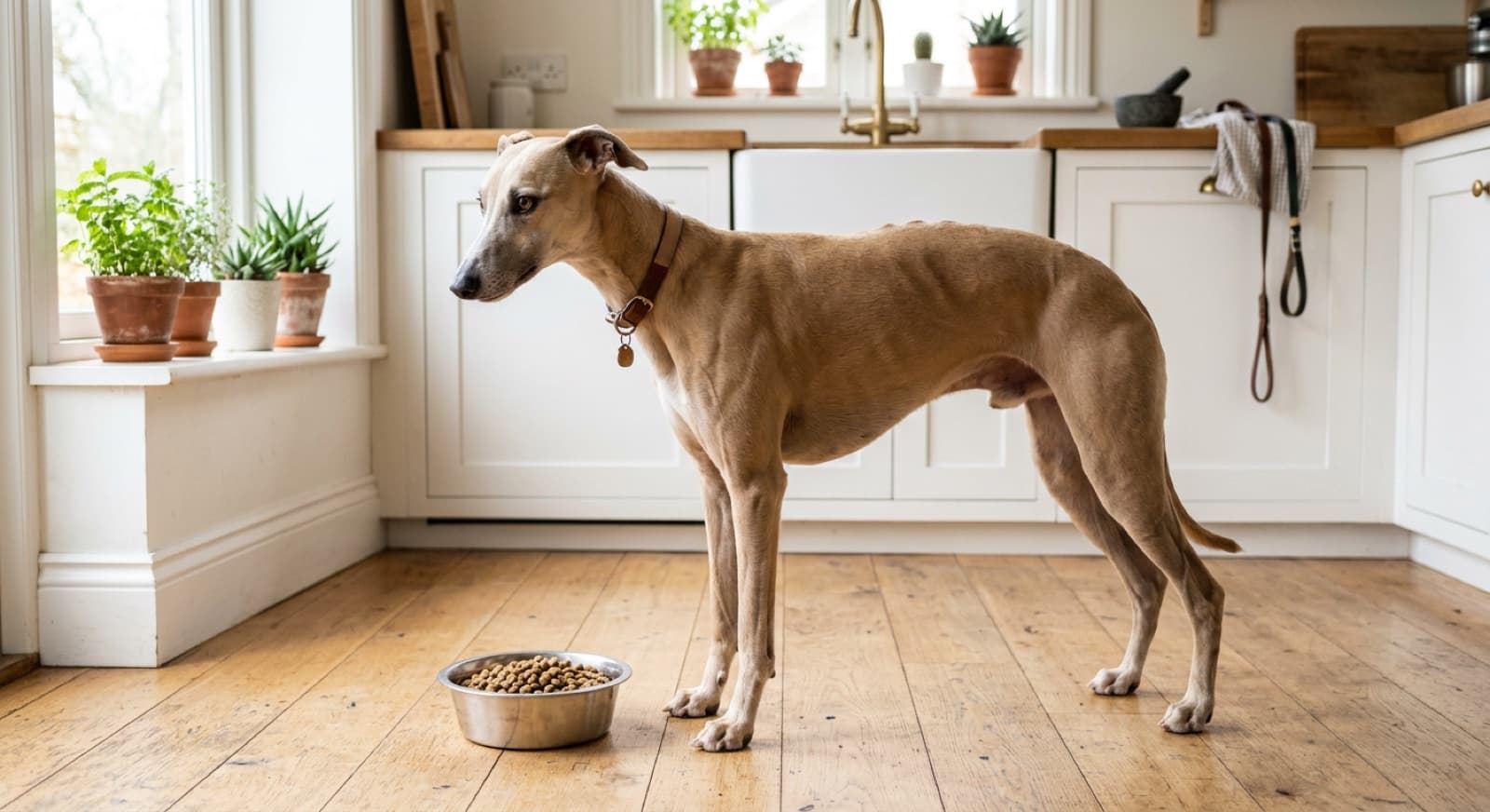
Feed a Whippet a complete, calorie-dense food and keep it at its natural lean weight, which shows more rib and spine than other breeds. A correct Whippet reveals the shadow of the last rib and two or three vertebrae; the belief that you should see no ribs is wrong and leads to overfeeding. Many are hard keepers and picky eaters, so a nutrient-dense food and scheduled meals help. Learn to tell normal-lean from genuinely underweight, feed two meals from the floor, and tell any vet your dog is a sighthound before procedures.
A Whippet is supposed to look lean
This is the heart of feeding the breed. Whippets are sighthounds, built for speed with little body fat, and a healthy one looks far leaner than the average dog. The AKC spells it out: sighthounds carry low fat stores and unusual metabolisms, and people routinely mistake a correct-weight one for underweight. The AKC's chief veterinarian makes the same point, that on a lean breed the hint of the last rib is not cause for concern.
The practical standard from breed authorities is consistent: on a correct Whippet you should see the shadow of the last rib or two but not all of them, two or three vertebrae along the topline but not every bone, and a waist and hip points that are felt but not buried in fat or dimpled. The widespread owner belief that a correct Whippet should show no ribs contradicts the breed clubs, and it is precisely the pressure that turns a healthy sighthound into an overweight one. Standard body-condition charts like the 1-to-9 scale still apply, but read against the leaner sighthound build, a fit Whippet simply looks more skeletal than a fit Labrador at the same score.
Normal-lean versus genuinely underweight
Because the breed runs so lean, owners and even some general-practice vets get this wrong in both directions. One vet pressures an owner to fatten a perfectly healthy Whippet; another waves off a genuinely sick, wasting dog as “just a Whippet.” Knowing the difference protects your dog from both mistakes.
Normal-lean looks like the shadow of the last rib or two, two or three vertebrae visible, ribs easily felt under a thin layer of flesh, a defined waist and tuck, and firm, dry muscle over the frame. Genuinely underweight is different in kind: every rib visible and protruding, each spinal bone individually standing out with loose skin, a sharply sunken belly, prominent dimpled hip bones, and a clear lack of muscle. The deciding signs are change and behaviour. As the AKC advises, unexplained weight loss, muscle wasting, lethargy, or a dog that stops wanting to move warrants a vet exam to rule out parasites, dental pain, or disease. Do the check with your hands, not just your eyes.
Hard keepers and picky eaters
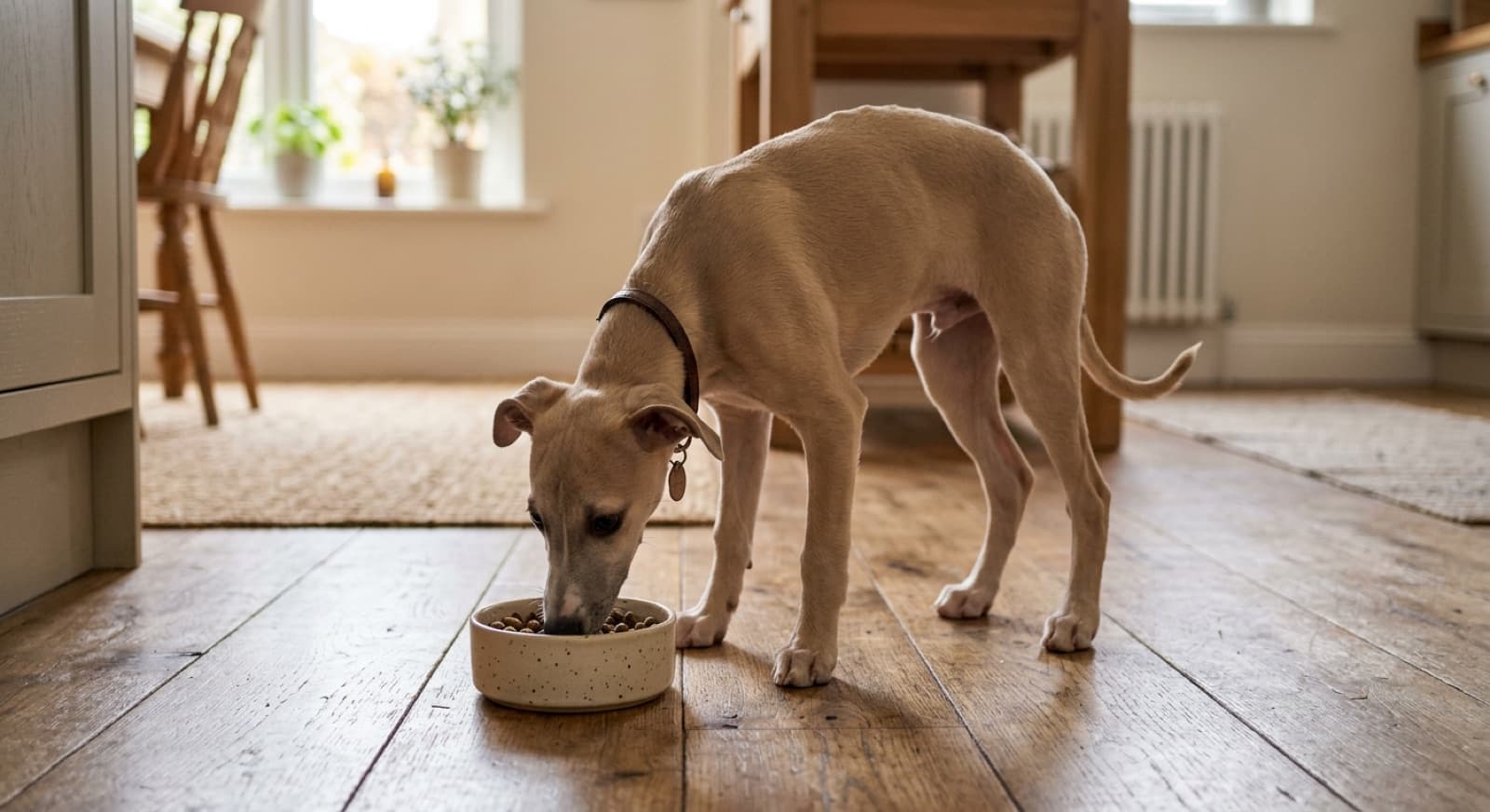
Plenty of Whippets are easy to feed, but the breed has a real reputation for fussy, intermittent eaters and for hard keepers that struggle to hold weight, especially the athletic ones that seem to burn everything off. Metabolism varies so much that two Whippets of the same height can need quite different amounts.
The fixes that actually work: choose a quality, calorie-dense food so the dog gets more nutrition from a smaller, less daunting bowl; feed on a schedule rather than leaving food down, putting the bowl out for 20 to 30 minutes and then lifting it; and resist constantly switching foods, which only teaches the dog to hold out for something better. To tempt appetite and add calories, owners commonly add a little oily fish such as sardines, a bit of cooked egg, or plain lean meat. Keep any such extras under about 10 percent of the diet so the nutritional balance holds, and if a normally good eater suddenly refuses food or loses weight, see the vet rather than just piling on toppers.
The sighthound body the diet protects
Keeping a Whippet lean is not just about looks; it works with the breed's unusual physiology. Sighthounds carry far less body fat than typical dogs, and that has a real medical consequence: fat-soluble anesthetic drugs have little fat to redistribute into, and sighthounds also metabolize some drugs differently. As Clinician's Brief notes, the strongest evidence is in Greyhounds, but it applies across sighthounds including Whippets.
This is not a diet problem, but it comes from the same low-body-fat build, so two things follow. Always tell your vet your dog is a sighthound before any anesthetic procedure. And recognize that fattening a Whippet to look like a “normal” dog works against a body that is meant to be lean, which is one more reason to hold the natural weight rather than push past it.
Bloat and dental care
Raised bowls do not prevent bloat and have been linked to higher risk. Feed a Whippet from the floor, in two smaller meals, and avoid hard exercise right after eating.
Whippets have the deep, narrow chest that is the main conformational risk factor for bloat, so it is worth knowing the signs, but they are not a recognized high-risk breed the way giant dogs are, and no high incidence is published for them. Cornell's Riney Canine Health Center notes any deep-chested dog can bloat, so the sensible precautions are worth taking: two smaller meals, slowing a fast eater, no hard exercise right after meals, and a floor-level bowl. A drum-tight belly with unproductive retching is an emergency.
Dental care matters more than many owners expect, because sighthounds as a group are prone to periodontal disease. A peer-reviewed study in Greyhounds found daily brushing reduced gingivitis, and the same applies to Whippets. Daily brushing, dental chews carrying the VOHC seal, and professional cleanings do far more for the teeth than any feeding trick, so build a brushing habit early.
Should I feed my Whippet grain-free?
Not unless your vet diagnoses a grain allergy, which is uncommon. The FDA has been investigating a possible link between grain-free diets built on peas, lentils, and potatoes and dilated cardiomyopathy, a heart condition. The causation is not proven, but most vets steer toward established, nutritionist-backed brands over boutique grain-free, choosing a company that employs a veterinary nutritionist and runs feeding trials. For a hard keeper, calorie density and palatability matter far more than whether the food contains grain.
Foods to avoid
Keep these away from a Whippet completely:
- Chocolate (darker is worse)
- Grapes and raisins (can cause kidney failure, even a few)
- Xylitol (in sugar-free gum, some peanut butters, and baking), which is rapidly fatal to dogs
- Onions, garlic, leeks, and chives
- Macadamia nuts
- Alcohol and caffeine
- Cooked bones (they splinter)
If your Whippet eats something on this list, call your vet, the nearest emergency clinic, or a pet poison helpline right away.
Looking to adopt a Whippet?
Know what a healthy lean Whippet looks like before day one. Browse Whippets and Whippet mixes available now from the rescues we track across Canada.
See Available Whippets →Where to buy Whippet food
Every brand worth feeding a Whippet is easy to find:
- Pet specialty chains (Pet Planet, Tail Blazers, Tisol). Carry the calorie-dense, nutritionist-backed formulas that suit a hard keeper.
- Pet Valu and PetSmart. Stock the major puppy and adult formulas.
- Your vet clinic. The best source if you are genuinely struggling to keep weight on a Whippet and need to rule out a medical cause.
A nutrient-dense calorie-dense formula is often the easiest win for a picky Whippet, since the dog gets more from a smaller bowl. Read the calories per cup on the bag rather than going by volume.
Frequently Asked Questions
Is my Whippet too skinny? They show ribs and spine.
Almost certainly not. Whippets are sighthounds, built lean by design, and a correct-weight Whippet shows the shadow of the last rib or two and a couple of vertebrae along the topline, with hip bones felt but not buried in fat. The AKC notes that sighthounds are naturally far leaner than typical breeds and are often mistaken for underweight. The forum belief that you should see no ribs at all is wrong and is exactly what leads owners to overfeed. Use your hands: ribs should be easily felt under a thin layer, with visible waist and tuck.
How do I tell normal-lean from genuinely underweight?
Normal-lean looks like a shadow of the last rib or two, two or three vertebrae visible, ribs easily felt under a thin layer, a clear waist and tuck, and firm muscle. Genuinely underweight is different: every rib showing and protruding, each spinal bone individually visible with loose skin, sharply sunken belly, prominent dimpled hip bones, and a lack of hard muscle, especially with unexplained weight loss, lethargy, or refusing to exercise. Normal-lean needs no action. Real weight loss or muscle wasting needs a vet to rule out parasites, dental pain, or disease.
How much should I feed a Whippet?
It varies a lot between individuals, even at the same size, because metabolism differs. Start from the food label guideline for a 25 to 40 pound dog, then adjust to hold a correct sighthound body condition. A higher-calorie, nutrient-dense food lets you feed a smaller volume, which suits a picky eater. Feed adults twice a day. The honest answer is that you feed the dog, not the bag: weigh portions, check the body weekly with your hands, and tune from there rather than chasing a fixed cup number.
My Whippet is a hard keeper and a picky eater. What helps?
Hard keepers and fussy eaters are common in the breed. The most reliable fixes are a calorie-dense quality food so the dog gets more from less, scheduled meals rather than free-feeding (put the bowl down for 20 to 30 minutes, then lift it), and not constantly switching foods, which teaches fussiness. Owners commonly add small amounts of oily fish like sardines, a little cooked egg, or plain lean meat to tempt appetite and add calories. Keep any extras under about 10 percent of the diet so the balance holds, and rule out medical causes if a normal eater suddenly stops.
Are Whippets at risk of bloat?
They have the deep, narrow chest that is the main conformational risk factor for bloat, so it is worth knowing the signs, but Whippets are not on the high-risk breed lists the way giant breeds are, and there is no published high incidence for the breed. Sensible precautions still apply: feed two smaller meals rather than one large one, slow a fast eater, and avoid hard exercise right after eating. A swollen, drum-tight belly with unproductive retching and distress is an emergency. Note that raised bowls do not prevent bloat and have been linked to higher risk, so feed from the floor.
Why does my vet need to know my Whippet is a sighthound?
Because the same leanness that defines the breed changes how it handles anesthesia. Sighthounds carry very little body fat, so fat-soluble anesthetic drugs have nowhere to redistribute, and they metabolize some drugs differently. The strongest evidence is in Greyhounds, but it applies across sighthounds including Whippets. This is not a diet issue, but it flows from the same low-body-fat physiology, so always tell your vet your dog is a sighthound before any procedure. It is also why keeping a Whippet at its natural lean weight, rather than fattening it, is genuinely healthier.
How should I feed a Whippet puppy?
Whippet puppies are hard to overfeed and can be kept a little better covered than adults, since that puppy weight turns into muscle as they mature. Feed a complete puppy or all-life-stages food, starting with around four meals a day for a young puppy and dropping to three, then two as it grows. Many Whippets are slow to fill out and do not look fully mature until two or even three to four years old, so do not panic at a lanky adolescent. Stay on a puppy formula a bit longer rather than switching to adult food too early, and confirm timing with your vet.
What to Feed a Rhodesian Ridgeback
Another lean, athletic breed where owners overfeed to fix a healthy body.
What to Feed a Doberman
Lean body condition and deep-chest bloat care for another athletic breed.
What to Feed a Great Dane
The deep-chested bloat playbook in detail, including the raised-bowl myth.
Whippets for Adoption
Live listings of Whippets and Whippet mixes from the rescues we track.