The short answer
First find out whether your Yorkie has a silky or a cottony coat, because a cottony coat mats far more and needs more maintenance or a shorter cut. The coat is single-layered, fine, continuously growing hair with no undercoat, so it tangles fast at friction points. Line brush to the skin and confirm with a comb, and never bathe a matted coat. For most pet homes a puppy cut is the smart, humane default over the demanding show coat, and shaving a single-coated Yorkie will not ruin the coat.
Silky or cottony: the fact that decides everything
Here is the thing generic Yorkie guides never tell you, and it explains most of the frustration owners feel. Not all Yorkie coats are the same, and the difference is the whole game. A silky coat is fine, flat, and glossy, with an almost metallic sheen, and it lies close to the body and stays relatively smooth. A cottony or wooly coat is softer, wavier, and higher in volume, and it mats far more, breaks more easily, and is harder to keep clean.
So the owner who brushes daily and still fights mats is usually not doing anything wrong. They have a cottony coat, and no amount of guilt changes the texture. You can often tell early: a curl or wave showing up around twelve weeks tends to predict a cottony adult coat, and owners use the trick that a silky coat photographs with a green eye-shine while a cottony one shows red. Once you know which you have, the plan follows. A silky coat stays smooth on a normal routine, while a cottony coat needs either more frequent brushing or, honestly, a shorter cut. Naming this upfront is the single most useful thing this guide can do, because it turns an impossible-seeming problem into a straightforward decision.
Hair, not fur, and why it mats
Whatever the texture, the underlying fact is that a Yorkie has a single coat of fine, continuously growing hair, much like human hair, with no undercoat, as the American Kennel Club describes. That is why a Yorkie barely sheds, why the coat needs cutting rather than just brushing, and why it tangles: with no undercoat to give it structure, the fine hair catches at any friction and, because it is so soft, compacts down to the skin fast.
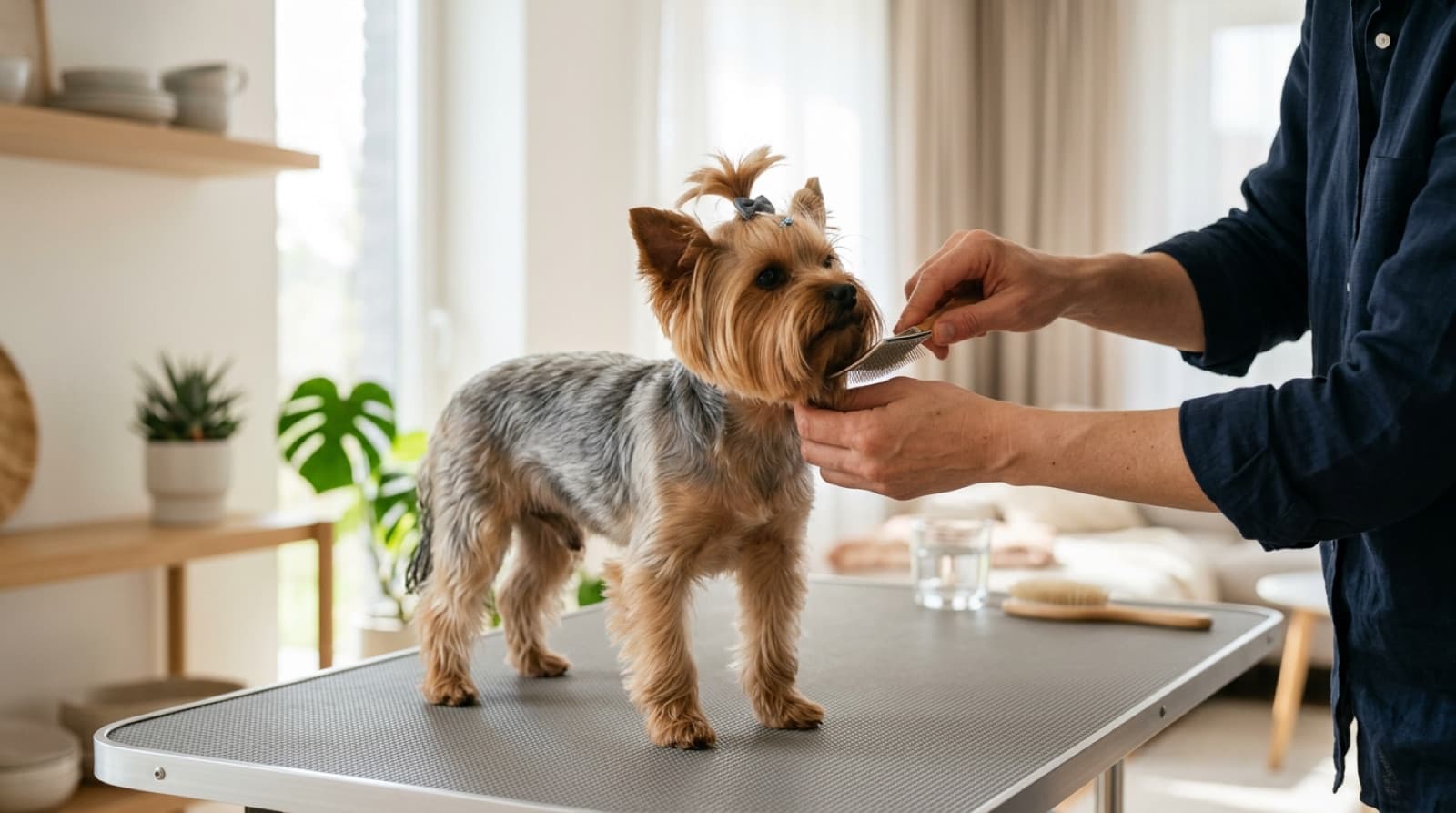
The technique that keeps it out of trouble is line brushing. Part the coat in a line, hold the hair above it out of the way, and brush the exposed layer from the skin outward with a pin brush, working a slicker brush into small knots at the friction points, then confirm with a steel comb. If the comb will not pass to the skin, that section is not brushed out. Mist first with a detangling spray, because brushing fine, bone-dry hair snaps it. Increase the brushing during the coat change between roughly six and eighteen months, when the puppy coat and adult coat meet and matting peaks.
Some of the product links in this section are Amazon affiliate links — we may earn a small commission at no extra cost to you. It never changes which products we recommend.
Show coat or puppy cut, honestly
The floor-length, centre-parted Yorkie show coat is beautiful and it is a real commitment: daily brushing, weekly baths, and a salon visit every three to four weeks. For a pet home that is a lot, and there is a persistent fear that clipping a Yorkie will ruin the coat. For a single-coated breed, that fear is misplaced. Unlike a double-coated dog, a Yorkie can be clipped into a puppy cut without harming how the coat grows back.
So the puppy cut, taken to about an inch or shorter all over, is the sensible pet default, and the teddy-bear variation keeps a rounded face while the kennel or summer cut goes shorter still, often as a reset after a matting episode. Experienced owners are blunt about it: when a coat is fighting you, especially a cottony one on a puppy, it is not worth hanging on to length, and starting short is the kinder call. Choose the length you will actually maintain, and the rest of the routine gets easier.
Topknot, face, ears, and nails
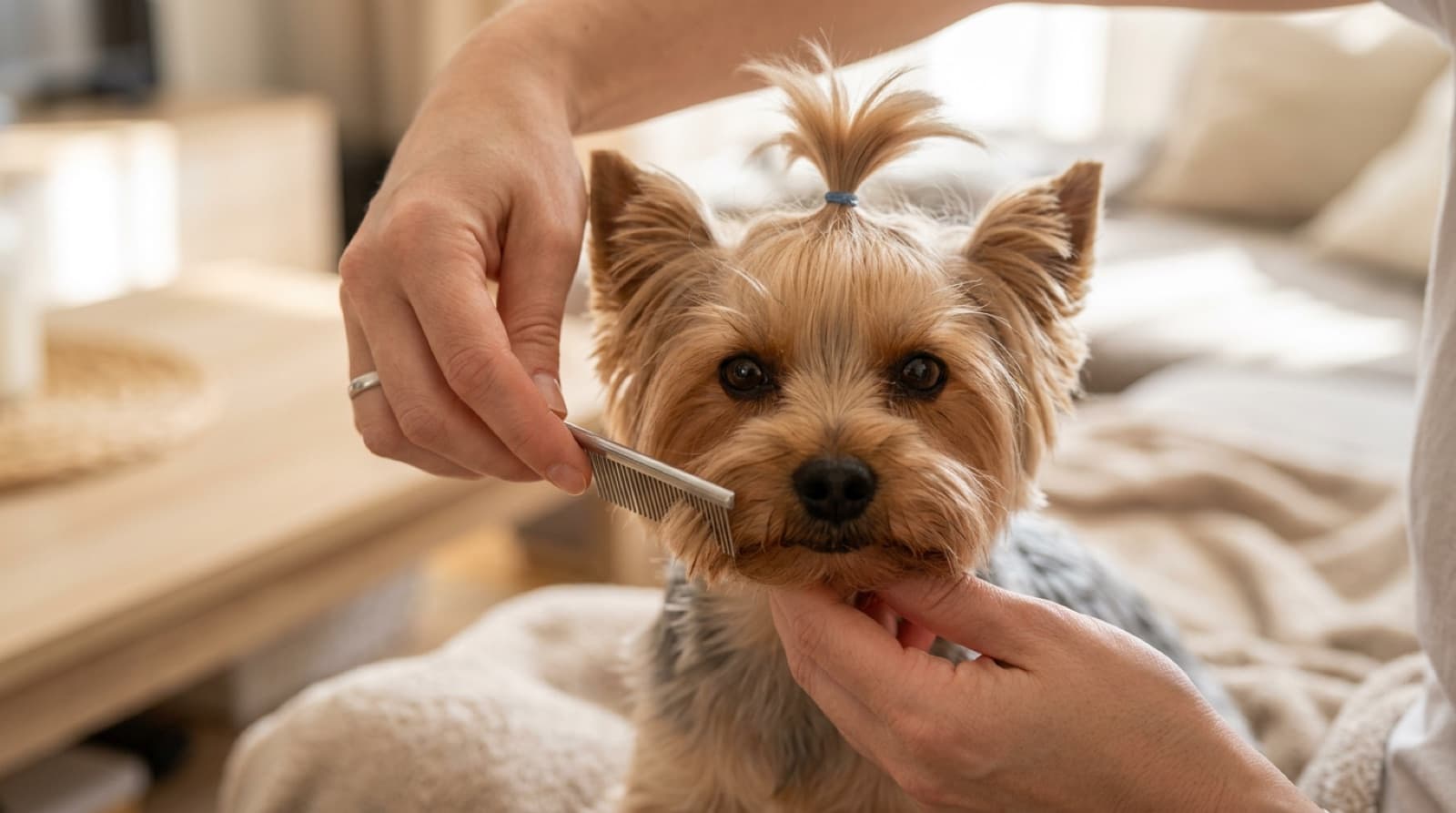
On a coat kept long around the face, the topknot is functional, keeping the hair out of the eyes where it causes irritation and off the tear line. Use a soft latex grooming band rather than a household rubber band, redo it every day or two so the base does not mat, and never tie it tight. On a short cut a simple trim above the eyes replaces it. For the rust-coloured staining some Yorkies get around the muzzle and eyes, the reliable daily habit is wiping the face with a damp cloth or a face-safe wipe to remove moisture before it stains, and any sudden or worsening staining is worth a vet check to rule out a tear-duct or eye issue.
The top third of the ears is often trimmed short to keep them standing and because behind the ears is a prime matting zone. Keep nails short with a nail grinder or small-dog clipper, taking a little at a time, and clean the ears at bath time with cotton balls rather than swabs. Bathe every week or two depending on coat length, always after a full brush-out, and dry a silky coat straight and smooth rather than fluffing it, since air-drying invites tangles.
The honest cost: groomer versus doing it yourself
A Yorkie costs more to groom than its size suggests. In Canada a full groom commonly runs somewhere around $60 to $100 or more per visit, higher in cities like Toronto and Vancouver, every four to eight weeks, and Canadian grooming cost surveys such as Dogster's give a sense of the ranges, which swing with coat condition. A matted coat adds a de-matting surcharge.
The cost is higher than the dog's size because the fine coat takes time to brush out and the face shaping, eye-corner work, topknot, ear-tip trim, and sanitary work are all fiddly detail. Grooming at home cuts the bill, and a modest starter kit, quiet clippers with guard combs, a pin brush, a slicker, a metal comb, blunt-tip scissors, a gentle shampoo, detangler, and a nail grinder, pays back within a few salon visits. The honest caveat is the familiar one, plus a Yorkie-specific twist: the tools only help if you brush regularly, and a cottony coat will always ask more of you than a silky one.
Thinking about adopting a Yorkie?
Pick a coat length you can maintain and you will love the breed. Browse Yorkshire Terriers and Yorkie mixes available now from the rescues we track across Canada.
See Available Yorkies →Frequently Asked Questions
How can I tell if my Yorkie has a silky or a cotton coat?
A silky coat is fine, flat, and glossy with an almost metallic sheen, and it lies close to the body. A cottony or wooly coat is softer, wavier, and higher in volume, and it mats far more. Owners often spot it early: a curl or wave by about 12 weeks tends to predict a cottony coat, and a common trick is that a silky coat photographs with a green eye-shine while a cottony one shows red. Knowing your coat type reframes the whole matting conversation, because a cottony coat needs more maintenance or a shorter cut, and that is not a failing on your part.
Should I keep the long coat or get a puppy cut?
For most pet owners the puppy cut is the smart default, not a compromise. The floor-length show coat is genuinely demanding, with daily brushing, weekly baths, and a salon visit every three to four weeks, and unlike a double-coated breed a Yorkie is single-coated, so a shorter clip will not ruin the coat. A puppy or teddy-bear cut still looks like a Yorkie and brings the brushing down to something a normal household can keep up with.
Why does my Yorkie mat so easily?
The Yorkie coat is fine, single-layered hair with no undercoat to hold its shape, so it tangles at any friction, worst behind the ears, in the armpits, along the collar or harness line, and on the inner back legs. If the coat is on the cottony side it mats even faster. And because the hair is so fine, a tangle that starts at the surface compacts down to the skin quickly, which is why brushing only the top of the coat misses it.
Why is my black-and-tan Yorkie turning grey or silver?
That is the normal coat change, not greying or illness. Yorkies are born black and tan and transition to the adult steel-blue-and-tan coat, where the blue is really a diluted, faded black rather than a literal blue. It usually starts around six months and completes somewhere between one and two years, occasionally up to three, and the texture matures from fluffy to silky alongside the colour.
Can I bathe a matted Yorkie?
No. Water and drying shrink and set mats tighter, turning a loose tangle into felt that is very hard to remove. Always brush and comb the coat completely mat-free first, then bathe. This is one of the highest-value rules for the breed, and it is exactly backwards from what many owners instinctively do.
How do I keep the hair out of my Yorkie's eyes?
Either keep the head hair short in a puppy or teddy-bear cut, or use a soft topknot tied with a latex grooming band and redo it every day or two so it does not mat at the base. Never use household rubber bands, which snap and break the coat, and never tie it tight enough to tent the skin. On a short cut the topknot becomes optional, since a trim above the eyes does the same job.
How often should I brush a Yorkie?
A long or full coat needs daily brushing, and a short puppy cut can stretch to roughly weekly, though the longer and silkier the coat the less forgiving a once-a-week routine is. Whatever the length, brush down to the skin in layers rather than skimming the top, and mist the coat first, since brushing fine, bone-dry hair snaps it. Increase brushing during the six-to-eighteen-month coat change, when matting peaks.
What is the best brush for a Yorkie?
A pin brush for the daily first pass on the fine coat, plus a stainless-steel comb to confirm you have reached the skin, and a slicker for working out small knots at the friction points. The comb is the tool that actually prevents mats: after brushing, run it through in sections, and if it will not pass cleanly to the skin, that section is not done no matter how good the top looks.
How to Groom a Maltese
Another small, single-silky-coated breed with the same puppy-cut trade-off.
How to Groom a Shih Tzu
Another small long-coated breed with a topknot and the same face care.
What to Feed a Yorkie
The other half of Yorkie care: tiny-dog portions, dental care, and treats.
Yorkies for Adoption
Live listings of Yorkshire Terriers and Yorkie mixes from the rescues we track.