The short answer
Shelters are loud, crowded, and frightening, and they bring out fear in even the most loving pets. A dog who freezes or a cat who hides behind the litter box is usually overwhelmed, not damaged. The honest answer to anxious or traumatized is that you often cannot tell in the shelter at all. Give a fearful pet a quiet space, a predictable routine, and time (think days and weeks, not minutes), and the real animal usually starts to surface. If there is no improvement over several weeks, or you see panic, fear-based aggression, or signs of possible pain, that is your cue to bring in a vet and a certified force-free trainer or veterinary behaviourist.
Why shelters distort behaviour
Picture the worst version of your own bad day, then take away your home, your people, your routine, and your ability to leave. That is roughly what a shelter feels like to a pet. There is constant noise from barking dogs and clanging gates. There are unfamiliar smells layered on top of cleaning products. There are strangers reaching toward the kennel all day, and almost no control over any of it. Even a confident, well-loved animal can fall apart in that environment.
Because of this, the pet you meet in a kennel is often not the pet you will live with. A dog who cowers at the back of the run might be a goofball who flops on his back the moment he relaxes at home. A cat who flattens herself into a loaf and will not look at you might be a chatty lap cat within a couple of weeks. Fear in a shelter tells you how the animal is coping with chaos right now. It does not tell you their true temperament.
This is the single most important reframe to carry with you: a scared, shut-down, or hiding animal is showing a normal reaction to an overwhelming situation, not a defect. Fear is not the same as a bad temperament. Once you understand that, you stop reading every flinch as a warning sign and start reading it as a pet asking for patience.
Signs of stress and fear
Stress shows up in two broad directions, and it helps to recognize both. The shut-down version is the one people miss most often. A frightened pet may hide, freeze, tremble, cower, tuck their tail, pin their ears, avoid eye contact, or refuse food and treats. Their body looks small and flat, and they may seem eerily calm or well behaved when they are actually too scared to do anything. A quiet dog in a kennel is not always a calm dog. Sometimes they have simply given up trying.
The opposite direction is the over-aroused version: frantic pacing, spinning, relentless barking, jumping, mouthing, or an inability to settle. This pet looks crazy or too much, but it is often the same underlying fear and stress wearing a different outfit. High energy in a kennel can come from genuine drive, but it can just as easily come from an animal who cannot cope with confinement and noise.
Other quieter signals are worth noticing too: a tucked or low body, lip licking, yawning when not tired, a hard freeze when touched, or a cat who eats and uses the litter box only when no one is watching. None of these mean the pet is broken. They are simply the body's way of saying this is a lot right now. Read them as information, not as a verdict.
Decompression vs trauma
Most of what looks alarming in the first days at home is decompression, not deep trauma. A useful rough timeline is the 3-3-3 rule. In roughly the first 3 days, many pets are overwhelmed and may hide, sleep a lot, refuse food, or seem shut down as they realize they are no longer in the shelter. Over about 3 weeks, they start to settle in, learn the household routine, and let a bit more personality show. By around 3 months, many feel truly at home and have bonded with their people.
Treat 3-3-3 as a gentle guide, not a stopwatch. Some pets decompress in an afternoon. Others, especially those who came from very hard backgrounds or who have never lived indoors, take longer at every stage, and that is normal. The point of the rule is to set realistic expectations and to stop you from judging the whole relationship by week one.
So what actually separates ordinary decompression from deeper trauma? Direction of travel. With normal adjustment, you see small wins over days and weeks: the cat comes out a little sooner, the dog takes a treat from your hand, sleep improves, appetite returns. Deeper trauma tends to look like fear that stays stuck or worsens despite a calm, patient home, or fear that spikes into genuine panic or defensive aggression. Even then, many traumatized pets do recover with time and the right support. It just takes longer and sometimes needs a professional alongside you.
What helps in the first weeks
The biggest gift you can give a fearful new pet is less, not more. Resist the urge to introduce them to every friend, take them everywhere, or shower them with attention. That well-meant enthusiasm can flood an already overwhelmed animal. Think calm, quiet, and predictable instead.
Set up a safe space they can retreat to and call their own: a covered crate or a quiet corner for a dog, a small room with a hiding spot, food, water, and a litter box for a cat. Keep the household calm, lower the noise, and let them observe the world from somewhere they feel secure. A steady daily routine of meals, walks, and rest does a lot of the heavy lifting, because predictability is what tells a nervous animal they are finally safe.
Most of all, let them come to you. Sit nearby, toss a treat, read a book out loud, and let your presence become boring and trustworthy rather than something to brace against. Do not force handling, do not pull a hiding cat out into the open, and do not corner a dog to prove there is nothing to fear. Trust built on the pet's own terms is far stronger and far faster in the long run. Patience here is not passive. It is the actual work.
Red flags: get help
Patience is the right first answer for most fearful pets, but some signs mean it is time to bring in professionals rather than wait it out. Reach out if you see no improvement at all over several weeks despite a calm, low-pressure home, if the pet stays severely shut down and will not eat or move, or if fear escalates into true panic such as frantic escape attempts, self-injury, or relentless distress.
Fear-based aggression is another clear flag. Growling, snapping, lunging, or biting when an animal feels cornered or frightened is a safety issue and a welfare issue, and it deserves expert guidance rather than guesswork or punishment. Punishing a scared pet almost always makes fear worse, so this is exactly the moment to get the right help instead.
It is also worth remembering that some behaviour that looks like anxiety is actually pain or illness. A pet who suddenly hides, stops eating, becomes irritable when touched, or changes dramatically may be telling you something hurts. Start with a vet to rule out medical causes, then work with a certified force-free trainer or a veterinary behaviourist for a tailored plan. Asking for help is not a failure. It is often the kindest and fastest path forward, and any medication questions belong with your vet, not the internet.
Why fearful pets bond deeply
Here is the part rescue volunteers wish more people knew: fearful pets are not lost causes, and they are frequently the ones who bond the deepest. When you are the person who never forced them, who waited, who let them choose you, that trust means something profound to an animal who started out terrified. The watching becomes a slow lean. The slow lean becomes a shadow who follows you room to room.
Be honest with yourself about the timeline. This can take weeks or months, not days, and a small number of pets will need ongoing support to feel safe in the world. That is okay. Progress in this work is rarely a straight line, and a setback is not a failure. It is just part of the path.
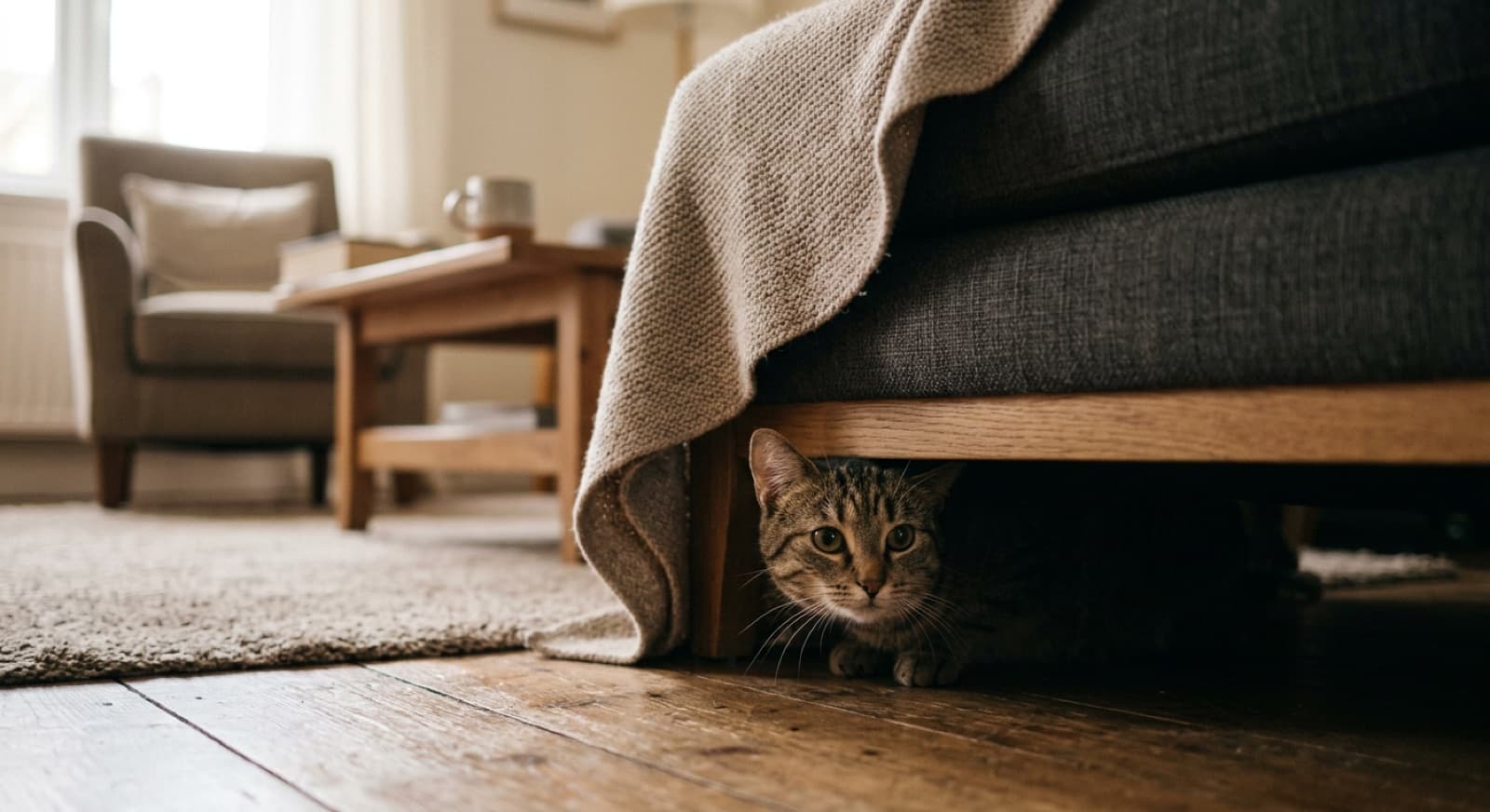
But the payoff is real and worth every quiet evening of waiting. So many anxious, scared, and even traumatized rescue pets grow into confident, affectionate, wonderful companions once they finally believe they are home. The shut-down dog in the kennel and the hiding cat under the bed are not the finished story. With patience, decompression, and help when it is needed, they are very often just getting started.
Further reading: the ASPCA on helping a fearful pet, Fear Free Pets, the AVSAB.
Ready to give a shy pet a chance?
Shy and shut-down pets are the most overlooked, and often the most rewarding. See who is waiting.
Browse adoptable cats →FAQ
Tap a question to expand