The short answer
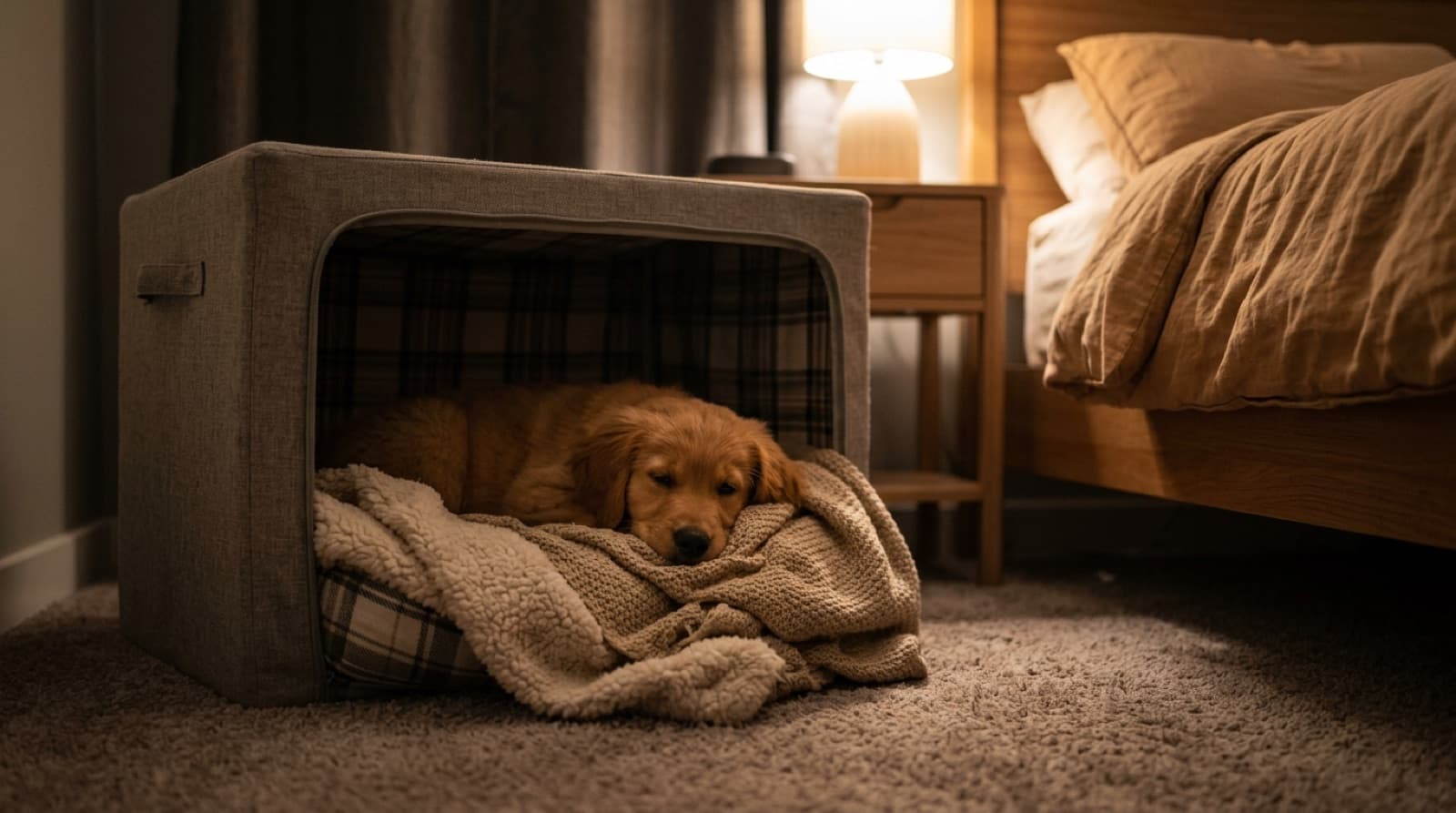
Set the night up before bed: a good play and exercise session, a final trip outside to potty, and a calm wind-down. Put the crate in or right next to your bedroom so the puppy can hear, see, and smell you, which is the single biggest thing that prevents panic on night one. Give it a cosy bed and maybe a worn shirt with your scent. Expect crying, and learn to tell a genuine need from a bid for attention: a young puppy usually cannot hold its bladder all night, so take it out calmly for one or two quiet potty trips with no playtime, then back to bed. Do not reward frantic crying by getting it out to play, but do not ignore a real need to go either. It feels rough, but it is short: most puppies are settling and sleeping much better within one to two weeks.
Set the first night up before bed
A lot of first-night success is decided before bedtime. A puppy with pent-up energy will not settle, so give it a good play and gentle exercise session in the evening to take the edge off, then ease into a calm wind-down so it is sleepy rather than wired by bedtime. Keep the last hour low-key, with quiet handling and no rowdy games that rev it back up.
Right before bed, take the puppy outside for a final bathroom trip, and give it the chance to fully empty its bladder so it can last as long as possible overnight. Have everything ready: a comfortable bed inside the crate, fresh water available earlier in the evening but not a huge drink right at bedtime, and the crate set up in the spot you have chosen. Going into night one with a tired, recently emptied puppy and a cosy, familiar crate stacks the odds in your favour.
Where your puppy should sleep
The single most effective decision you can make is where the crate goes. For the first nights, put it in or right next to your bedroom. A puppy that has just lost its littermates is comforted enormously by being able to hear, see, and smell you, and a puppy left alone in a distant room on its very first night is far more likely to panic, cry for hours, and start associating sleep with distress. Closeness is reassurance.
A crate is the ideal first-night setup, because it gives the puppy a small, den-like space that feels safe and doubles as house-training support, since dogs avoid soiling where they sleep. Make it inviting with a soft bed and a worn t-shirt or blanket that carries your scent, which is genuinely calming. If you are not sure how to introduce the crate positively in the first place, our crate training guide walks through it step by step. You can always move the crate to a more permanent spot later, gradually, once the puppy is sleeping soundly.
The crying, and what to do about it
Almost every puppy cries on its first nights, and it is heartbreaking to hear, but it is normal and it passes. The skill is telling apart two very different things: a genuine need and a bid for company or play. A puppy that settled, then wakes and cries, may well need to potty, and that need should be met. A puppy crying purely because it wants out to play or be cuddled is a different matter, and giving in to that teaches it that crying is how to summon you.
The balance most people land on works like this: do not rush to a puppy the instant it makes a noise, but do not let a genuinely distressed or potty-needing puppy cry endlessly either. Having the crate right beside your bed helps hugely, because you can offer quiet reassurance, a calm word or a hand near the crate, without taking the puppy out to play. When you do need to take it out for a real potty trip, keep it boring and businesslike, so the lesson is that night-time is for sleeping, not socialising.
Overnight potty trips
A young puppy simply cannot hold its bladder through a full night, so plan for one or two overnight trips outside in the early weeks rather than seeing them as a failure. As a rough guide, a puppy can hold on for about one hour per month of age, so a two-month-old will need to go at least once or twice overnight. Listen for the wake-and-cry that signals a need, and take it out promptly so it does not have an accident in the crate, which would undermine house-training.
Handle these trips to encourage sleep, not play. Carry or lead the puppy straight outside to its usual spot, wait quietly for it to go, reward it calmly, then bring it straight back to the crate with no games, no treats-party, and minimal lights and talk. Kept this dull and predictable, the puppy learns that night wakings are only for a quick bathroom break, and as its bladder matures over the coming weeks the overnight trips naturally drop away. Our puppy potty training guide has the full age-by-age schedule.
How long until a puppy sleeps through the night
The good news is that the brutal first nights are short-lived. Most puppies settle significantly within the first one to two weeks as the new home becomes familiar and the routine sinks in. Sleeping fully through the night, without a potty trip, depends largely on bladder development and usually arrives somewhere around four months of age, though it varies by individual and breed. The trend, even in that first week, is steady improvement.
Consistency is what gets you there fastest. Keeping the same bedtime routine, the same crate spot, and the same calm response to night wakings teaches the puppy what to expect, and predictability is deeply settling for a young animal. Resist the temptation to change the approach every night out of exhaustion. Pick a sensible plan, stick to it, and let the puppy grow into it. The early nights feel endless in the moment and are over surprisingly quickly.
What not to do
Do not banish the puppy to a far-off room or the garage on night one in the hope it will cry itself out. That tends to create panic and a lasting fear of being alone, which is far harder to undo than getting through a few close, supported nights. Likewise, do not punish or scold a crying puppy. It is frightened, not naughty, and punishment only adds fear to an already stressful situation.
Be intentional about habits you may not want forever. If you do not want the puppy sleeping in your bed long-term, starting that on night one can be hard to reverse, though a crate right beside the bed gives closeness without that. And try not to swing between extremes night to night, ignoring crying one night and scooping the puppy up for a play the next, because the mixed message slows everything down. Calm, consistent, and close is the formula that gets a puppy sleeping well the fastest.
Further reading: Humane World for Animals on crate training, the American Kennel Club on puppies and overnight potty needs.
Just brought a puppy home?
The first night is night one of many. Our free training roadmap puts every new-puppy step in order.
See the first-90-days plan →FAQ
Tap a question to expand