The short answer
Build the crate up as a good place, never a punishment. Start with the door open and toss in treats and toys, then feed meals inside, then close the door for a few seconds at a time and slowly extend it. Pick a crate just big enough for the dog to stand, turn, and lie down, and no bigger. Keep crate time within what the dog can handle: roughly one hour per month of a puppy's age during the day, and never all day for any dog. For the first while, put the crate in or near your bedroom so a puppy is not alone, and expect a young puppy to need one or two overnight potty trips. Patience and a positive build-up get almost every dog comfortable in days to a few weeks.
A lot of new owners feel uneasy about crates, picturing a cage and a sad dog locked inside. That is the opposite of what good crate training is. Used properly, a crate taps into a dog's natural instinct to den, giving it a safe, cosy place of its own, while making house-training, settling, and safe alone-time dramatically easier for you. The whole thing rests on one rule: the crate must always be a good place, never a punishment. Here is how to do it right.
Why crate training works (and is not cruel)
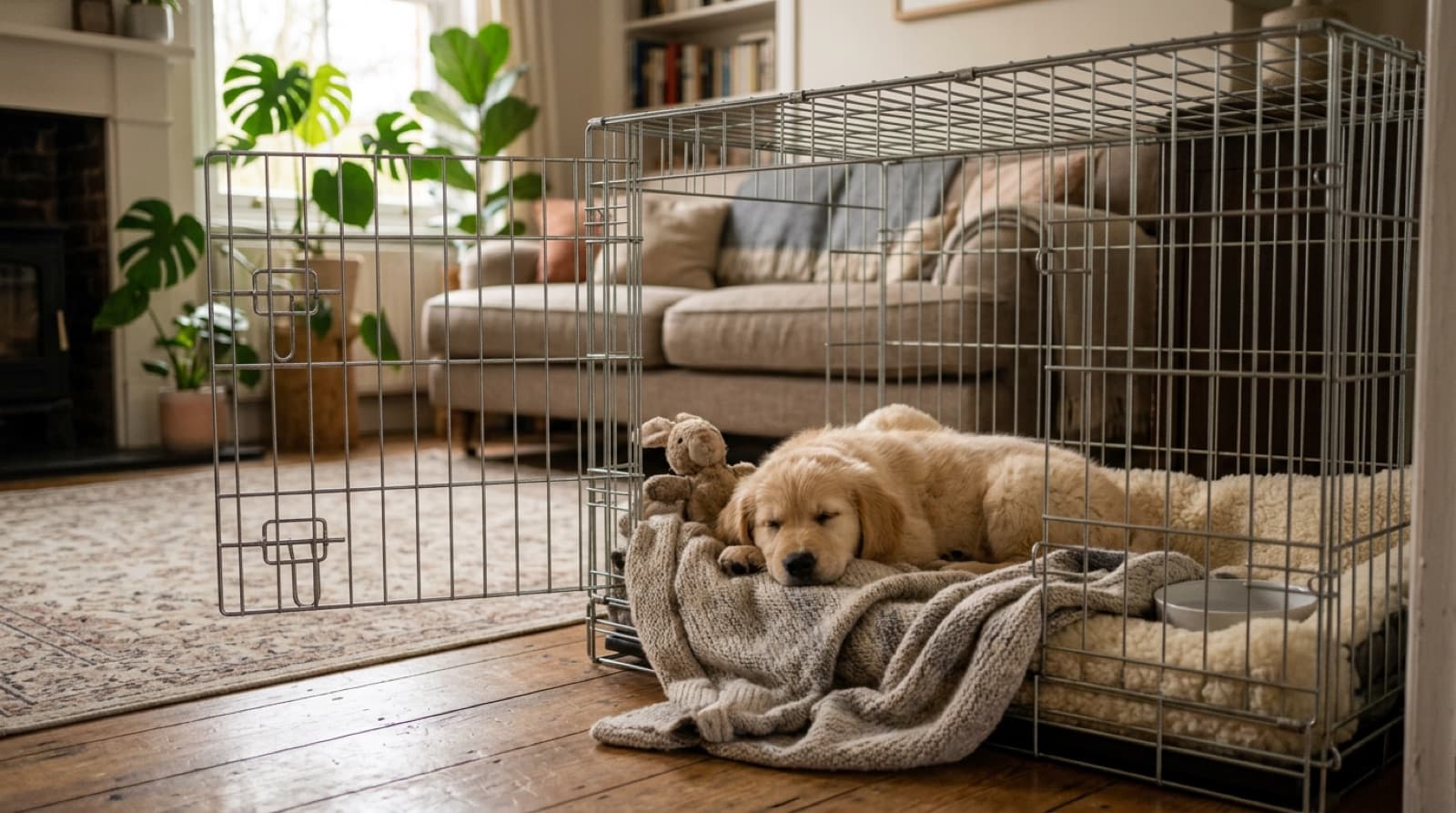
Dogs are den animals by instinct. In the wild, a den is a small, enclosed, defensible space where they feel safe and can rest, and a crate recreates exactly that. Far from being a punishment, a properly introduced crate becomes a dog's own bedroom, a place it chooses to retreat to when it wants to sleep or feel secure. According to Humane World for Animals, the crate should always be associated with something pleasant.
Beyond comfort, a crate does real practical work. It prevents accidents and destructive chewing when you cannot supervise, because dogs avoid soiling and tend to settle in their den. It keeps a curious puppy safe from hazards. It gives a nervous or newly adopted dog a secure retreat while it decompresses. And it is the foundation for teaching a dog to be calm and content on its own, which helps prevent separation problems later. The catch is simple: all of that only holds if the crate is built up positively and never used to punish.
Choosing the right crate and size
Size is the detail people most often get wrong. The crate should be just big enough for your dog to stand up, turn around, and lie down comfortably, and no bigger. That snug fit is part of what makes it feel den-like and safe, and it is essential for house-training: in a crate that is too large, a puppy will happily relieve itself at one end and sleep at the other, which defeats the purpose.
For a growing puppy, the trick is to buy a crate sized for its expected adult size, then use a divider panel to block off a smaller section, expanding the usable space as the puppy grows. That way you get the right fit at every stage without buying multiple crates. Add a comfortable bed or blanket, and make it inviting. Wire crates with a divider are popular for this reason, though plastic and soft crates work too depending on the dog.
How to crate train, step by step
The goal is for the dog to walk into the crate happily, so go slowly and keep every step positive. Rushing is the most common mistake.
- Introduce it open. Set up the crate with the door open or removed, and toss treats and a favourite toy inside so the dog explores it freely, with no pressure.
- Feed meals inside. Start placing the dog's food bowl in the crate. Eating in there builds a strong positive association.
- Close the door briefly. Once the dog goes in willingly, close the door for just a few seconds while you sit beside it, then open it and reward calm. Slowly build up the time.
- Add short absences. Once the dog is relaxed with the door closed, step out of the room for a minute, then return. Gradually extend how long you are gone.
- Build to longer stays. Work up to leaving the house for short, then longer, periods, always within what the dog can comfortably handle.
Throughout, keep arrivals and departures low-key, give the dog a safe chew or stuffed toy to enjoy in the crate, and never open the door in response to frantic barking or whining, which only teaches the dog that fussing works. Let the dog out when it is calm.
How long can a dog be in a crate?
A crate is a short-term rest and management tool, not a place a dog should spend most of its day. The main limit for a puppy is bladder control: a useful rule of thumb is that a puppy can hold it for roughly one hour per month of age during the day. The table below is a general daytime guide. Overnight is a bit different, since dogs sleep and can usually hold on longer, though a young puppy will still need one or two trips outside.
| Age | Max daytime crate time |
|---|---|
| 8 to 10 weeks | About 30 to 60 minutes |
| 11 to 14 weeks | 1 to 3 hours |
| 15 to 16 weeks | 3 to 4 hours |
| 4 to 6 months | 4 to 5 hours |
| Adult dog | 6 to 8 hours maximum, and not every day |
These are upper limits, not targets. No dog should be crated all day, every day. If you are regularly away longer than your dog can handle, arrange a dog walker, daycare, or a safe puppy-proofed room instead of extending crate time.
Crate training at night
The first few nights are the hardest, especially with a puppy that has just left its littermates. The single most effective move is to put the crate in or right next to your bedroom for the first while. Being able to hear, see, and smell you makes the crate far less lonely, and you will also hear a puppy stir when it needs to go out. A puppy left alone in a distant room on night one is far more likely to panic and cry.
Set the night up for success: make sure the dog is well exercised, has had a chance to go to the bathroom right before bed, and has a comfortable bed and maybe a worn shirt that carries your scent. Expect a young puppy to need one or two overnight potty trips, and handle those calmly and boringly, straight out to the spot and straight back to the crate, with no playtime, so the puppy does not learn that crying earns a party. Resist letting a fussing puppy out to play, but do respond to a genuine need to potty. Most puppies settle into sleeping through within the first week or two.
Crate training and potty training
Crate training and house-training are a natural team. Because a dog avoids soiling the small space where it sleeps, a correctly sized crate teaches a puppy to hold on and signals you when it needs to go. The key is to take the puppy straight from the crate to its outdoor spot the moment you let it out, and reward it for going there. Used this way, the crate prevents the unsupervised accidents that slow house-training down. For the full potty routine and an age-by-age schedule, see our puppy potty training guide and our broader house-training guide.
Whining, crying, and other hiccups
Some fussing early on is normal as a dog gets used to the crate. The art is telling apart a genuine need from a bid for attention. A puppy that has been quiet then starts crying may well need to potty, so take it out calmly, then back to the crate. Crying purely for attention or to be let out to play should not be rewarded by opening the door, or the dog learns that noise works. Wait for a pause in the fussing to let it out, so calm is what earns freedom.
If a dog is genuinely panicked in the crate, drooling heavily, frantically trying to escape, or injuring itself, that is not ordinary fussing and may signal separation anxiety or a bad past association, which needs a slower, gentler plan and sometimes professional help rather than more crate time. Build back up from the very first steps, keep everything positive, and never use the crate as a punishment, which poisons the safe-place association you are trying to create.
Crate training is one piece of the plan
It pairs with potty training, settling, and alone-time. Our free first-90-days training plan puts every new-dog skill in the order that works.
See the Free Dog Training Plan →Frequently asked questions
Is crate training cruel?
No, when it is done right, because dogs are den animals that instinctively seek out a small, enclosed space to feel safe. A crate gives them that, plus it prevents accidents and destructive chewing when you cannot supervise, and it gives an anxious or newly adopted dog a secure retreat. Crate training only becomes a problem if the crate is used as punishment, or if a dog is left in it far too long. Built up positively and used sensibly, most dogs come to choose their crate as their favourite spot to rest.
How long can a dog be left in a crate?
It depends mostly on age and bladder control. A rough guide is that a puppy can hold it for about one hour per month of age, so an 8-week-old puppy should not be crated more than about an hour at a time during the day, a 3-month-old around three hours, and so on. Adult dogs should not be crated longer than about six to eight hours, and no dog should be crated all day, every day. The crate is a short-term management and rest tool, not a place a dog should live. If you are away for long stretches, you need a dog walker, daycare, or a safe larger space instead.
What size crate do I need?
Just big enough for the dog to stand up, turn around, and lie down comfortably, and no bigger. A crate that is too large lets a puppy use one end as a bathroom while sleeping at the other, which defeats the house-training benefit. For a growing puppy, buy a crate sized for its adult size and use a divider to section off a smaller area, then expand it as the puppy grows. The snug, den-like fit is part of what makes a dog feel secure in there.
How do I crate train a puppy step by step?
Make the crate a wonderful place, slowly. Start by leaving the door open and tossing treats and toys inside so the puppy explores it on its own. Then feed meals in the crate to build a positive association. Next, encourage the puppy in with a treat, praise it for going in, and begin closing the door for a few seconds at a time while you sit nearby, gradually building up the duration. Work up to short absences, always keeping it calm and positive. The whole process can take days to a few weeks, and rushing it or using the crate as punishment sets you back.
How do I stop my puppy crying in the crate at night?
First make sure the crying is not a genuine need: a young puppy usually cannot hold its bladder all night and will need one or two trips outside, so a cry may mean it needs to potty. Take it out calmly and with no fuss, then back to the crate. Beyond real needs, put the crate in or near your bedroom for the first while so the puppy is not alone, give it a comfy bed and maybe a worn shirt that smells like you, and make sure it is well exercised and has been to the bathroom before bed. Try not to reward frantic crying by letting the puppy out to play, or it learns that crying works. Most puppies settle within the first week or two as the crate becomes familiar.
Where should I put the crate?
For the first few weeks, especially with a puppy or a newly adopted dog, put the crate where the family is, and at night in or near your bedroom. Dogs are social, and being able to see, hear, and smell you makes the crate far less lonely and helps a new dog settle. A quiet corner of a main living area works well for daytime. Once the dog is comfortable and sleeping through the night, you can move the crate to a permanent spot if you prefer, doing it gradually.
How long does crate training take?
Anywhere from a few days to a few weeks, depending on the dog and how positively you build it up. Some dogs take to a crate almost immediately, while others, especially those with a bad past association, need more patience. The pace is set by the dog: go too fast or force it and you create fear that slows everything down. Keep every step positive, never use the crate as punishment, and let the dog tell you when it is ready for a little more time. Consistency gets almost every dog there.
Further reading: Humane World for Animals on crate training, the American Kennel Club training library.
Puppy Potty Training
The other half of the crate: tips, schedule, and the method.
House-Training a Dog and Cat
The full house-training routine for any age.
Free Dog Training: First 90 Days
Where crate training fits in the full roadmap.
New Pet Checklist
Crate, divider, bed, and the rest of the day-one gear.