The short answer
Take your puppy to the same outdoor spot on a tight schedule, after waking, eating, drinking, and playing, plus roughly every couple of hours, and reward it the instant it goes in the right place. Between trips, prevent accidents with close supervision or a correctly sized crate, since dogs avoid soiling where they sleep. A puppy can hold its bladder for about one hour per month of age, so plan trips around that. Never punish accidents, which only teaches a puppy to hide when it goes. Clean any indoor mess with an enzymatic cleaner so no scent draws it back. Expect the basics in a few weeks and full reliability over a few months, with consistency the biggest factor in how fast it goes.
Potty training is the very first thing almost every new puppy owner needs to get right, and the good news is that it is more about management than complicated training. Get the schedule, the supervision, and the rewards right, and most puppies sort it out faster than you would expect. Get sloppy with any of the three and it drags on. This guide walks through the method, an age-by-age schedule, the crate, the pads question, and what to do when accidents happen.
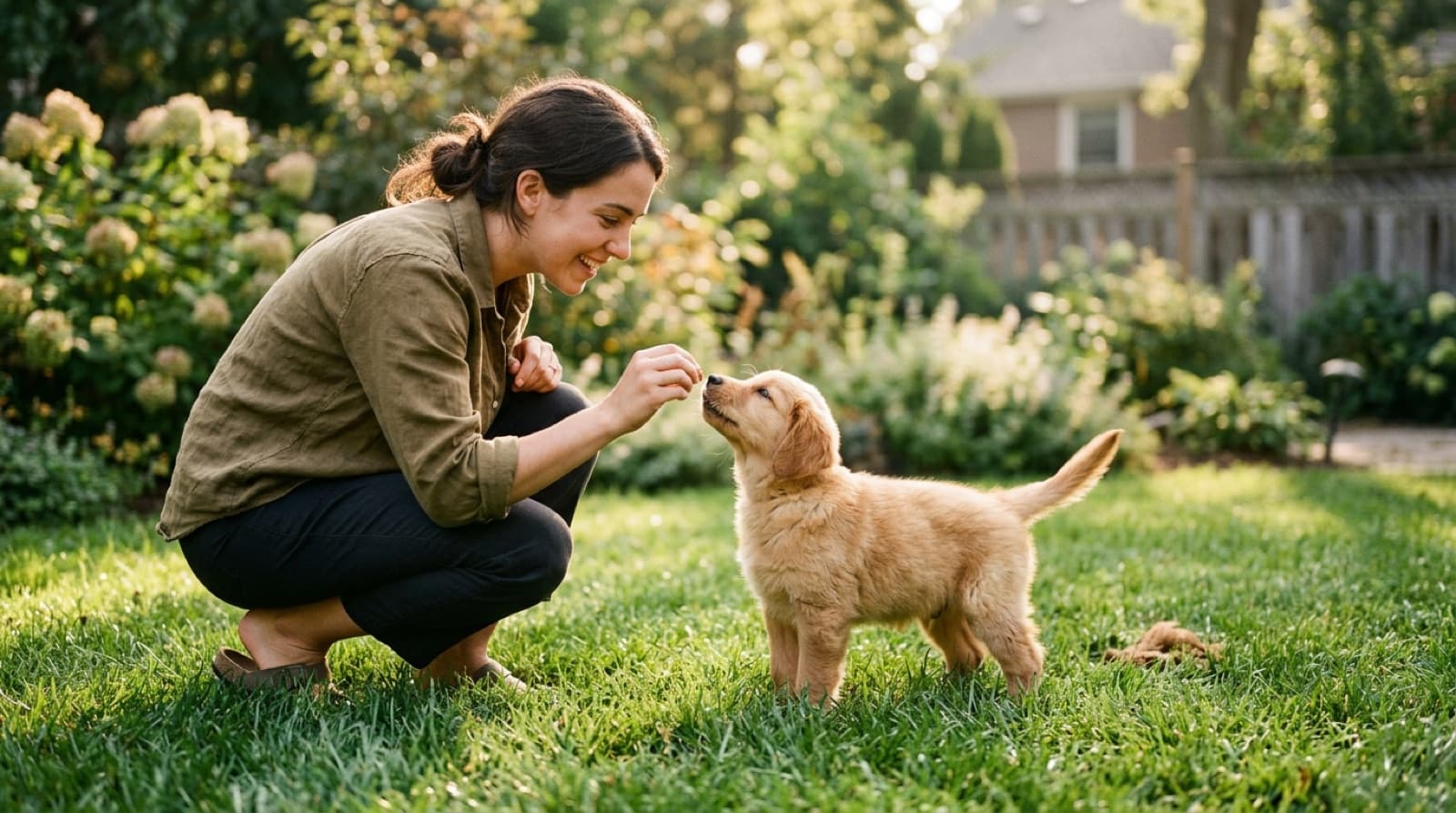
The potty training tips that actually matter
Strip away the noise and potty training rests on three principles. First, a consistent routine: predictable meals, water, naps, and outdoor trips create predictable bathroom needs you can get ahead of. Second, supervision and prevention: a puppy that never gets the chance to make a mistake learns far faster than one left to wander and get it wrong. Third, reward: praising and treating the puppy the instant it finishes in the right place teaches it exactly what you want, fast.
- Use one outdoor spot. Always take the puppy to the same place. The lingering scent cues it that this is where to go.
- Reward on the spot, immediately. Praise and treat the moment it finishes, right there, not back inside, so it connects the reward to the act.
- Go out after every trigger: waking, eating, drinking, and playing all reliably make a puppy need to go.
- Supervise or confine between trips. Active eyes on the puppy, or a crate or pen, so accidents simply do not get the chance to happen.
- Never punish accidents. Scolding or rubbing a nose in a mess does not teach where to go. It teaches the puppy to fear going in front of you, which makes things worse.
That last point is the one new owners get wrong most. An accident is information that your schedule or supervision slipped, not defiance. The fix is always to tighten the routine, never to punish the puppy.
Puppy potty training schedule by age
A young puppy has a small bladder and limited control, so the schedule changes as it grows. A widely used guide, noted by the American Kennel Club, is that a puppy can hold its bladder for roughly one hour per month of age, up to about nine months. Use the table below as your baseline, and always add a trip after every meal, nap, drink, and play session on top of it.
| Puppy age | Daytime trips outside | Overnight |
|---|---|---|
| 8 to 10 weeks | Every 1 to 2 hours, plus after every meal, nap, drink, and play | 1 to 2 trips |
| 10 to 12 weeks | Every 2 hours, plus after triggers | 1 trip |
| 3 to 4 months | Every 3 to 4 hours, plus after triggers | Often through the night |
| 4 to 6 months | Every 4 to 5 hours, plus after triggers | Through the night |
| 6 months and up | Every 5 to 6 hours as it matures | Through the night |
These are baselines, not strict limits. Every puppy is different, and asking a puppy to hold it much longer than it can is unfair and sets up accidents. When in doubt, take it out more often.
A predictable feeding schedule makes the potty schedule predictable too. Feeding at set times rather than leaving food down all day means you can anticipate when your puppy will need to go, usually shortly after eating.
The crate method
Crate training and potty training go hand in hand. Dogs instinctively avoid soiling the small space where they rest, so a correctly sized crate becomes a powerful potty-training tool: it prevents accidents when you cannot supervise, and it teaches the puppy to hold on and signal you. The crate should be just big enough for the puppy to stand up, turn around, and lie down comfortably, and no bigger, because a too-large crate lets it use one end as a bathroom. Many crates come with a divider so you can expand the space as the puppy grows.
Use the crate any time you cannot actively watch the puppy, and the instant you let it out, carry or lead it straight to its outdoor spot and reward it for going there. The crate must always be a positive, safe den, never a place of punishment, so feed meals in it and build up time gradually. For the full approach, including how long a dog can be crated by age, see our crate training guide.
Should you use puppy pads?
Puppy pads are one of the most common questions, and the honest answer is that they involve a real trade-off. Pads can genuinely help in certain situations: an apartment or high-rise with no quick outdoor access, a puppy too young to be outside safely, or a stretch where you are away longer than a very young puppy can possibly hold. In those cases a pad is better than forcing an impossible hold or a guaranteed accident.
The catch is that pads teach a puppy that going indoors is acceptable, which can slow full outdoor training and often means a second round of training later to move the behaviour outside. If you have easy outdoor access, many trainers recommend skipping pads entirely and going straight to outdoor training, which gets you to the end goal faster. If you do use pads, keep them in one consistent location, treat going on the pad as a success worth rewarding, and plan to phase them out by gradually moving them toward and eventually outside the door.
Troubleshooting accidents and setbacks
Accidents are a normal part of the process, not a failure, and the right response is to adjust your routine rather than scold the puppy. Clean any indoor mess thoroughly with an enzymatic cleaner made for pet messes, because puppies return to spots that still smell like a previous accident, and ordinary cleaners can leave a scent that invites a repeat. Then look at what slipped: was the puppy out long enough ago, was it supervised, did a trigger like a meal or nap get missed?
If your puppy will not go outside, stay out longer and stay calm, since some puppies get distracted, cold, or nervous and need a boring few minutes at the same spot to relax enough to go. Reward the instant it finishes, and do not rush it straight back indoors the moment it is done, or it may learn to hold on to make the outing last. Expect some backward steps too, especially after a big change like coming home to a new house, which is normal and usually passes quickly as the puppy settles.
When an accident means call the vet. A sudden change in a previously reliable dog, or a puppy that strains, goes very frequently, or seems uncomfortable, can signal a urinary tract infection or other medical issue. If you see that, treat it as a health question, not a training one, and call your veterinarian.
Housebreaking an adult or rescue dog
The same method works for an adult dog, and the word housebreaking just means the same thing as potty training. Adult dogs often learn faster than puppies because they already have full bladder control and a longer attention span, and many rescue dogs arrive already house-trained from a previous home or foster. A newly adopted dog may have a few accidents in its first days simply from the stress of a new place, which is not a training failure, just a dog finding its feet. Treat the early days as a gentle refresher: show it the spot, reward success, keep the routine calm and consistent. Our broader house-training guide covers dogs and cats of any age.
Potty training is step one of many
Once the bathroom basics are in place, our free first-90-days training plan walks you through everything else in the order that actually works.
See the Free Dog Training Plan →Frequently asked questions
How do I potty train a puppy?
Three things: a tight schedule, close supervision, and rewarding success outdoors. Take your puppy to the same outdoor spot first thing in the morning, after every meal, after drinking, after every nap, after play, and last thing at night, plus roughly every couple of hours in between. The moment it goes in the right place, reward it on the spot with praise and a treat. Between trips, prevent accidents with active supervision or a correctly sized crate, and never punish an accident, because that only teaches the puppy to hide when it goes. Most puppies get the basics within a few weeks of consistent effort.
How often should I take my puppy out to pee?
A useful rule of thumb is that a puppy can hold its bladder for roughly one hour per month of age, up to about nine months, so an 8-week-old puppy needs to go out very often, around every two hours, while a 4-month-old can usually wait three to four hours. On top of that timer, always take the puppy out after it wakes, eats, drinks, and plays, since those reliably trigger the need to go. Young puppies also need at least one overnight trip outside. As the puppy grows and stays reliably clean, you can gradually stretch the time between trips.
Should I use puppy pads?
It depends on your situation, and there is a real trade-off. Pads can make sense if you live in an apartment or high-rise with no quick outdoor access, if the puppy is too young to go outside safely yet, or if you are gone longer than a very young puppy can hold. The downside is that pads teach a puppy it is acceptable to relieve itself indoors, which can slow down or confuse full outdoor training and often means a second round of training later to move it outside. If you have easy outdoor access, most trainers suggest skipping pads and going straight to outdoor training. If you do use them, place them in one consistent spot and plan to phase them out.
How does a crate help with potty training?
Crate training works because dogs instinctively avoid soiling the small space where they sleep, so a correctly sized crate teaches a puppy to hold it and signals you when it needs to go out. The crate must be just big enough for the puppy to stand up, turn around, and lie down comfortably, and no bigger, or it may use one end as a bathroom. Use it when you cannot actively supervise, and take the puppy straight outside to its spot the moment you let it out, then reward going in the right place. The crate should always be a positive, safe den, never a punishment.
How long does it take to potty train a puppy?
Usually a few weeks of consistent effort for the basics, but full reliability often takes several months, because a young puppy does not have complete bladder control until it is older. Adult dogs typically learn faster, and many rescue dogs already arrive house-trained. The single biggest factor in speed is your consistency: a puppy on a rock-solid schedule whose every success is rewarded learns far faster than one getting a patchy approach. Expect occasional slip-ups during the learning period, and stay patient rather than frustrated.
My puppy will not pee outside. What do I do?
First, give it time and stay out longer, because some puppies get distracted, cold, or nervous outdoors and need a calm, boring ten minutes at the same spot to relax enough to go. Take the puppy to the exact same place each time so the lingering scent cues it, wait without rushing or playing, and the instant it goes, reward it immediately and warmly so it connects the reward to going there. Avoid bringing it straight back inside the second it finishes, or it may learn to hold on to extend the outing. If a puppy genuinely cannot urinate, strains, or seems uncomfortable, call your veterinarian to rule out a medical issue.
Is potty training the same as housebreaking?
Yes, they are different words for the same thing: teaching a dog to relieve itself outside or in a designated spot rather than in the house. You may also see it called house-training or toilet training. The method is identical no matter what it is called, a consistent schedule, supervision and crating to prevent mistakes, and rewarding success, with no punishment for accidents. The term housebreaking is just the older phrase for it.
How do I clean up a potty accident so my puppy does not go there again?
Use an enzymatic cleaner made for pet messes, not a regular household cleaner. Puppies are drawn back to spots that smell like a previous accident, and ordinary cleaners (especially anything with ammonia) can leave a scent that actually invites a repeat. An enzymatic cleaner breaks down the odour at the source so the spot no longer signals bathroom to your puppy. Then tighten your supervision and schedule so the accident does not happen again, since prevention is what really moves potty training forward.
Further reading: the American Kennel Club on potty training, the Canadian Veterinary Medical Association.
House-Training a Dog and Cat
The broader overview for dogs and cats of any age.
Crate Training a Puppy
The crate method in full, the other half of potty training.
Free Dog Training: First 90 Days
Where potty training fits in the full new-dog roadmap.
New Pet Checklist
The crate, enzymatic cleaner, and gear to have ready first.