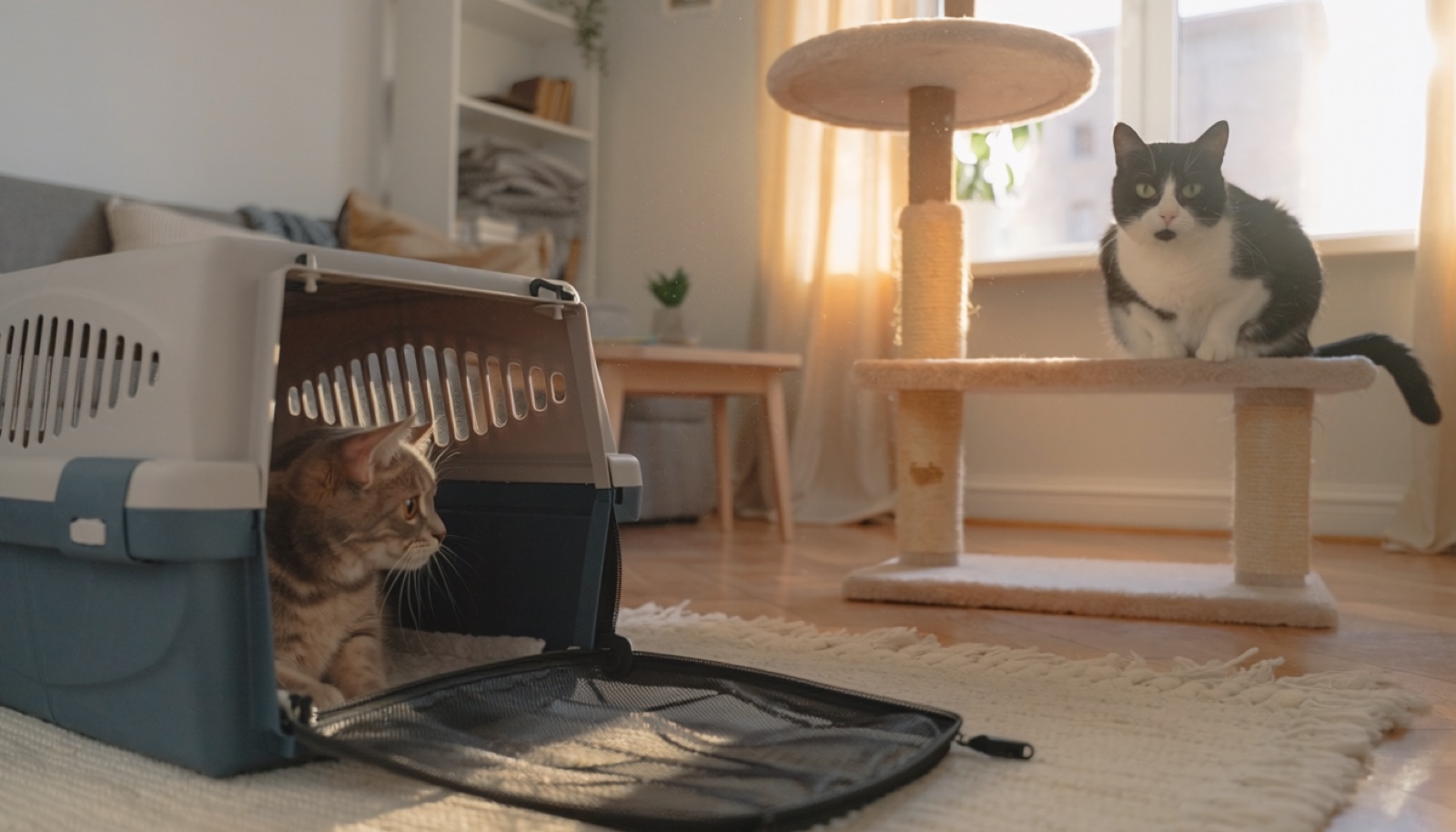
The short answer
New cat goes into a closed safe room first. Then the stages, in order: scent swapping, door feeding, gated visual sessions, then supervised shared space. Two to four weeks is normal. A former street or barn cat from SCAT Street Cat Rescue (306-955-7228) usually needs a longer decompression runway before stage one even starts. A bonded pair skips the cat-to-cat introduction; the two cats already did it. If things stall, SCAT and the Saskatoon SPCA (306-374-7387) both take post-adoption calls.
Heads up: This article is informational and is not veterinary or behaviour-consult advice. New aggression, hiding, or litter box changes in a previously settled pet can be medical; a cat that stops eating for more than a day needs a vet before a training plan. Contact details and bylaw fees are current as of July 2026; confirm before relying on them.
Saskatoon's adoption pipeline shapes how introductions go here. A meaningful share of the city's adoptable cats come through SCAT Street Cat Rescue, which has worked Saskatoon's street and community cats since 1996. A cat that spent its first year outdoors, or grew up around a barn, is not just meeting your resident pets; it is meeting indoor life itself. Those cats do fine, and often spectacularly well, but they need a longer runway. The Saskatoon SPCA side of the pipeline sends home cats that are already fixed, vaccinated, and microchipped, with a free vet visit included, so the health groundwork is done before the social work begins.
Scope note: this guide covers the introduction (new cat meets resident cat or dog). General settling (decompression, hiding, appetite, the first vet trip) belongs to our first week with your rescue cat guide. Only pet in the house? Read that one; the safe room is the only section below you need.
Still choosing a cat? Browse adoptable Saskatoon cats or compare organisations in our Saskatoon cat rescue roundup. If you have a resident cat, ask the rescue directly whether a cat has lived with other cats before. SCAT's foster homes usually know, and a cat-experienced cat cuts your introduction time substantially.
Before Stage One: The Street-Cat Decompression Rule
Match the runway to the background. A confident, home-raised adult may be done decompressing in three or four days. A former street cat, a barn-background cat, or a long-term colony cat may need one to two weeks of pure safe-room settling before you start any introduction work at all. Everything indoors is new: the furnace kicking on, the television, footsteps overhead, the vacuum. Adding a strange cat on top of that is stacking stress.
Ask the foster. SCAT cats live in foster homes before adoption, and the foster can tell you where the cat already is: still hiding at week two, or lounging on the couch by day three, already fine with the foster's own cats or dogs. That report should set your starting speed. A cat that lived calmly with the foster's three cats does not need the maximum-caution track.
Hiding is not a setback. Under-the-bed weeks happen with street-background cats and resolve on the cat's clock. Food disappearing and a used litter box are your progress metrics, not visible friendliness. Start introductions only once the cat moves around the safe room with you present.
The Four Stages, In Order
Safe room
One closed room holds the litter box (one corner), food and water (opposite corner), a hiding spot, a scratcher, and toys. The closed door protects the newcomer's decompression and lets resident pets learn the new smell through the gap on their own schedule. Your resident cat parked outside the door, sniffing, is stage one working as designed. The room stays available as a retreat long after the door opens.
Scent swapping and door feeding
Trade cheek-rubbed cloths between animals daily and swap bedding every couple of days. Add room swaps once the newcomer has settled: resident explores the safe room, newcomer tours the house, never at the same time. Meanwhile, feed both animals at the same time on opposite sides of the closed door, starting a metre or two back and inching the bowls closer each day. Sniff-and-ignore reactions to swapped scent plus relaxed eating near the door on both sides means move on. Hissing at a cloth or skipped meals means hold here longer.
Gated visual sessions
A baby gate in the safe-room doorway (stack a second gate for jumpers, or drape a blanket over the top half) or a wedged, barely-open door. Sessions run five to ten minutes and always pair the sight of the other animal with something good: meals on both sides, treats, a wand toy each. End while everyone is still calm. Glance-then-ignore, loose bodies, and slow blinks are green lights. Fixated staring, building growls, or swatting through the gate mean close the door and back up to stage two for a few days.
Supervised shared space, then trial absences
Open the gate for short sessions with you present and attentive; a towel and a flat piece of cardboard nearby let you split a scuffle without your hands. Stretch session length over days, keep the newcomer sleeping in the safe room at night, then trial short absences (a grocery run) before full unsupervised cohabitation. Escape routes stay open, and the resource math stays permanent: one litter box per cat plus one, separate feeding stations, duplicate perches in different rooms. Peaceful coexistence is the finish line; actual friendship is a bonus that often shows up months later.
The Bonded-Pair Shortcut
Here is the one genuine shortcut in this whole topic. If you adopt a bonded pair, the cat-to-cat introduction is already done. The two cats arrive as an established social unit that eats, sleeps, and grooms together. SCAT prices pairs to go home together (pair adoption fees run below two singles across every age band) specifically to keep bonds intact.
What you skip: the entire two-cat negotiation, which is the longest and most failure-prone part of building a multi-cat home from strangers. Two cats who already like each other also buffer each other's stress; a nervous cat with a confident bonded partner settles faster than either would alone.
What you still do: the pair shares one safe room and goes through the full staged introduction to any resident cat or dog as a unit. Resource math scales too: litter boxes for a three-cat home (two arriving, one resident) means four boxes.
Who it suits: first-time multi-cat households, homes with no resident cat, and anyone who wants two cats without running two separate introductions a year apart. If that sounds like you, ask about current pairs when you browse adoptable Saskatoon cats.
Introducing the New Cat to Your Dog
Same stages, harder safety rails. The safe room, scent swaps, and door feeding are unchanged. The difference is physics: a dog can injure a cat in seconds, so the dog is leashed for every visual session until calm behaviour is boring and proven over weeks.
Train the dog before the sessions. Solid sit, stay, and attention around distractions come first. During gated sessions, reward the dog for looking at you instead of the cat. Stiffness, whining, and locked-on staring are prey-drive signals; end the session, add distance, repeat shorter.
Build the cat's escape network. Vertical space the dog cannot reach, plus at least one permanently dog-free room behind a gate the cat can slip through. The litter box lives there, so the cat is never cornered mid-business. A street-background SCAT cat may already have strong opinions about dogs; ask the foster before assuming either way.
No accidental tests. Unsupervised dog-cat time comes only after weeks of consistent calm, and many Saskatoon households separate the two whenever nobody is home as a permanent policy. That is not paranoia; it is cheap insurance.
Mistakes That Sink Introductions
- The day-one free-for-all. Opening the carrier in the middle of the house and letting everyone sort it out. Cats form sticky first impressions; a bad one can take months to undo, and you get exactly one chance at a first meeting.
- Forcing contact. Carrying one cat to the other, holding animals face to face, or blocking a retreat “so they can get used to each other.” A cat denied its escape route learns fear, not friendship. Every approach must be chosen, never imposed.
- Skipping the runway for a street cat. Starting gate sessions with a former outdoor cat who is still hiding from the furnace noise. Decompression first, introduction second.
- Promoting after one good session. One calm meeting is a data point, not a graduation. Each stage needs several boring repetitions before it counts.
- Starving the resource math. Shared bowls and a single litter box manufacture conflict. Duplicate everything, separate locations, permanently.
- Punishing warning signals. Squirt bottles and yelling at a hiss teach the cat that the other animal's presence brings punishment. Interrupt calmly, add distance, drop back a stage.
When to Step Back, and When to Call Someone
Most wobbles are self-service fixes: back up one stage, add days, shrink sessions. Escalate past self-service when you see actual fights with injuries, a cat eating nothing for more than a day (vet, immediately), litter box avoidance that outlasts a few days, one animal living in round-the-clock fear, or a complete patient restart that still ends in aggression.
Your first call is the organisation you adopted from. The Saskatoon SPCA (306-374-7387) offers post-adoption support and includes a free vet visit with every adoption, which is the right venue to rule out medical causes early. SCAT Street Cat Rescue (306-955-7228) can loop in the foster who actually lived with your cat, which turns generic advice into specific advice. Both organisations would rather troubleshoot with you at week three than process a return at month three.
One administrative note while you are settling in: Saskatoon requires every cat over four months to be licensed under Bylaw 7860 within 30 days ($23.50 per year for a fixed cat in 2026; no tag needed if the microchip is on file with the City). Every rescue cat arrives fixed and microchipped, so the cheap rate applies automatically.
The Winter Pickup
Cold-weather carrier rules
Saskatoon January lows average around -18°C, with a handful of -30°C nights most winters, and adoption day does not wait for spring. A plastic carrier is a windbreak, not insulation. For the drive home:
- Warm the car completely before the cat leaves the building, and park as close as you can
- Thick blanket inside the carrier, second blanket draped over it with an airflow gap
- Pickup is the only stop on the trip; a parked winter car loses heat fast
- Carry the carrier hugged to your body across icy lots instead of swinging it by the handle
At home, the cold season makes one choice for you: the new cat stays indoors from day one, which is what the introduction plan wants regardless. Our Saskatoon indoor vs outdoor guide explains why that should hold after the snow melts too.
Browse adoptable Saskatoon cats
Singles, bonded pairs, and foster-raised former street cats, all spayed/neutered, vaccinated, and microchipped before they come home. Foster notes tell you how each cat handles other pets.
See Available Saskatoon Cats →Frequently Asked Questions
How long should a cat introduction take in a multi-pet home?
Budget two to four weeks for a typical cat-to-cat introduction and treat anything faster as a bonus. Cat-to-dog introductions usually need at least as long, and the trust-building tail runs for weeks after. The pace is set by whichever animal is slower, which is often the resident, not the newcomer. You move forward when both animals are relaxed at the current stage, and you move back the moment you see stiff posture, hard staring, or refusal to eat. There is no version of this where rushing saves time; a botched first meeting costs you a restart from zero.
My new cat came from SCAT and used to live outside. Does that change the plan?
It stretches the front of it. SCAT Street Cat Rescue has been pulling cats off Saskatoon streets since 1996, and a cat with a street or barn background often needs noticeably longer in the safe room before it is ready for any introduction. Indoor life itself is new: furnaces, televisions, vacuum cleaners, and hallways are all foreign. Give a former street cat one to two weeks (or more) of pure decompression before starting scent swaps, and let hiding be part of the process rather than a problem to fix. SCAT cats are fostered in homes first, so ask the foster (306-955-7228) how far along the cat already is.
What goes in the safe room?
One closed room with everything the cat needs: litter box in one corner, food and water in the opposite corner, a hiding spot (the carrier with its door off works), a scratcher, a couple of toys, and something that smells like you. The door stays closed for roughly the first week; longer for shy or street-background cats. The room gives the newcomer a small, claimable territory and gives your resident pets a safe way to learn the new smell through the door gap. Our first-week guide for rescue cats covers the settling-in details day by day.
How does scent swapping actually work?
You trade smells before you trade sightlines. Rub a clean cloth or sock on the new cat's cheeks and chin, leave it where your resident cat lounges, and bring a resident-scented cloth into the safe room. Fresh cloths daily. Swap bedding every couple of days, and once the new cat has settled, add room swaps: the resident explores the safe room while the newcomer gets a supervised tour of the house. The goal is sniff-then-ignore from both sides. A cat that hisses at a swapped cloth just told you it needs more time, which is cheap information compared to learning it face to face.
What is door feeding?
Both animals eat at the same time on opposite sides of the closed safe-room door, starting a metre or two back and inching the bowls closer over several days. Meals are the most reliably positive event in a cat's day, so each animal learns that the sounds and smell of the other predict food. If either stops eating or fixates on the door, move the bowls back to the last calm distance and hold for a day or two. Calm eating with bowls near the door on both sides is your green light for visual sessions through a baby gate or cracked door.
I adopted a bonded pair. Do the two cats need to be introduced to each other?
No, and this is a genuine shortcut. A bonded pair arrives as an established unit: they already share space, groom each other, and have their social needs partly covered between them. SCAT adopts bonded cats out together at reduced pair pricing precisely to keep those units intact. You skip the entire cat-to-cat introduction and run one process instead of two. The pair still needs a shared safe room and the full staged introduction to any resident pets, and to your dog if you have one. But the hardest part of a multi-cat household (getting two strangers to accept each other) was done before you signed the paperwork.
How do I introduce my new cat to my dog?
Same stages, stricter safety. Safe room, scent swapping, and door feeding run exactly as with a cat, but the dog is on leash for every visual session until it has weeks of proven calm. Reward the dog for sitting, checking in with you, and looking away from the cat. A stiff, fixated, or lunging dog is not ready; end the session and add distance. The cat needs high ground (a cat tree or shelf) and a permanent dog-free zone, ideally behind a gate it can slip through, with the litter box inside it. No unsupervised time together until trust is boringly well established, and for strong prey-drive dogs, possibly never.
My new cat has been hiding for days. Is the introduction failing?
Almost certainly not. Hiding is the default settling behaviour for a newly adopted cat, and for a former street cat it can run a week or more without meaning anything is wrong. As long as food disappears, water goes down, and the litter box gets used (check overnight; shy cats operate on the night shift), the cat is coping. Keep the safe room quiet, sit in the room reading rather than reaching under the bed, and let the cat make the first move. Settling and introducing are different jobs; our first-week guide owns the settling side.
What are the signs I should slow down or back up a stage?
Flattened ears, puffed or lashing tails, crouched stiff bodies, hard unbroken staring, growling that builds instead of fading, swatting through the gate, guarding food or the litter box, and either animal refusing to eat during a session. Also watch for indirect signals: a resident cat that starts avoiding a favourite room, or litter box lapses from either cat. None of these mean failure. They mean the current stage arrived too soon. Drop back to the previous stage where everyone was relaxed, stay there a few extra days, and try again with more distance or shorter sessions.
Who do I call in Saskatoon if the introduction goes sideways?
The organisation you adopted from, first. The Saskatoon SPCA (306-374-7387, saskatoonspca.com) supports its adopters post-adoption and would far rather field a phone call than see an adoption quietly fail. SCAT Street Cat Rescue (306-955-7228, streetcat.ca) is foster-based, so the foster who lived with your cat can tell you what that specific animal responds to. If aggression appears suddenly in a previously settled pet, or a cat stops eating for more than a day, put your vet at the front of the line; pain and illness regularly disguise themselves as behaviour problems.
Do I need to license my new cat in Saskatoon?
Yes. Under Saskatoon's Animal Control Bylaw, every cat over four months must be licensed within 30 days, the same as dogs. The 2026 fee is $23.50 for a fixed cat and $52.50 for an intact one, and a tag is not required if your cat is microchipped with the chip on file with the City. Every Saskatoon SPCA and SCAT cat arrives fixed and microchipped, so you qualify for the cheaper rate on day one. It is an easy errand to do online during the safe-room week while the cat is busy ignoring you from under the bed.
What if my resident cat never accepts the newcomer?
Genuine permanent incompatibility exists but is much rarer than an introduction that went too fast. Before concluding you have it, restart completely: safe room, scent swaps, door feeding, at half your previous speed, and audit the resource math (one litter box per cat plus one, separate feeding stations, duplicated perches in different rooms). If a patient full restart still produces fights or a cat living in constant fear, call the rescue you adopted from before making any decision. Returns and rehoming through the original organisation are the safe path; our Saskatoon rehoming guide walks through the options.
Anything different about bringing a cat home in a Saskatoon winter?
The trip, yes; the plan, no. Saskatoon January nights regularly sit near -18°C and the city sees a handful of -30°C nights most winters, and a plastic carrier offers a cat almost no insulation. Pre-warm the car, line the carrier with a thick blanket and drape a second over it with an air gap, park close, and make the pickup your only stop. Once home, winter simplifies a decision for you: the cat stays in from day one, which is what the introduction needs anyway. Our indoor vs outdoor guide for Saskatoon covers why indoor should outlast the winter.
Related Saskatoon Guides
One Cat, or Two Who Already Get Along
Saskatoon rescue cats arrive vetted, fixed, and microchipped, and bonded pairs come with the hardest introduction already finished.
Browse Available Saskatoon Cats →New cat? Start with these care guides
Everything a new adopter needs to set up a safe, happy home.