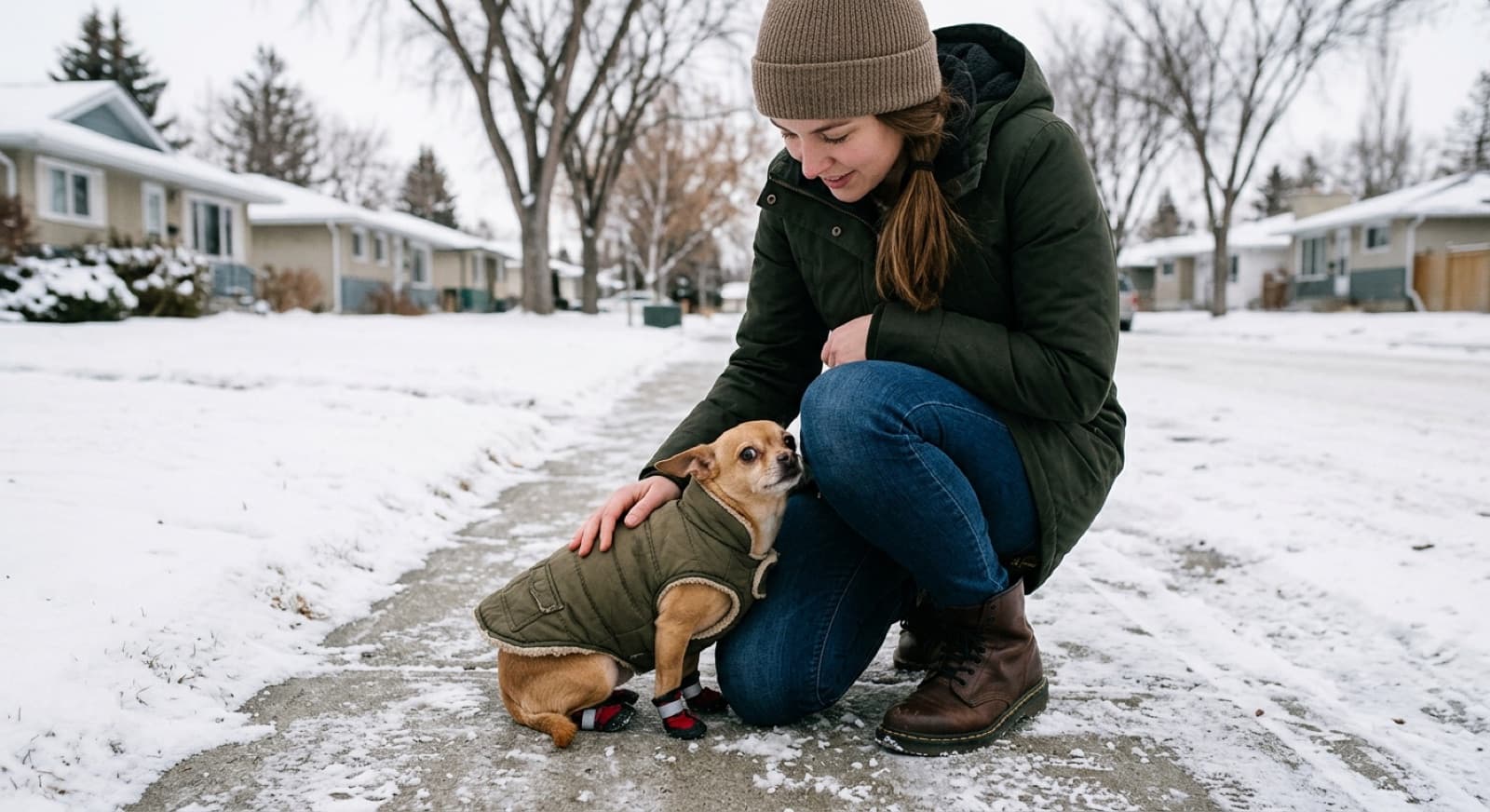
The short answer
Treat it as fear and give the dog more distance rather than correcting it. Rule out pain first, because a sore mouth or knee shortens any dog's fuse. Use the small-dog-only areas at Charlottetown Park and Hyde Park North rather than gambling in a shared park, and over winter aim to hold ground rather than progress.
It is fear, and the label decides the response
The phrase people reach for is small dog syndrome, which frames the behaviour as a character flaw the dog should be talked out of. It is more useful to ask what the same behaviour would be called in a larger animal. A Labrador that barks and lunges at strangers is an anxious dog who needs a plan. A Chihuahua doing precisely the same thing gets laughed at, or scooped up, or told off.
Both are saying that something is too close and they would like it further away. The label matters because it picks the response. Read as attitude it leads to correction, and correcting a frightened animal removes the warning while leaving the fear in place, which is how a barky dog becomes a biting one. Read as fear it leads to distance and patience. That is not training fashion: the American Veterinary Society of Animal Behavior position on humane dog training is that reward-based methods should be used for all training including behaviour problems, and that aversive methods relying on force, pain or discomfort should not.
The small-dog-only areas are a real advantage
Every guide written for small-dog owners ends up giving the same weak advice about off-leash areas: go at a quiet hour, watch carefully, and leave if a large dog arrives. It is weak because it asks you to manage a variable you do not control. The danger is rarely aggression. It is a big dog playing entirely normally with an animal a fraction of its weight, and a single rough moment can undo months of work with a nervous Chihuahua.
Saskatoon removes that variable. Alongside the full-sized parks, the city designates small-dog-only off-leash areas at Charlottetown Park and Hyde Park North. For a dog that is already worried about other dogs, that is where to start, and the shared parks become something to work toward rather than the only option. A valid city dog licence is required for any dog park, and dogs should be up to date on vaccinations before visiting.
Rule out pain before you train anything
This breed carries two painful conditions that are easy to overlook: dental disease, close to expected given how crowded the jaw is, and a luxating patella. A dog in ongoing discomfort has a shorter fuse, tolerates handling less well, and may snap when touched somewhere that never used to bother it.
A dog that has become less tolerant recently therefore needs a veterinary examination before anybody writes a behaviour plan. Working on training while an untreated sore mouth drives the behaviour is effort aimed at the wrong thing, and it makes a solvable problem look intractable. Our Saskatoon Chihuahua health guide covers what to have checked.
Distance is the whole technique
Nearly everything that works is a version of one idea: find the distance at which your dog can notice the thing and stay calm, reward that, and close the gap over weeks. If your dog reacts on most outings, the honest read is that you are working too close, not that the dog is failing you.
Resist making the scoop your default response. Lifting the dog ends the moment but teaches that the exit from fear is to be carried, which over time produces a more dependent animal. Walking away calmly teaches that its own feet solve the problem. The exception is a loose dog genuinely bearing down on you, where you pick your dog up and think about training afterwards.
Winter takes months out of the year
A short-coated four-pound dog cannot spend long outside in a prairie cold snap, so outings contract at exactly the moment a newly adopted dog most needs unpressured exposure to ordinary life. A dog that comes home in November can arrive at spring with months of missed practice behind it, and that shows up as a dog that appears to have gone backwards.
A coat and boots that actually fit are the first answer, because they buy back sessions you would otherwise skip. Sheltered ground is the second: underground parking, building entryways and quiet lobbies let you sit near ordinary activity for a few minutes without either of you being punished for it. The third is to lower the target. Over a Saskatchewan winter the aim is to hold ground rather than progress, and much of the underlying work is indoor anyway. A dog that comes out of February no worse than it went in has had a successful winter.
Getting help, and choosing well
Ask early rather than after an incident. Look for credentials from a body such as the International Association of Animal Behavior Consultants, and ask one question before booking: what do you do when a dog gets something wrong? If the answer involves a prong collar, a shock collar or a correction, keep looking. That single question sorts the field faster than any amount of website reading.
Where anxiety is severe, medication alongside behaviour work is sometimes the right call. That is a conversation for your veterinarian rather than something to arrange yourself, and it is not a shortcut or an admission of failure. For some dogs it is what makes the behaviour work possible at all.
Browse adoptable Chihuahuas in Saskatoon
Plenty are not reactive at all, and a foster home can tell you which is which before you commit.
See Available Chihuahuas →Questions Saskatoon owners ask
Why is my Chihuahua so reactive to other dogs and people?▼
Almost always fear rather than attitude. A four-pound dog living among animals many times its size has a genuine reason to want distance, and barking and lunging are how it asks when nothing else has worked. It looks like bravado and is usually the opposite. What helps is increasing the space between your dog and whatever worries it, then rewarding calm at a distance the dog can actually manage. Correcting the barking removes the warning while leaving the fear untouched.
Where can a small dog go off leash in Saskatoon?▼
Saskatoon is unusual in having designated small-dog-only off-leash areas as well as full-sized dog parks. The small-dog areas are at Charlottetown Park and Hyde Park North. That matters for this breed more than it sounds, because the standard advice everywhere else is to use a shared off-leash area at a quiet hour and hope no large dog arrives. A small-dog-only area removes the variable rather than managing it. A valid city dog licence is required to use any Saskatoon dog park, and dogs should be up to date on vaccinations before visiting.
Should I use the full-sized dog parks with a Chihuahua?▼
You can, but read the room before you unclip. The risk is not usually aggression: it is a large dog playing normally with an animal a fraction of its weight, and one rough moment can set a nervous Chihuahua back for months. If you use a shared area, go at a quiet hour and be willing to leave immediately. If your dog is already worried about other dogs, start at the small-dog areas instead and treat the shared parks as something to work toward rather than a starting point.
Is "small dog syndrome" a real thing?▼
Not as a temperament. It is a label people attach to fearful behaviour in small dogs that would be called anxiety in a bigger one. The difference is in our response rather than the dog: a growling Labrador gets a training plan, a growling Chihuahua gets laughed at or picked up. Both are saying the same thing. Reading it as attitude leads to correction, and correcting a frightened dog usually escalates it. Reading it as fear leads to distance and patience, which is slower and works.
Could pain be causing the reactivity?▼
Yes, and it belongs at the top of the list. Chihuahuas are prone to dental disease and to a luxating patella, and both hurt. A dog in pain has a shorter fuse, tolerates handling less well, and may snap when touched somewhere it never used to mind. Any noticeable change in tolerance deserves a veterinary examination before anyone writes a behaviour plan. Training around an untreated painful mouth is effort aimed at the wrong target.
Should I pick my Chihuahua up when it reacts?▼
Try not to make it the default. Lifting the dog ends the moment, but it teaches that the way out of something frightening is to be carried away from it, and it removes the dog's ability to move itself. Over time that produces a more dependent and more reactive animal. Walking calmly away, so the dog learns its own feet solve the problem, is the better habit. The obvious exception is a loose dog genuinely coming at you, where you pick your dog up and think about the training later.
Does a Saskatoon winter make this harder?▼
It does, and it is worth planning for rather than being surprised by. A short-coated four-pound dog cannot spend long outside in a prairie cold snap, so outings shrink at exactly the point a newly adopted dog most needs varied, low-pressure exposure. A dog that comes home in November can reach spring with months of missed practice behind it. A coat and boots that fit buy back sessions you would otherwise skip, and sheltered ground such as underground parking and building entryways lets you work near ordinary activity without either of you freezing.
How do I work on reactivity when it is too cold to be outside?▼
Shift the work indoors and keep it small. Much of what builds confidence is the dog practising being calm near something mildly interesting, and a lobby, a corridor or a covered entry all qualify. Watching the street from a window while something good happens counts. So do handling practice, food puzzles and short training sessions, which build the same underlying calm. Over a Saskatchewan winter the aim is to hold ground rather than progress; a dog that comes out of February no worse than it went in has had a good winter.
When should I get professional help, and what kind?▼
Early, rather than after an incident, and from someone who works without pain or intimidation. Credentials from a body such as the International Association of Animal Behavior Consultants are a reasonable filter, and the most useful question to ask before booking is what the trainer does when a dog gets something wrong. If the answer involves a prong collar, a shock collar or a correction, keep looking. Where anxiety is severe, medication alongside behaviour work is sometimes appropriate, and that is a conversation with your veterinarian rather than something to arrange yourself.
Chihuahuas in Saskatoon Apartments →
What the licence buys, landlord terms, winter house training.
Chihuahua Health Issues →
Teeth, knees, windpipe and heart, and ruling out pain.
Temperament and Training →
What the breed is like and where to start.
Chihuahua Adoption in Saskatoon →
Where to look, real costs, and what to ask a foster.
New dog? Start with these care guides
Everything a new adopter needs to set up a safe, happy home.