The short answer
Saskatoon winter dog care comes down to a few hard rules. Watch the windchill, not the air temperature, because a strong prairie wind turns -22 into a -35 frostbite risk. Above -10 most healthy dogs walk fine; below -20, keep walks short and skip them for small, senior, thin-coated, or puppy dogs. Protect paws from road salt with balm before and a rinse after. Move exercise indoors during extreme cold warnings. Watch for frostbite (pale, hard ear tips, tail, and paws) and hypothermia (shivering that turns to weakness and confusion), and treat both as a vet emergency. Keep antifreeze sealed away, and keep a new rescue dog leashed and close while it settles.
Saskatoon winter is a windchill problem
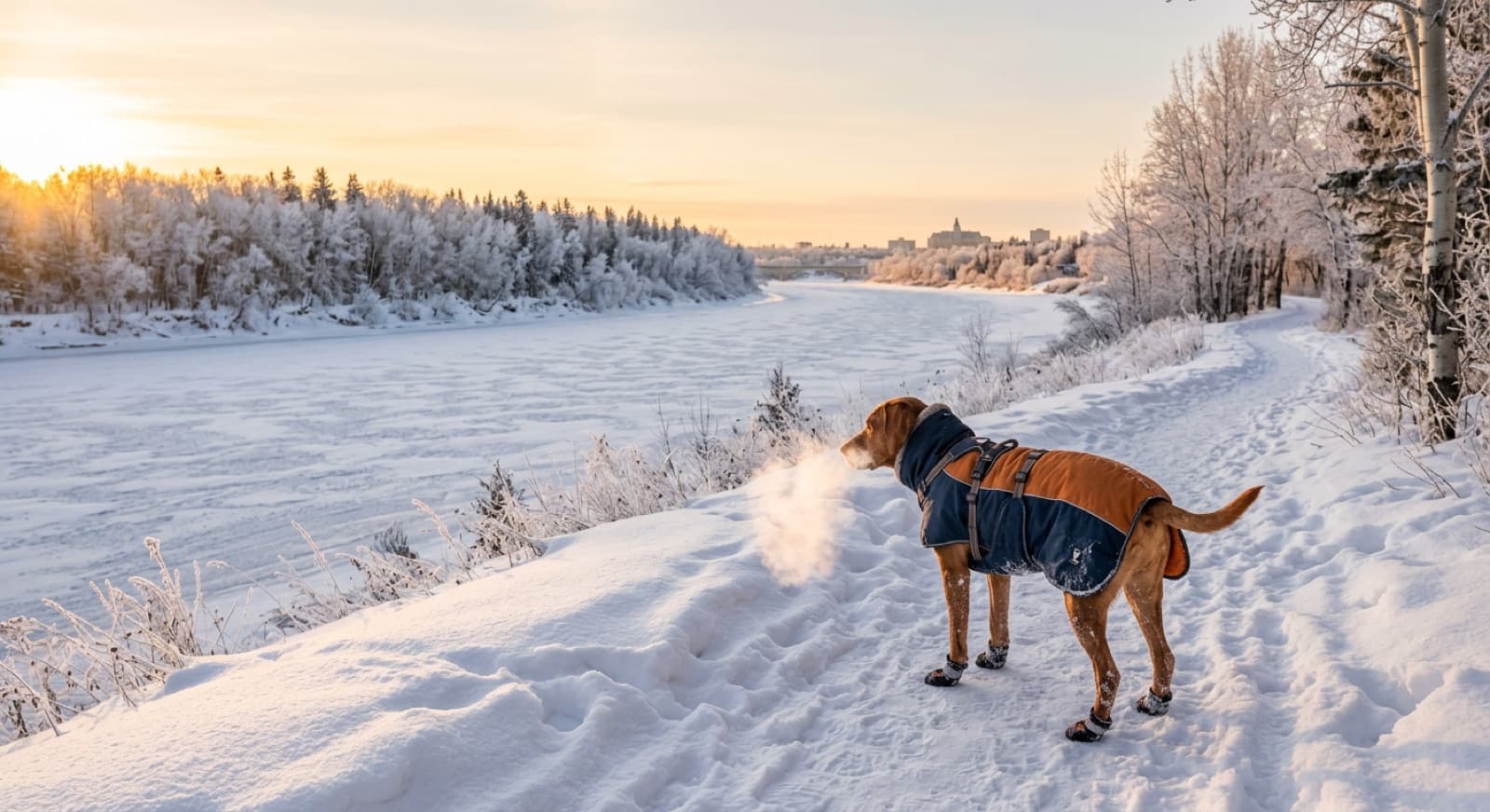
Saskatoon winters are among the harshest of any major Canadian city. Deep cold runs from late November through March, and the air temperature regularly sits between -20 and -30 Celsius. The number that decides your dog's safety, though, is the windchill. The prairies are open and flat, the wind has nothing to slow it down, and a -22 air temperature with a stiff wind can feel like -35 or colder on exposed skin and paw pads.
That distinction matters because frostbite risk climbs sharply with windchill. At a -35 windchill, exposed skin, including a dog's ear tips, paw pads, and tail, can start to freeze in minutes. When Environment and Climate Change Canada issues an extreme cold warning for the Saskatoon area, that is the signal to change your routine: short potty breaks only, coats on the dogs that need them, and exercise moved indoors.
Here is a practical Saskatoon walk-length guide. It assumes a healthy adult dog with no medical issues, and it errs on the side of caution.
- Above -10 (with windchill): Normal walks for most dogs. Add a coat for short-coat and thin breeds.
- -10 to -20: Shorten walks. Coat for short-coat, small, and senior dogs. Watch paws for ice and salt.
- -20 to -28: Brief walks for thick-coated dogs only. Potty break and indoors for small, thin, senior, and puppy dogs.
- Below -28 or any extreme cold warning: Quick potty break for everyone, then inside. Move exercise indoors entirely.
Frostbite and hypothermia: the signs that send you to the vet
These are the two cold injuries every Saskatoon owner should be able to spot. Knowing the early signs is the difference between a quick course correction and an emergency.
Frostbite
Frostbite hits the extremities first because that is where blood flow drops in the cold: ear tips, tail tip, and paw pads. Early signs are skin that looks pale, grey, or bluish, feels cold and hard, and a dog that keeps lifting or shaking a paw. As the tissue rewarms it can turn red, swollen, and painful. If you suspect frostbite, get your dog warm, loosely wrap the area in a warm (not hot) towel, and do not rub the skin, because friction damages frozen tissue further. Skip the hair dryer and heating pad. Then call your vet or an emergency vet. Mild-looking frostbite can hide deeper damage that only a professional can judge.
Hypothermia
Hypothermia is a drop in core body temperature, and it progresses in stages. It starts with hard shivering, a hunched body, and a dog that wants to turn home. Then, alarmingly, the shivering can stop, replaced by weakness, stumbling, lethargy, slow breathing, and confusion. That later stage is a true emergency. Get the dog dry, wrap it in blankets, move somewhere warm, and call an emergency vet immediately. Small dogs, puppies, seniors, and thin-coated breeds slide into hypothermia much faster than a thick-coated working dog, so the window to act is shorter than people expect.
None of the rewarming steps above replace veterinary care. They are first aid while you get help. For anything beyond mild and brief, call an emergency vet rather than waiting to see if it improves.
Paw protection and the road-salt problem
Paws take the most winter damage in Saskatoon, and most of it is preventable. The threats are ice, dry cracking from the cold, and the salt and de-icer spread on sidewalks, parking lots, and crosswalks across the city.
- Salt cracks and burns pads. De-icer is harsh on paw pads. The cracks it causes become entry points for infection and the dog starts to limp. The damage often shows up a day or two after the walk, not during it.
- Dogs lick salt off and get sick. Ingested de-icer causes drooling, vomiting, and in larger amounts more serious illness. A dog that grooms its paws after a salty walk swallows whatever is on them.
- Ice balls form in toe hair. Long hair between the toes collects snow that packs into hard ice balls. These hurt, and they cut the pad. Trim toe hair flush with the pad before deep winter.
The routine that solves all of this takes two minutes. Apply paw balm or musher's wax before the walk to create a barrier between the pad and the salt. When you get home, wipe or rinse each paw with lukewarm water and dry between the toes. Boots solve the salt problem completely for the dogs that tolerate them, but plenty of dogs refuse boots, and the balm-and-rinse routine is a perfectly good backup. If your dog is drooling, vomiting, or off after a salty walk, call your vet.
Coats, breeds, and who feels the cold
Not every dog needs a coat, and not every dog handles -30 the same way. Saskatoon rescue listings skew toward mixed-breed dogs, often husky-cross and shepherd-cross from rural and northern Saskatchewan intake, so the breed picture here is its own thing.
Thick-coated and northern breeds
Huskies, Malamutes, Samoyeds, and the husky-cross and shepherd-cross mixes common in Saskatoon rescues are built for this climate. Their double coats handle prairie cold well, and many of them visibly prefer winter to summer. They rarely need a coat. The thing to watch is still windchill and exposure time, because even a thick coat does not protect bare paw pads, ear tips, or the nose during a long outing in extreme cold.
Short-coat, thin, and small breeds
Greyhounds, Whippets, Boxers, Pit Bull mixes, and most toy breeds feel Saskatoon cold acutely. Thin skin, low body fat, and minimal coat mean they lose heat fast. A coat is mandatory below freezing, walks should be short, and below -20 these dogs are usually better off with a quick potty break and indoor exercise. Very small dogs lose heat fastest of all and can get into trouble in minutes.
Puppies and senior dogs
Puppies cannot regulate their body temperature well, and seniors often have arthritis that cold and damp make worse. Both groups need shorter walks, a coat regardless of coat type, and a warm-up of slow indoor movement before stepping out. Watch a senior for stiffness, limping, or reluctance after a cold walk, and talk to your vet about joint support if you see it. A heated or well-padded bed away from drafts makes a real difference for an older dog through a long prairie winter.
Antifreeze: the winter poison to know
Antifreeze poisoning spikes in winter, and it is one of the few true emergencies on this list. Ethylene glycol antifreeze tastes sweet, so dogs will drink it from a garage floor, a driveway puddle, or a slick spot in a parking lot. It is extremely toxic and attacks the kidneys quickly. Even a small amount can be fatal, and treatment has to begin within hours to work.
Prevention is straightforward. Keep antifreeze containers sealed and out of reach, clean up any spill immediately, and pay attention to where your dog sniffs and licks in garages and on driveways and parking lots. If you have any reason to think your dog drank antifreeze, do not wait for symptoms to appear. Go straight to an emergency vet. This is a case where minutes genuinely change the outcome.
Browse adoptable dogs in Saskatoon
Many Saskatoon rescue dogs are northern husky-cross and shepherd-cross mixes built for prairie winters. Match by coat type and energy to find a dog suited to the climate you actually live in.
See Available Saskatoon Dogs →Indoor exercise when it is -40 outside
Saskatoon gets stretches of cold so deep that a real walk is off the table for days. A working dog still needs to burn energy, and the owners who skip exercise on those days end up with chewing, barking, and a stir-crazy dog. The good news is that mental work tires a dog out faster than physical work, so you can settle most dogs without leaving the house.
- Snuffle mat or scatter feeding. Hide kibble in a snuffle mat or scatter it across a towel. Twenty minutes of sniffing settles most dogs.
- Puzzle feeders. Replace the food bowl with a puzzle feeder or a stuffed Kong on cold days. The work of getting the food out is the exercise.
- Training sessions. Five to ten minutes of focused training (sits, downs, spins, place, a new trick) is real mental exercise. Run a couple of short sessions through the day.
- Hide and seek. Have someone hold the dog, hide in another room, and call. Easy, free, and dogs love it.
- Scent games. Hide a high-value treat in one of a few boxes and let the dog find it. Build up to hides across rooms. This is genuine cognitive work.
- Stairs. If you have stairs, a few slow sets up and down is physical exercise for an energetic dog.
- Daycare for a day. During a long cold snap, an indoor daycare day is a reasonable answer for a high-drive dog.
A quick potty break in a coat plus two or three indoor sessions across the day covers even an active dog. A skipped cold-snap walk is not a welfare problem. Pushing a dog through a -40 windchill for the sake of a routine is.
Recall, ice, and winter off-leash safety
Winter changes the math on off-leash time in Saskatoon. Snow muffles sound, so a dog hears recall less clearly, and a dog chasing a scent or wildlife across a frozen field is harder to call back. The single biggest hazard is ice on water.
Ice on the South Saskatchewan River is never reliably safe, especially near moving water, inflow points, and pressure ridges. The same goes for rural sloughs and dugouts around the city. A dog that breaks through into cold water is a life-threatening emergency, and owners who go in after their dogs are at serious risk too. Keep your dog leashed near any open or frozen water, and never let a dog chase a ball or wildlife onto river ice.
For winter walks, stick to the established and groomed paths. The Meewasin Trail along the South Saskatchewan River stays maintained through winter and keeps you safely off the ice. Saskatoon's fenced off-leash dog parks, including the popular sites at Avalon and Hampton Village, let an energetic dog run without river or recall risk. If your dog's recall is not rock-solid, winter is the season to keep it on a long line rather than fully off-leash.
Settling a new rescue dog through a prairie winter
Adopting in deep winter means a new dog faces two adjustments at once: a strange home and a climate that may be harsher than anything it has known. Many Saskatoon rescue dogs come from rural and northern Saskatchewan and have spent real time outdoors, but a freshly adopted dog is still decompressing and needs a careful start.
Keep early outings short and on-leash, even for potty breaks. A spooked dog in its first days can bolt, and recall is unreliable until trust is built. Set up a warm, quiet indoor base where the dog can settle, and lean on indoor enrichment instead of long cold walks while it adjusts. Do not push a nervous new dog into a -30 windchill for exercise it does not yet need. Let the home settle first, and build winter walks up gradually as the dog relaxes.
The first few weeks follow a predictable arc. Our first-week rescue dog guide walks through the 3-3-3 decompression timeline and how to start a Saskatoon rescue dog right, winter or not.
When to call a vet
Some winter problems are wait-and-see. Others need a vet the same day or right now. Here is the rough triage. When in doubt, call. An emergency vet will help you decide over the phone.
Go to an emergency vet now:
- Suspected antifreeze ingestion. Do not wait for symptoms.
- Hypothermia signs that do not resolve quickly with warming (continued shivering, weakness, stumbling, confusion, slow breathing).
- Suspected frostbite (pale, grey, or hard skin on ears, tail, or paws).
- A dog that broke through ice into cold water.
Book a regular vet visit soon:
- Paw pad cracking with bleeding or limping.
- Mild drooling or stomach upset after a salty walk that does not pass quickly.
- Senior dog stiffness or reluctance that gets worse through the cold months.
- Any persistent paw licking, redness, or sores between the toes.
For more on affordable care and the local options, see our Saskatoon rescue guide, which covers the vetting your dog arrives with. The American Veterinary Medical Association also publishes solid general guidance on cold-weather pet safety worth reading before your first prairie winter.
Frequently asked questions
What temperature is too cold to walk a dog in Saskatoon?
A useful Saskatoon rule of thumb: above -10 Celsius, most healthy medium and large dogs are fine for a normal walk. Between -10 and -20, shorten the walk and add a coat for short-coat breeds. Below -20, keep it brief for everyone and skip it entirely for small, thin-coated, senior, or puppy dogs. The number that actually matters here is windchill, not the air temperature. A -22 air temperature with a strong prairie wind can hit -35 or colder on exposed skin, and frostbite can start on ears, paws, and tail within minutes. When Environment and Climate Change Canada posts an extreme cold warning, treat the walk as a quick potty break and move exercise indoors.
How do I know if my dog has frostbite?
Frostbite hits the extremities first: ear tips, tail tip, paw pads, and the scrotum. Early signs are pale, grey, or bluish skin that is cold and hard to the touch, and the dog favouring a paw or shaking it. As the area rewarms it can turn red, swollen, and painful. If you suspect frostbite, move your dog somewhere warm, wrap the area loosely in a warm (not hot) towel, and do not rub the skin because that causes more damage. Never use a hair dryer or heating pad directly on the area. Call your vet or an emergency vet right away. Frostbite that looks mild can hide deeper tissue damage that only a vet can assess.
What are the signs of hypothermia in a dog?
Hypothermia is a drop in core body temperature, and it follows a clear progression. Early on you see strong shivering, a hunched posture, and the dog wanting to stop and turn home. As it worsens the shivering can actually stop, replaced by lethargy, weakness, stumbling, slow breathing, and confusion. That stage is a medical emergency. Get the dog dry, wrap it in blankets, move somewhere warm, and call an emergency vet immediately. Small dogs, puppies, seniors, and thin-coated breeds reach this point far faster than a thick-coated working dog. On the prairies, a short-coat dog out too long in a -30 windchill can get into trouble quicker than most owners expect.
Do dogs need boots and coats in a Saskatoon winter?
Coats: yes for short-coat, small, senior, or thin breeds (Greyhounds, Whippets, Boxers, Pit Bull mixes, Chihuahuas, most toy breeds). Thick-coated northern breeds (Husky, Malamute, Samoyed, and the husky-cross and shepherd-cross mixes common in Saskatoon rescues) usually handle the cold well without one. Boots are more about the road salt and ice than the cold. Many dogs hate boots, so if yours refuses them, the backup plan is paw balm before the walk and a lukewarm rinse after. The real winter essentials in Saskatoon are paw protection, a coat for the dogs that need one, and the discipline to keep walks short when the windchill spikes.
Is road salt dangerous for my dog in winter?
Yes, in two ways. Salt and de-icer on Saskatoon sidewalks and parking lots crack and burn paw pads, and the cracks become entry points for infection. Worse, dogs lick salt off their paws afterward, and ingested de-icer causes drooling, vomiting, and in larger amounts more serious illness. The fix is simple: apply paw balm or musher's wax before the walk to create a barrier, wipe or rinse each paw with lukewarm water when you get home, and dry between the toes. If your dog is drooling heavily, vomiting, or seems unwell after a salty walk, call your vet.
How do I keep my dog exercised when it is too cold to go outside?
Mental work tires a dog out faster than a walk does. On a -35 windchill day, replace the walk with indoor enrichment: a snuffle mat or scattered kibble for sniffing, puzzle feeders, a short training session running through sits, downs, spins, and place commands, hide-and-seek with a person or a treat, and stairs if you have them. Twenty minutes of brain work leaves most dogs settled and ready to nap. A high-energy working dog still needs more, so a quick potty break in a coat plus two or three short indoor sessions across the day covers it. Doggy daycare for a day is a reasonable option during a long cold snap.
Why does antifreeze poisoning spike in winter?
Antifreeze (ethylene glycol) leaks and spills are more common in winter, and it tastes sweet, so dogs will lap it up from a garage floor, a driveway puddle, or a parking lot. It is extremely toxic and damages the kidneys fast. Even a small amount can be fatal, and treatment has to start within hours to work. Keep antifreeze containers sealed and out of reach, clean up spills immediately, and watch where your dog sniffs and licks in garages and on driveways. If you suspect your dog drank any antifreeze, do not wait for symptoms. Go straight to an emergency vet. This is one of the few true winter emergencies where minutes matter.
How do I settle a newly adopted rescue dog through a Saskatoon winter?
A new rescue arriving in deep winter has two adjustments at once: a new home and a climate that may be harsher than anything it has known. Many Saskatoon rescue dogs come from rural and northern Saskatchewan and have spent time outdoors, but a freshly adopted dog still needs a careful start. Keep early outings short and on-leash, even for potty breaks, because a spooked dog can bolt and recall is unreliable in the first weeks. Build a warm, quiet indoor base, lean heavily on indoor enrichment, and do not push long cold walks while the dog is still decompressing. Our first-week guide covers the 3-3-3 decompression timeline in detail.
Is it safe to let my dog off-leash on frozen rivers or sloughs near Saskatoon?
No. Ice on the South Saskatchewan River and on rural sloughs and dugouts is never reliably safe, especially near moving water, inflow points, and pressure ridges. A dog that breaks through ice into cold water is a life-threatening emergency for the dog and for any owner who follows it in. Keep your dog leashed near any open or frozen water, stick to the established Meewasin Trail and groomed park paths, and never let a dog chase wildlife or a ball onto river ice. Snow also muffles sound and hurts recall, so winter is the season to be more conservative about off-leash time, not less.
Related Saskatoon dog guides
First Week With a Rescue Dog
The 3-3-3 rule, decompression, and how to start a Saskatoon rescue dog right.
Saskatoon Off-Leash Parks
Every off-leash park in Saskatoon, including which work for new rescue dogs in winter.
Best Dog Rescues Saskatoon
Saskatoon SPCA and Saskatoon Dog Rescue compared on cost, wait time, and best fit.
All Saskatoon Dogs
Every adoptable dog from Saskatoon rescues, with size, breed, and energy filters.
Find your prairie-ready Saskatoon dog
Browse adoptable dogs from Saskatoon rescues. Match by coat type and energy to find a dog built for prairie winters.
Browse All Saskatoon Dogs →New dog? Start with these care guides
Everything a new adopter needs to set up a safe, happy home.