The short answer
Adult Bengals settle at 8 to 15 lbs and reach full size around 18 months to 2 years. An Edmonton rescue Bengal or Bengal mix is $300 to $500 fully vetted. An ethical Canadian TICA breeder kitten with PRA-b and PK-Def DNA-tested parents and HCM-screened lineage is $1,800 to $3,500 with a 6 to 12 month waitlist. Anything under $1,200 from a self-described breeder is the scam zone. F1 to F3 Bengals fall under Alberta provincial wildlife rules and are not permitted as private pets; only F4 and later are treated as domestic cats with TICA paperwork. Pure Bengals are uncommon at Edmonton rescues, but Bengal mixes and adult surrenders are regular intake at Edmonton Humane Society, Zoe's Animal Rescue, and AARCS Edmonton fosters.
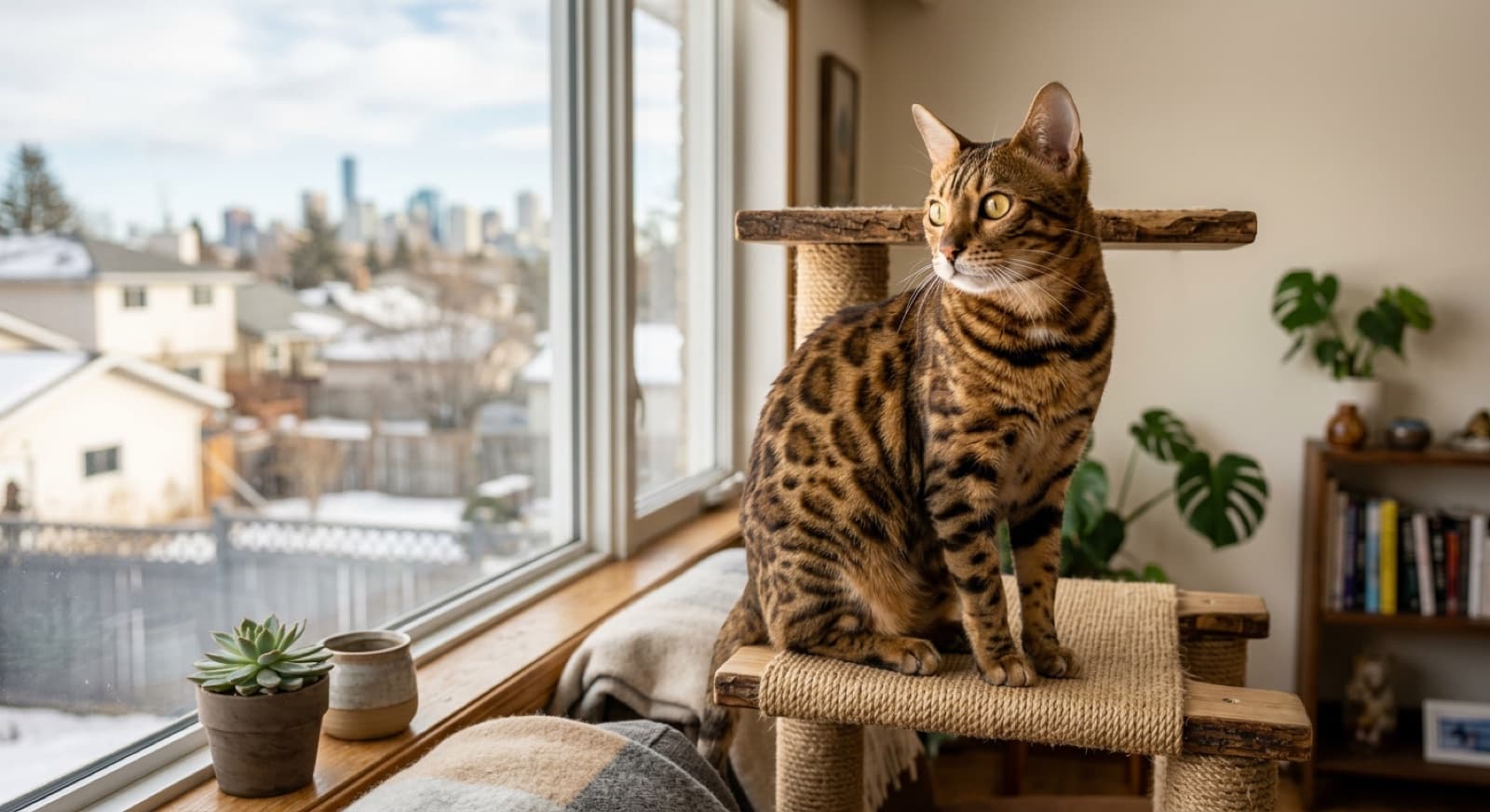
The buy-vs-adopt question without the shaming
Most people who land on this page have already done the homework on Bengals. They want the rosetted coat, the athletic build, the dog-like personality, the water-loving quirk, and the wild-looking face. The question they actually arrive with is harder: pay a Canadian TICA breeder $2,500 and wait a year, or take a Bengal mix from an Edmonton rescue this month for $400. Both are reasonable. We are a rescue aggregator, so our framing leans toward adoption, but the math deserves an honest look without the moral judgment that often clouds this conversation.
The breeder path gives you predictability. A registered SBT kitten from a TICA-tested line comes with parents DNA-screened for PRA-b and PK-Def, an HCM-screened pedigree, and verified F-generation paperwork. You know roughly what coat pattern, size, and energy level your kitten will develop into. You pay $1,800 to $3,500 plus deposit and travel, plus the wait. For an adopter who specifically wants a verified SBT Bengal with documented health testing, this is the right path.
The rescue path gives you a real cat now at a fraction of the price, and bypasses the F-gen scam risk entirely. Most Edmonton rescue intake labelled as Bengal mix is a spotted-coat cat with most of the right look and a recognisably high energy level. The cat is already spayed or neutered, vaccinated, microchipped, vet-checked, and assessed in foster. You save $1,500 to $3,000 against a breeder kitten, and a cat that would otherwise stay in care leaves the system. The trade-off is no pedigree paper and slightly less predictability on adult coat and temperament.
Neither path is wrong. The reframe most Bengal adopters miss is that the question is not breeder kitten or rescue kitten, it is breeder kitten or rescue adult Bengal. The latter is usually the better answer for an Edmonton household that wants a Bengal as a pet, not a show cat. Adult Bengals at rescue are almost always surrendered because of energy mismatch or multi-cat conflict, not because anything is wrong with the cat. That framing holds up over a 12 to 16 year lifespan.
Where to find a Bengal in Edmonton
The purebred Bengal at an Edmonton rescue is rare. Bengal mixes and adult energy-mismatch surrenders are not. Here is where they show up:
| Rescue | Good to know |
|---|---|
| Edmonton Humane Society | 13620 163 Street NW, operating since 1907, 3,905 placements in 2024. Same-day adoption for approved applicants. Largest single Edmonton cat intake. See edmontonhumanesociety.com. |
| Zoe's Animal Rescue | Volunteer-run shelterless rescue, every cat in a foster home until adoption. Caretaker Cat Program and Warm Whiskers Program. Strong written compatibility notes. See zoesanimalrescue.org. |
| SCARS (Second Chance Animal Rescue Society) | Northern Alberta intake including remote First Nations communities. Foster-based, detailed compatibility profiles. See adopt.scarscare.ca. |
| AARCS Edmonton fosters | Alberta-wide rescue with foster homes across Edmonton. Strong written notes on how each cat does with kids, dogs, and other cats. |
| Bengal Rescue (US-based, occasional cross-border) | A US 501(c)(3) at bengalrescue.org focused on the western United States. No Canadian or Edmonton chapter, but they sometimes coordinate cross-border placements. Long waits, real pedigrees. |
The honest read on this list: Edmonton Humane Society is your best single bet for a spotted-coat Edmonton cat given the scale of their intake. Zoe's Animal Rescue and AARCS see Bengal mixes regularly enough that monthly checks are worth it; their foster notes are usually the most useful read on temperament. SCARS works for adopters open to a rural-intake cat that may need a longer settle-in window. Bengal Rescue is the right path if you specifically want a verified pedigreed Bengal and are open to a US-based application with occasional cross-border placement, though the wait can match a breeder waitlist.
Shelter Bengals are rare in the strict pedigree sense. What looks like a Bengal at an Edmonton rescue is usually a Domestic Shorthair with spotted tabby markings, or a Bengal mix from an accidental breeding or an early-generation surrender. The label is often directionally right, but DNA testing and TICA registration are rarely available. For most adopters, this matters less than it sounds, because the day-to-day pet experience is close enough.
Set up alerts so you do not have to check every site by hand. LocalPetFinder pulls live cat listings from these Edmonton rescues regularly into one searchable place. A Bengal-type intake moves quickly because so many adopters are watching for the look, so the day the cat posts is usually the day to apply.
The real Edmonton cost breakdown
A rescue adoption fee is not the cat's price. It is a partial reimbursement for vetting the rescue already paid for. That is why a $400 Bengal mix from Edmonton Humane Society is cheaper than a “free” Kijiji kitten. And any Bengal listed under $1,200 by a self-described breeder is almost always a scam, a backyard breeder, or a misrepresented F-generation.
2026 Edmonton Bengal and Bengal mix pricing across the realistic options:
| Path | Typical price | What is included |
|---|---|---|
| Edmonton rescue (Bengal mix or adult) | $300 to $500 | Spay or neuter, vaccines, microchip, deworming, vet workup, foster assessment. |
| Bengal Rescue (US-based, cross-border possible) | $400 to $800 | Surrendered or retired pedigreed Bengal, full vetting, sometimes TICA papers. Cross-border placement is occasional, not routine. |
| Ethical Canadian TICA breeder (pet quality) | $1,800 to $3,500 | TICA-registered SBT, PRA-b and PK-Def DNA tested parents, HCM-screened lineage, kitten released at 12 to 16 weeks. |
| Show or breeding rights kitten | $4,500 plus | Same testing, breeding contract, often co-ownership terms. |
| Under $1,200 unverified seller | Scam zone | Red flag. No paperwork, no health testing, often a fake listing, a backyard breeder, or a misrepresented F-generation. |
The adoption fee covers spay or neuter, core vaccines, a microchip, deworming, parasite treatment, and a vet exam. Paying for that vetting yourself on a free Kijiji kitten in Edmonton runs about $500 to $1,000, before any Bengal-specific health screening. So even at the top of the rescue range, a $500 adopted Bengal mix is cheaper than catching up a free kitten on the same vetting.
Annual care for a Bengal is moderate to high, with a few line items running above a small short-haired cat:
- Food: $50 to $90 per month. A 12 to 15 lb Bengal eats more than a 9 lb Domestic Shorthair. High-protein wet food plus a quality dry sits in the $60 to $80 range. Therapeutic or fresh-food diets push to $100.
- Litter: $25 to $40 per month. A standard large litter box works fine. Bengals produce more waste than a smaller cat, and many do better with two boxes in a single-cat household.
- Enrichment infrastructure: $300 to $700 first year, $50 to $150 ongoing. This is the Bengal-specific line item. A tall weight-rated cat tree built for a 12 to 15 lb climber, multiple scratching surfaces, rotating puzzle feeders, secure window perches, and harness training gear add up. Edmonton winters keep cats indoors for months at a stretch, which makes vertical and puzzle enrichment even more important than in milder climates.
- Annual vet care: $400 to $700. Routine wellness, vaccines, dental. Higher if you carry pet insurance for HCM and PRA-b risk (recommended for breeder kittens, optional for rescue mixes).
First-year setup costs another $500 to $900 above a normal cat because of the enrichment-heavy reality of the breed. A large litter box ($40 to $70), a sturdy cat tree rated for a 15 lb climber ($150 to $300), a large carrier rated for 20 lbs ($80 to $150), heavy scratching posts, puzzle feeders, secure window perches, and if you have a balcony, escape-proof screening because Bengals jump and climb. Honest first-year total: $2,000 to $3,500 for a rescue Bengal mix, $3,500 to $5,500 for a breeder kitten. Ongoing years run $1,400 to $2,400.
Our full Edmonton cat cost breakdown has the standard-cat line items for comparison.
What sends a Bengal into Edmonton rescue?
Bengal surrenders are more common than most adopters expect, and the patterns are predictable.
Energy mismatch. This is the number-one reason Bengals end up at Edmonton Humane Society and Zoe's Animal Rescue. Adopters underestimate the breed's exercise and enrichment needs, particularly in working households where the cat is alone 8 to 10 hours a day, or in small condos without vertical space. A bored Bengal becomes a destructive Bengal: counter-surfing, opening cabinets, knocking things over, vocalising at 3 a.m. The mismatch shows up around month four or five, often coinciding with the cat reaching social maturity at age one.
Vocalisation. Bengals are loud. Male Bengals especially are loud. They yowl, chirp, trill, and sometimes scream, particularly at night. Households sensitive to cat sounds discover quickly that the breed reputation is real, and condo neighbours sometimes complain. This is one of the top reasons adult male Bengals get surrendered between ages one and three.
Cat-cat aggression. Bengals are territorial. Many do not tolerate mellow or senior cats well, particularly when introductions are rushed. A common pattern at Edmonton rescues is a Bengal surrendered because the resident cat was being bullied or because two adult Bengals stopped getting along. Slow introductions and a willingness to keep cats separated long-term in some cases are the only ways through this.
Financial hardship after HCM diagnosis. HCM treatment in a diagnosed Bengal can run $3,000 to $10,000 over the course of the disease. Owners who did not budget for breed-specific cardiac risks sometimes surrender when bills hit. The Edmonton specialty option for breed-specific cardiac care is typically referral from your general-practice vet to an Edmonton veterinary cardiology service. Talk to your primary vet about the referral pathway before any specialty visit is needed.
Owner life change. Move to a no-pet rental, divorce, new baby, financial hardship, owner illness. The cat is healthy, sociable on its own terms, and ends up an excellent adoption candidate for a household that knows what it is signing up for. This is the adult Bengal population most adopters actually meet at Edmonton rescues.
Browse adoptable Bengal-type cats in Edmonton
Bengal-type cats currently in Edmonton rescue: mixes and adult surrender placements from Edmonton Humane Society, Zoe's Animal Rescue, SCARS, and AARCS Edmonton fosters. Refreshed regularly. Filter by age, size, and personality.
See Available Bengals →Adult Bengal adoption: the underserved path
The Bengal question on most adoption forums is “where can I find a kitten?” The better question for most Edmonton households is “why am I not considering an adult?” Adult Bengal adoption is genuinely underrated, and the reasons hold up.
The advantages of adopting an adult Bengal. The temperament is already known. The energy level is visible from the foster notes. The size is already there. Most adults are fully litter-trained, often clicker-trained or harness-trained, and accustomed to handling. There is no kitten chaos, no zoomies at 3 a.m. that you did not know were coming, no months of teething. The foster home can tell you exactly how the cat behaves around other cats, dogs, children, and strangers, because they have seen it. A Bengal kitten is a temperament gamble. An adult is a known quantity, which matters more for this breed than for almost any other.
The adjustment timeline. Four to eight weeks for most adult Bengals, longer for retired breeder cats. The 3-3-3 rule still applies but stretches a bit: three days of mostly hiding, three weeks of testing the new environment, three months to fully relax and bond. Bengals show stress more visibly than other breeds, often through vocalisation, hyper-vigilance, and sometimes inappropriate elimination during weeks one and two. Signs of progress are predictable. The cat starts eating in the open. The cat uses the litter box reliably without you watching. The cat sleeps where you can see it instead of behind the couch. Eventually the cat seeks physical contact, climbs into your lap, and stays. From there the bonding deepens for years.
The honest framing. A Bengal kitten is months on a TICA breeder waitlist plus a $2,500 kitten plus a year of high-intensity kitten chaos. A surrendered adult Bengal from an Edmonton rescue is $400, available within weeks, and you skip the kitten phase entirely. For first-time Bengal owners and households that want the look and personality without the chaos, the adult path is usually the better answer.
Edmonton climate and indoor-only commitment
Bengals are strictly indoor cats, and the case is stronger for this breed than for most. Several reasons make it non-negotiable in Edmonton.
Theft risk. Bengals are visually distinctive and recognisable. A rosetted spotted cat outside in an Edmonton neighbourhood draws attention. Cats with breed value are stolen, and Bengals are at higher theft risk than a Domestic Shorthair simply because the coat advertises “Bengal,” which advertises “expensive.” An Edmonton owner who lets a Bengal outdoors is gambling against neighbours, passers-by, and opportunistic theft.
Escape-prone behaviour. Bengals are athletic, intelligent, and curious. They can open doors with lever handles, jump 6 feet vertically, and squeeze through gaps that other cats ignore. An indoor-only Bengal that gets even brief outdoor exposure often becomes an escape artist. Child-locks on lever-handle doors, secure window screens, and balcony enclosures are routine for serious Bengal owners.
Edmonton winter. The short pelt-like single coat is not built for true Alberta winter conditions. There is no dense undercoat to trap warmth. A Bengal outdoors at -30 degrees Celsius (a multi-week reality in an Edmonton winter) risks frostbite on ears, paws, and tail within minutes. The breed was developed in warm climates from a wild ancestor adapted to tropical Asia, not the Edmonton prairies.
Edmonton river-valley coyotes. Coyotes are well established in Edmonton river valley corridors and increasingly active in suburban neighbourhoods. A Bengal outdoors is not safe from this risk, particularly because the breed's confident, curious temperament does not predispose it to flee.
That said, Bengals genuinely need outdoor stimulation more than most breeds. A secure catio (enclosed outdoor patio) is the strongest single enrichment investment for the breed, giving the cat safe outdoor air, bird-watching, and weather exposure. An Edmonton catio works most of the year except in the deepest cold snaps. Many Bengals also leash-train better than the typical cat and tolerate harness walks in safe areas, though this is individual and not universal. Our indoor vs outdoor cats Edmonton guide covers the full Edmonton safety case.
Breed background worth knowing
The Bengal is a young breed by cat standards. Developed in California in the 1960s and 1970s by breeder Jean Mill, the foundation cross was an Asian Leopard Cat (a small wild cat native to Asia) with a domestic shorthair. The goal was to combine the wild coat pattern with a domestic temperament. TICA recognised the breed as Experimental in 1986 and as a full Championship breed in 1991. The Cat Fanciers' Association does not recognise the breed, partly because of the wild ancestry.
The wild ancestry is the source of both the breed's appeal and its complications. The legality issues, the high energy, the vocalisation, and the territorial behaviour all trace back to the Asian Leopard Cat foundation. Most Bengals sold today are SBT (Stud Book Tradition, meaning F4 or later, with three generations of Bengal-to-Bengal breeding). SBT Bengals are considered fully domestic by TICA and most jurisdictions, including Alberta. Early-generation Bengals (F1 to F3) are subject to Alberta provincial wildlife regulations and many other jurisdictions because they retain more wild traits.
Three traits surprise most first-time Bengal adopters:
Extreme energy. Bengals are more dog-like than cat-like in their activity needs. Daily interactive play, climbing structures, puzzle feeders, and ideally a second cat or other companion are not optional. A bored Bengal is a destructive Bengal. Plan 30 to 45 minutes of dedicated daily play and several hours of self-directed enrichment.
Vocalisation. Bengals are loud, especially males, and especially at night. They meow, yowl, chirp, trill, and sometimes scream. Households sensitive to cat sounds tend not to find Bengals a good match. Condo neighbours sometimes complain.
Water-loving. Bengals play in faucets, jump in showers, and drink from running taps. Some swim. This is a breed signature traced to the Asian Leopard Cat ancestor. Most owners find it charming. Some find it inconvenient when the cat splashes in the dog's water bowl every morning.
Note: most Bengals sold today are SBT and are genetically far removed from the wild ancestor (96 percent or more domestic genetics). They are not “part wild cat” in any meaningful behavioural sense, but the selection pressure of the breed has retained some behavioural quirks that other breeds do not show.
Frequently Asked Questions
Where can I adopt a Bengal in Edmonton?
A pure Bengal at an Edmonton rescue is rare, but Bengal mixes and adult Bengal surrenders show up often enough that patient adopters find them. The rescues to watch are Edmonton Humane Society (the largest Edmonton intake, 3,905 placements in 2024), Zoe's Animal Rescue (foster-based, strong written compatibility notes), SCARS (Second Chance Animal Rescue Society, northern Alberta intake), and AARCS Edmonton fosters. For verified pedigreed Bengals, Bengal Rescue (bengalrescue.org) is a US-based 501(c)(3); they occasionally coordinate cross-border placements but there is no dedicated Canadian or Edmonton chapter. Watch live listings on LocalPetFinder and set an alert so you hear about a Bengal-type cat the day it posts, because they move quickly.
How much does a Bengal cost in Edmonton?
A Bengal or Bengal mix from an Edmonton rescue runs about $300 to $500. That fee covers spay or neuter, core vaccines, microchip, deworming, and a vet workup. An ethical Canadian TICA breeder charges $1,800 to $3,500 for a pet-quality kitten with TICA registration, HCM-screened lineage, and DNA testing on both parents for PRA-b and PK-Def. Show or breeding rights push pricing past $4,500. Anything under $1,200 from a self-described breeder is the scam zone. Annual care for a Bengal in Edmonton is roughly $1,400 to $2,400 once the cat is home, with enrichment infrastructure pushing the first year higher.
Is $800 a fair price for a Bengal kitten in Edmonton?
Not from a breeder. The honest Canadian breeder floor for a pet-quality Bengal kitten with TICA registration and DNA-tested parents is about $1,800. A kitten advertised at $800 by a self-described breeder is in the scam zone. The most common pattern is a backyard breeder with no health testing, a stolen-photo listing, or a cat sold as F2 or F3 (which falls under Alberta provincial wildlife rules) when it is actually F5 or unverifiable. An $800 price is reasonable for a Bengal mix from an Edmonton rescue with full vetting, but it is not fair for a kitten with paperwork. Pay $1,800 plus from a verified TICA breeder, or $300 to $500 from rescue.
Can I find a purebred Bengal at an Edmonton shelter?
Occasionally. Most shelter cats labelled as Bengal are Domestic Shorthairs with spotted tabby markings or genuine Bengal mixes from accidental or surrendered breedings. True purebred Bengals land in Edmonton rescue mainly through energy-mismatch surrenders, multi-cat-home conflict, financial hardship after an HCM diagnosis, and owner life changes. The realistic path to a verified purebred is through Bengal Rescue or a TICA-breeder retired-cat placement, not weekly Edmonton shelter checks. For most adopters, a Bengal mix from an Edmonton rescue delivers most of the experience for a fraction of the breeder cost.
What is the difference between F1, F2, F3, and F4 Bengals?
F-generations describe how many generations a Bengal is removed from its wild Asian Leopard Cat ancestor. F1 is the direct first-generation cross (one wild parent). F2 has a wild grandparent. F3 has a wild great-grandparent. F4 and beyond (called SBT, or Stud Book Tradition) are considered fully domestic by TICA and most jurisdictions. The behavioural and legal differences across generations are significant. F1 to F3 cats are subject to Alberta provincial wildlife regulations and are not permitted as private pets. The full breakdown including legality details lives in the dedicated F1-F4 Alberta legality guide in this cluster.
Are F1 Bengals legal in Edmonton?
No. F1, F2, and F3 Bengals are subject to Alberta provincial wildlife regulations because they are considered too closely related to the wild Asian Leopard Cat. Only F4 and later (SBT) Bengals are treated as domestic cats in Alberta, provided TICA paperwork verifies the generation. Roughly 99 percent of TICA-registered Bengals sold today are SBT, so any Edmonton breeder offering you an F1, F2, or F3 cat is either misrepresenting the generation, violating provincial rules, or both. Verify the current rule directly with Alberta Fish and Wildlife (alberta.ca/wildlife-as-pets) and the City of Edmonton Animal Care and Control before acquiring any low-generation Bengal. If a seller insists the cat is F1 to F3 in Alberta, walk away.
Are Bengals always spotted, or can they have stripes?
Both, and a few other patterns. The two recognised Bengal coat patterns are spotted (the rosetted leopard-like markings most people picture) and marbled (swirling horizontal patterns rather than spots). Rosettes are the breed signature and come in several types including arrowhead, paw print, and donut. Marbled Bengals are equally purebred and equally TICA-recognised. Snow Bengals are a less common variant with lighter coats and blue eyes. The defining trait is the high-contrast wild-looking pattern on a warm background, plus the muscular athletic build, regardless of whether the pattern is spotted or marbled.
Are Bengals hypoallergenic?
No, though the myth is persistent. Bengals have a short pelt-like single coat with a glittered look in some lines, and they shed less than a double-coated breed. But cat allergies are triggered by Fel d 1 protein in saliva and skin dander, not by coat length or shedding volume. Bengals produce Fel d 1 like every cat and trigger allergies in sensitive people. Adopters sometimes buy a Bengal believing the coat type means lower allergens, develop symptoms anyway, and surrender. There are no truly hypoallergenic cats.
Should I adopt an adult Bengal or wait for a kitten?
Adult Bengal adoption is genuinely underrated. The temperament is already known, the energy level is visible, and most adult Bengals are litter-trained and accustomed to handling. Bengal kittens are intensely high-energy, vocal, and demanding, and the chaos catches many first-time owners off guard. An adult Bengal you meet at Edmonton Humane Society or through Bengal Rescue is a known quantity, including how they do with other cats, dogs, and kids. The trade-off is a longer adjustment window, often 4 to 8 weeks for full settling, but the resulting bond holds up over the 12 to 16 year lifespan.
How long does it take an adult Bengal to adjust to a new home?
Four to eight weeks for most adult Bengals, longer than a Domestic Shorthair or a Ragdoll. The breed has a higher baseline arousal level, which means stress takes longer to wear off in a new environment. The 3-3-3 rule still applies but stretches: three days mostly hiding, three weeks testing the space, three months to fully relax and bond. Bengals are more likely than other breeds to show stress through vocalisation, hyper-vigilance, and sometimes inappropriate elimination during weeks one and two. Patience plus a quiet decompression room plus consistent feeding and play schedules carry most adult Bengals through to a deep bond.
Are Bengals good with other cats?
Sometimes, but cat-cat aggression is one of the top reasons Bengals get surrendered. The breed is territorial, high-energy, and can be intolerant of mellow cats that do not match its play style. Many Bengals do well with another Bengal or another high-energy breed, but pairing a Bengal with a senior Domestic Shorthair often does not work. If you have an existing cat, slow introductions over several weeks and a willingness to return the new cat if the match fails are non-negotiable.
What are the main Bengal health concerns?
Three matter most when adopting or interviewing a breeder. Hypertrophic cardiomyopathy (HCM) is the breed-defining cardiac concern, with no DNA test available, so annual echocardiograms from age 2 are the screening protocol. Progressive retinal atrophy (PRA-b) is an autosomal recessive vision-loss condition with a DNA test available through UC Davis VGL. Pyruvate kinase deficiency (PK-Def) is an inherited hemolytic anemia, also DNA-testable. For a rescue Bengal where parents are unknown, your own vet can monitor cardiac and ocular health at annual exams. The dedicated Bengal health article in this cluster covers screening and Edmonton specialty cardiology options.
Bengal Cats in Edmonton
Browse adoptable Bengals, Bengal mixes, and adult surrender placements from Edmonton rescues.
Bengal F1-F4 Alberta Legality
F-generation breakdown, why F1 to F3 fall under provincial wildlife rules, TICA verification, and the under-$1,200 scam protocol.
Bengal Health Issues: HCM, PRA-b, PK-Def
Bengal health: HCM screening from age 2, PRA-b and PK-Def DNA tests, FIP treatment, and the specialty vets that handle breed care.
Bengal Energy: Enrichment & Apartment Living
Bengal energy: why high-drive Bengals get surrendered, the enrichment setup that actually works in apartments, and adolescence survival tips.
New cat? Start with these care guides
Everything a new adopter needs to set up a safe, happy home.