The short answer
Adult Ragdolls settle at 10 to 20 lbs and take 3 to 4 years to reach full size. An Edmonton rescue Ragdoll or Ragdoll mix is $400 to $900 fully vetted. An ethical Canadian breeder kitten with HCM-tested parents is $1,800 to $4,500 with a 6 to 12 month waitlist. Anything under $1,000 from a self-described breeder is the scam zone. Pure pedigrees are uncommon in Edmonton rescue, but adult retired breeder Ragdolls and Ragdoll mixes are regular intake at Edmonton Humane Society, Zoe's Animal Rescue, SCARS, and AARCS Edmonton fosters, and they deliver most of the Ragdoll experience.
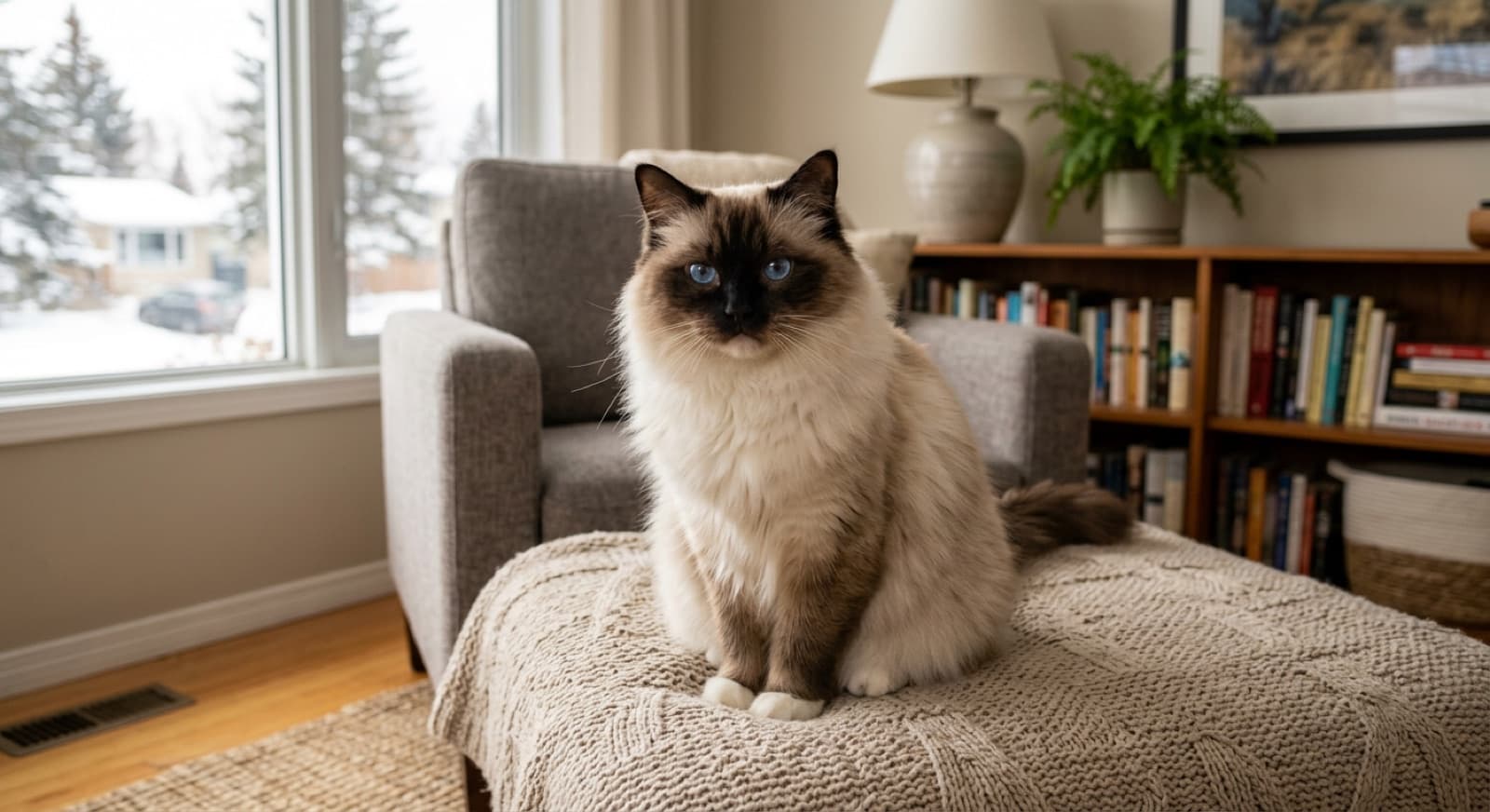
The buy-vs-adopt question without the shaming
Most people who land on this page have already done the homework on Ragdolls. They want the gentle dog-like temperament, the blue eyes, the colour points, the semi-long silky coat, and the famous floppy-when-held reputation. The question they actually arrive with is harder: pay a Canadian breeder $2,500 and wait a year, or take a Ragdoll mix from an Edmonton rescue this month for $600. Both are reasonable. We are a rescue aggregator, so our framing leans toward adoption, but the math deserves an honest look without the moral judgment that often clouds this conversation.
The breeder path gives you predictability. A registered kitten from a tested line comes with parents screened for hypertrophic cardiomyopathy, polycystic kidney disease, and the Ragdoll-specific HCM mutation (R820W in MYBPC3, available through UC Davis VGL). You know roughly what size, coat pattern, and colour your kitten will develop into, and you have paperwork. You pay $1,800 to $4,500 plus deposit and travel, plus the wait. For an adopter who wants a specific colour (flame, lilac, lynx) or matching kitten energy from day one, this is the right path.
The rescue path gives you a real cat now at a fraction of the price, and bypasses the scam-listing risk entirely. Most Edmonton rescue intake labelled as Ragdoll mix is a long-haired colour-pointed cat with the right look and most of the right temperament. The cat is already spayed or neutered, vaccinated, microchipped, vet-checked, and assessed in foster. You save $1,000 to $3,500 against a breeder kitten and a cat that would otherwise stay in care leaves the system. The trade-off is no paperwork and slightly less size predictability.
Neither path is wrong. The breed-versus-buy reframe most adopters miss is that the question is not breeder or rescue, it is breeder kitten or rescue adult Ragdoll. The latter is usually the better answer for an Edmonton family that wants a Ragdoll as a pet, not a show cat. That framing holds up over a 12 to 16 year lifespan.
Where to find a Ragdoll in Edmonton
The purebred Ragdoll at an Edmonton rescue is rare. Ragdoll mixes and adult retired breeder Ragdolls are not. Here is where they show up:
| Rescue | Good to know |
|---|---|
| Edmonton Humane Society | 13620 163 Street NW, operating since 1907, 3,905 placements in 2024. Largest single Edmonton cat intake. Steady stream of long-haired colour-pointed mixes labelled Domestic Longhair that often have visible Ragdoll ancestry. See edmontonhumanesociety.com. |
| Zoe's Animal Rescue | Volunteer-run shelterless rescue, every cat in a foster home until adoption. Caretaker Cat Program and Warm Whiskers Program. Strong written compatibility notes per cat. See zoesanimalrescue.org. |
| SCARS (Second Chance Animal Rescue Society) | Northern Alberta intake including remote First Nations communities. Foster-based, detailed compatibility profiles. Occasional rural Alberta breeder closures bring retired Ragdoll surrenders through here. See adopt.scarscare.ca. |
| AARCS Edmonton fosters | Alberta-wide rescue with foster homes across Edmonton. Strong written notes on how each cat does with kids, dogs, and other cats. |
| National breed-specific rescues | RagaMuffin Cat Fanciers and Specialty Purebred Cat Rescue handle pedigreed retired breeder placements across North America. Long waits, real pedigrees. |
The honest read on this list: Edmonton Humane Society is your best single bet for a long-haired colour-pointed cat given the scale of their intake. Zoe's Animal Rescue and AARCS Edmonton fosters see Ragdoll mixes regularly enough that monthly checks are worth it; their foster notes are usually the most useful read on temperament. SCARS works for adopters open to a rural-intake cat that may need a longer settle-in window. National breed-specific networks are the right path if you specifically want a verified pedigreed Ragdoll, but the wait can match a breeder waitlist.
Shelter Ragdolls are extremely rare in the strict pedigree sense. What looks like a Ragdoll at an Edmonton rescue is usually a Domestic Longhair with similar colouring or a Ragdoll mix from an accidental breeding. The label is often directionally right, but DNA testing is rarely done. For most adopters, this matters less than it sounds.
Set up alerts so you do not have to check every site by hand. LocalPetFinder pulls live cat listings from these Edmonton rescues regularly into one searchable place. A Ragdoll-type intake moves quickly, so the day the cat posts is usually the day to apply.
The real Edmonton cost breakdown
A rescue adoption fee is not the cat's price. It is a partial reimbursement for vetting the rescue already paid for. That is why an $800 Ragdoll mix from Edmonton Humane Society is cheaper than a “free” Kijiji kitten. And any Ragdoll listed under $1,000 by a self-described breeder is almost always a scam.
2026 Edmonton Ragdoll and Ragdoll mix pricing across the realistic options:
| Path | Typical price | What is included |
|---|---|---|
| Edmonton rescue (Ragdoll mix or adult) | $400 to $900 | Spay or neuter, vaccines, microchip, deworming, vet workup, foster assessment. |
| National breed-specific rescue (pedigreed) | $500 to $1,200 | Retired breeder cat, full vetting, sometimes registration papers. |
| Ethical Canadian breeder (pet quality) | $1,800 to $4,500 | Registered, HCM and PKD tested parents, kitten released at 12 to 16 weeks. |
| Show or breeding rights kitten | $4,500 plus | Same testing, breeding contract, often co-ownership terms. |
| Under $1,000 unverified seller | Scam zone | Red flag. No paperwork, no health testing, usually a fake listing or backyard breeder. |
The adoption fee covers spay or neuter, core vaccines, a microchip, deworming, parasite treatment, and a vet exam. Paying for that vetting yourself on a free Kijiji kitten in Edmonton runs about $480 to $900, before any size or specialty Ragdoll factors. So even at the top of the rescue range, a $900 adopted Ragdoll mix is cheaper than catching up a free kitten on the same vetting.
Annual care for a Ragdoll is moderate, not extreme, but a few line items run higher than for a small short-haired cat:
- Food: $40 to $80 per month. A 12 to 18 lb Ragdoll eats more than a 9 lb cat. Quality wet food plus dry sits in the $50 to $70 range. Premium or therapeutic diets push to $80.
- Litter: $25 to $40 per month. A standard large litter box works, but Ragdolls produce more waste than a smaller cat.
- Professional grooming: $70 to $110 per visit, every 8 to 12 weeks. The semi-long single coat needs less work than a Maine Coon double coat, but matting still happens behind the ears, in the armpits, and on the belly. Most owners do weekly brushing plus a professional grooming quarterly.
- Annual vet care: $400 to $700. Routine wellness, vaccines, dental. Higher if you carry pet insurance for HCM and PKD risk (recommended for breeder kittens, optional for rescue mixes).
- Edmonton winter humidifier: $50 to $120 plus ongoing filter costs. Edmonton indoor humidity drops to 15 to 25 percent through 5 to 6 months of furnace heat. A simple cool-mist humidifier reduces winter skin and respiratory irritation that semi-long-coated cats notice.
First-year setup costs another $400 to $700 above a normal cat. A large litter box ($40 to $70), a sturdy weight-rated cat tree built for 15 to 20 lb cats ($150 to $250) because Ragdolls climb more than people expect, a large carrier rated for 20 lbs ($80 to $150), heavy scratching posts, and food and water bowls sized appropriately. Honest first-year total: $1,600 to $2,800 for a rescue Ragdoll mix, $3,000 to $5,500 for a breeder kitten. Ongoing years run $1,200 to $2,200.
Our full Edmonton cat cost breakdown has the standard-cat line items for comparison.
Adult Ragdoll adoption: the underserved path
The Ragdoll question on most adoption forums is “where can I find a kitten?” The better question for most Edmonton households is “why am I not considering an adult?” Adult Ragdoll adoption is genuinely underrated, and the reasons hold up across breeds.
Why adult Ragdolls land in rescue. The patterns are predictable: owner allergy diagnosis after the cat is already home, divorce or relationship breakup, retired breeder cats placed at age 5 to 8, separation anxiety surrenders from households where the cat was alone all day, and financial hardship surrenders when medical bills overwhelmed the family budget. None of these reflect anything wrong with the cat itself.
The advantages of adopting an adult Ragdoll. The temperament is already known. The size is already there. Most adults are fully litter-trained, often clicker-trained, and accustomed to being handled. There is no kitten chaos, no zoomies at 3 a.m., no months of teething. The foster home or rescue can tell you exactly how the cat behaves around children, dogs, other cats, and strangers, because they have seen it. A kitten is a temperament gamble. An adult is a known quantity.
Retired breeder Ragdolls deserve a special note. Ethical breeders retire breeding females around age 5 to 8 and place them in pet homes. These cats were originally selected for temperament because that is what Ragdoll breeders breed for. They are pedigreed, fully vetted, usually spayed at retirement, and almost always wonderful companions once they trust their new people. The catch is the adjustment window: a cat that lived its first 5 years in a cattery environment needs 2 to 3 months to fully relax in a single-family home. The first few weeks can look like a shy cat hiding under furniture. The bond that develops after that period is genuinely deep.
The adjustment timeline. Two to four weeks for most adult Ragdolls, longer for retired breeder cats. The 3-3-3 rule applies cleanly to the breed: three days of mostly hiding, three weeks of testing the new environment, three months to fully bond. Signs of progress are predictable. The cat starts eating in the open. The cat uses the litter box reliably without you watching. The cat sleeps where you can see it instead of under the bed. Eventually the cat seeks physical contact, climbs into your lap during a quiet evening, and stays. From there the bonding deepens for years.
The honest framing. A Ragdoll kitten is months on a breeder waitlist plus the cost of a $2,500 kitten plus a year of kitten chaos. A retired breeder Ragdoll from rescue is $600, available within a month, and you skip the kitten phase entirely. For first-time Ragdoll owners and households that want a calm settled cat, the adult path is usually the better answer.
Edmonton climate and indoor-only commitment
Ragdolls are uniquely poorly suited to outdoor life, and the case is even stronger in Edmonton than in milder cities. Several reasons make this non-negotiable:
No street smarts. Ragdolls were bred for trust and gentleness. They walk up to strangers, follow dogs, and have no fear-flee response to predators. A Ragdoll outdoors in Edmonton will not run from a coyote on a river-valley path. It will not hide from a loose dog in an off-leash zone. The trusting nature that makes the breed wonderful in the home is exactly what makes it vulnerable outdoors.
Edmonton river-valley coyotes. Coyotes are well established in Edmonton river-valley corridors including Mill Creek Ravine, Whitemud Creek, Capilano Park, and Hawrelak Park. They are increasingly active in suburban neighbourhoods that back onto green space. A Ragdoll outdoors is not safe from this risk, particularly because the breed's trusting temperament does not predispose it to flee.
Theft risk. Ragdolls are visually distinctive and recognisable. A blue-eyed colour-pointed long-haired cat outside in an Edmonton neighbourhood draws attention. Cats with breed value are stolen, and Ragdolls are at higher risk than a Domestic Shorthair.
Edmonton cold. The semi-long single coat is not built for true Alberta winter conditions. There is no dense undercoat to trap warmth. A Ragdoll outdoors at -30 degrees Celsius (a multi-week reality in an Edmonton winter) for even 10 minutes risks frostbite on ears, paws, and tail. The breed was developed in temperate California, not on the prairies.
The breed is genuinely indoor-only. Indoor enrichment matters more for Ragdolls than for many breeds because they are intelligent and sociable. A tall weight-rated cat tree, window perches positioned for bird and squirrel watching, interactive play 15 minutes twice a day, and ideally a second cat for company while you are at work cover most of the enrichment need. A secure catio (enclosed outdoor patio) gives the cat safe outdoor air without any of the risks, and an Edmonton catio works most of the year except in the deepest cold snaps. Our indoor vs outdoor cats Edmonton guide covers the full case.
What sends a Ragdoll into Edmonton rescue?
Pedigreed Ragdoll surrenders are uncommon but predictable. The pattern Edmonton rescues see most:
Owner allergy diagnosis. A surprise for many adopters: cat allergens are dander and saliva proteins, not coat length. A Ragdoll has a single coat without an undercoat, sheds less than a double-coated breed, and still produces full Fel d 1 protein levels. People adopt a Ragdoll believing the coat type means lower allergens, develop allergies anyway, and surrender. There are no truly hypoallergenic cats.
Separation anxiety, intensified by Edmonton winters. Ragdolls are intensely social and prone to anxiety when alone all day. A single Ragdoll in an Edmonton household where everyone works long hours through a dark prairie winter often develops destructive behaviour, excessive vocalisation, inappropriate elimination, or stress eating. The fix is usually a second cat, ideally adopted together as a bonded pair. This is the single most common Ragdoll behaviour issue and the dedicated separation anxiety article in this cluster covers the full prevention and management protocol.
Underestimated cost. HCM treatment in a diagnosed Ragdoll can run $3,000 to $10,000 over the course of the disease. Owners who did not budget for breed-specific health risks sometimes surrender when bills hit. The Edmonton specialty option for breed-specific cardiac care is typically referral from your general-practice vet to an Edmonton veterinary cardiology service. Talk to your primary vet about the referral pathway before any specialty visit is needed.
Retired breeder cats. Ethical breeders retire breeding females around age 5 to 8 and place them in pet homes. National networks handle most placements, but some land at Edmonton rescues directly, especially through SCARS rural intake when a small Alberta cattery closes. These cats are pedigreed, fully vetted, often spayed at retirement, and usually wonderful companions because they were chosen for temperament originally.
Owner life change. Move to a no-pet rental, divorce, new baby with severe allergies, financial hardship, owner illness or death. The cat is healthy, sociable, and ends up an excellent adoption candidate. This is the Ragdoll mix and adult Ragdoll population most adopters actually meet at Edmonton Humane Society and Zoe's Animal Rescue.
Breed background worth knowing
The Ragdoll is a relatively young breed by cat standards. Developed in Riverside, California in the 1960s by breeder Ann Baker from a white Persian-like cat named Josephine and several local cats with desirable temperament and colour-point genetics, the breed was deliberately selected for gentleness, sociability, and the floppy-when-held trait. The Cat Fanciers' Association recognised the breed in 1993, and TICA followed.
Three traits surprise most first-time adopters:
Slow growth. Ragdolls reach full size at 3 to 4 years, not 1 to 2 like most cats. A kitten you adopt at 12 weeks is still filling out at age three. Plan furniture, cat tree, and carrier purchases for the adult size, not the kitten size.
Dog-like sociability. Ragdolls follow their humans around the house, greet visitors at the door, and often play fetch. The dog-comparison shows up across every owner forum because it is genuinely accurate. The breed is not aloof.
Soft voices. Ragdolls are quieter than many breeds. They meow softly, chirp occasionally, and rarely yowl. Households sensitive to cat sounds tend to find Ragdolls a good match.
The myth-busting note: the floppy-when-held trait is partial across the breed today, not universal. The blue eyes and colour points are universal in purebreds. The size and slow growth are universal. The temperament is mostly universal, though individual personality still varies, so trust the foster notes on the specific cat over the breed reputation.
Browse adoptable Ragdoll-type cats in Edmonton
Browse Ragdoll-type cats currently in Edmonton rescue: purebred, mix, and adult retired breeder placements from Edmonton Humane Society, Zoe's Animal Rescue, SCARS, and AARCS Edmonton fosters. Refreshed regularly. Filter by age, size, and personality.
See Available Cats in Edmonton →Frequently Asked Questions
Where can I adopt a Ragdoll in Edmonton?
A pure Ragdoll at an Edmonton rescue is rare, but Ragdoll mixes and adult retired breeder Ragdolls show up regularly enough that patient adopters find one. The rescues to watch are Edmonton Humane Society (13620 163 Street NW, since 1907, the largest Edmonton cat intake with 3,905 placements in 2024), Zoe's Animal Rescue (foster-based, strong written compatibility notes through their Caretaker Cat Program and Warm Whiskers Program), SCARS (Second Chance Animal Rescue Society, northern Alberta intake), and AARCS Edmonton fosters. For pedigreed retired breeder placements, national networks like RagaMuffin Cat Fanciers and Specialty Purebred Cat Rescue are worth joining. Watch live listings on LocalPetFinder and set an alert so you hear about a Ragdoll-type cat the day it posts.
How much does a Ragdoll cost in Edmonton?
A Ragdoll or Ragdoll mix from an Edmonton rescue runs about $400 to $900. That covers spay or neuter, core vaccines, microchip, deworming, and a vet workup. An ethical Canadian TICA or CFA breeder charges $1,800 to $4,500 for a pet-quality kitten with HCM-tested parents and registration papers. Show or breeding rights push pricing to $4,500 and up. Anything under $1,000 from a self-described breeder is almost always a scam or a backyard breeder with no health testing. Annual care is roughly $1,400 to $2,200 once the cat is home.
Is $600 or $800 a fair price for a Ragdoll kitten in Edmonton?
Almost never from a breeder. The honest Canadian breeder floor for a pet-quality Ragdoll kitten with HCM-tested parents and registered pedigree is about $1,800. A kitten advertised at $600 to $800 by a self-described breeder is in the scam zone. The most common pattern is a non-existent kitten, a backyard breeder with no health testing, or a stolen-photo listing. A $600 to $800 price tag is fine for a Ragdoll mix from an Edmonton rescue with full vetting, but it is not a fair price for a breeder kitten with paperwork. Pay $1,800 plus from a verified breeder, or $400 to $900 from rescue.
Can I really find a purebred Ragdoll at an Edmonton shelter?
Occasionally. Most shelter cats labelled as Ragdoll are Domestic Longhairs with similar colouring (blue eyes plus colour points) or genuine Ragdoll mixes from accidental breedings. True purebred Ragdolls land in rescue mainly through retired breeder placements, owner allergy surrenders, divorce, and financial hardship surrenders. The realistic path to a verified purebred is through a national breed-specific rescue or the retired breeder network, not by checking Edmonton shelter listings weekly. For most adopters, a Ragdoll mix from an Edmonton rescue delivers most of the experience for half the breeder cost.
Are Ragdolls always blue-eyed?
Yes for purebreds. The Cat Fanciers' Association breed standard requires blue eyes for pedigreed Ragdolls, and the colour ranges from pale ice blue to deep sapphire. A cat labelled as Ragdoll with green, gold, or copper eyes is a mix or a different breed entirely. The blue eyes are tied to the colour-point gene that also produces the breed's signature darker face, ears, paws, and tail against a lighter body. If an Edmonton rescue lists a long-haired blue-eyed colour-pointed cat as Ragdoll mix, the label is probably close to accurate. If the cat has gold eyes, it is not a Ragdoll regardless of coat length.
Do all Ragdolls really go limp when held?
No, and this is the most common Ragdoll myth. The breed is named for the trait, but only some individuals actually relax fully when picked up. Many Ragdolls are tolerant of handling and sociable without going truly limp. The trait was strongest in the original 1960s foundation cats developed by California breeder Ann Baker and has been diluted across generations. If you adopt a Ragdoll and it does not flop like a noodle, your cat is normal. The trait that holds up consistently is the temperament: gentle, dog-like sociability, low aggression, and tolerance of children and other pets.
What is the typical Canadian Ragdoll breeder waitlist?
Six to twelve months from a reputable Canadian breeder is normal, sometimes longer. Some Alberta and BC breeders run longer waitlists for specific colours (flame, lilac, lynx) or specific patterns (bicolour, mitted, colour-point). The waitlist exists because ethical breeders run two or three litters per year and screen homes carefully. If a Canadian breeder offers an immediate kitten with no application and no waitlist, that is a strong red flag. The honest options are wait, adopt a Ragdoll mix from an Edmonton rescue now, or join a national breed-specific rescue for a retired breeder cat placement.
Should I adopt an adult Ragdoll or wait for a kitten?
Adult Ragdoll adoption is genuinely underrated. The temperament is already known, the size is already there, and most adult Ragdolls are housetrained and socialised. Retired breeder cats (age 5 to 8) are particularly good matches because they were originally selected for temperament. The trade-off is a longer adjustment window: an adult Ragdoll takes 1 to 3 months to fully bond versus days for a kitten. For first-time Ragdoll owners or Edmonton households that want a calm settled cat right away, the adult path often beats the kitten waitlist.
How long does it take an adult Ragdoll to adjust to a new home?
Two to four weeks for most adults, longer for retired breeder cats. The 3-3-3 rule applies: three days of hiding, three weeks of testing the new environment, three months to fully relax and bond. Retired breeder Ragdolls who lived in cattery environments need extra time, often two to three months before they show full personality. The signs of progress are predictable: eating in the open, using the litter box reliably, choosing to sleep where you can see them, and eventually seeking physical contact. Patience pays off because the bond Ragdolls form is genuinely deep.
Are Ragdolls strictly indoor cats?
Yes, and this is non-negotiable for the breed in Edmonton specifically. Ragdolls are bred for trust and gentleness, which means no street smarts, no fear of strangers, and no instinct to flee predators. A Ragdoll outdoors in Edmonton is at real risk from river-valley coyotes (well-established in Mill Creek Ravine, Whitemud, and Capilano corridors), dogs, vehicles, theft, and cold. The semi-long single coat is not built for true Alberta winter conditions, and a Ragdoll outdoors for even 10 minutes at -30 degrees Celsius (a multi-week reality in Edmonton winter) risks frostbite on ears and paws. Indoor enrichment (cat trees, window perches, interactive play, a catio if you have outdoor space) gives the breed what it actually needs.
Are Ragdolls hypoallergenic?
No. The myth comes from the fact that Ragdolls have a semi-long single coat without a dense undercoat, which sheds less than a double-coated breed. But cat allergies are triggered by Fel d 1 protein in saliva and skin dander, not by coat length. Ragdolls produce dander like every cat and trigger allergies in sensitive people. People sometimes adopt a Ragdoll believing the coat type means lower allergens, develop allergies anyway, and surrender. There are no truly hypoallergenic cats.
What are the main Ragdoll health concerns?
Three matter most when interviewing a breeder or adopting an adult. Hypertrophic cardiomyopathy (HCM) is a heritable heart condition with a Ragdoll-specific genetic test (the R820W mutation in the MYBPC3 gene), available through UC Davis Veterinary Genetics Laboratory, and both parents should be tested clear. Polycystic kidney disease (PKD) has a DNA test as well. Urinary tract issues (FLUTD, bladder stones) show up in the breed more than average and respond to wet-food-heavy diets. For a rescue cat where parents are unknown, your own vet can monitor heart and kidney function at annual exams. The dedicated Ragdoll health article in this cluster covers the testing protocol in full.
Ragdoll Health Issues: HCM, PKD, FIP
Ragdoll health issues owners need to know: HCM (genetic and acquired), PKD, FIP, and bladder issues, with vet-first guidance.
Ragdoll Scams: How to Spot Fake Breeders
Ragdoll kitten scams cluster on Facebook re-homing groups under $1,000. The 10 Reddit-validated red flags, the video-call test, and the rescue alternative.
Ragdoll Separation Anxiety: A Working-Household Guide
Ragdolls are the most human-attached cat breed. Working-household solutions, the one-cat-or-two decision, and when to call a cat behaviourist.
Best Cat Rescues Edmonton
Three Edmonton cat rescues compared on adoption fee, wait time, and adopter fit.
New cat? Start with these care guides
Everything a new adopter needs to set up a safe, happy home.