The short answer
Aussiedoodles are uncommon in Calgary rescue because the breed is young and most dogs come from breeders. Apply broadly to Calgary Humane Society, AARCS, BARCS, Pawsitive Match, ARF Alberta, Cochrane Humane Society, and Heaven Can Wait, and set up notifications because listings move within hours. Calgary adoption fees are $500 to $900 versus $2,000 to $5,000 from a reputable breeder. Most importantly: both parent breeds are working dogs, so plan for 90 to 120 minutes of daily exercise and lifelong herding-instinct management. Every Aussiedoodle adopter should run an MDR1 DNA test before any medication or surgery; the Australian Shepherd parent carries a mutation that makes common drugs dangerous.
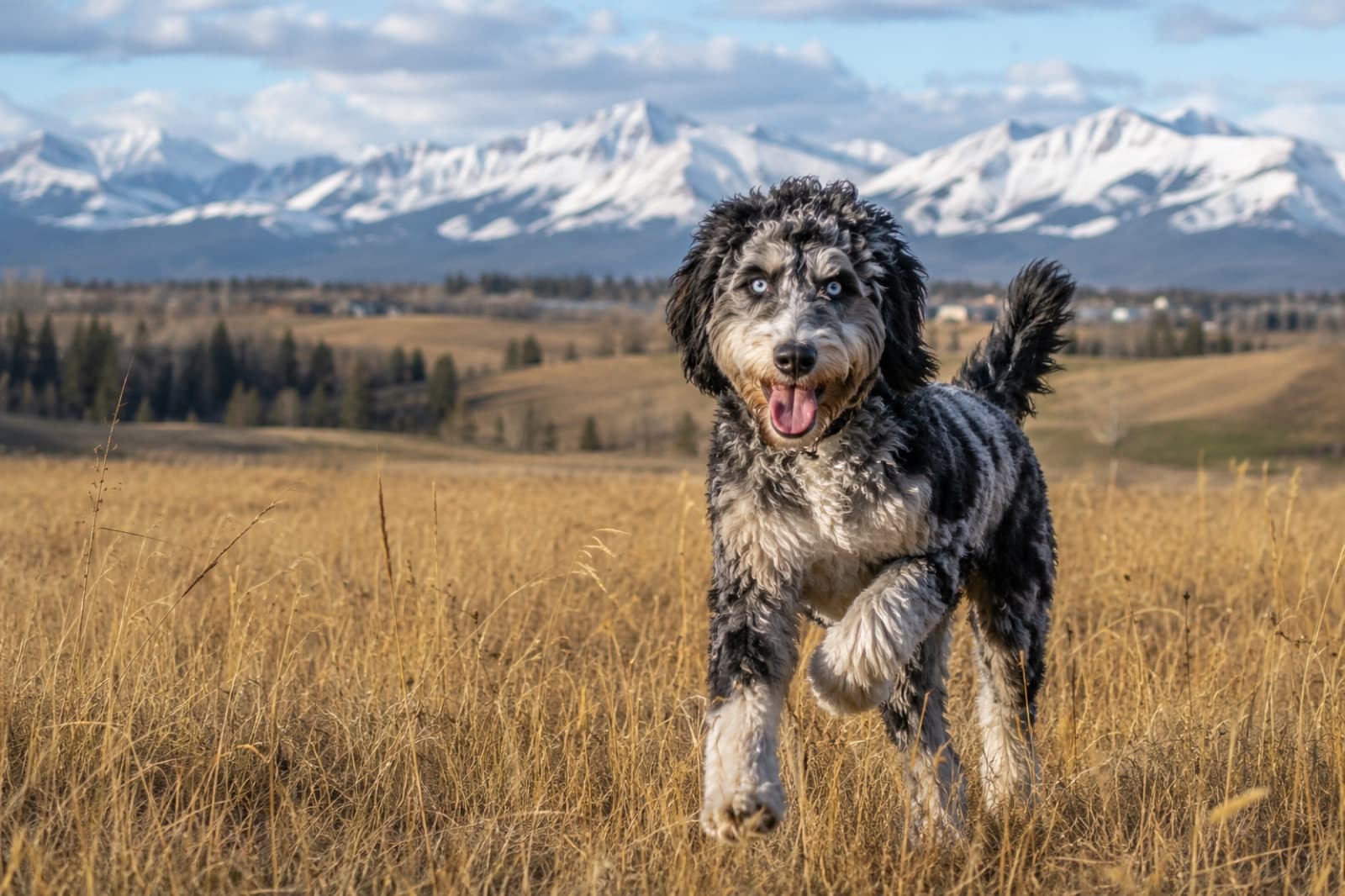
The Aussiedoodle is an Australian Shepherd and Poodle designer cross developed in the United States during the 1990s, riding the same doodle wave that produced the Labradoodle and the Goldendoodle. Unlike those calmer crosses, the Aussiedoodle pairs two working breeds. The Aussie parent brings tireless herding drive, intense intelligence, and a hardwired urge to round up moving objects. The Poodle parent brings athletic endurance and a low-shed coat potential. The result is a striking, athletic, brilliant dog that does brilliantly with the right family and tears a household apart with the wrong one. This guide covers where Aussiedoodles actually appear in Calgary rescue, what they cost to live with, why they get surrendered, and the single medical test every Aussiedoodle adopter needs before any vet visit.
The Aussiedoodle at a glance
Aussiedoodles are a designer cross, not a recognised purebred. Neither the Canadian Kennel Club nor the American Kennel Club registers Aussiedoodles as a breed. Smaller registries such as the Designer Breed Registry and the International Designer Canine Registry recognise the cross. Most Calgary Aussiedoodles are F1 or F1B crosses from smaller Canadian and American breeders. Multigenerational Aussiedoodle programmes exist but are less established than the equivalent Labradoodle or Bernedoodle lines.
| Trait | Typical range |
|---|---|
| Adult weight | 25 to 75 lbs depending on Poodle parent size |
| Size variants | Standard 45 to 75 lbs / Mini 25 to 45 lbs |
| Lifespan | 10 to 13 years |
| Coat types | Wavy or curly; blue merle, red merle, black tri, red tri, solid, phantom |
| Energy level | High; both parents are working breeds bred for all-day stamina |
| Exercise needs | 90 to 120 minutes daily plus structured mental work |
| Temperament | Brilliant, playful, family-bonded, herding instinct retained, can be vocal |
The headline trait of the breed is intelligence. Aussiedoodles learn fast, generalise concepts, and figure out how to open doors, fridges, and child gates within months. This is wonderful when channelled into agility, scent work, or trick training. It is a serious problem when the dog is bored. A bored Aussiedoodle will invent jobs. Those jobs usually involve dismantling something the household values. The dog who gets 90 to 120 minutes of real exercise plus a 20 minute training session is a different animal from the dog who gets a 30 minute neighbourhood walk and is left alone all day.
Where to adopt an Aussiedoodle in Calgary
Calgary Aussiedoodle rescue intake is uncommon for a specific reason: the breed is young (1990s origin), heavily breeder-acquired, and the families who buy them generally pay $2,000 to $5,000 up front, which biases them toward private rehoming if things go sideways. Aussiedoodles do appear in Calgary rescue, but the cadence is closer to one every two or three months than one a week. The strategy is the same as any low-volume designer cross: apply broadly, set up alerts, and be ready to move within hours of a listing appearing.
Calgary-area rescues to monitor:
- Calgary Humane Society: the largest local shelter; occasional Aussiedoodle and Aussie-mix intakes from owner surrenders.
- AARCS: foster-based; structured “good with” evaluations matter for a high-drive working cross where temperament documentation is critical.
- BARCS Rescue: Calgary foster network; medium and large active dogs regularly, with occasional doodle-mix surrenders.
- Pawsitive Match: Calgary foster-based; family-oriented placements common.
- ARF Alberta: Calgary foster network; broad medium and large-dog inventory.
- Cochrane Humane Society: Cochrane-based, serves the Calgary region; working-breed mixes more common given the rural catchment.
- Heaven Can Wait: High River-based, Calgary placement common.
- Calgary Animal Services: the municipal facility; occasional Aussiedoodles surface when an apartment owner hits a no-pet violation or an exercise-mismatch wall.
The single best move is to set up notifications on the LocalPetFinder Aussiedoodle breed page. Live listings from all Calgary rescues land there as they appear, and a foster-evaluated adult Aussiedoodle is the best possible match because adult temperament and herding-drive intensity are already documented.
One additional source matters. Australian Shepherd mixes appear in Calgary rescue more often than purebred Aussiedoodles, and the line between an Aussiedoodle and an Aussie-Poodle-something-else mix is fuzzy without DNA testing. Foster-based rescues will tell you honestly when parentage is uncertain. Trust the foster notes describing actual behaviour more than the breed label on the kennel card.
What does an Aussiedoodle cost in Calgary?
Calgary fees vary by rescue and what is included. The realistic ranges below are directional, not quotes:
| Source | Fee range | Typically includes |
|---|---|---|
| Calgary Humane Society | $500 to $700 | Spay or neuter, vaccinations, microchip, vet exam |
| AARCS | $600 to $800 | Spay or neuter, vaccinations, microchip, foster history |
| BARCS / Pawsitive Match / ARF Alberta | $500 to $900 | Spay or neuter, vaccinations, microchip, foster notes |
| Standard breeder puppy (F1 or F1B) | $2,000 to $3,500 | Variable health screening, contracts vary, 6 to 12 month waitlist |
| Premium breeder (multigen, full health panel) | $3,500 to $5,000 | Full parent health screening including MDR1 DNA, multigen lineage, 12 to 18 month waitlist |
The adoption fee is only the entry cost. Annual care for an Aussiedoodle in Calgary runs higher than many medium breeds because of the every 8 to 10 week grooming requirement plus the high food consumption of an active working-breed cross. Plan for:
- Professional grooming: $80 to $140 per session every 8 to 10 weeks at Calgary salons. That works out to $500 to $900 per year. The wavy and curly coats do not shed out on their own; they keep growing and need trimming and de-matting on a steady schedule. Skip this and the coat mats to the skin, which forces a full shave-down.
- Home grooming tools: a slicker brush, metal comb, detangling spray, and grooming scissors for between-salon touch-ups. Budget $80 to $150 once, then refill consumables every year or two.
- Active-dog gear: a well-fitted Y-front harness, 6 to 8 foot leash, long line for recall work, and a flirt-pole for high-drive play. Weatherproof boots and coat for winter, particularly for clipped grooming styles. Budget $200 to $400 in the first month.
- Food and treats: $60 to $140 per month depending on quality tier and adult size. A 60 lb Standard Aussiedoodle eats roughly double what a 30 lb Mini eats. Working dogs need higher-protein active formulas, not lifestyle kibbles.
- Vet and preventive care: roughly $500 to $900 per year for routine wellness, vaccines, parasite prevention, and dental. Add the one-time MDR1 DNA test at $150 to $200, ideally before any medication or surgery.
- Pet insurance: worth considering given the working-breed activity level and the joint and eye risks inherited from the Aussie line. Plan for $50 to $110 per month, with Calgary specialty care available through Western Veterinary Specialist Centre.
- Training and daycare: the single most underbudgeted line item. Plan for a force-free puppy class series ($200 to $400) and weekly daycare ($30 to $50 per day, two to three days a week) through the first two years. An under-stimulated Aussiedoodle is destructive, anxious, and vocal; daycare is structural for apartment owners.
- Calgary dog licence: required for every dog three months and older under the Responsible Pet Ownership Bylaw 3M2006. A small annual fee that improves recovery odds if your dog ever goes missing.
First-year totals typically land between $3,000 and $5,500 once you add gear, training, grooming, daycare, and licence on top of the adoption fee. For a full breakdown of lifetime ownership cost in Calgary, see our Calgary adoption costs guide.
Why Aussiedoodles end up in Calgary rescue
Intake is uncommon but the patterns are consistent. Understanding them helps you build a household where it does not happen to your dog.
- The exercise-demand wall. The single most common surrender driver. Families who expected a docile family doodle hit month four and realise the dog actually needs 90 to 120 minutes a day of real exercise, plus mental work, plus training. The dog who gets 30 minutes ends up destructive, vocal, and anxious. By month nine the family has lived through it and decides the breed is not the fit.
- Herding-behaviour problems. Ankle-nipping kids, chasing bikes and skateboards down the pathway, circling family members during walks, rounding up the family cat. The instinct is hardwired from the Australian Shepherd parent and cannot be trained out. Families who did not know to expect it sometimes hit a child-bite incident or a neighbour complaint and conclude the dog is dangerous. The dog is not dangerous; the instinct just needs management.
- Grooming workload fatigue. The every 8 to 10 week salon visit at $80 to $140 plus the 2 to 3 times weekly home brushing catches families by surprise. Owners who underestimated the workload sometimes let the coat mat to the skin, which forces a shave-down. By year two the family decides the workload is not sustainable.
- MDR1 medication emergency. Less common but serious. An owner who did not DNA test for MDR1 gives the dog a routine dose of ivermectin or loperamide and the dog seizures or collapses. The vet bill, the trauma, and sometimes the loss of the dog drive a surrender or a complete reassessment of dog ownership. Every Aussiedoodle adopter should test once and document the result.
- Apartment lifestyle changes. Babies, moves to smaller condos, divorces, owner illness. Common across breeds but particularly hard on a high-drive working dog who needs constant outlets. A Mini Aussiedoodle in a one-bedroom condo with a busy owner is the surrender pattern we see most often in this category.
None of these are problems with the breed concept. They are problems with the match, the source, or the household honesty before adoption. Calgary rescues that run foster-based programmes (AARCS, Pawsitive Match, ARF Alberta, BARCS) are the best resource for an Aussiedoodle whose adult temperament, herding intensity, and exercise tolerance are already documented in the foster home.
Breed background: a 1990s American working-doodle
The Aussiedoodle emerged in the United States during the 1990s, riding the same doodle wave that produced the Labradoodle and the Goldendoodle. Unlike those crosses, which paired the Poodle with sporting breeds bred for biddability, the Aussiedoodle paired the Poodle with a working herding breed. The original goal was a low-shed, highly intelligent dog with working-breed athleticism, suitable for active families and dog sports.
No single founding kennel claims credit the way Swissridge does for the Bernedoodle. The Aussiedoodle developed in parallel across multiple American breeders, which means the breed lacks a single quality benchmark. The Australian Shepherd parent itself is misnamed; the breed was developed in the western United States during the 1800s, not Australia. The two parent breeds together produce a dog with intense working drive, high intelligence, and a striking coat palette that draws heavily from the Aussie merle pattern. Neither the AKC nor the CKC recognises the Aussiedoodle as a breed; the Designer Breed Registry and the International Designer Canine Registry do.
The practical implication for Calgary adopters: because there is no single founding kennel, the breeder landscape is more variable than the Bernedoodle or Labradoodle markets. Ethical Canadian breeders running full health testing exist, but they are outnumbered by backyard operations skipping the MDR1 test and the eye CERF screening. Vetting a breeder against the ethical framework matters more for Aussiedoodles than for many designer crosses.
Mini vs Standard: which size fits Calgary?
An Aussiedoodle adult size is set by which Poodle was used in the cross. The variation is wide enough that two Aussiedoodles can be 40 lbs apart and both be correct for the breed. The two commonly bred variants:
| Variant | Weight | Poodle parent |
|---|---|---|
| Standard Aussiedoodle | 45 to 75 lbs | Standard Poodle |
| Mini Aussiedoodle | 25 to 45 lbs | Miniature Poodle |
The Standard is the closest match to the original working-breed feel: full Australian Shepherd substance, athletic, capable of long working days, and most likely to handle Calgary mountain hiking and dog-sport venues comfortably. The Mini is the most popular Calgary size because it fits more housing situations while still carrying the working drive. The Mini is not a lower-energy dog. It is a smaller dog with the same exercise demand. Calgary owners who buy a Mini expecting a lapdoodle are the families who surrender at month nine.
A Toy Aussiedoodle variant exists (Toy Poodle parent, 10 to 24 lbs) but raises the same welfare concerns as the Tiny Bernedoodle. The size disparity between a 50 lb Australian Shepherd and a 7 lb Toy Poodle requires artificial insemination, and the resulting puppies sometimes show structural problems from compressing a working-breed body shape into a toy frame. Most established designer-breed clubs and reputable breeders do not produce Toy Aussiedoodles. Calgary rescues see Mini and Standard sizes; Toys are very rare.
Temperament: brilliant, affectionate, herding-driven
Aussiedoodles are intelligent, playful, family-bonded, and prone to following one person around the house. They form strong attachments and can develop separation anxiety if left alone for long stretches without daycare or structured enrichment. They are typically affectionate with their household, polite with new people once introduced properly, and engaged with everything happening in their environment.
The trait Calgary households need to plan for is herding instinct. The Australian Shepherd parent contributes a hardwired drive to round up moving objects: kids running through the yard, bikes on the pathway, the family cat sprinting through the kitchen, joggers in the off-leash park. In a Calgary household this typically shows up as:
- Ankle-nipping kids and other dogs. The dog is trying to round them up. It is not aggression but it can still draw blood or trigger a child-bite report. Manage with structured introductions, indoor leash work, and redirection to alternate outlets like a flirt-pole.
- Chasing bikes, skateboards, and joggers. Particularly hazardous on Calgary pathways and at Nose Hill or Fish Creek. Manage with leash work past triggers and counter-conditioning protocols from a force-free trainer.
- Circling family members during walks. The dog is treating the walk as a herding job. Often manageable with structured loose-leash training but never fully eliminated.
- Vocalisation during play and excitement. Aussiedoodles can be barky. Apartment owners need realistic neighbours and structural sound management.
Force-free Calgary trainers like Raising Canine and Pup City Pup Academy teach impulse-control protocols, alternate outlets, and management strategies that redirect the herding instinct rather than punishing it. The instinct cannot be trained out; you redirect it for the dog full life. Households with kids should expect to manage child-dog interactions actively for the first year and remain attentive forever.
Calgary climate fit: capable in winter, manageable in summer
Aussiedoodles handle Calgary winters reasonably well. The wavy or curly coat insulates better than a smooth coat, and most dogs are comfortable to about minus 15 degrees Celsius without a jacket. Below minus 20, a winter coat helps, particularly for clipped grooming styles or hair-coat F1 dogs. The Australian Shepherd parent contributes a double coat developed for cold mountain work, so cold tolerance is genuine. Long winter walks at Nose Hill Park, Fish Creek Park, Bowmont Park, and Edworthy Park are natural Aussiedoodle activities from November through March.
Practical Calgary winter routine:
- Most Aussiedoodles do not need a winter coat above minus 15 degrees Celsius. Hair-coat F1 dogs and recently clipped dogs may need one earlier.
- Booties are usually optional on packed snow, but salt irritation on Beltline and Inglewood sidewalks is real; a quick paw rinse on return solves it.
- Watch for ice-ball formation between the toes in long wavy or curly coats; trim the foot hair short during winter.
- Calgary chinooks can swing temperatures 30 degrees in hours. Keep gear close at hand and watch the forecast.
- Keep working drive engaged through indoor scent work, structured training, or weekly daycare. A snowed-in Aussiedoodle without enrichment is a destructive Aussiedoodle.
Summer is comfortable but the Aussiedoodle is athletic and can overheat on hot July afternoons. Above 24 degrees Celsius, walk before 8am or after 8pm, provide constant water and shade, and consider Bow River swims at Sandy Beach as a cooling routine. The merle coat colours common in Aussiedoodles also benefit from sunscreen or shade on light-pigmented patches during long outdoor sessions.
F1, F1B, multigen: a quick framework
Generation labels describe the genetic recipe and predict coat reliability. The headline is the same as other doodles: the further you move from F1, the more consistent the coat and the more reliable the low-shed claim becomes.
| Label | Recipe | Coat reliability |
|---|---|---|
| F1 | Aussie x Poodle (50/50) | Lottery; thirds split between wavy low-shed, wavy medium-shed, and double-coat shedder |
| F1B | F1 Aussiedoodle x Poodle (25/75) | Reliably low-shed in most puppies |
| F2 | F1 Aussiedoodle x F1 Aussiedoodle | Most variable; hardest to predict |
| Multigen | Aussiedoodle x Aussiedoodle across 3+ generations | More consistent coat and temperament |
For an allergic Calgary family that needs a reliable low-shed coat, the dependability order is multigenerational Aussiedoodle, then F1B, then F2, then F1. An F1 from an ethical breeder is still a valid dog; it is just not the right pick for a family that genuinely needs low-shed reliability. The multigenerational Aussiedoodle market is smaller than the equivalent Bernedoodle or Labradoodle market, so expect waitlists at the longer end (12 to 18 months) and pricing toward the top of the range.
The MDR1 medication caveat (the part every Aussiedoodle owner needs to know)
This is the most important medical fact about the breed and the section every Aussiedoodle adopter should read carefully. MDR1 (Multi-Drug Resistance 1) is a genetic mutation common in herding breeds. Roughly 50 percent of Australian Shepherds carry one or two copies of the mutation, which means a large share of Aussiedoodles inherit it. The mutation affects how the dog processes several common medications. An MDR1-positive dog given a standard dose can experience tremors, seizures, coma, or death.
Medications that are dangerous in MDR1-positive dogs include:
- Ivermectin at high doses (used in some heartworm and parasite treatments). Standard low-dose monthly heartworm prevention is generally safe; high-dose treatments for demodex are not.
- Loperamide (Imodium, common over-the-counter diarrhoea medication). Calgary owners who reach for Imodium during a stomach upset can poison their MDR1-positive dog.
- Certain anaesthetics used in surgery (acepromazine, butorphanol). A routine spay or dental cleaning becomes a serious risk without knowing MDR1 status first.
- Several chemotherapy drugs (vincristine, vinblastine, doxorubicin). Critical for any owner whose dog faces a cancer diagnosis.
- Some antidiarrhoeals and antiemetics beyond loperamide.
The practical reality for Calgary owners:
- Test once, document forever. A one-time DNA test through Embark, Wisdom Panel, or your vet ($150 to $200) tells you the dog MDR1 status. Record it in the dog file, the dog collar tag, and your phone notes. Tell every Calgary vet at every visit.
- Status comes in three results. Normal/Normal (no mutation copies, safe). Normal/Mutant (one copy, sensitive but lower-risk). Mutant/Mutant (two copies, full sensitivity). Even a Normal/Mutant dog should be treated as sensitive for the highest-risk drugs.
- Update the vet record. Calgary clinics keep medication records, but a flagged MDR1 status on the file is the single best safety net. Ask your clinic to enter it as a medication alert.
- Watch for over-the-counter risk. The most common Aussiedoodle MDR1 incident in Calgary involves an owner giving Imodium for diarrhoea without knowing the risk. If you do not know your dog status, do not give over-the-counter medications without calling your vet.
- Specialty care matters. Emergency situations at Western Veterinary Specialist Centre or Calgary 24-hour ER vets benefit from knowing the dog MDR1 status before any sedation. Carry the test result in your phone for emergencies.
The Washington State University College of Veterinary Medicine, which runs the most active MDR1 research programme in North America, maintains a free database of medications and dose adjustments for MDR1-positive dogs. Calgary vets can reference it for any prescription decision. The takeaway for every Aussiedoodle adopter: test once, document the result everywhere, tell every vet, and never give over-the-counter medications without checking. The test is the single most important medical step you take for an Aussiedoodle, and it pays back over the dog full life.
Browse adoptable Aussiedoodles in Calgary
See current Aussiedoodles and Aussiedoodle mixes across Calgary rescues in one place. Foster temperament evaluation matters more than the breed label for a high-drive working cross like this. Inventory updates regularly, and because Aussiedoodle intake is uncommon, set up notifications and apply within hours when a listing appears.
See Available Aussiedoodles →The ethical breeder framework (when rescue is not realistic)
Because rescue intake is uncommon, a real portion of Calgary Aussiedoodle families end up going through a breeder. The case for rescue is strongest when you can accept “next dog who appears, regardless of timing or generation”; the case for a breeder is strongest when you have a specific timeline and want to shape socialisation from week 8. Either path can be ethical. Buying an unverified Kijiji puppy with no MDR1 test is not.
The Aussiedoodle is a designer cross, so the CKC purebred framework does not apply. The substitute frameworks worth using:
- Demand the MDR1 DNA test on both parents. Non-negotiable. An ethical Aussiedoodle breeder tests both parents and discloses status. A breeder who shrugs at the MDR1 question or says “we have not had any problems” is not the right source. Cross them off the list.
- Ask for parent health clearances in writing. From the Aussie side: OFA hip and elbow clearance, eye CERF clearance, Collie Eye Anomaly (CEA) DNA test, hereditary cataract DNA test, and the MDR1 panel. From the Poodle side: OFA hip clearance, CERF eye clearance, PRA DNA test, Addison disease screening. Ethical breeders publish results on the OFA database.
- Visit the home or request a live video tour of where puppies are raised. Puppies raised in a home environment with structured early socialisation start life differently than puppies raised in a barn or kennel. This matters extra for a high-drive working cross.
- Expect the breeder to interview you. Ethical Aussiedoodle breeders ask detailed questions about your exercise routine, your home, your fenced yard, your prior dog experience, and your understanding of the working-breed energy level and herding instinct. Breeders who do not ask questions are a red flag.
- Confirm a written take-back contract. Ethical breeders take their dogs back at any age, for any reason.
- Reject the “ready now” listings. Reputable Canadian Aussiedoodle breeders run 6 to 18 month waitlists. A Kijiji listing for “Aussiedoodle puppies ready now, $1,200” is almost always a mill or backyard operation. The math does not work otherwise; full parent health testing plus MDR1 alone costs $1,500 to $2,500 per breeding pair.
The realistic price floor for an ethically bred Aussiedoodle in Canada is $2,000 to $3,500 for a standard F1 or F1B with full health testing. Multigenerational lines with documented health histories run $3,500 to $5,000. Below those floors the breeder almost certainly skipped some combination of health testing (including MDR1), early socialisation, or proper parent care.
Frequently Asked Questions
Where can I adopt an Aussiedoodle in Calgary?↓
How much does it cost to adopt an Aussiedoodle in Calgary?↓
Are Aussiedoodles hypoallergenic?↓
How much exercise does an Aussiedoodle need?↓
Are Aussiedoodles good for first-time owners?↓
Can Aussiedoodles live in Calgary apartments?↓
Are Aussiedoodles good in Calgary winters?↓
What is herding behaviour in an Aussiedoodle and how do I manage it?↓
What is MDR1 and why does it matter for Aussiedoodles?↓
What is the difference between Mini and Standard Aussiedoodle?↓
Why are Aussiedoodles so expensive from breeders?↓
Why do Aussiedoodles get surrendered to Calgary rescue?↓
Continue reading
Adoptable Aussiedoodles in Calgary
Live Aussiedoodle and Aussiedoodle-mix listings across Calgary rescues, refreshed regularly. Set up notifications for new arrivals.
Aussiedoodle health issues
MDR1 medication sensitivity, hip and elbow dysplasia, eye conditions, epilepsy. The stacked screening list and the Calgary specialty vets who handle each condition.
Australian Shepherd Adoption Calgary
The Aussie parent. Working-breed drive, herding instinct, and where to find purebred Aussies in Calgary rescue.
Labradoodle Adoption Calgary
The calmer doodle cousin. F1 coat lottery, exercise demands, Australian Labradoodle distinction, and how rescue and breeder paths compare.
New dog? Start with these care guides
Everything a new adopter needs to set up a safe, happy home.