The short answer
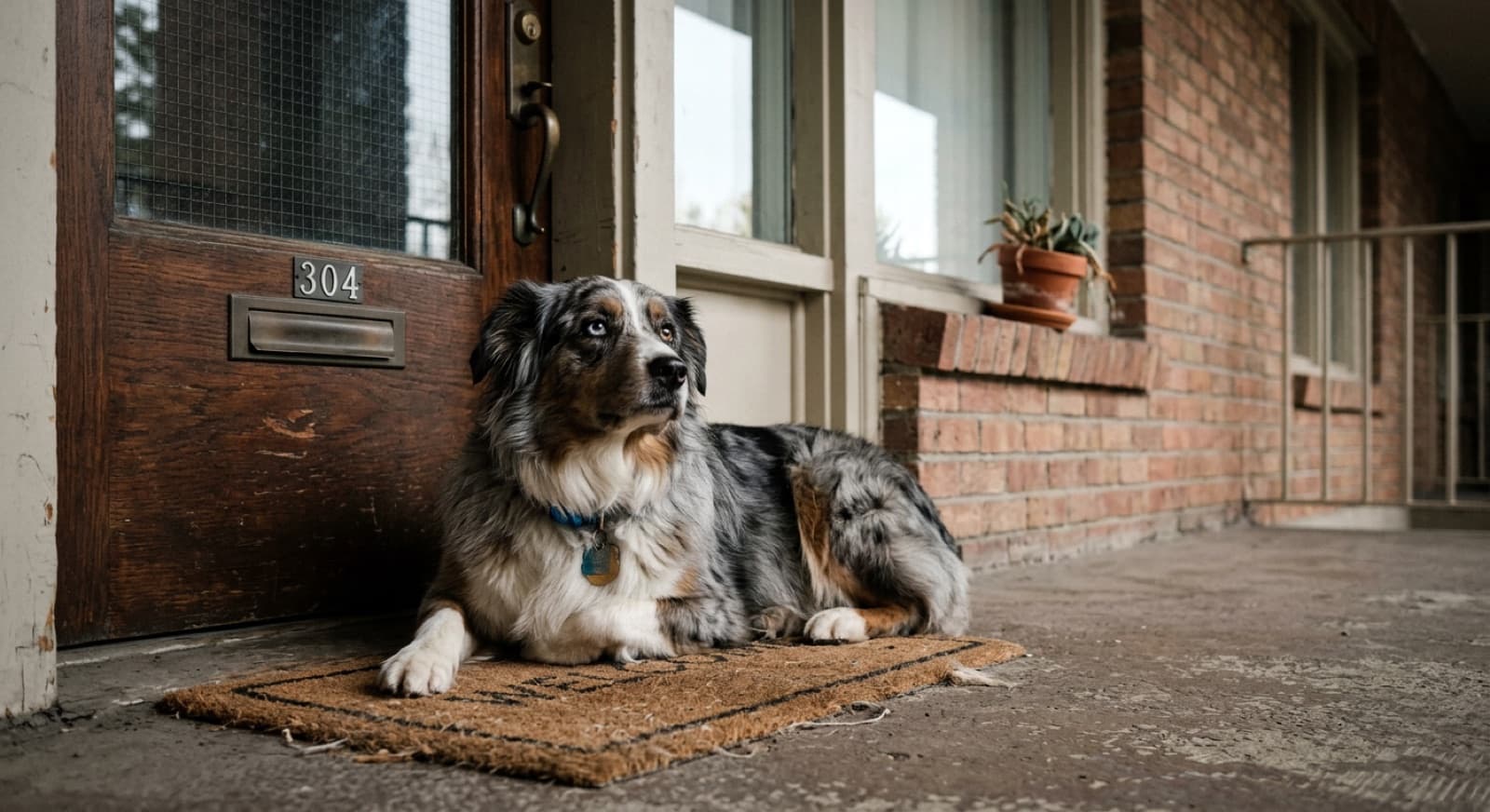
Aussies were bred to work next to humans 8+ hours a day. Cortisol research on working breeds shows stress hormones rise sharply after 3 to 4 hours alone. Most adult Aussies tolerate 4 to 6 hours occasionally. Past 6 hours, stress builds. A Calgary downtown commute of 30 to 60 minutes each way plus a 9-hour office day adds up to 9 to 11 hours alone. Most Aussies cannot handle this. Without daycare or a midday walker, many Calgary Aussies end up in rescue within 1 to 2 years of a full-time-office adoption. The good news: velcro behaviour alone is not separation anxiety, and the difference is easy to see on a puppy cam.
Why Aussies are velcro
Aussies were bred to work shoulder-to-shoulder with humans 8+ hours daily on American ranches. The breed was selected for constant handler attention, strong family bonding, following human direction, and reading body language. The American Veterinary Society of Animal Behaviour (AVSAB) treats this kind of attachment as normal sociability, distinct from clinical separation anxiety. Those traits do not turn off in suburban Calgary.
Adult Aussies typically:
- Follow their owner room-to-room (“velcro” or “shadow dog”)
- Choose to nap in the same room as family rather than a separate space
- Watch family activities closely
- Greet enthusiastically after even brief separations
- Settle calmly when family is present
This is normal healthy Aussie behaviour. Velcro behaviour alone is NOT separation anxiety.
The critical distinction: healthy velcro Aussies can be calmly alone for moderate periods (3 to 4 hours typical, longer with training). Clinical separation anxiety is panic when alone, regardless of duration.
Many Calgary Aussie owners worry about velcro behaviour and over-correct, sometimes creating separation anxiety where none existed by isolating the dog too much. The healthier path is to enjoy the velcro nature while building independence skills gradually.
Velcro behaviour vs clinical separation anxiety
| Behaviour | Velcro (normal) | Clinical SA (medical) |
|---|---|---|
| Following you | Room-to-room when home | Frantic, panic when door closes |
| Departure prep | Watches calmly, may follow to door | Trembling, hiding, panic at keys/coat |
| Settling alone | Within 5 to 15 min | Cannot settle, escalating distress |
| Vocalization | Brief whining or none | Continuous howling/barking 30+ min |
| Destruction | None | Doors, windows, escape attempts |
| Self-injury | None | Broken nails, raw paws, mouth wounds |
| Soiling | Housetrained, no accidents | Soiling indoors despite housetrained |
| Eating alone | Normal | Refuses food/water for hours |
| Greeting return | Normal enthusiastic | Hyperventilating, can't calm |
Puppy cam test (the diagnostic): set up a phone or camera (Wyze, Ring, Furbo, Nest) and record the dog alone. Watch the first 30 minutes after departure.
- Normal: dog follows you to the door, watches briefly, lies down, sleeps or rests calmly
- Clinical SA: dog panics, paces continuously, destroys items, vocalizes endlessly, cannot settle
The test removes guesswork. Many Calgary Aussie owners assume their dog is fine alone, but the puppy cam reveals chronic stress.
If puppy cam shows clinical SA: do NOT continue the current alone-time pattern. Continued exposure worsens the cortisol cycle and creates lasting trauma.
The WFH-to-office return crisis
The most common Calgary Aussie crisis pattern of the last two years. Calgary professionals adopted Aussies during the 2020 to 2024 WFH era. As companies returned to office in 2024 to 2026, many of those Aussies experienced devastating bond rupture.
The pattern:
- Aussie adopted during WFH (often 8 weeks to 2 years old)
- 2 to 4 years with owner home most or all day
- Owner returns to office 5 days weekly
- Aussie hits sudden 8 to 10 hour daily isolation
- Within 1 to 4 weeks: destruction, vocalization, soiling, severe distress
- Within 2 to 6 months: many of these Aussies surrendered to Calgary rescues
Prevention during WFH ownership: train alone-time even when you do not need to. Leave the dog in another room. Take walks without the dog. Build the muscle. WFH-trained Aussies handle a return to office with adjustment but no crisis.
If you are facing return-to-office now:
- Gradual exposure 4 to 8 weeks before return: increase alone time slowly. Start with 2-hour absences and build to 8 to 9 hours over 6 to 8 weeks
- Daycare 2 to 3 days weekly minimum. Calgary downtown-area daycares: K9 Sports Connection, Doggie District, Tail Blazers, Bow Wow, Calgary Pet Crew, Dogtopia. $30 to $50/day
- Midday dog walker on non-daycare days. Calgary services: Wag, Rover, local independents. $20 to $40 per visit
- Hybrid schedule if possible: 3 office plus 2 WFH preserves the dog's well-being and your sanity
- Work-friend or neighbour lunch drop-ins at first
- Puppy cam monitoring during initial return-to-office days
- Behaviourist consultation if the dog shows clinical SA signs. Medication is sometimes appropriate during transition
Building alone-time tolerance: the desensitization protocol
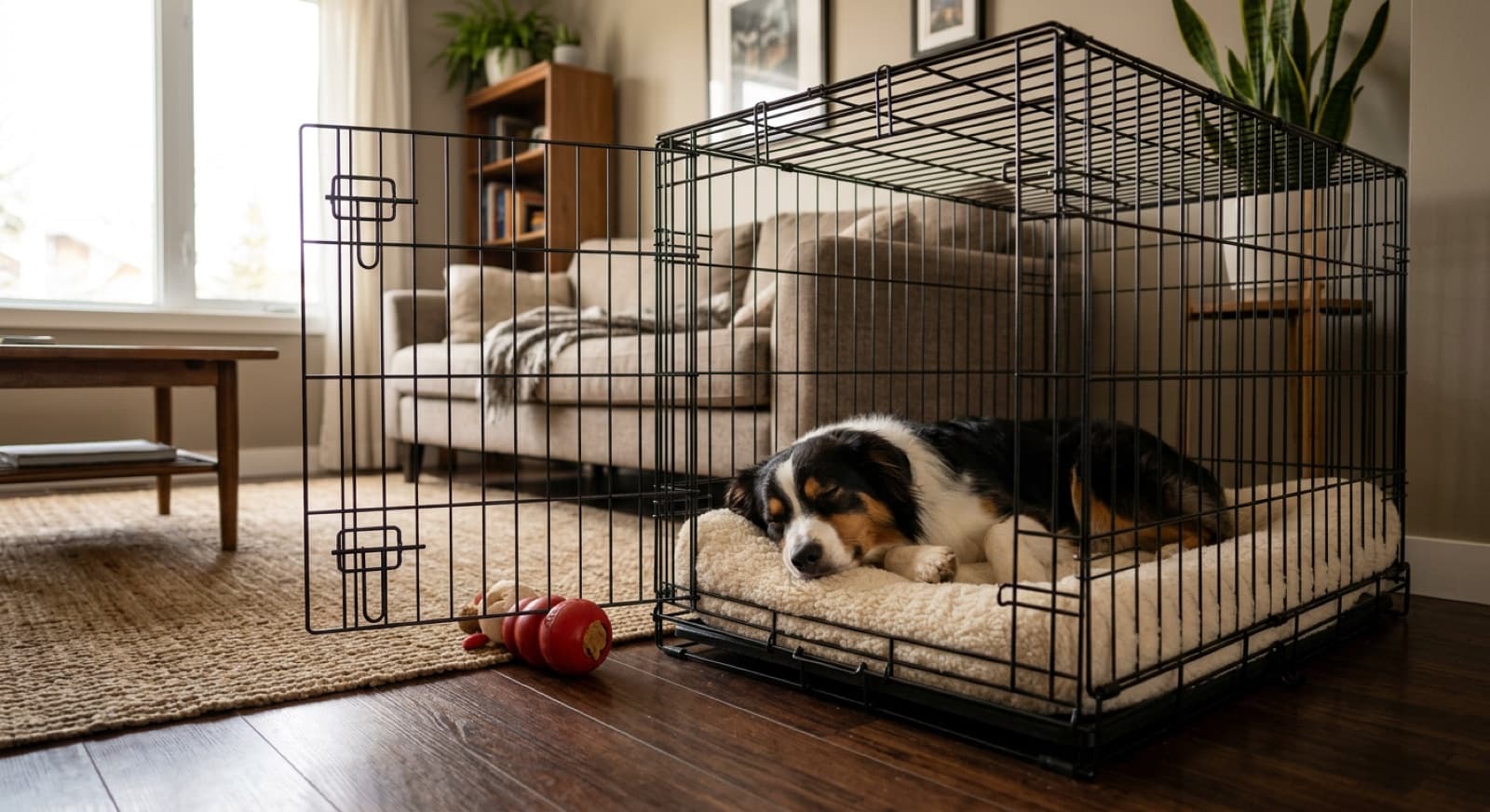
Most Aussies build healthy alone-time tolerance with consistent work over 4 to 12 weeks.
- Foundation Days 1 to 7: dog is NEVER alone in the new home. Decompression and bonding. Take time off work or arrange WFH
- Micro-separations Days 8 to 14: leave the dog in one room while you are in another. 30 seconds, then 1 minute, building to 5. Use baby gates rather than closed doors at first
- Brief departures Week 3: leave the house for 2 to 5 minutes (out front, then back). Build to 10 to 15 minutes. Watch the puppy cam during departures
- Durational alone time Weeks 4 to 6: 30 minutes to 1 hour alone. Keep monitoring on camera
- Working-length absences Weeks 7 to 12: 2 to 4 hours alone. Build to 4 to 6 hours over weeks 8 to 12 if the dog is handling it well
Critical techniques:
- Departure cue desensitization. Pick up keys without leaving. Put on a coat without leaving. 100+ repetitions until the cues stop predicting departure.
- Calm departures and arrivals. No dramatic goodbyes. No big “I'm home!” greetings. Neutral.
- Frozen Kong or Lickimat at departure. Gives the Aussie 15 to 30 minutes of positive activity.
- Background sound. Low-volume TV or radio reduces stress.
- Pre-departure exercise. A 30 to 60 minute walk plus 15 minutes of training before you leave.
Some of the product links in this section are Amazon affiliate links — we may earn a small commission at no extra cost to you. It never changes which products we recommend.
What NOT to do:
- Don't flood. Leaving an Aussie alone for hours hoping they get used to it creates lasting trauma.
- Don't punish stress behaviours. Punishment raises cortisol and does not fix the problem.
- Don't skip the puppy cam. You can't fix what you can't see.
When the protocol fails: if 6 to 12 weeks of consistent work does not produce calm alone-time tolerance, this is clinical separation anxiety and needs a veterinary behaviourist. Sometimes medication too. Not a training failure. A medical condition.
When to escalate: veterinary behaviourist and medication
Criteria to consult a veterinary behaviourist:
- Self-injury during alone time (broken nails, mouth wounds, paw bleeding)
- Continuous distress without calming for 30+ minutes
- Escape attempts (jumping fences, breaking windows, ripping doors)
- Refusing food alone for 24+ hours
- Cannot be left even 15 to 30 minutes without panic
- Behaviour worsening despite training
Calgary veterinary behaviourists: limited locally. Options include virtual consultation with a DACVB, referral to Edmonton (Western College of Veterinary Medicine, University of Alberta), and USA referral for complex cases. Costs: initial consultation $300 to $600, follow-ups $200 to $400, medication $20 to $150/month.
Medications commonly used for Aussie separation anxiety:
- Fluoxetine (Reconcile, generic Prozac). Daily SSRI. 4 to 6 weeks to reach effect. $30 to $70/month. Long-term medication.
- Trazodone. Situational anti-anxiety and sedative. Useful for predictable triggers like departure. $30 to $60/month.
- Sileo (dexmedetomidine oromucosal). Short-term acute anxiety relief. $40 to $80 per dose.
- Clomipramine (Clomicalm). TCA antidepressant labelled for SA. $40 to $80/month.
MDR1 considerations: most psychiatric medications are MDR1-safe, but verify with your vet. Some require dose adjustment in MDR1-positive Aussies.
The framework. Medication is a tool, not a fix. Paired with behaviour modification, it reduces baseline anxiety enough for the dog to learn new patterns. Most dogs stay on medication for 6 to 18 months while behaviour modification builds new responses, then wean slowly.
The stigma is undeserved. Severe SA is a medical condition like diabetes. No shame in treating it with the right tools.
Calgary daycare + walker network
Essential infrastructure for full-time-working Calgary Aussie owners. The $400 to $1,000+ monthly investment is far less than rehoming costs and the emotional toll.
Calgary doggy daycare options:
- Doggie District. Multiple Calgary locations, $40 to $50/day.
- K9 Sports Connection. Sport-focused, $40 to $55/day, agility and active play. Excellent for high-drive Aussies.
- Tail Blazers Daycare. Calgary multiple, $30 to $45/day.
- Bow Wow Daycare. Calgary, $35 to $50/day.
- Calgary Pet Crew. Multiple locations, $35 to $45/day.
- Dogtopia. Calgary chain, $40 to $50/day.
- Independent neighbourhood daycares. $25 to $40/day.
What to look for: small group size (max 8 to 12 dogs per handler), active play structure, force-free handling, temperament evaluation before enrollment, indoor and outdoor space, camera monitoring, and Aussie-friendly intake.
Calgary dog walker options:
- Rover. Calgary widely available, $20 to $35 per visit.
- Wag. Calgary, $20 to $30 per visit.
- Local independents. Often the best quality, $25 to $40 per visit.
- Pack walking services. Group walks, $15 to $25 per dog (good socialization).
Investment math. A typical Calgary full-time-working Aussie owner runs 2 daycare days ($80 to $100) plus 3 midday walks ($60 to $120) for $140 to $220 per week, or $560 to $880 per month. Annual: $6,720 to $10,560. Significant, but far less than rehoming and starting over with another dog.
Prioritization: if budget is tight, prioritize 1+ daycare day weekly over daily walks. A daycare-wiped Aussie handles alone time much better.
Frequently Asked Questions
Why are Aussies so velcro?
Bred to work shoulder-to-shoulder with humans 8+ hours daily on ranches. Selected for handler attention, bonding, and reading body language. Healthy velcro looks like following room-to-room, preferring same-room company, settling calmly when family is present, and resting when alone. Velcro alone is not separation anxiety. It is breed nature.
How long alone is OK?
3 to 4 hour ceiling. Adult well-conditioned Aussies handle 4 to 6 hours occasionally and 3 to 4 hours daily. Adolescent (8 months to 3 years): 3 to 4 hours max. Puppy under 8 months: 1 to 3 hours. Rescue Aussies in their first 30 to 60 days: start at 30 minutes to 2 hours and build slowly. A Calgary downtown commute totals 9 to 11 hours alone without intervention. Most Aussies cannot handle that.
Velcro vs SA: how to tell?
The puppy cam test. Velcro settles within 5 to 15 minutes with no destruction, normal eating, and calm waiting. Clinical SA looks like panic at departure prep, destruction, self-injury (broken nails, raw paws), continuous 30+ minute vocalization, indoor soiling despite housetraining, refusing food, and escape attempts. A Wyze, Ring, or Furbo cam for $30 to $80 reveals the truth.
How to build alone-time tolerance?
Gradual desensitization over 4 to 12 weeks. Foundation week (never alone), then micro-separations (30 seconds building), then brief departures (2 to 5 minutes), then durational (30 to 60 minutes), then working-length (2 to 6 hours). Departure cue desensitization (100+ key and coat pickups). Calm departures and arrivals. Frozen Kong plus background sound plus pre-departure exercise. Do not flood. Do not punish. Do not skip the puppy cam.
Crate vs pen vs free-roam?
Crate is best for puppy-trained Aussies and mild velcro. Not for severe SA panic. Exercise pen suits dogs needing more space and multi-dog homes. Not for Aussie jumpers. Free roam works for adults past the adolescent destruction phase. Not for chewing or SA history. Partial free roam (one room plus a baby gate) is often the sweet spot. Test with the puppy cam to see what works for your dog.
WFH-to-office return crisis?
The most common Calgary Aussie crisis of 2024 to 2026. An Aussie adopted during WFH 2020 to 2024 plus a return to office equals 8 to 10 hours of isolation, which leads to destruction, vocalization, and SA within 1 to 4 weeks. Intervention: 4 to 8 weeks of gradual exposure before the return, 2 to 3 daycare days weekly, a midday walker, a hybrid schedule, puppy cam monitoring, and a behaviourist if SA emerges.
When to involve a behaviourist and medication?
Self-injury, 30+ minute continuous distress, escape attempts, refusing food 24+ hours, inability to be left 15 to 30 minutes, or behaviour worsening despite 6 to 12 weeks of training. Calgary options include virtual DACVB and Edmonton WCVM referral. Initial $300 to $600, follow-ups $200 to $400. Medications: fluoxetine SSRI ($30 to $70/month, 4 to 6 weeks to effect), trazodone situational, Sileo acute, clomipramine TCA. Mostly MDR1-safe but verify. Used with behaviour modification and weaned over 6 to 18 months.
Calgary daycare + walker network?
Daycares: Doggie District, K9 Sports Connection, Tail Blazers, Bow Wow, Calgary Pet Crew, Dogtopia. $30 to $55/day. Walkers: Wag, Rover, local independents. $20 to $40/visit. A typical setup: 2 daycare plus 3 walker visits at $560 to $880/month, or $6.7K to $10.5K/year. Less than rehoming. If budget is tight, prioritize daycare days over walker days. A daycare-wiped Aussie handles alone time much better.
Karen Overall relaxation protocol?
A free 15-day structured training that teaches a dog to default-settle. Dr. Karen Overall, veterinary behaviourist. Free PDF at animalbehavior.net or vetbehavior.com.au. Active training (gives the Aussie a job) works better than passive desensitization. 15 to 20 minutes daily, at the dog's pace not the calendar. Typical completion 4 to 8 weeks. Calgary force-free trainers (ImPAWSible Possible, Dogma, Sit Happens, Raising Fido) all incorporate it. Solo implementation works.
Calgary 311 noise complaints?
A real risk for condo Aussie owners. Calgary noise bylaw 5N2007 covers excessive barking. Repeated 311 complaints can mean bylaw fines, condo violation notices, and (in extreme cases) dog-removal orders. Prevention: soundproof, use calming background sound, position the crate away from doors and windows, and use daycare days to reduce alone-time barking. If a complaint comes in, do not ignore it. Address the barking immediately. Talk to the neighbour. Document training efforts.
Bottom line for Calgary working Aussie owners?
Right if: hybrid schedule or WFH, $400 to $1,000+/month for daycare and walker support, 4 to 12 weeks of alone-time training, realistic expectations, suburban house preferred or condo with a serious SA plan, and an adult rescue (3+) as your first Aussie. Wrong if: full-time office without daycare or walker support, apartment plus frequent travel, expectation that the Aussie will adapt without effort, first-time herding-breed owner, or a budget that cannot fit $500+ per month of support care. Honest self-assessment beats wishful thinking.
Adoptable Aussies in Calgary
Live listings of Aussies and Aussie mixes from Calgary rescues.
Aussie Training Calgary
Force-free training foundation, Karen Overall protocol, Calgary trainer network.
Aussie Exercise + Apartment Living
Daily exercise budget, condo-living realities, Calgary off-leash + sport outlets.
Bringing Home a Rescue Aussie
First 30 to 60 day decompression, alone-time training schedule, Calgary daycare onboarding.
New dog? Start with these care guides
Everything a new adopter needs to set up a safe, happy home.