The short answer
A Calgary apartment Beagle works if four things line up. One: the owner has a hybrid or flexible schedule, or budgets $400 to $700 a month for daycare and a midday walker. Two: the building has thick concrete walls (most modern Beltline and downtown high-rises) so baying does not become a neighbour complaint. Three: the household commits to 60 to 90 minutes of daily exercise plus 15 to 30 minutes of indoor enrichment, even at -25C. Four: the condo board has no restricted-breed clause and the unit's weight cap is above 30 lbs. If those fit, the breed thrives in a condo. If even one is shaky, our resources hub covers steadier small-space breed options.
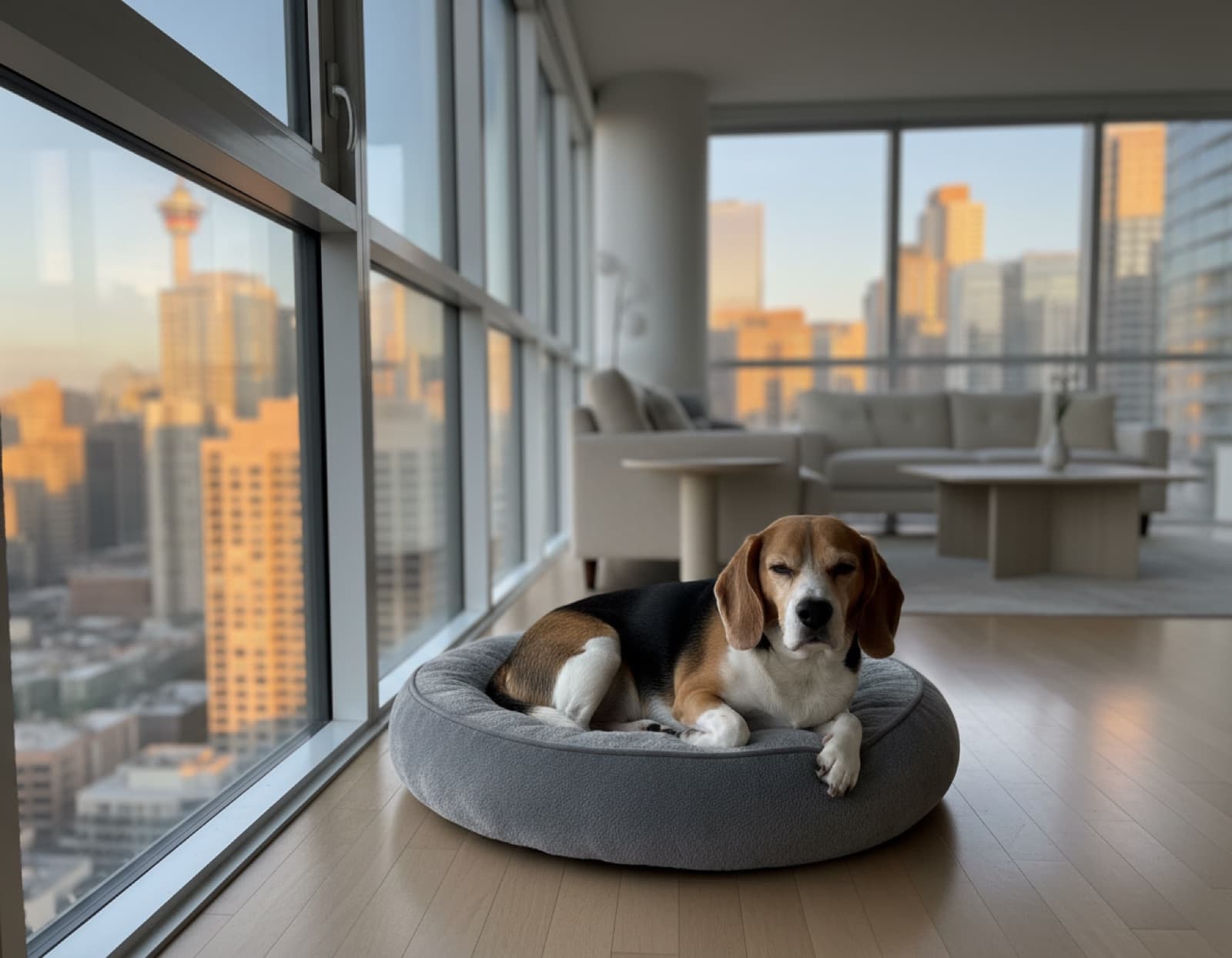
The Honest Verdict on Apartment Beagles
Beagles are sized for apartments. At 15 to 30 lbs they fit comfortably in a Beltline studio, a Bridgeland one-bedroom, or a downtown high-rise. The breed's low-slung body, moderate height, and quiet-most-of-the-day demeanour make square footage a non-issue. People who visit a Beagle in a tidy apartment usually walk out thinking the dog is the easiest medium-sized breed they have ever met.
That impression is half true. The other half is what happens when the front door closes and the owner leaves for the day. Beagles are pack-bonded scent hounds with a vocal range bred for hunting across distances. The breed was selected for centuries to bay loudly enough to coordinate a hunting party half a mile away. Apartment walls do not stop that sound. Calgary neighbours notice it within a week.
The verdict that works: a Beagle can live happily in a Calgary apartment if the owner plans honestly for the noise, the exercise floor, and the alone-time ceiling. The verdict that does not work: assuming a small dog automatically equals a low-maintenance apartment dog. Beagles are small. They are not low-maintenance. The two are different problems.
This guide walks through every apartment-specific challenge: howling and Bylaw 3M2006 exposure, the exercise math at -25C, the alone-time ceiling, doorway and elevator routines, condo board rules, indoor enrichment for small spaces, and the genuine red-flag scenarios where the breed is the wrong pick. If you are still in the “is this breed right for me at all” phase, read our Beagle decision guide first.
The Howling and Baying Factor
Beagles do not bark like a typical dog. They bay. The sound is deep, drawn-out, resonant, and engineered to carry across open country. Hunting Beagles in 18th-century England were bred to vocalise loudly enough for hunters on horseback to track a pack of 30 dogs through dense woods. The breed standard still selects for that voice. Modern Beagles inherit it whether they ever see a rabbit or not.
What this means for apartment owners: when your Beagle bays, your neighbour two units over can hear it clearly. Concrete walls reduce transmission but do not eliminate it. Wood-frame walls barely slow it. The sound carries down hallways, through vents, and across courtyards. A bored, anxious, or separation-distressed Beagle baying for 20 minutes will reach every unit on your floor.
The triggers most apartment Beagles bay at:
- Separation distress. The owner leaves, the dog vocalises. This is the most common neighbour complaint trigger.
- Other dogs in the building. A bark in the hallway, a dog passing on the sidewalk below, or a neighbour's dog two units away.
- Sirens and emergency vehicles. The pitch triggers a hound-throat response. Calgary downtown apartments hear plenty of these.
- Door knocks and doorbells. Building visitors, deliveries, neighbours in the hallway.
- Mealtime anticipation. Food bowl preparation, treat jar lid, fridge opening.
- Occasionally nothing. A bored Beagle invents reasons.
This is not a training failure. It is the breed's functional design. Training can reduce the frequency and intensity, but you will never get a silent Beagle. The honest planning question is not “will my Beagle be quiet” but “is my building and my routine set up to absorb a vocal medium dog without creating neighbour conflict.”
Calgary Bylaw 3M2006 and the Noise Complaint Reality
Calgary's Responsible Pet Ownership Bylaw 3M2006 governs pet noise complaints in the city. The bylaw makes it an offence for a dog to disturb a neighbour through persistent barking, howling, or whining. The enforcement path is graduated and worth understanding before you adopt:
- First complaint: Calgary Animal & Bylaw Services typically opens a file, contacts the owner, and issues a warning. The owner is asked to address the noise.
- Repeated complaints: An officer may visit the unit, document the noise, and issue a ticket. Fines start at $250 for a first conviction and escalate from there.
- Persistent escalation: Beyond bylaw, condo boards can apply their own nuisance clauses, which sometimes move faster than the city process. Some boards reserve the right to demand the dog be removed under a nuisance violation.
- Worst case: A court order to remove the dog from the property. This is rare but does happen in extreme repeat cases.
What this means in practice: one isolated baying episode will not get you fined. A daily 30-minute bay session through the workday will, eventually. The path from happy adopter to bylaw conflict usually runs over six to twelve months as the owner's schedule strains and the dog's baying escalates.
Before you adopt, do three things. Read the bylaw at calgary.ca so you understand the actual standard. Read your condo board's rules and bylaws document for any nuisance or noise clauses that escalate faster than the city standard. And meet your immediate neighbours (the units sharing walls, the unit below, the unit above) so they have a relationship with you. Neighbours who know you usually knock on your door before they call bylaw. Neighbours who do not know you call bylaw first.
If a complaint does come in, the constructive response is to take it seriously. Adjust the routine (more exercise before alone time, daycare on heavy office days, white noise during work hours), talk to the neighbour directly, and document what you are doing. Defensive responses (denial, hostility, retaliation) accelerate the escalation. Calgary Animal & Bylaw Services treats engaged owners differently from absent ones.
Exercise Math for a Small-Space Beagle
An apartment Beagle needs 60 to 90 minutes of physical exercise plus 15 to 30 minutes of mental enrichment every day. Below this, the breed becomes vocal, destructive, and prone to counter-surfing. The exercise floor is not optional; it is the price of apartment living for a working scent hound.
A workable Calgary apartment Beagle routine:
- Morning walk: 30 to 45 minutes before work. The Bow River pathway, Prince's Island Park, or a neighbourhood loop through Beltline or Bridgeland.
- Midday break: 15 to 20 minutes of sniff time, ideally from a dog walker or daycare for office days.
- Evening walk: 30 to 45 minutes after work. Longer route, scent-game stops, social pause if the dog is people-friendly.
- Indoor enrichment: 15 to 30 minutes of snuffle mats, food puzzles, scatter feeding, scent games, or short force-free training across the day.
Calgary winter changes the math. At -25C with windchill, an outdoor walk longer than 15 to 20 minutes risks frostbite on paws, ears, and underbelly. Most Beagles tolerate -10 to -15C in a snug fleece coat and booties, but below -20C the outdoor session shrinks dramatically. The indoor enrichment piece is what carries the dog through Calgary's cold snaps.
This is where apartment Beagles often fail. Owners plan for the summer routine and underestimate the winter pivot. When the weather drops and walks shorten, the dog's pent-up energy spikes, baying intensifies, and counter-surfing starts. The fix is to triple down on indoor mental work when outdoor time shrinks. We cover the specific indoor enrichment toolkit further down.
The Alone-Time Ceiling
Beagles are pack-bonded. The breed was selected for centuries to live and work in groups of 20 to 30 dogs alongside human handlers. The modern household Beagle still carries that wiring. A full 9-hour stretch alone is a known mismatch for the breed, and apartment dwellers feel it more than house owners because there is nowhere for the dog's vocal stress to go that does not reach a neighbour.
Realistic alone-time limits for an apartment Beagle, based on patterns rescues see in surrender intakes:
- 4 hours or less: Most adult Beagles cope well, especially with morning exercise and a food puzzle. Puppies and seniors may need more frequent breaks.
- 4 to 6 hours: Manageable with a tired dog (real exercise first, not just a backyard pee), a long-lasting food puzzle (frozen Kong, lick mat), and a comfortable confinement area.
- 6 to 9 hours: The mismatch zone. Most Beagles in this window without intervention develop separation distress and a baying habit. The honest fix is breaking the stretch: a midday walker, a daycare day, or working from home part of the time.
- 9 hours or more: Not a good fit for the breed. Either rethink the routine or rethink the breed.
Calgary apartment Beagle owners who succeed almost always use a combination plan: daycare two to three days a week ($40 to $55 per day at most Calgary facilities), a midday walker on non-daycare days ($25 to $35 per 30-minute visit), and a hybrid or flexible work schedule that keeps the owner home some afternoons. The realistic monthly care budget runs $400 to $700.
If that budget is not feasible, the breed is likely the wrong pick for the household. This is not a judgement; it is breed-specific math. We cover separation anxiety prevention in more depth in our housetraining and separation anxiety guide; this article focuses on the apartment-specific lifestyle fit.
Doorway and Elevator Management
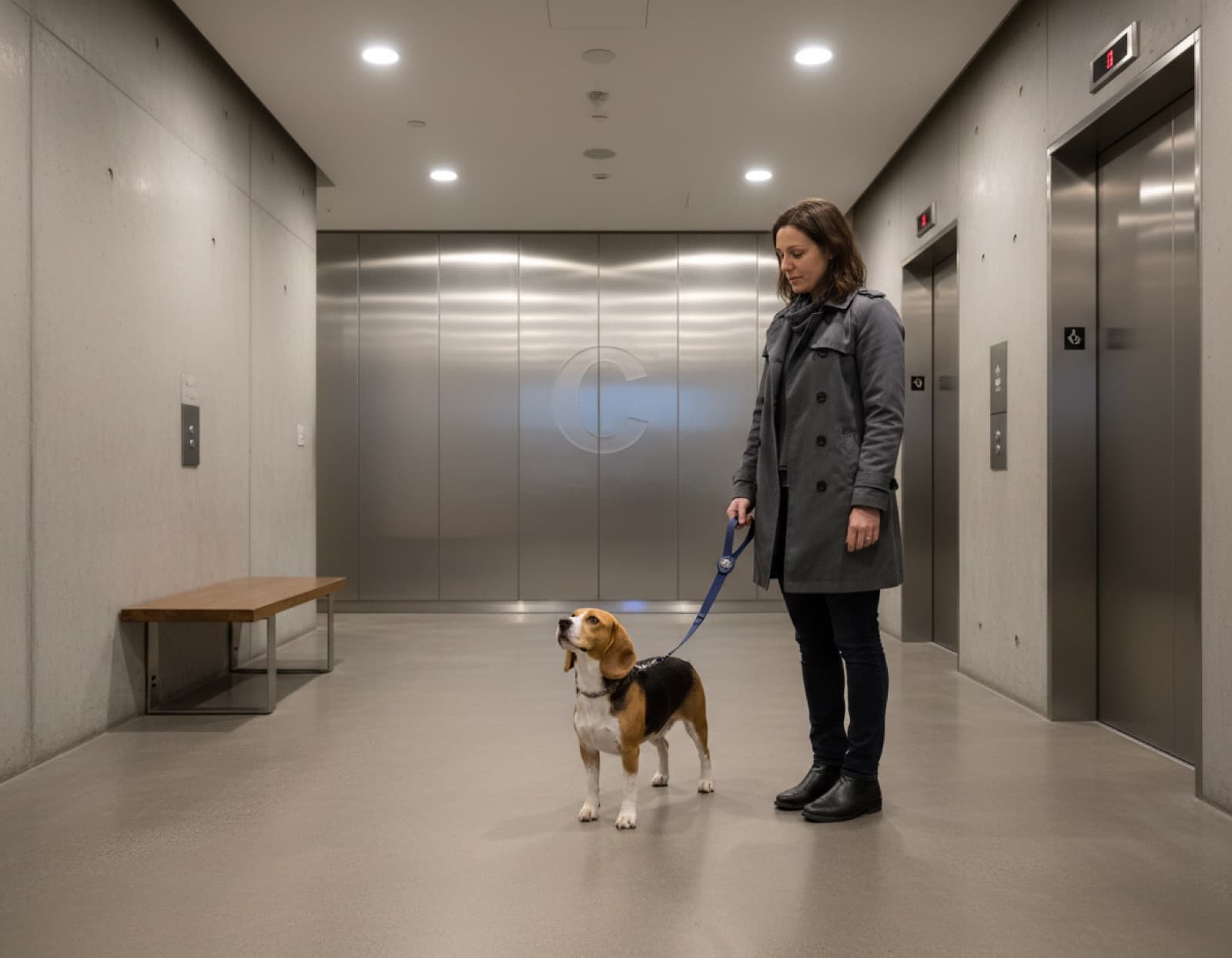
A Beagle is a bolt risk. The nose locks onto an outside scent and the dog blows past the handler before anyone reacts. In a single-family home this means a fenced backyard saves the day. In a Calgary high-rise this means the dog hits an elevator lobby, slips into an open elevator, or runs down a stairwell. Apartment Beagle owners need a deliberate doorway routine from day one.
The Calgary high-rise doorway protocol that works:
- Baby gate at the entry. A physical barrier between the front door and the rest of the apartment. The dog cannot reach the door area when it opens. This single piece of gear prevents most door-dash escapes.
- Station training. Teach the dog to go to a mat or crate when the doorbell rings or the door opens. Force-free trainers like Raising Canine and Pup City Pup Academy run this as a standard module.
- Always leash up before opening. No exceptions. The leash goes on inside the apartment, before the door opens, every single time. This is true for trips to the elevator, the parkade, the lobby, and even the trash chute.
- Elevator etiquette. Keep the leash short during the elevator ride. The dog sits or stands beside you, not at the elevator door. When the doors open, the human steps out first and the dog follows on a short leash. Teach this from week one.
- Hallway awareness. Beagles can squeeze through closing elevator doors and bolt down a hallway after a scent. Pay attention every time the door opens. A distracted scroll-on-the-phone elevator moment is when escapes happen.
If your Beagle does get loose in the building, the recovery routine is the same as outdoor recall failure: do not chase, lower your body, open a bag of high-value treats (cheese, hot dog) and let the smell pull the dog back. Chasing a Beagle just turns the chase into a fun game. We cover recall failure in detail in our scent drive and escape guide.
Condo Board Rules and Restricted-Breed Lists
Most Calgary condo boards do not have a Beagle-specific restriction. The breed's size and reputation put it in a friendlier category than Pit Bulls, Rottweilers, or other commonly-restricted breeds. That said, condo pet rules vary widely and need to be checked before signing a lease or buying.
Common Calgary condo pet rules to look for:
- Weight cap. Many buildings cap pet weight at 25 to 30 lbs. A full-grown Beagle is 15 to 30 lbs, so the breed is often right at the limit. Get this in writing before you commit.
- One-pet-per-unit rule. Common in older condo buildings. If you are planning a second dog, check this clause carefully.
- Pet registration. Some boards require registering the pet with the board, including a photo and vet records. Annual renewals are typical.
- Pet deposit. $250 to $500 is the common range. Refundable if no damage at move-out; held by the property manager.
- Nuisance clauses. Most pet-friendly buildings have a clause allowing the board to require removal of a pet that creates persistent disturbance. This can move faster than city bylaw enforcement.
- Common-area leash rules. All common areas (lobby, hallways, elevators, parkades, courtyards) require leashes. Some buildings also have specific areas where dogs are not allowed (rooftop patios, pool areas, gym).
Beyond the rules, ask the property manager or board about the building's actual culture around dogs. A pet-friendly building on paper that has an aggressive neighbour culture is harder to live in than a stricter building with a supportive dog-owner community. Many modern Beltline, East Village, and downtown high-rises have informal Facebook groups or building chats where dog owners coordinate. Those are good signs.
If you are buying rather than renting, request the condo bylaws and the rules document before the offer. Both are legally enforceable. Verbal assurances from a realtor are not.
Apartment Gear for Vocal Management
The gear that actually helps a Calgary apartment Beagle stay liveable for both dog and neighbours:
- White-noise machine. A $30 to $60 sound machine running during alone-time hours dampens external triggers (hallway footsteps, sirens, other dogs in the building). It also masks the dog's vocalising to nearby units. This is the single highest-ROI gear purchase.
- Crate or enclosed confinement area. A properly-sized crate or a baby-gated room creates a den environment. Beagles often vocalise less in a confined space than in an open apartment. Crate training has to be positive (force-free, treat-paired) or it backfires.
- Frozen Kong and lick mats. The single best alone-time tool. A frozen Kong stuffed with peanut butter, wet food, or banana keeps a Beagle engaged for 30 to 60 minutes. Lick mats spread thin food and add another 10 to 20 minutes. Both can be rotated through the workday.
- Camera with two-way audio. Furbo, Petcube, or a similar pet camera ($150 to $300) lets you see and hear what is actually happening when you are out. Most apartment owners are surprised by how much (or how little) their dog vocalises. The camera also lets you intervene verbally to interrupt a bay session before it escalates.
- Door sign and neighbour intro. A small “dog in residence” sign on your door and a personal introduction to neighbours sharing walls. Most noise complaints come from neighbours who feel ignored; a brief hello and a request to text you before bylaw goes a long way.
- Harness, not collar. Beagles pull and can damage their throats on a flat collar. A front-clip harness reduces pulling and protects the neck. $30 to $60 from most Calgary pet stores.
Skip ultrasonic anti-bark devices and citronella collars. The evidence is weak and they often increase stress in vocal breeds. The American Veterinary Society of Animal Behaviour (AVSAB) publishes position statements supporting force-free training methods over aversive tools for vocal management.
Winter Bathroom Layout: Pee Pad as Supplement, Not Replacement
Calgary winters drop to -25 to -30C with windchill. On those days, the standard outdoor potty routine becomes a frostbite risk. Most adult Beagles tolerate a quick outdoor trip in a coat and booties, but apartment owners on a 14th floor cannot get the dog outdoors fast enough for a sudden bathroom need on the coldest mornings.
The realistic Calgary apartment Beagle bathroom plan uses pee pads as a winter supplement, not a primary system. The structure:
- Default to outdoor potty. Three to four outdoor trips a day in normal weather. The dog learns the building routine: leash up, elevator, parkade or sidewalk, business, back up.
- Indoor pee pad station for extreme cold. A pad-holder tray in a consistent location (bathroom, balcony, or laundry room) for -25C mornings when outdoor time is unsafe. Use only on the worst days so the dog does not confuse the system.
- Real-grass indoor pads as an upgrade. Subscription services like Doggie Lawn or Bark Potty deliver real grass patches to the apartment. Beagles respond to real grass better than artificial pads, and the surface signals “bathroom” more clearly than a generic plastic tray.
- Balcony potty consideration. Some apartment owners use a balcony pad system year-round. This works only if the balcony drains properly, the building bylaws allow it, and downstairs neighbours do not have an issue. Check the rules and the drainage before committing.
The plan that fails: training the dog to use pee pads as the primary system from puppyhood with no outdoor routine. This produces a dog that prefers indoor elimination and never reliably transitions to outdoor potty. The plan that works: solid outdoor housetraining as the default, with pee pads as the cold-snap backup. Most adult Beagles adapt to the dual system within a few weeks.
Indoor Enrichment for Small Spaces
When Calgary winter shortens outdoor walks and apartment square footage caps the running-around budget, indoor enrichment is what keeps a Beagle sane. The breed has a nose engineered for problem-solving, and the same nose makes indoor scent games genuinely engaging.
The apartment Beagle enrichment toolkit:
- Snuffle mat. A fabric mat with long fleece strips that hides kibble or treats. The dog spends 15 to 20 minutes nose-searching for food. Available locally for $30 to $50.
- Food puzzles. Kong Wobbler, Outward Hound interactive puzzles, treat-dispensing balls. Rotate through three or four to keep novelty. Start with easy versions and graduate to harder ones as the dog learns.
- Scatter feeding. Skip the food bowl entirely. Toss the dog's meal across the living room rug. The dog spends 15 to 30 minutes nose-searching for each kibble. Best on a low-pile rug or carpeted area.
- Hide-and-find treat games. Hide a high-value treat behind a chair, under a cushion, or on the edge of a bookshelf (within nose reach). Cue “find it” and let the dog work. Builds over weeks into a real indoor scent-work practice.
- Frozen Kong. Stuff a Kong with wet food, peanut butter, banana, or pumpkin and freeze it. Keeps a Beagle engaged 30 to 60 minutes. Rotate fillings to maintain interest.
- Short force-free training sessions. 5 to 10 minute trick training sessions add mental fatigue. Spin, paw, touch, find-the-treat, basic obedience. The International Association of Animal Behaviour Consultants (IAABC) publishes free training resources online.
- Lick mat at meal times. Spread wet food, plain yogurt, or pumpkin on a textured silicone mat. Adds 10 to 15 minutes of calming licking, useful before alone time or during stressful moments.
The principle: mental fatigue is real fatigue. A Beagle that has spent 30 minutes nose-searching for kibble is genuinely tired and ready to sleep, even with only a short outdoor walk that day. This is the Calgary winter survival kit for the breed.
When an Apartment Is Genuinely the Wrong Fit
Be honest about when the apartment Beagle plan does not work. Skipping the breed in these scenarios is the right call, not a failure.
Thin-wall pre-war or wood-frame walk-up buildings
Older Bridgeland and Inglewood walk-ups, converted character buildings, and wood-frame low-rises transmit sound dramatically. A Beagle that bays for 10 minutes will be heard clearly by every unit on the floor. If your building has known noise-transmission issues or you can hear neighbour conversations clearly, the breed will create conflict within weeks. Modern concrete construction is the apartment Beagle's friend; older wood-frame construction is its enemy.
Full 9-to-5 in-office work with no daycare budget
Beagles are pack-bonded and a 9-hour solo stretch is a known mismatch. Without daycare, a midday walker, or a hybrid schedule, the dog develops separation distress and a baying habit within months. If the monthly $400 to $700 care budget is not feasible, the breed is the wrong pick for the household. There is no Beagle-specific hack that eliminates this requirement.
No nearby off-leash trail or daily walk route access
Calgary core is well-served (Bow River pathway, Prince's Island, Edworthy, the fenced section at Sue Higgins Park). Some suburban apartment buildings on the city edge have limited daily-walk options without a drive. If your routine requires driving 20 minutes just to reach a decent walking route, the daily exercise floor becomes impractical and the dog will be under-exercised within months.
Condo board with a sub-20 lb weight cap or vocal-breed restriction
A full-grown Beagle is 15 to 30 lbs. If your building's weight cap is 20 lbs, you are likely over the limit at adulthood. Some buildings also have specific restrictions on “persistent barkers” or scent hounds. Read the bylaws before signing.
Choosing the breed for the photo, not the math
If your reason for picking a Beagle is “they are so cute” and you have not run the exercise, alone-time, and noise math, the breed will outpace the household. A Cavalier King Charles Spaniel, a Bichon Frise, a senior small-breed mix, or an older Pug-cross fits the low-maintenance apartment profile better. Pick the breed for the math, not the photo.
Browse adoptable Beagles in Calgary
Apartment-living Beagles in Calgary often come from rescues with foster temperament notes about noise, alone-time tolerance, and elevator behaviour. That information is gold for prospective condo adopters. Filter the live inventory and ask the rescue specifically about how the dog has done in apartment or condo foster placements.
See Available Beagles →Frequently Asked Questions
Can Beagles live in apartments?
Yes, with the right owner and the right building. Beagles are 15 to 30 lbs and physically apartment-sized. The challenge is not square footage. It is the baying and howling that carries through walls, the 60 to 90 minute daily exercise requirement, and the pack-bonded temperament that does not tolerate a full 9-to-5 alone. Calgary apartment Beagles thrive when the owner works hybrid or from home, the building has thick concrete walls (most modern Beltline and downtown high-rises do), there is a daycare or walker budget for office days, and the household commits to indoor enrichment when winter hits -25C. Thin-wall pre-war buildings, full-day alone schedules, and households without a daycare option struggle within months.
Do Beagles need a yard?
No, a yard is not required. What the breed needs is daily 60 to 90 minutes of physical exercise plus 15 to 30 minutes of mental enrichment, regardless of the source. That can be a fenced yard, a long-line walk along the Bow River pathway, a Sniffspot rental at $15 to $30 an hour, or the fenced section at Sue Higgins Park. A Beagle with a yard but no walks gets bored and bays. A Beagle in a condo with two solid walks and a snuffle mat is happier than a yarded Beagle with no engagement. Plan the exercise route, not the square footage.
How much space does a Beagle need?
Square footage is a weak predictor of Beagle success. A 500 sq ft Beltline studio with a daily-walk routine and a hybrid-working owner works fine. A 2,000 sq ft house with an absent owner does not. What matters more is wall thickness (sound transmission to neighbours), proximity to walking routes (Bow River pathway, Edworthy Park, Prince's Island), daycare access for office days, and whether the building allows a vocal medium dog. Modern concrete high-rises in Beltline, East Village, and downtown are usually better acoustic fits than wood-frame walk-ups in pre-war Bridgeland or Inglewood.
Can a single owner with a 9-to-5 job have a Beagle in a Calgary apartment?
Possible but only with a real support system. Beagles are pack-bonded and a full 9-hour stretch alone is a known mismatch. The single-owner apartment Beagle plan needs three pieces: a daycare two to three days a week (Calgary daycares run roughly $40 to $55 a day), a midday dog walker on non-daycare days (roughly $25 to $35 per 30-minute visit), and a hybrid or flexible work schedule that puts the owner home most afternoons. The realistic monthly add-on for a single-owner apartment Beagle is $400 to $700 in care costs. Without that budget, the dog bays through the workday, neighbours file noise complaints under Bylaw 3M2006, and the household unravels within six months.
Will my Beagle howl in my apartment and get me evicted?
Possible if you do not plan for it. Beagles bay (not just bark) and the sound carries through walls. Calgary's Responsible Pet Ownership Bylaw 3M2006 lets neighbours file complaints for persistent barking and howling. The first complaint usually triggers a warning. Repeated complaints trigger Animal & Bylaw Services investigation, fines starting at $250, and in extreme cases a court order to remove the dog. Condo boards can also escalate independently under nuisance clauses. Mitigation: leave the dog tired before alone time (walk first, then crate or confinement area with food puzzle), use white-noise machines, train a quiet cue with force-free methods, avoid full-workday alone stretches, and meet your neighbours before any complaint exists so they reach out to you before bylaw. Check the City of Calgary bylaw page at calgary.ca before adoption.
How much exercise does an apartment Beagle need every day?
Plan 60 to 90 minutes of physical exercise plus 15 to 30 minutes of mental enrichment, every day, for the next 12 to 15 years. The physical can be two 30-minute on-leash walks plus a 15-minute play session, or one longer 60-minute walk plus 30 minutes of yard or fenced-space sniff time. The mental piece is snuffle mats, food puzzles, scent games, scatter feeding, or short force-free training. Below this, the breed gets vocal, destructive, and counter-surfing. When Calgary hits -25C and outdoor walks shorten to 10 minutes, the indoor enrichment math doubles. That is the apartment Beagle's winter survival plan.
Are Beagles allowed in Calgary condos?
Most Calgary condo boards do not have a Beagle-specific restriction, but breed and size rules vary widely. Common restrictions include a 25 to 30 lb weight cap (a full-grown Beagle is 15 to 30 lbs, so often right at the limit), a one-pet-per-unit rule, mandatory pet registration with the board, and a pet deposit ($250 to $500 typical). Some buildings have nuisance clauses that escalate faster than the city bylaw. Read the bylaws and the rules document before signing the lease or buying. Get a written copy of any pet policy, not a verbal assurance from the realtor or property manager.
Is a high-rise or a low-rise better for a Beagle?
Modern concrete high-rises usually beat low-rise wood-frame walk-ups for Beagle living. Concrete absorbs sound better, so baying transmits less to neighbouring units. Elevators reduce the doorway-bolt risk (controlled small space vs an open stairwell). And many concrete high-rises have on-site dog amenities, indoor parkades for cold-weather access, and dog-friendly communal areas. The trade-off is elevator etiquette: the dog needs to wait politely while other residents enter, and a reactive Beagle in a confined elevator can be a problem. Train elevator behaviour from day one.
How do I prevent my Beagle from bolting through the apartment door?
Beagle door-dashing is a classic scent-hound problem. The nose locks onto an outside scent and the dog blows past the handler. Prevention is a deliberate routine, not hope. Teach a station cue (the dog goes to a mat or crate when the doorbell rings or the door opens), use a baby gate between the entry and the rest of the apartment as a physical fail-safe, always leash the dog before opening the door for an outing, and never let the dog be in the entryway with the door unsecured. For elevators, leash up before stepping out the apartment door, and keep the leash short during the elevator ride. Force-free trainers like Raising Canine and Pup City Pup Academy run door-management classes.
When is an apartment the wrong fit for a Beagle?
Skip apartment Beagle ownership if any of these are true. Your building is a pre-war wood-frame walk-up with thin walls and noise-sensitive neighbours. You work 9-to-5 in-office full-time with no daycare or walker budget. Your monthly budget cannot absorb $400 to $700 in extra care costs. You have no nearby off-leash trail access (Calgary core is fine for this; some suburbs are not). Your condo board has a sub-20 lb weight cap or a restricted-vocal-breed clause. Or you are buying the Beagle as a low-maintenance apartment dog because you saw a cute photo and the breed's actual exercise and alone-time math has not been considered. A different breed (a Cavalier, a Bichon, an older small-breed mix) fits the low-maintenance apartment profile better.
Sources and further reading
- City of Calgary, Responsible Pet Ownership Bylaw 3M2006 at calgary.ca/bylaws/animals.html: barking and howling complaint process, fines, and enforcement steps.
- American Veterinary Society of Animal Behaviour (AVSAB) at avsab.org: position statements on force-free training and humane vocal management.
- International Association of Animal Behaviour Consultants (IAABC) at iaabc.org: free training resources and behaviour articles.
- Calgary Humane Society at calgaryhumane.ca: adoption process, behaviour support, and surrender prevention resources.
This article is informational only and not a substitute for veterinary, behavioural, legal, or condo-board advice. Consult a Calgary veterinarian, a force-free trainer, and your specific building's pet rules before adopting.
Related Beagle guides
Beagles for Adoption in Calgary →
Live listing of available Beagles and Beagle mixes across Calgary rescues when inventory exists.
Beagle Housetraining and Separation Anxiety Calgary →
The pack-bonded breed's separation patterns, prevention plan, and force-free response when alone-time anxiety shows up.
Beagle Scent Drive and Escape Calgary →
Why Beagles bolt, the leash-life plan, long-line gear, and the recall-failure reality every owner needs to understand.
Is a Beagle Right for You? Calgary →
Pros, cons, who fits, who does not, and a self-assessment for prospective Calgary Beagle adopters.
New dog? Start with these care guides
Everything a new adopter needs to set up a safe, happy home.