The short answer
Beagles are genuinely harder to housetrain than most breeds. Plan for 4 to 12 months, not 8 to 12 weeks. They also bond to pack life and have a 3 to 4 hour comfortable alone-time ceiling, which puts a Calgary downtown commute plus a 9-hour office day (effectively 9 to 11 hours of alone-time) well outside what most Beagles can handle. Mitigation runs roughly $400 to $800 a month for a daycare-plus-walker network, and apartment owners need to manage Calgary 311 noise risk on top. With the right setup, Beagles do beautifully in Calgary homes. Without it, they are the breed most likely to be surrendered.
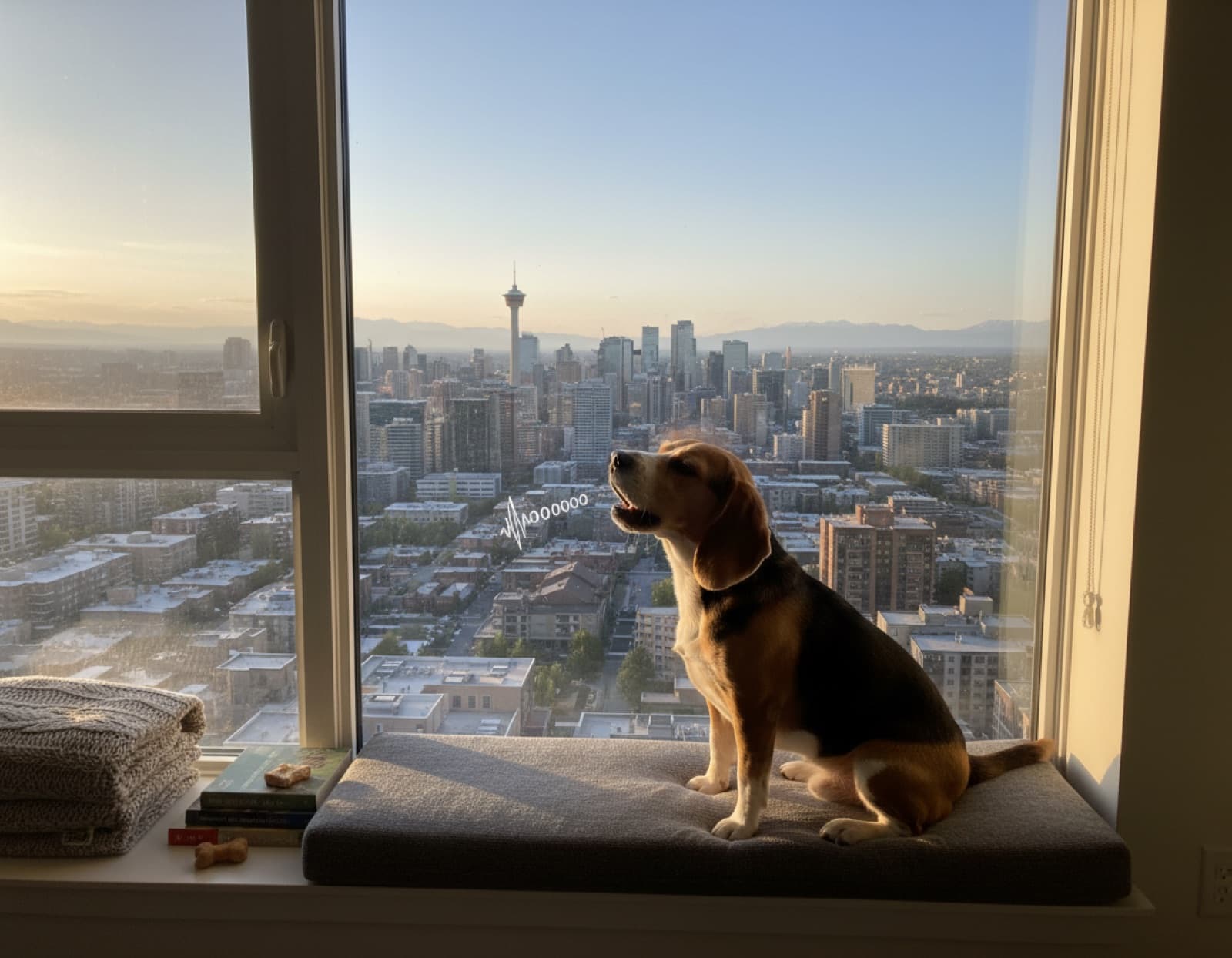
Why Beagles are uniquely hard to housetrain
Several factors stack together to make Beagle housetraining harder than most breeds.
- Scent memory. Beagles remember exact spots they have eliminated. With roughly 220 million olfactory receptors (humans have about 5 million), even thoroughly cleaned spots stay “marked” to a Beagle nose. They return to the same accident spots.
- Pack-breeding heritage. They were bred to live in pack kennels, often eliminating in shared spaces. Housetraining (eliminate only in a designated outdoor area) is genetically less natural for them.
- Stubbornness and independence. Beagles were bred for independent decision-making during scent pursuit. They do not inherently care about owner approval the way Golden Retrievers do.
- Food-drive obsession competes with pottying. They get distracted by scents outdoors, forget to eliminate, then go indoors when comfortable.
- Small bladder. Small dogs need more frequent potty trips. Owners underestimate frequency.
Timeline reality. Most breeds reliable in 8 to 12 weeks. Beagles typically need 4 to 12 months or more. Many adult Beagles continue having occasional accidents during stress, schedule changes, or extreme cold.
Lab-rescue Beagles (Envigo dogs and similar) are extremely undersocialised to household life. They have never lived in homes, with no concept of indoor versus outdoor. A 6 to 12 month adjustment is typical.
For a deeper read on the cooperative-cognition science behind why scent-hound stubbornness is real and not just attitude, the American Kennel Club has a useful primer on Beagle vocalisation and pack heritage.
Adult rescue beagle still having accidents. Medical or behavioural?
Investigate medical causes before assuming behavioural. Many adoptable Beagles labelled “not housetrained” actually have undiagnosed medical issues.
Medical causes to rule out:
- UTI (Urinary Tract Infection). Common in Beagles, especially females. Vet workup essential. Calgary $200 to $400 vet visit with urinalysis. Treatment: antibiotics and sometimes diet changes.
- Bladder stones. Beagles are predisposed to certain stone types. Diagnosed via radiograph and ultrasound.
- Diabetes. Increased thirst, urination, and appetite changes. Bloodwork diagnoses.
- Kidney disease. Older Beagles. Increased thirst and urination.
- Hormonal incontinence. Spayed females can develop estrogen-responsive incontinence. Treatable with phenylpropanolamine.
- IVDD. Sudden incontinence plus back pain points to a spinal issue. This is an emergency.
Behavioural causes (after medical is ruled out): submissive or excitement urination, marking, stress, incomplete housetraining, and separation anxiety.
The protocol. Vet first. A $200 to $400 Calgary workup includes physical exam, urinalysis, and sometimes bloodwork. If medical, treat. If clear, behavioural work begins.
Best enzymatic cleaner for Beagle-level scent
This matters more for Beagles than for most breeds. Standard cleaners do not eliminate Beagle-perceptible scent. Enzymatic cleaners break down the urea and uric acid components dogs detect.
Recommended products (Calgary pet stores):
- Nature's Miracle Advanced Stain & Odor Remover. Most widely available. $15 to $30 spray bottle.
- Rocco & Roxie Professional Stain & Odor Eliminator. Higher-strength, better for Beagle-level scent. $20 to $40.
- Simple Solution Extreme. Concentrated, good for severe cases. $25 to $45.
- Animal Chemistry Urine Off. Veterinary-grade. $30 to $50.
- Sunny & Honey Enzyme-Based Cleaner. Pet store available. $20 to $35.
Application protocol:
- Blot excess liquid (do not rub, which spreads scent).
- Apply enough cleaner to saturate down to subfloor or padding.
- Let sit 10 to 30 minutes. Do not rinse. Air-dry.
- Multiple applications often needed for set-in spots over 2 to 3 days.
- Black light detection ($15 to $30 on Amazon) reveals invisible old urine spots.
Avoid: ammonia-based cleaners (they smell like urine to dogs and encourage repeat). Vinegar alone is insufficient. Bleach is insufficient.
Severe cases: professional steam cleaning plus an enzymatic cleaner plus sometimes carpet padding replacement. Calgary professional cleaning runs $150 to $400. Severely soiled subfloor may require replacement at $500 to $2,000 or more.
The 3 to 4 hour alone-time ceiling
Most adult Beagles top out at 3 to 4 hours of comfortable alone-time daily before stress accumulates. Less than Golden Retrievers (4 to 6 hours), similar to Australian Shepherds, slightly more than Dobermans (2 to 4 hours).
- Adult Beagles (3+ years): 4 to 6 hours occasionally with training.
- Adolescent Beagles (8 months to 3 years): 3 to 4 hours maximum.
- Puppies (under 8 months): 1 to 3 hours maximum.
- Rescue Beagles, first 30 to 60 days: start with 30 minutes to 2 hours and build slowly.
- Lab-rescue Beagles: much less alone-time tolerance. 6 to 12 months to build basic alone-time skills. May never tolerate a full work-day alone.
Calgary downtown commute reality. A 30 to 60 minute commute plus a 9-hour office day equals 9 to 11 hours of alone-time. Most Beagles cannot handle this.
What actually works. Daycare 1 to 3 days a week, a midday walker, work-from-home days, family or friend lunch visits, or a second beagle as a companion. Calgary infrastructure costs typically run $400 to $800 a month.
Calgary daycare: Pup City Doggy Daycare, Paws Dog Daycare, Doggie District, and Dogtopia. $30 to $55 a day. Calgary walkers: Wag, Rover, and local independents. $20 to $40 per visit. For Beagles with genuine separation anxiety, talk to a force-free Calgary trainer such as Raising Canine or Pup City Pup Academy before scaling daycare expectations.
Calgary apartment and Bylaw 5N2007 noise complaint risk
Beagle baying carries surprisingly far. Neighbours hear it easily through standard apartment construction. For more on apartment-specific Beagle management, see our Beagle apartment living guide.
Calgary's Responsible Pet Ownership Bylaw covers excessive barking. Repeated 311 complaints can mean bylaw fines plus condo violations and sometimes evictions.
Prevention:
- Adequate exercise and mental stimulation reduces boredom barking.
- Soundproofing: close windows, sound-absorbing curtains, white noise machines.
- Crate placement away from shared walls and the front door.
- Daycare days reduce alone-time barking.
- Force-free training to reduce visitor-trigger barking.
- Sometimes medication for severe separation-anxiety vocalisation.
- Talk to neighbours before complaints escalate.
If a complaint is filed: work with the neighbour and property manager actively, address vocalisation immediately, document training efforts (trainer receipts, behaviourist consultation), and consider Calgary Animal Bylaw mediation services.
Investment for a Calgary condo Beagle: a real SA management protocol, daycare 2 to 3 days weekly minimum, behaviourist consultation if vocalisation persists, medication for severe cases, and $100 to $500 in soundproofing.
If you are a Calgary condo dweller with full-time office work, no daycare or walker investment, and no plan for behaviour modification, a Beagle is probably the wrong breed for your situation. There is no shame in matching a different breed to your living arrangement instead.
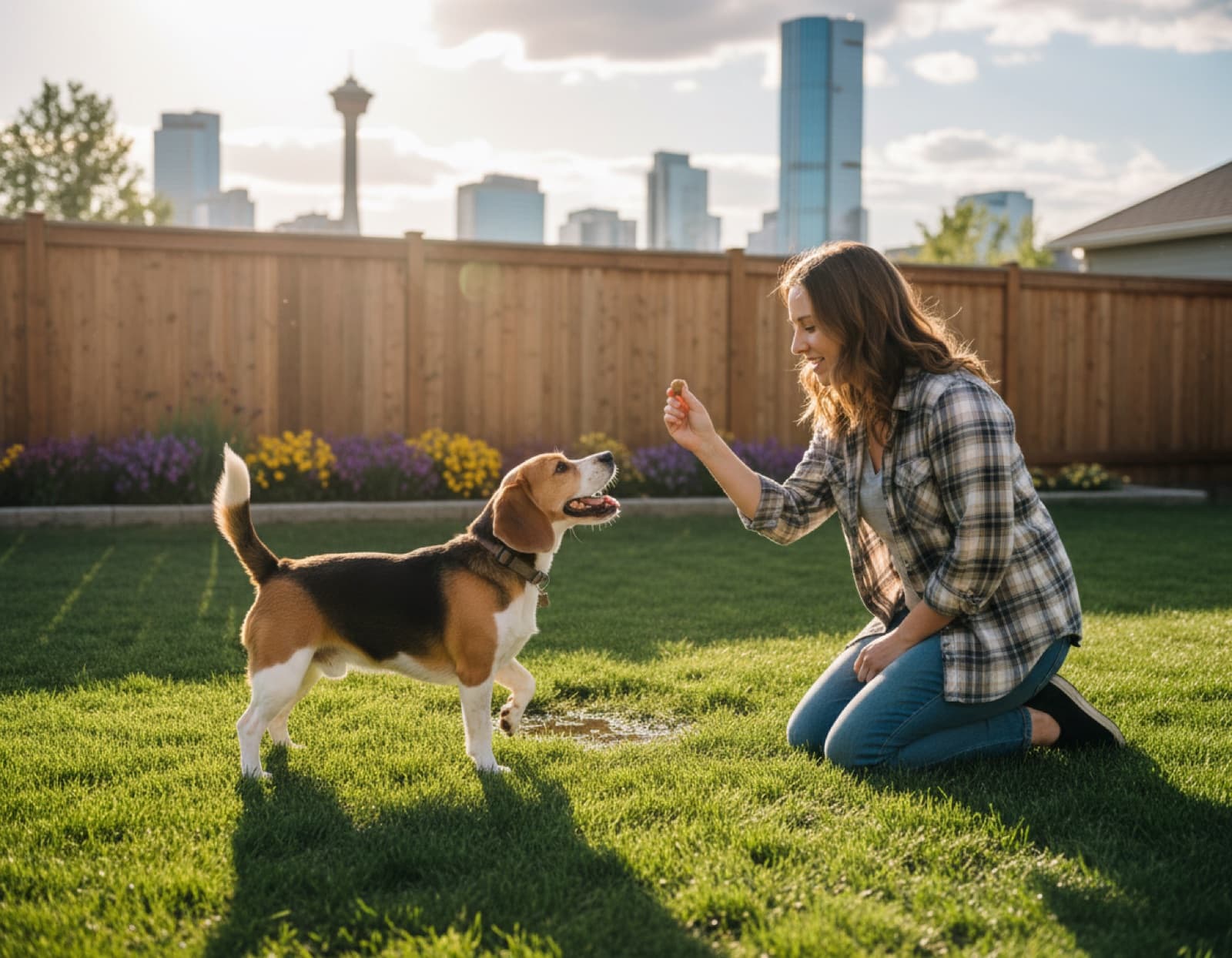
Crate training the howler. Beagle-specific protocol.
Many Beagle owners report crate training as one of the hardest parts of the first year. The dog vocalises and bays intensely in the crate, sometimes for hours. Here is the Beagle-specific protocol.
- Foundation days 1 to 7: crate present and open in the main living area. Treats inside randomly. No confinement.
- Feeding in crate. Meals served inside with the door open initially.
- Close the door briefly (30 seconds, then 1 minute, building) when the dog is calmly eating.
- Watch for distress. If the dog is vocalising but settling, wait for 30 seconds of silence before releasing. Releasing during howling reinforces howling.
- Beagle vocalisation is different from other breeds. Pack communication, not always panic. Some baying is tolerable if the dog calms after 5 to 10 minutes.
- Calgary 311 noise reality for apartment owners: crate placement away from shared walls, plus soundproofing and white noise.
- Timing: most Beagles tolerate the crate at night better than alone during the day.
- High-value crate-only treats: frozen Kong with peanut butter, lickimat, or other special items.
- Medication is sometimes required for severe cases (vet-prescribed trazodone).
Alternatives if the crate does not work: an exercise pen with a safe-room setup, single-room confinement (laundry room with a baby gate), or free-roam in a dog-proofed home. Some Beagles never tolerate crating. The crate is a tool, not a requirement.
Some of the product links in this section are Amazon affiliate links — we may earn a small commission at no extra cost to you. It never changes which products we recommend.
Warning signs: persistent self-injury attempts, broken teeth from chewing the bars, severe panic that does not reduce after 4 to 6 weeks of training. Switch to alternatives.
Calgary winter when minus 25 Celsius limits pre-departure exercise
Standard advice (“tire your beagle out before leaving”) assumes outdoor walks are possible. At minus 25 Celsius and colder, they are not. Indoor exercise can fully replace outdoor walks during extreme Calgary cold.
Indoor exercise alternatives (60 to 90 minutes daily):
- Indoor fetch or retrieve in long hallways or basement.
- Stair work for adults (avoid for puppies under 12 months and seniors).
- Tug-of-war: 10 to 20 minutes vigorous tug equals 30 to 45 minutes of walking.
- Flirt pole indoors with space.
- Food puzzles and snuffle mats. Mental enrichment exhausts Beagles particularly. $20 to $60.
- Scent-work games. Hide treats around the home and let the beagle search.
- Trick training sessions, 15 to 20 minutes.
- Indoor dog daycare. Particularly valuable on minus 25 Celsius stretches. Calgary $30 to $55 a day.
- Calgary nose work classes (Cypress K9 Detection).
- Brief outdoor enthusiastic play in protective gear (5 to 10 minutes).
Calgary Beagle winter gear: insulated jacket from Hurtta, Voyagers, or Chilly Dogs ($80 to $200). Boots from Muttluks, Ruffwear, or Pawz ($40 to $120). Musher's Secret paw wax ($15 to $25).
Housetraining impact. Insufficient pre-departure exercise equals unsettled Beagle alone, which equals potty accidents plus howling plus destruction. Investing in indoor enrichment keeps housetraining and alone-time progress on track. Chinook days are an opportunity: when the wind warms Calgary 20 degrees overnight, get the outdoor walk in.
Daily housetraining protocol
Structured protocol works best. Beagles thrive on predictability.
- Strict feeding schedule. Meals at exact times. Predictable feeding equals predictable elimination.
- Potty trips at key times: first thing in the morning, after meals (15 to 30 minutes), after naps (10 to 15 minutes), after play (10 to 15 minutes), before bedtime, and every 2 to 4 hours for adults (every 1 to 2 hours for puppies).
- Designated potty area. Same outdoor spot. Scent triggers elimination.
- Cue word. A consistent phrase like “go potty.” Reward immediately when the dog eliminates with a high-value treat.
- Timing is critical. Reward within 1 to 3 seconds, not when returning indoors.
- Stay with the dog. Do not send a Beagle outside alone for potty. Watch for elimination.
- No rushing. Patient outdoor time, sometimes 10 to 15 minutes.
- Limit indoor freedom. Supervised, crated, penned, or tethered when not actively watching.
- Accident protocol: do not punish, clean enzymatically, adjust the schedule, consider a medical workup if persistent.
Progress metrics: typical Calgary Beagle housetraining runs 4 to 12 months reliable, with occasional accidents during stress, cold, or schedule changes.
Lab-rescue beagles: a 6 to 18 month timeline is typical. Indoor pee pads as long-term backup are fine. Worth the patience.
Velcro vs separation anxiety
Critical distinction. Different conditions need different responses.
Boredom or under-exercise looks like:
- Vocalisation with breaks (intermittent).
- Some destruction, not concentrated at exit points.
- Settles between activity bursts.
- No self-injury.
- Calm greeting on return.
- Solution: increased exercise, mental work, and enrichment toys.
Clinical separation anxiety looks like:
- Continuous vocalisation for 30 minutes or more.
- Destruction concentrated at exit doors and windows.
- Self-injury (broken nails, raw paws, broken teeth from biting bars).
- Soiling indoors despite being housetrained.
- Refusing food or water alone.
- Trembling, hiding when you grab keys or coat.
- Hyperventilating greeting on return.
- Escape attempts.
Puppy cam test (Wyze, Ring, Furbo) reveals truth. Boredom settles after a period. Clinical SA panics and escalates.
When to involve a behaviourist. Any escalating reactivity, or severe shutdown lasting a week or more. Calgary virtual DACVB consultations run $300 to $600 initial. For moderate cases, Calgary force-free trainers such as Raising Canine and Pup City Pup Academy are the starting point. The American Veterinary Society of Animal Behaviour position statements explain why force-free methods matter for anxiety-driven behaviour, particularly with vocal hounds.
Medication options for severe SA: fluoxetine ($30 to $70 a month), clomipramine ($40 to $80 a month), and situational trazodone. Used with behaviour modification, never alone.
Browse adoptable Beagles in Calgary
Calgary rescue Beagles often arrive with partial housetraining and unknown alone-time history. The bio and foster notes matter more than the photo for this breed.
See Available Beagles →Frequently Asked Questions
Why are Beagles harder to housetrain?
Scent memory of accident spots (220 million olfactory receptors), pack-breeding heritage (eliminating in shared spaces was normal), stubbornness and independence (Beagles do not care about owner approval the way Goldens do), food-drive obsession competing, and a small bladder needing more frequent trips. Most breeds reliable in 8 to 12 weeks. Beagles typically need 4 to 12 months or more. Lab-rescue Envigo dogs need 6 to 12 months of basic adjustment. Do not panic at month 3 with incomplete training. Keep the routine going.
Adult rescue still having accidents?
Vet first. Rule out UTI, bladder stones, diabetes, kidney disease, hormonal incontinence in spayed females, and IVDD. A Calgary $200 to $400 workup with urinalysis and sometimes bloodwork covers this. Many Beagles labelled “not housetrained” have undiagnosed medical issues. After medical is ruled out, behavioural protocol begins.
Best enzymatic cleaner?
Nature's Miracle Advanced ($15 to $30), Rocco & Roxie ($20 to $40), Simple Solution Extreme ($25 to $45), Animal Chemistry Urine Off ($30 to $50). Saturate down to subfloor. Multiple applications for set-in spots. A $15 to $30 black light reveals invisible old urine. Avoid ammonia-based cleaners (they smell like urine to dogs).
Crate training nightmare?
Foundation week (no confinement), then feed in open crate, then brief closed-door 30 seconds to 1 minute building up. Wait for 30 seconds of silence before release. Beagle baying is pack communication, not always panic. Apartment owners need crate placement away from shared walls plus soundproofing. Trazodone helps severe cases. Some Beagles never tolerate a crate. Alternatives that work: ex-pen, single-room, free-roam.
3 to 4 hour ceiling?
Adult Beagles handle 4 to 6 hours occasionally, 3 to 4 hours comfortably daily. Adolescents max 3 to 4 hours. Puppies 1 to 3 hours. Rescue Beagles in their first 30 to 60 days: 30 minutes to 2 hours and build slowly. Lab-rescue dogs need 6 to 12 months. A Calgary downtown commute equals 9 to 11 hours of alone-time, which most Beagles cannot handle. Mitigation: daycare 1 to 3 days a week plus a walker midday plus work-from-home days, or a second beagle. $400 to $800 a month in Calgary.
Calgary 311 noise complaint risk?
Real risk for apartment owners. Bylaw fines of $200 to $1,500 for a first offence, plus condo violations and sometimes evictions. Prevention: exercise plus mental stimulation, soundproofing, daycare days, force-free training, medication for severe cases, and neighbour communication. If a complaint is filed: address immediately, document training efforts, and use mediation services where available. An apartment Beagle is a serious commitment.
Calgary winter exercise compensation?
Indoor exercise can replace outdoor walks. Indoor fetch plus stairs (cautiously) plus tug plus flirt pole plus food puzzles plus scent games plus trick training plus Calgary daycare at $30 to $55 a day plus Calgary nose work classes (Cypress K9 Detection). Calgary Beagle winter gear: jacket $80 to $200, boots $40 to $120, paw wax $15 to $25. Insufficient exercise equals housetraining regression plus howling.
Boredom vs clinical SA?
Boredom looks like intermittent vocalisation, settling between activities, no self-injury. Clinical SA looks like continuous 30+ minute panic, destruction at exits, self-injury (broken teeth, raw paws), soiling despite housetraining, refusing food, escape attempts. A puppy cam test reveals truth. Severe SA needs a behaviourist plus medication (fluoxetine $30 to $70 a month, clomipramine $40 to $80 a month, situational trazodone).
Second beagle as companion?
Sometimes helps, not guaranteed. Helps when: the primary dog enjoys other dogs, the first beagle has worked through alone-time training, and the household can absorb $3,000 to $6,000 a year in added costs. Worsens things when: there is resource guarding, dog reactivity, or an untrained first beagle. Beagle-specific: two beagles vocalising together is significantly louder, which amplifies Calgary 311 risk. IVDD insurance and emergency vet costs double. A foster-to-adopt trial through a Calgary rescue is sometimes available.
Daily housetraining protocol?
Strict feeding plus potty trips at morning, after meals, after naps, after play, before bed, and every 2 to 4 hours plus designated outdoor spot plus cue word plus immediate reward plus staying with the dog plus no rushing plus limited indoor freedom plus no-punish accident protocol plus enzymatic cleaner. A 4 to 12 month timeline is typical. Lab-rescue dogs take 6 to 18 months. Indoor pee pads as long-term backup are fine.
Lab-rescue Beagle housetraining?
Lab beagles have never lived in homes. Indoor versus outdoor concepts are unknown. They have never been leash-trained. Outdoor exposure is fear-based at first. They are pack-dependent. They sometimes arrive with untreated UTIs, dental disease, or parasites, so a vet workup comes before housetraining begins in earnest. A 6 to 18 month timeline is typical. A calm housetrained companion dog modelling outdoor elimination helps a lot. Indoor pee pads as long-term backup are reasonable. Lab beagles are profoundly grateful for home life, and the trade-off is real.
Is a Beagle right for a Calgary downtown professional?
Without daycare and walker investment, no. With $400 to $800 a month for daycare 1 to 3 days a week and a midday walker, plus a real commitment to indoor enrichment through Calgary winter, yes. Apartment dwellers add Calgary 311 noise risk on top. The Beagles surrendered to Calgary rescues largely come from households that did not anticipate the timeline and the alone-time difficulty.
Adoptable Beagles in Calgary
Live listings of Beagles and Beagle mixes from Calgary rescues.
Beagle Apartment Living Calgary
High-density living, condo board rules, and the soundproofing playbook for Calgary apartment Beagles.
Beagle Scent Drive and Off-Leash
Why Beagles cannot be off-leash, scent drive reality, Calgary off-leash unsuitability, long-line setup.
Beagle Adoption Calgary
Where to find Beagles, Beagle Paws Edmonton verification, Envigo 1500 beagles context, and Calgary surrender patterns.
New dog? Start with these care guides
Everything a new adopter needs to set up a safe, happy home.