The short answer
Many Beagles inherit a POMC gene variant that disrupts the brain's satiety signal, so the dog never genuinely feels full. Counter-surfing, garbage raiding, and intense begging are not training failures, they are wiring. The owners we work with succeed by managing the environment (gated kitchens, locked bins, no counter food) and by channelling the drive into snuffle mats, slow feeders, and scent work. Compassion plus management works. Punishment does not.
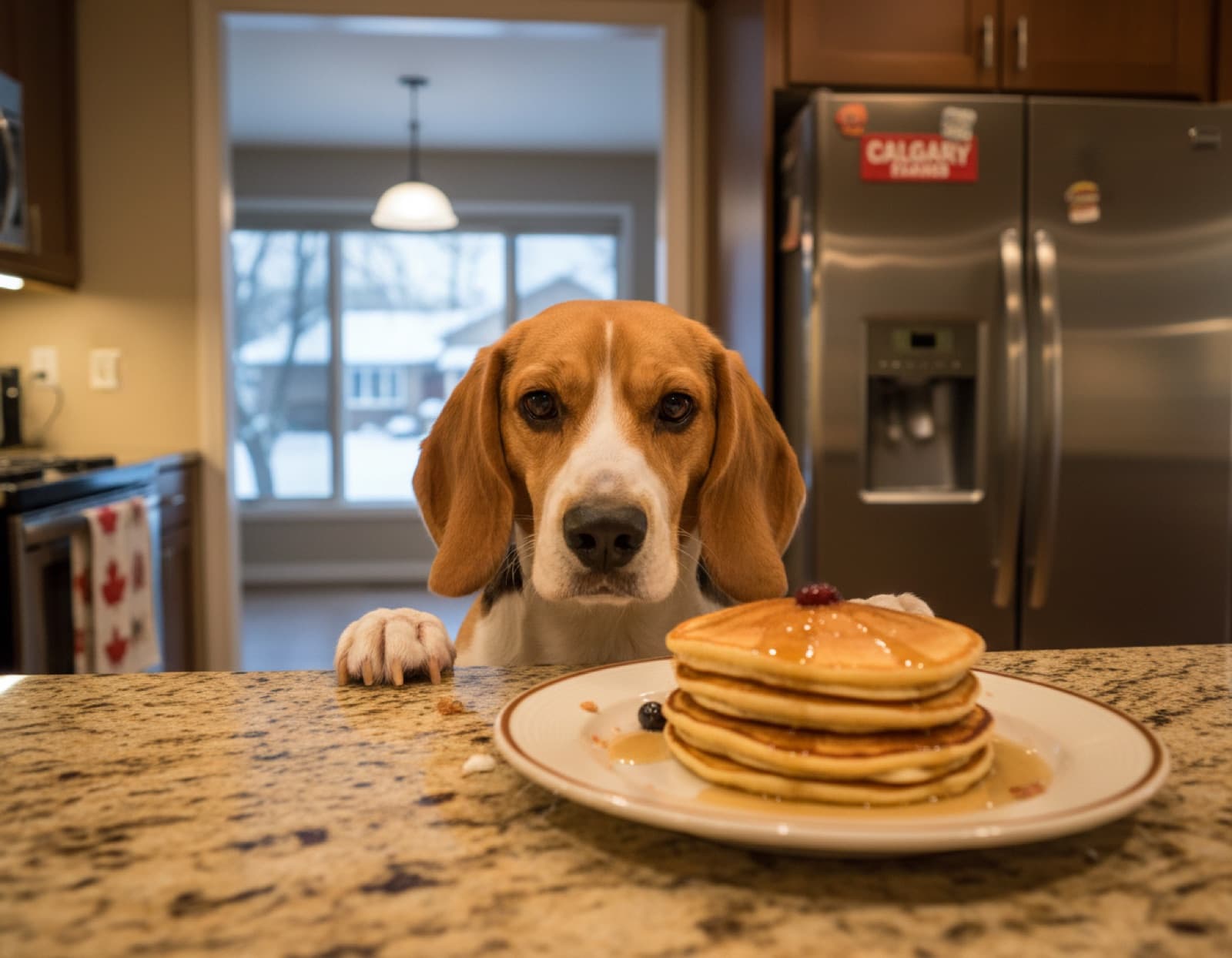
Counter-surfing setups that actually work
A motivated Beagle reaches a standard 36-inch counter. Most Calgary kitchens are not Beagle-proof out of the box.
- Push-back zone. Keep all food and items 6 to 12 inches in from the counter edge. Beagles paw forward.
- Baby gates on the kitchen. The most reliable single fix. About $30 to $80 at Calgary pet stores.
- Dog-restricted zones. Treat the kitchen as a permanent dog-free room. Practise “place” on a living-room mat instead.
- High shelving only. Bread, fruit, snacks, and butter live in cabinets, the fridge, or the pantry. Never the counter.
- Stove knob covers, dishwasher closed right after loading, and a dedicated bed for the dog during meals.
- No counter food storage. Fruit bowl, bread basket, candy dish: all accessible.
Calgary context: long winters mean more indoor time, which means more counter-surfing opportunity. Open-concept kitchens are harder to gate, so the food storage rules matter more.
Reality check: Beagles counter-surf whenever the opportunity exists. One family member leaving food on the counter equals food eaten. The whole household has to be on the same page.
Calgary garbage management for beagle-proof bins
A standard kitchen garbage can is an open buffet for a Beagle. Better options, roughly in order of how Beagle-proof they actually are:
- Under-counter pull-out bins built into cabinetry. Most reliable if the cabinet itself has a childproof latch.
- Step-pedal bins. Some Beagles work out the pedal, some never do. About $50 to $200.
- Locking-lid bins. simplehuman ($150 to $400), Itouchless, Polder.
- Heavy-duty outdoor-style bins repurposed for the kitchen.
- Garage or utility room placement behind a closed door. Most reliable, mildly inconvenient.
- Childproof cabinet latches on whichever cabinet hides the bin ($5 to $20 per latch).
What not to use: open-top kitchen bins, simple swing-top lids (pushable), thin-walled bins a Beagle can knock over.
Protocol: assume your Beagle will access the garbage if anything is left unlocked. Cooked bones (perforation), chocolate, xylitol gum, grapes (toxicity), fatty leftovers (pancreatitis), spoiled food, and small objects (foreign body obstruction) are all real risks.
Calgary ER visits for garbage ingestion are routine in our experience, with bills running roughly $300 to $5,000+ depending on what was eaten and what the workup needs.
Pro tip: most owners we work with land on dual-layer protection. An under-counter cabinet bin behind a latched door, with a locking lid on the bin itself. A one-time $200 to $500 investment that pays for itself the first time it stops a chocolate emergency.
“Leave it” training with a scavenger hound
This is the hardest cue for a Beagle. Their genetics fight you. A force-free protocol works, it just takes patience.
- Foundation indoor. Closed-fist treat in palm. Wait for the moment of disengagement, then mark and reward with a higher-value treat from the other hand.
- Add the cue word “leave it” once the dog reliably waits.
- Dropped-treat progression. Cover the treat with your foot, reward the dog for not pursuing, then gradually reveal it.
- Food item progression: kibble, then cheese, then meat. Higher value is harder.
- Real-world context. Practise on walks, in the kitchen, and outside.
- High-value reward is critical. Cooked chicken, hot dog, freeze-dried liver. Standard kibble is not enough.
- Never punish failure. Punishment creates resource guarding and secret eating.
Calgary force-free trainers we recommend for this kind of work: Raising Canine and Pup City Pup Academy. Group classes typically run $150 to $300 over 6 to 8 weeks.
Reality check: even a well-trained Beagle fails “leave it” on novel temptations. Do not test it by setting chicken on the counter and walking away. Manage the environment instead.
Advanced option: scent work or nosework classes channel the scavenging drive into a real sport. Beagles excel at this, and it visibly reduces inappropriate scavenging at home.
Prognosis: most Calgary Beagles develop a reasonable “leave it” over 6 to 12 months of consistent work. It is never 100% reliable when high-value food is left unattended. Plan accordingly.
Pancreatitis emergency signs after fatty-food binges
CRITICAL Beagle owner knowledge. Pancreatitis common in Beagles after fatty food + garbage ingestion. Can be life-threatening.
Symptoms (typically 12 to 48 hours after a fatty-food binge):
- Vomiting (often repeated)
- Diarrhoea (sometimes bloody)
- Severe abdominal pain. Hunched posture, painful belly when touched, and the classic “praying position” with the front legs down and back end up.
- Lethargy
- Loss of appetite. A food-obsessed Beagle refusing food is a serious sign.
- Fever and dehydration
This is an emergency. Go to a 24-hour ER vet immediately. The AVMA describes canine pancreatitis as potentially life-threatening, and prompt fluid therapy makes a real difference in outcomes.
Calgary 24-hour ER options: CARE Centre, Western Veterinary Specialist Centre, and VCA Canada West Veterinary Specialists.
Typical costs: mild outpatient pancreatitis runs $300 to $1,000. Moderate cases with 1 to 3 days of hospitalization run $1,500 to $4,000. Severe intensive-care cases run $5,000 to $10,000 or more.
Prevention: tight garbage management, no fatty table scraps (turkey skin, bacon grease, butter, cheese), real vigilance around Thanksgiving and Christmas leftovers, no cooked bones, and a slow-feed bowl to reduce gulping.
When in doubt: any Beagle showing vomiting, lethargy, and appetite loss after possible access to fatty food belongs at an ER vet. Plan for at least one pancreatitis visit during your Beagle's lifetime. Pet insurance covers it only if you enrolled before the diagnosis, so the time to sign up is on day one.
Holiday + toxic food risks
Beagles WILL find food owners hide. Holiday seasons are highest emergency vet visit periods for Beagles.
Critical toxic foods:
- Chocolate. Dark and baking chocolate are the most toxic. Symptoms include vomiting, diarrhoea, hyperactivity, tremors, seizures, and cardiac arrhythmia. The Pet Poison Helpline publishes a dose-by-weight chart that is worth bookmarking.
- Xylitol. Extreme toxicity. Found in sugar-free gum, candy, baked goods, some peanut butter brands, and toothpaste. Causes hypoglycaemia, liver failure, seizures, and death within hours. The ASPCA Animal Poison Control Centre tracks xylitol as one of the fastest-acting common household toxins for dogs.
- Grapes and raisins. Kidney failure even from small amounts.
- Onions, garlic, macadamia nuts, alcohol, and caffeine.
Calgary holiday protocol:
- Halloween: candy in sealed containers inside cabinets. Trick-or-treater bowls never on a coffee table. Beagle gated away during evening traffic.
- Christmas: chocolate ornaments and hanging candy canes come down. Gift-wrapped chocolate goes up high.
- Easter: chocolate eggs are a major risk, including the ones the kids hide.
- Valentine's: chocolate hearts and boxes.
Always check ingredients. Some pet treats contain xylitol. Read labels.
Emergency poison control:
- Pet Poison Helpline: 1-800-213-6680, 24/7, $99 consultation fee. Invaluable for “did the dog just eat X?” questions.
- ASPCA Animal Poison Control: 1-888-426-4435.
If you suspect any toxic ingestion, drive to the ER vet. Do not wait to see if symptoms develop, because xylitol and chocolate can both progress faster than the appointment slot.
Coprophagia (eating poop)
Common Beagle behaviour with multiple possible causes. Sometimes it is just genetic food drive, and sometimes it is medical, so it is worth investigating instead of writing it off as gross.
Possible causes: genetic food drive, nutritional deficiency, enzyme deficiency, intestinal parasites, boredom, stress, and puppy exploration.
What to do:
- Rule out medical first. A vet workup runs $150 to $300 in Calgary and typically includes a physical exam, faecal panel, and sometimes bloodwork.
- Clean up immediately. Scoop the yard after every elimination.
- Dietary adjustment. Sometimes a prescription diet helps. Ask the vet.
- Bitter commercial deterrents (Forbid, Coproban). Evidence is mixed. About $20 to $50 a month.
- Enzyme supplements, on vet recommendation only.
- Behaviour training. A rock-solid “leave it” plus immediate redirect when poop is visible.
- More exercise and more mental work. Bored Beagles develop coprophagia.
Prevention: on-leash potty trips and an immediate scoop. In Calgary winter, when the potty area freezes solid, scoop after each thaw or before the next refreeze.
Multi-dog + kids-with-snacks household management
- Multi-dog food management. Separate feeding rooms or crates. A Beagle will eat the other dogs' food.
- Resource guarding. Some food-obsessed Beagles develop guarding (growling, snapping). A Calgary force-free trainer can run a CARE or BAT 2.0 protocol for around $200 to $500.
- Kids with snacks: the biggest household management challenge. The non-negotiable rule is no table feeding, ever.
- Birthday parties and kid gatherings: Beagle gated or crated for the duration.
- Pack-fed Beagles can develop competitive eating, which carries a real GDV/bloat risk.
- Baby and infant households: gate the Beagle out of the eating area during feeding times.
- Multi-cat households: cat food and litter boxes are highly attractive to Beagles. Elevated bowls and a dog-restricted litter room.
Resource guarding warning: severe food-driven resource guarding in a household with kids is a real bite risk. If signs emerge, book a force-free behaviourist consult before it escalates.
Channel-the-drive playbook
This is the most useful single intervention for a Beagle. Channel the scavenging instinct into an appropriate outlet instead of trying to suppress it.
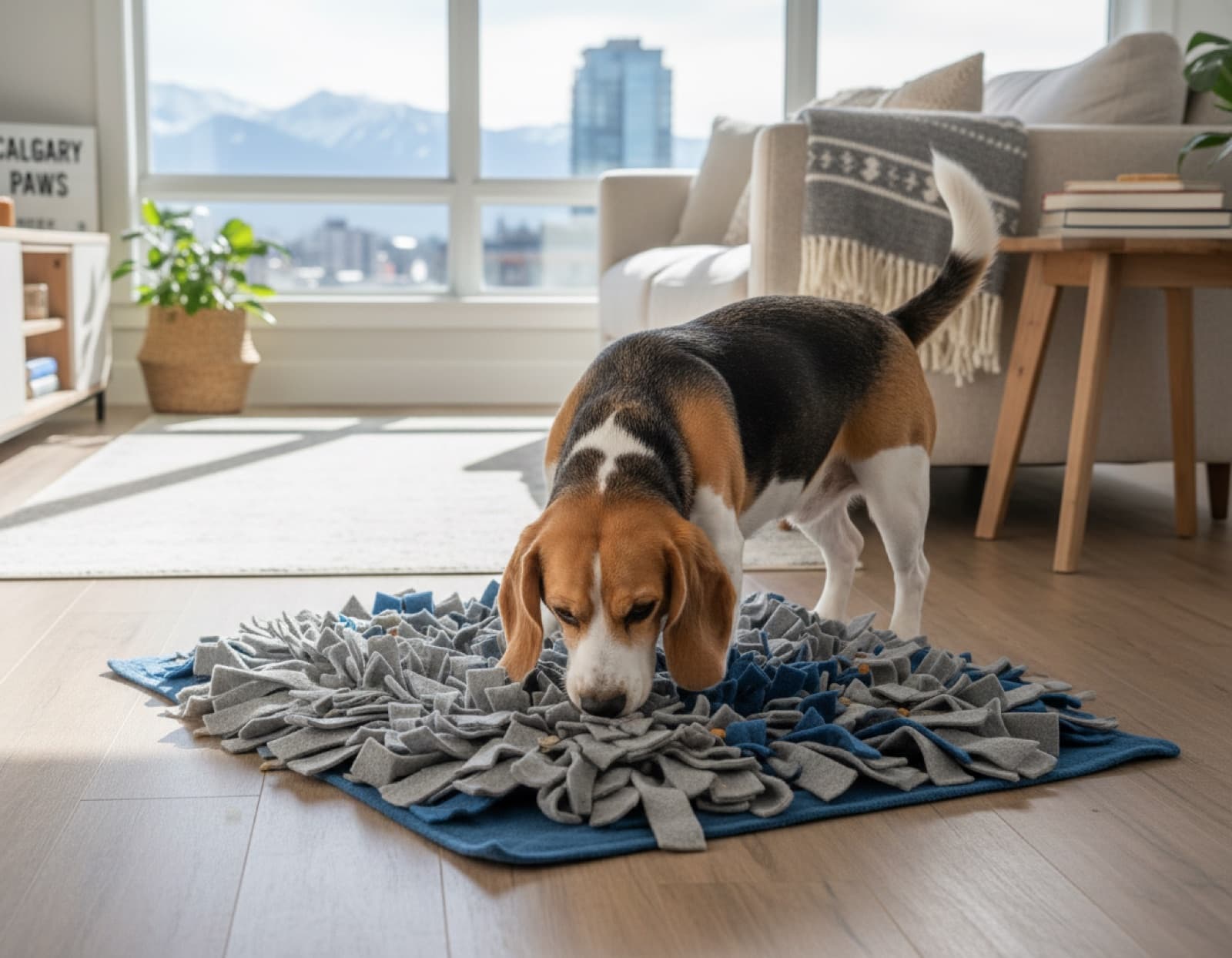
- Snuffle mats. Hidden-treat fabric mats. About 10 to 30 minutes of focused mental work. $20 to $50. Use for one meal a day.
- Slow feeders. Bowls with built-in obstacles that slow eating from 30 seconds to 5 to 15 minutes. $15 to $50.
- Food puzzles. Kong Wobbler (simple), Kong Classic frozen (moderate), Outward Hound Hide-A-Squirrel, Nina Ottosson (advanced). $20 to $80 each. Rotate to keep them novel.
- Frozen Kongs. Peanut butter (xylitol-free), kibble, and treats packed and frozen. About 30 to 45 minutes of focused chewing. $15 to $30.
- Hide-and-seek games. Hide treats around the house and send the Beagle to find them.
- Scatter feeding in the back yard. Easier in summer than in a Calgary winter snowbank.
- Nosework or scent-detection classes. Calgary clubs run these in 6 to 8 week sessions for roughly $150 to $300. Beagles excel.
Calgary minimum: 15 to 30 minutes of daily mental food-work plus 60 to 90 minutes of physical exercise.
Why this matters: the scavenging drive is going to express itself one way or another. Channelled, it shows up as mental satisfaction and a calmer dog. Unchannelled, it shows up as counter-surfing, garbage raiding, and coprophagia.
Why free-feeding never works for beagles
Free-feeding is a categorical no for Beagle owners. The reasons stack:
- Beagles do not self-regulate. The POMC drive means they will keep eating.
- Obesity is essentially guaranteed within weeks or months.
- Housetraining falls apart. Random feeding gives random elimination.
- In multi-dog homes, the Beagle eats the other dog's food.
- You lose the appetite-monitoring signal that catches early illness.
- Dental disease worsens.
- Pest control gets harder. Open bowls attract mice, ants, and flies in a Calgary summer.
Instead: 2 to 3 scheduled meals a day, measured portions, bowl removed after 15 to 20 minutes whether or not the dog finished.
Rescue Beagles coming out of free-feed homes need about 2 to 4 weeks to settle into scheduled feeding. They are usually anxious about food availability at first. Calmly establish the routine and the anxiety fades.
Calgary 24-hour ER vet directory for food emergencies
Save these contacts. Most Calgary Beagle owners use one of these at least once during the dog's lifetime.
- CARE Centre (Calgary Animal Referral & Emergency), 7140 12 Street SE.
- Western Veterinary Specialist Centre. Multi-specialty hospital with 24-hour emergency.
- VCA Canada West Veterinary Specialists, 1815 32 Avenue NE. 24-hour ER plus specialty referrals.
Pre-program these numbers into your phone and post a copy on the fridge so the rest of the household has it.
True emergency (drive immediately):
- Vomiting plus lethargy plus abdominal pain. Possible pancreatitis.
- Suspected toxic ingestion: chocolate, xylitol, grapes, raisins, onions.
- Bloody diarrhoea.
- Foreign body obstruction (vomiting, can't keep food down).
- Suspected GDV or bloat: distended belly, unproductive retching.
- Severe distress or visible pain.
Pet Poison Helpline: 1-800-213-6680, 24/7, $99 consultation fee.
ASPCA Animal Poison Control: 1-888-426-4435.
Calgary ER visits routinely run $500 to $5,000 or more depending on the workup and treatment. Pet insurance taken out before the diagnosis cuts the financial sting substantially. Insurance taken out after the diagnosis does not cover it.
Browse adoptable Beagles in Calgary
Most Calgary Beagles in rescue carry POMC food drive. Knowing the management routine before you adopt is the difference between thriving and surrendering.
See Available Beagles →Frequently Asked Questions
Why is my beagle ALWAYS hungry?
Many Beagles carry a POMC gene variant that disrupts satiety signalling, so the dog never feels genuinely full. This is genetic, not a training failure. The practical consequence is constant counter-surfing, inevitable garbage raiding without management, intense begging, and a real obesity risk. Compassion plus environment management is the answer. Punishment is not.
Counter-surfing setups?
A motivated Beagle reaches a standard 36-inch counter. The setup that holds up is a push-back zone (food kept 6 to 12 inches in from the edge), baby gates closing off the kitchen, high shelving only for bread and butter, stove knob covers, the dishwasher closed right after loading, and no counter-stored food at all. Calgary winters compound the problem because there is more indoor time and more opportunity.
Calgary garbage management?
Best options in roughly that order: under-counter pull-out bins, step-pedal bins (some Beagles work them out), locking-lid bins like simplehuman ($150 to $400), heavy-duty outdoor-style bins repurposed for the kitchen, or moving the bin to the garage behind a closed door. Add childproof cabinet latches at $5 to $20 each. Avoid open-top and thin-walled bins. Most owners we work with end up with dual-layer protection, around $200 to $500 total.
“Leave it” training?
It is force-free and it takes patience. Start with a closed-fist treat in your palm, then add the cue word, then a dropped-treat progression, then a food-item progression, then real-world contexts. Rewards have to be higher value than what the dog is being asked to leave (cooked chicken, hot dog, freeze-dried liver). Never punish failure, because punishment creates resource guarding and secret eating. Calgary force-free group classes (Raising Canine, Pup City Pup Academy) typically run $150 to $300 over 6 to 8 weeks. Even well-trained Beagles fail leave-it on novel temptations, so manage the environment instead of testing it.
Coprophagia?
Common in Beagles, with a mix of possible causes: genetic food drive, nutritional or enzyme deficiency, parasites, boredom, stress, or puppy exploration. Rule out medical first with a vet workup at $150 to $300, including physical exam, faecal panel, and sometimes bloodwork. Treatment is layered: scoop immediately, adjust the diet on vet advice, try bitter deterrents (Forbid or Coproban) if you want, run rock-solid leave-it training, and meet the dog's exercise and mental-work needs.
Pancreatitis emergency?
This is the single most important emergency to recognise. 12 to 48 hours after a fatty-food or garbage binge, watch for repeated vomiting, diarrhoea (sometimes bloody), severe abdominal pain (hunched or praying posture), lethargy, appetite loss, fever, and dehydration. Drive to a 24-hour ER vet immediately: CARE Centre, Western Veterinary Specialist Centre, or VCA Canada West. Costs run $300 to $10,000+ depending on severity. Plan for at least one pancreatitis ER visit during your Beagle's lifetime.
Holiday + toxic foods?
The headline risks are chocolate (dark and baking are the most toxic), xylitol (extreme; in sugar-free gum, candy, and some peanut butters; causes hypoglycaemia and liver failure within hours), grapes and raisins (kidney failure), and onions, garlic, macadamia nuts, alcohol, and caffeine. Calgary Halloween, Christmas, Easter, and Valentine's are all elevated-risk windows. Keep the Pet Poison Helpline (1-800-213-6680) and ASPCA Animal Poison Control (1-888-426-4435) saved. Always check ingredient labels, because some pet treats and peanut butter brands contain xylitol.
Multi-dog/kids household?
In multi-dog homes, feed the Beagle in a separate room or crate, because a Beagle will eat the other dogs' food. If resource guarding develops, a force-free trainer running a CARE or BAT 2.0 protocol typically costs $200 to $500. With kids, the non-negotiable rule is no table feeding, ever. Gate or crate the Beagle for birthday parties and gatherings. Pack-fed Beagles can develop competitive eating, which carries a real GDV/bloat risk. Gate the dog away from infant feeding areas, and keep cat food bowls and litter boxes elevated or in a dog-restricted room.
Channel-the-drive playbook?
Snuffle mats ($20 to $50, one meal a day), slow feeders ($15 to $50), food puzzles ($20 to $80 each, rotated to stay novel), frozen Kongs ($15 to $30), hide-and-seek games, scatter feeding in the yard, and Calgary nosework classes ($150 to $300 over 6 to 8 weeks). Aim for 15 to 30 minutes of daily mental food-work plus 60 to 90 minutes of physical exercise.
Why no free-feeding?
Beagles do not self-regulate because of the POMC drive. Free-feeding produces guaranteed obesity, broken housetraining, multi-dog food conflicts, delayed detection of illness through appetite changes, worsened dental disease, and pest problems in Calgary summers. Instead, run 2 to 3 scheduled meals a day with measured portions, removing the bowl after 15 to 20 minutes whether or not it is finished. Rescue Beagles from free-feed homes typically need 2 to 4 weeks to settle into the new routine.
Calgary 24hr ER vet contacts?
The Calgary 24-hour ER vets to keep on speed dial are CARE Centre (7140 12 Street SE), Western Veterinary Specialist Centre, and VCA Canada West Veterinary Specialists (1815 32 Avenue NE). Pre-program the numbers in your phone and post them on the fridge. Drive in for pancreatitis signs, suspected toxic ingestion, bloody diarrhoea, foreign body obstruction, GDV/bloat, or severe distress. Pet Poison Helpline 1-800-213-6680 ($99 consult) and ASPCA Animal Poison Control 1-888-426-4435 are the right first calls if you are not sure whether ingestion warrants an ER visit.
Is a Beagle right for our household?
A Beagle works in your household if you can spend roughly $200 to $500 in year one on counter-proofing, garbage management, and food puzzles, run scheduled feeding, hold a strict no-table-feeding rule across the whole family, save the Calgary 24-hour ER vet contacts, and enrol pet insurance on day one. It is a poor match if you want a dog that self-regulates around food, live in an apartment where you cannot gate the kitchen, have a household that struggles to keep food off counters consistently, or cannot absorb a possible ER bill.
Adoptable Beagles in Calgary
Live listings of Beagles and Beagle mixes from Calgary rescues.
Beagle Adoption in Calgary
Calgary rescue sources, real adoption costs, surrender patterns, and breed-vs-buy reframe.
Beagle Scent Drive and Escape Risk
Why off-leash fails, fencing and tracking gear, and the Calgary recall reality.
Beagle Health Issues
IVDD, ear infections, obesity, epilepsy, MLS, and Beagle Pain Syndrome.
New dog? Start with these care guides
Everything a new adopter needs to set up a safe, happy home.