The short answer
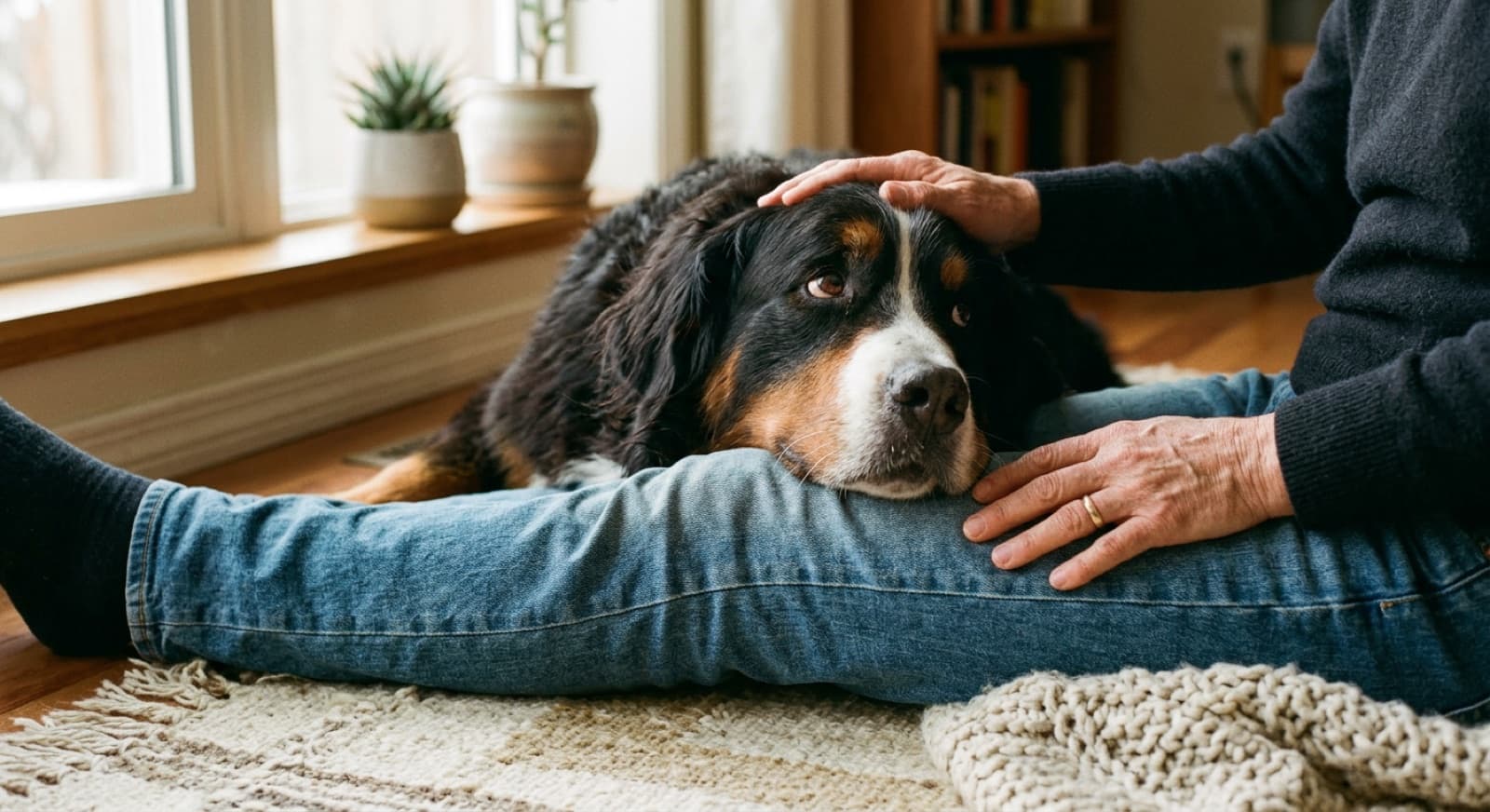
Bernese Mountain Dogs live 7 to 10 years on average per the AKC breed profile and BMDCA longevity surveys. Cancer is the leading cause of death in the breed, with histiocytic sarcoma a documented breed concern that can move quickly. The four most-cited Berner cancers are histiocytic sarcoma, lymphoma, mast cell tumour, and osteosarcoma. Cancer surveillance is often recommended starting in mid-life with abdominal ultrasound, chest x-rays, blood panel, and weekly home lump checks; exact protocols belong with your Calgary veterinarian or veterinary oncologist. Pet insurance must be enrolled before any symptoms appear, ideally as a puppy. The levers that bend a Berner's life expectancy in the right direction: lean weight, low-impact exercise, screening behaviour, fast vet visits for small symptoms, and choosing a breeder with pedigree longevity. None of this guarantees a long-lived Berner, but neglecting it tends to produce the shortest outcomes. This article is educational only; do not start, stop, or change treatment without veterinary guidance.
Berners do not get a pass on small symptoms
Sudden lethargy lasting more than 2 days, sudden lameness with no injury, any new lump, any old lump growing noticeably in 30 days, unexplained weight loss, or pale gums all deserve a Calgary vet visit that week. With Bernese, days matter. Histiocytic sarcoma can progress in weeks. An owner who watches a small symptom for “a few more days” sometimes loses the window where treatment could have helped. If your gut says something is off, trust it. Owners are right more often than they are wrong with this breed. For collapse, breathing difficulty, or severe weakness, head to a Calgary 24-hour emergency centre immediately.
The math: how long do Bernese actually live?
7 to 10 years on average. The AKC Bernese Mountain Dog breed profile and Bernese Mountain Dog Club of America (BMDCA) longevity surveys consistently show median lifespans in this range. Some Bernese reach 10 to 12 years. A small minority make it past 12.
For context, the average dog lives 10 to 13 years. Most large breeds live 9 to 12. Bernese sit on the short end of large-breed lifespans, comparable to Great Danes and Saint Bernards.
The single biggest driver is cancer. Cancer is the leading cause of death in the breed, per BMDCA surveys and Morris Animal Foundation research summaries. Other major contributors to shortened lifespan include joint disease (hip and elbow dysplasia leading to euthanasia for quality-of-life reasons), bloat (gastric dilatation-volvulus), and degenerative conditions tied to size.
Owners who enter the breed expecting 12 to 14 years are setting themselves up for grief that hits harder than it has to. Owners who enter expecting 8 years and end up with 11 feel like they were given extra time. Set expectations honestly from the start.
Why does this breed get so much cancer?
Genetic predisposition combined with a small founder population. Bernese descend from a tight group of dogs in the Swiss Alps. That bottleneck concentrated cancer-risk genes that the breed has never fully escaped.
Research groups including UC Davis and the University of Bern have identified candidate genes linked to histiocytic sarcoma risk. But no commercial DNA test currently screens for cancer risk in a way that meaningfully predicts outcomes. A pup with all the risk markers might never get cancer. A pup with none might.
The OFA CHIC (Canine Health Information Center) database lists the screens responsible Berner breeders run on parent dogs: OFA hips, OFA elbows, OFA cardiac (advanced echo by a board-certified cardiologist), OFA eyes, and Von Willebrand Factor testing. Cancer screening is not on the CHIC list because no validated parent-screen exists.
In place of a genetic test, the proxy is pedigree longevity. Ask a breeder how long the dogs in the past three generations of a litter's pedigree lived. A breeder who can rattle off ages confidently (and whose grandparent dogs lived past 9) is doing the right thing. A breeder who shrugs or claims the question does not matter is not. We cover breeder questions in more depth in our Bernese adoption Calgary guide.
Histiocytic sarcoma: the cancer that defines this breed
Histiocytic sarcoma (HS) is a well-documented breed concern in Bernese Mountain Dogs and is widely cited as a leading cause of cancer death in the breed by the BMDCA and Morris Animal Foundation. HS is aggressive, fast-moving, and difficult to treat once disseminated.
What HS is. A cancer of histiocytes, a type of immune cell. The malignant cells can spread aggressively through the bloodstream, often seeding multiple organs by the time the first symptom appears. The AVMA pet-cancer resource is a good general-public starting point.
Where it starts. Most commonly the spleen, lungs, liver, lymph nodes, bone marrow, or joints. None of these are places an owner can see or feel.
How fast it can move. From the first detectable clinical symptom to a serious decline is often weeks, not months. This is what makes HS so cruel. Owners describe a dog who was “completely fine” on Sunday and severely unwell three weeks later.
The two forms. The disseminated form (multi-organ at diagnosis) is the harder of the two; the localized form (single tumour, often in a joint or skin) tends to have a better prognosis with early intervention. Specific prognoses, treatment options, and median survival numbers depend heavily on staging and should be discussed with a Calgary veterinary oncologist before any decision is made.
This is why screening matters. Catching a small splenic mass on routine ultrasound before it spreads gives a Berner a real shot. The same mass found two months later when symptoms hit usually does not.
The other cancers: lymphoma, mast cell, osteosarcoma, hemangiosarcoma
| Cancer | First sign owners notice | General treatment direction | Prognosis |
|---|---|---|---|
| Histiocytic sarcoma | Sudden lethargy, weight loss, lameness, pale gums | Oncology-directed; multimodal in some cases | Guarded, especially disseminated. Discuss with oncologist. |
| Lymphoma | Swollen lymph nodes (jaw, behind knees) | Oncology-directed chemotherapy options | Often more treatable than HS. Oncologist sets the plan. |
| Mast cell tumour | Skin lump (any new lump) | Surgical excision per grade and margins | Low-grade caught early can be curable |
| Osteosarcoma | Sudden lameness, no injury, usually a leg | Surgical and oncology-directed options | Variable. Oncologist sets the plan. |
| Hemangiosarcoma | Sudden collapse, pale gums (internal bleeding) | Emergency stabilization, then oncology referral | Guarded. Many cases present late. |
Lymphoma is one of the more treatable Berner cancers; specific chemotherapy options and expected outcomes belong with a veterinary oncologist. The first sign is almost always swollen lymph nodes you can feel under the jaw or behind the knees. Weekly home palpation catches it.
Mast cell tumours appear as skin lumps. Any new lump on a Berner deserves a fine-needle aspirate (a quick in-clinic needle biopsy) the same week it appears. Low-grade mast cell tumours caught early are often curable with surgery alone.
Osteosarcoma presents as sudden lameness with no injury history, usually in a leg of a dog older than 6. Many Berner owners initially assume it's arthritis or a strain. Limping that doesn't resolve in a week deserves x-rays in this breed.
Hemangiosarcoma is the silent killer. The first sign is often collapse from internal bleeding when a splenic tumour ruptures. There is no reliable warning for owners. Annual abdominal ultrasounds catch some cases. Many are missed.
Cancer screening behaviour: what to discuss with your Calgary vet
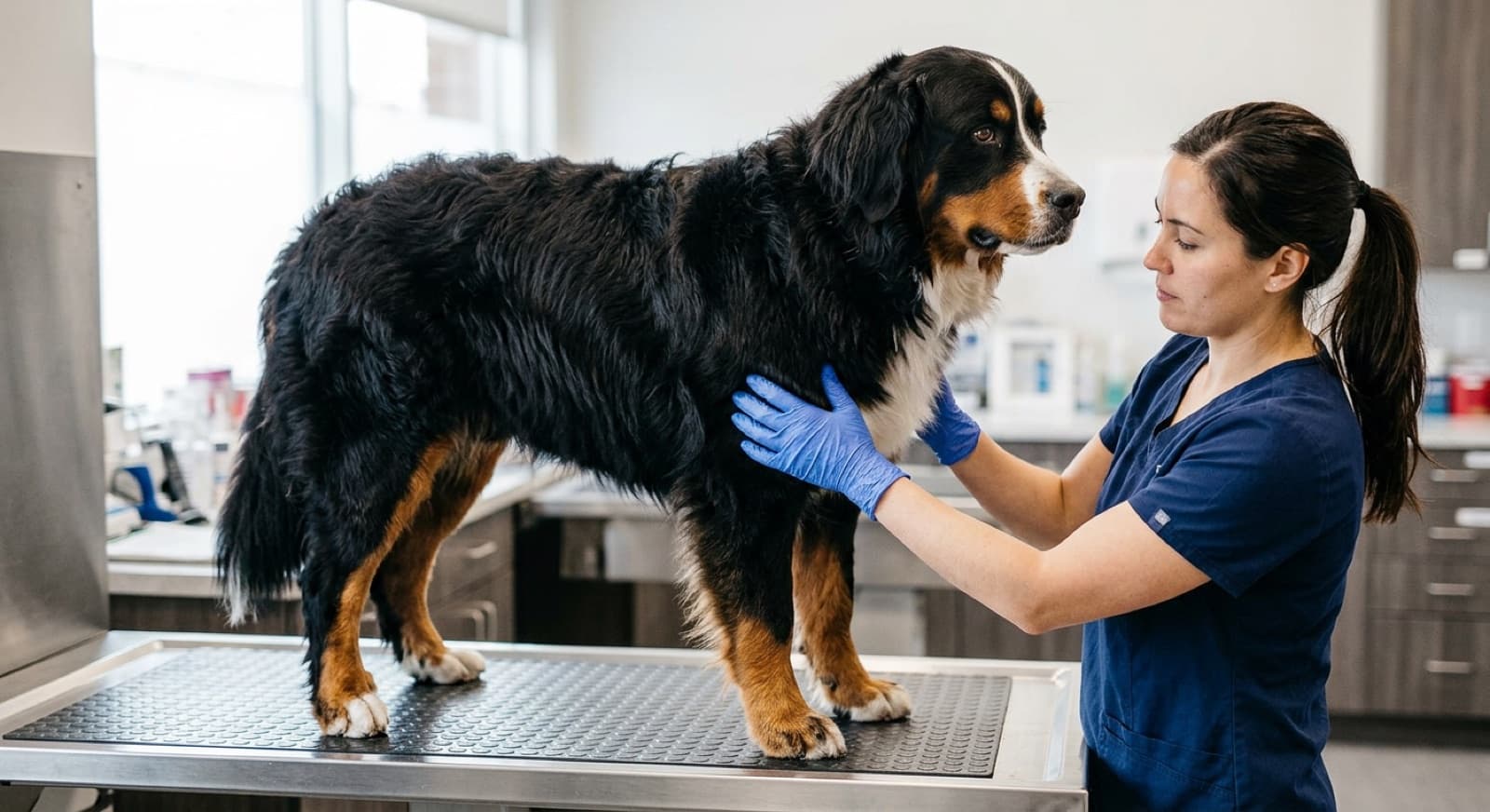
Start the conversation in mid-life, before symptoms. Many Calgary internal medicine and oncology vets recommend a baseline workup around age 4, then more frequent surveillance from age 6 onward. Exact protocol belongs with your dog's primary care vet and a referral oncologist.
A common surveillance framework includes:
- Abdominal ultrasound. Catches splenic, liver, kidney, and abdominal lymph node masses early. Available at most Calgary general practices and referral centres.
- Chest x-rays (three views). Catches lung metastases and primary lung tumours.
- Full CBC and chemistry panel. Anemia, elevated calcium, altered enzyme levels often appear before symptoms.
- Thorough physical exam. Including lymph node palpation under the jaw, in front of the shoulders, in the armpits, in the groin, and behind the knees.
- Weekly home lump checks. Run your hands over your dog every Sunday. Note new lumps in a phone note with date and rough size. Any new lump bigger than a pea, or any old lump that has grown noticeably in 30 days, deserves a fine-needle aspirate that week.
Calgary costs vary by clinic and patient. Ask your primary care vet for a written quote and confirmation of what is included. Pet insurance enrolled before symptoms can cover much of this. If you waited, surveillance becomes a meaningful out-of-pocket expense that many owners skip, then regret.
Where to run it in Calgary. Most general-practice vets can run bloodwork, chest x-rays, and physical exam. For abdominal ultrasound, ask whether your clinic has a vet trained in ultrasound or sends out to a mobile sonographer. If not, ask your primary care vet for a referral to a Calgary specialty centre for internal medicine consultation.
Early symptoms: what to act on
Bernese owners act on small symptoms that other breed owners watch and wait on. The list is short and specific. Do not normalize any of these.
- Sudden lethargy lasting more than 2 days, especially if combined with reduced appetite
- Sudden lameness with no injury history, particularly in a leg of a dog older than 6 (osteosarcoma until proven otherwise)
- Any new lump or bump, even small ones
- Any old lump that grows noticeably in 30 days
- Unexplained weight loss over 4 to 6 weeks
- Pale gums. Lift the lip. Healthy gums are salmon pink. White, grey, or yellow gums mean ER same day.
- Increased panting at rest in cool conditions
- Abdominal distension (sudden pot-belly appearance), especially with weakness
- Collapse or breathing difficulty: go to a Calgary 24-hour emergency centre immediately
The pattern of regret most Bernese owners describe sounds the same. “She was tired for a couple of days, then off her food, but seemed okay. We were going to call the vet on Monday, but Sunday she collapsed.” By Sunday, the window has closed. Call the vet on the first day, not the third.
Calgary 24-hour emergency centres are available for after-hours crises. Save the phone numbers of the nearest specialty/emergency centre in your area before you need them, and ask your primary care vet for a written referral pathway during your next routine appointment.
Treatment options: defer to your Calgary veterinary oncologist
Specific treatment decisions belong with a Calgary veterinary oncologist, not with an article. The categories below are framed at the level a general-public owner needs to understand options before referral.
Surgery. Often first-line for mast cell tumours, some localized histiocytic sarcoma cases, and bone tumours. Surgery alone can be curative for low-grade mast cell tumours.
Chemotherapy. Used for several Berner cancers under oncology supervision. Dogs generally tolerate chemotherapy better than humans do, and many Bernese on treatment continue to eat well and act like themselves. Specific drugs, doses, and protocols are oncologist territory. Ask about expected side effects, monitoring schedule, and quality-of-life goals before consenting.
Radiation. Used for some localized tumours. Not currently widely available in Alberta; closest centres are typically in British Columbia and Ontario, so travel and cost are part of the conversation.
Palliative care. A legitimate choice for many Berner owners, especially with advanced disseminated disease where aggressive treatment may add limited time. Pain management, anti-nausea care, appetite support, and hospice prioritize comfort. There is no wrong answer here. Many Calgary oncologists will have a frank conversation about expected quality of life before recommending or against aggressive treatment.
For detailed Calgary cost framing, see our Bernese cost of ownership Calgary guide, and for non-cancer health concerns see our Bernese health issues Calgary guide.
Pet insurance: this breed needs it more than most
Enroll before the first vet visit. Once a Bernese has any vet record mentioning a lump, a limp, or unusual bloodwork, insurance treats those as pre-existing and excludes them.
Several providers cover Calgary dogs and the major ones cover cancer when enrolled early. Reimbursement rates, annual caps, and waiting periods vary by provider and plan. Get current quotes from each before deciding, and read the exclusions section carefully.
The enrollment math. Most policies have a waiting period before illness coverage begins. A Bernese puppy enrolled at 8 weeks has all cancers covered after that waiting period. A Bernese enrolled at age 5 after the first lump is found has that cancer permanently excluded. The cost difference between insuring this breed and not insuring is often the difference between treating cancer and putting a dog down for financial reasons. That is a sentence Bernese owners hear from oncologists and hate, but it is honest.
For a detailed Calgary-specific comparison of Trupanion, Pets Plus Us, and Petsecure, plus enrollment timing and what to look for in fine print, see our Bernese pet insurance Calgary guide.
Do Bernese mixes live longer?
Often yes, but less than some breeders advertise. Hybrid vigour helps. It does not erase cancer risk.
Bernedoodles (Bernese + Standard Poodle) generally live longer than pure Bernese, often into the low-to-mid teens depending on the parent Poodle's genetics. F1 (50/50) Bernedoodles tend to land in the middle of the two breed averages. F1B Bernedoodles (a higher proportion of Poodle) tend longer still.
The benefit depends on the other parent breed. Berner-Saint Bernard mixes do not gain much because Saints share the same large-breed shortened lifespan. Berner-Lab mixes and Berner-Golden Retriever mixes tend toward the lower-to-mid teens, but every line is different.
Cancer risk does not go to zero in a Bernedoodle. Poodles have their own cancer risks. Goldens have notable lifetime cancer rates of their own. Mixing breeds reduces the concentration of any single breed's risk genes, but it does not produce a cancer-free dog.
The breeder ethics standard does not change. Reputable doodle breeders run the same OFA hip, elbow, eye, cardiac, and Von Willebrand testing on the Berner parent. If a doodle breeder cannot show parent CHIC clearances, that is the same red flag as in a purebred breeder. The longevity gain may be real. The standard for choosing a breeder is identical.
The emotional reality: loving a short-lifespan breed
This is the part most articles skip. Owning a Bernese means accepting that you will probably lose them by age 10, often sooner, and most likely to cancer.
The Bernese community has its own phrase for this: “A heart dog who breaks your heart.” Most owners describe the loss as worse than they expected, even when they entered the breed knowing the statistics. Bernese form intensely close bonds with their people. Their temperament (gentle, soulful, watchful) makes them feel more like family than most breeds. The shorter the life, the harder the goodbye.
The framework most Bernese owners eventually find: quality over quantity. A well-loved 8-year Berner had more good days than a neglected 14-year dog of any breed. Owners who fixate on extending lifespan often miss the point. Daily Calgary walks, frequent vet visits, lean weight, mental stimulation, and presence are what a Berner needs from you. The years will be what they will be.
Practical end-of-life planning. Many Calgary Berner owners pre-arrange in-home euthanasia with a mobile veterinary service rather than a final clinic visit. Bernese are large dogs and a peaceful death at home on their favourite mat is gentler for everyone than a vet exam room. Some owners also pre-arrange cremation and keepsakes (paw prints, fur clippings) with a Calgary pet aftercare provider.
Grief support. Many Calgary veterinary clinics and Alberta-wide resources offer pet-loss support. The OVMA (Ontario Veterinary Medical Association) Pet Loss Support Line is free for any Canadian and is staffed by trained counsellors. Grieving a Berner is not unusual. It is not over-reacting. The brevity of these dogs concentrates the love.
How to extend your Bernese's life
You cannot guarantee a long life. You can avoid the shortest one. These behaviours measurably bend the average Berner's life expectancy in the right direction.
- Choose a breeder with pedigree longevity and full CHIC clearances. Grandparent dogs who lived past 9, parents with OFA hip, elbow, cardiac, eye, and Von Willebrand testing, breeder who can name causes of death in past litters. The biggest single lever you control.
- Keep your Berner lean. Always. Aim for body condition score 4 to 5 out of 9. Ribs easily palpable, defined waist when viewed from above. Every extra pound is extra joint stress and extra cancer-feeding adipose tissue.
- Low-impact exercise. Daily Calgary walks at moderate pace. Avoid repetitive high-impact activity (long distance running on hard surfaces, repetitive ball fetching, dog park scrums) that hammers growing joints. Swimming and sniff walks are ideal.
- Cancer surveillance behaviour from mid-life. Abdominal ultrasound, chest x-rays, blood panel, lump checks. Annual at first, more frequent from age 6+, exact cadence set with your Calgary vet.
- Pet insurance enrolled as a puppy. Before the first vet visit when possible.
- Fast vet visits for small symptoms. Day 1, not day 5. Berners do not get the benefit of the doubt other breeds get.
- Discuss spay/neuter timing with your Calgary vet. Recent large-breed studies suggest waiting until growth plates close may reduce orthopedic disease and possibly some cancers; the right timing for your individual dog is a clinical decision.
- Annual senior bloodwork from age 5. Catches anemia, kidney changes, calcium elevations early.
- Dental care. Chronic periodontal disease drives systemic inflammation that may contribute to broader health decline. Annual cleaning under anesthesia from age 4.
- Quality, well-researched food. Discuss diet with your Calgary vet, especially in light of ongoing FDA investigations into grain-free diets and DCM. Berners with their cancer risk profile do not need additional dietary uncertainty.
None of these guarantee a long-lived Berner. All of them measurably bend the curve. Owners who do all 10 of these have meaningfully better outcomes than owners who do none.
Sources and further reading
- AKC: Bernese Mountain Dog breed profile
- Bernese Mountain Dog Club of America (BMDCA): health and longevity resources
- AVMA: Cancer in Pets
- Orthopedic Foundation for Animals (OFA) and the CHIC database
- Morris Animal Foundation: canine cancer research summaries
This article is general educational information about the breed and is not a substitute for individualized veterinary advice. Treatment decisions for a specific Bernese Mountain Dog must be made with a Calgary veterinarian and, where appropriate, a board-certified veterinary oncologist.
Frequently Asked Questions
How long do Bernese actually live?
7 to 10 years average per the AKC profile and BMDCA longevity surveys. Some reach 10 to 12; a small minority go past 12. Cancer drives most early deaths in the breed.
Why do Bernese get so much cancer?
Small founder population concentrated cancer-risk genes. Research from UC Davis and the University of Bern has identified candidate genes for histiocytic sarcoma, but no commercial DNA test currently predicts cancer risk meaningfully. Pedigree longevity is the best proxy.
What is histiocytic sarcoma?
Aggressive cancer of histiocytes (immune cells), often presenting in the spleen, lungs, liver, lymph nodes, or bone marrow. It is widely cited as a leading cause of cancer death in the breed and can progress in weeks. Prognosis and treatment options should be discussed with a Calgary veterinary oncologist.
What other cancers should I watch for?
Lymphoma (swollen nodes), mast cell tumour (skin lumps, often curable with early surgery), osteosarcoma (sudden lameness), and hemangiosarcoma (sudden collapse). Any of the above warrant prompt Calgary veterinary assessment.
When should cancer screening start?
In mid-life, before symptoms, with the exact schedule set by your Calgary vet. A common framework is annual baseline around age 4 and more frequent surveillance from age 6 onward: abdominal ultrasound, chest x-rays, CBC and chemistry, lymph node palpation, plus weekly home lump checks.
What early symptoms matter?
Sudden lethargy over 2 days, sudden lameness with no injury, new lumps, lumps growing noticeably in 30 days, unexplained weight loss, pale gums, increased rest panting, abdominal distension. Day 1 vet visit, not day 5.
What does cancer treatment cost in Calgary?
Costs vary widely by cancer type, staging, and treatment plan. Ask your Calgary veterinary oncologist for a written estimate before committing. Pet insurance enrolled before symptoms typically covers a significant share depending on policy.
Do Bernese mixes live longer?
Often yes, but not as much as some breeders advertise. Bernedoodles often live longer than pure Bernese; Berner-Saint Bernard mixes gain less. Cancer risk drops but does not reach zero. Breeder OFA testing standards still apply.
Bernese Adoption Calgary
Where to find a Bernese in Calgary. Rescue, breeders, costs, waitlists, and the right questions to ask about pedigree longevity.
Bernese Health Issues Overview
Hip and elbow dysplasia, bloat, cardiac, eye conditions, and the full Bernese health picture beyond cancer.
Cost of Owning a Bernese (Calgary)
Year-one costs, lifetime costs, food, grooming, insurance, vet, cancer-treatment reserves.
Pet Insurance for Bernese (Calgary)
Trupanion vs Pets Plus Us vs Petsecure. Cancer coverage, enrollment timing, and why this breed needs it more than most.
Is a Bernese Right for You?
The honest fit check before you commit. Short lifespan, drool, shedding, exercise needs, family fit.
Buy or Adopt a Bernese?
Reputable breeder vs rescue. CHIC clearances, pedigree longevity, and the right question to ask.
New dog? Start with these care guides
Everything a new adopter needs to set up a safe, happy home.