The honest version
Dachshunds were bred to bark at badgers underground. That same vocal, stubborn, “I am not going in there” wiring is what you are working against when you put one in a crate for the first time. The breed is also a velcro breed, so being shut behind bars away from you feels like punishment, not rest. Add in the fact that many Calgary rescue Dachshunds came from shelter kennels or backyard breeder pens where the crate was their whole world, and you have a dog who walks in with strong opinions. The good news is that crate training a Doxie works. It just takes a slower, food-led, positive-only approach than most generic dog-training advice describes. The goal is not obedience. The goal is a den the dog chooses to use.
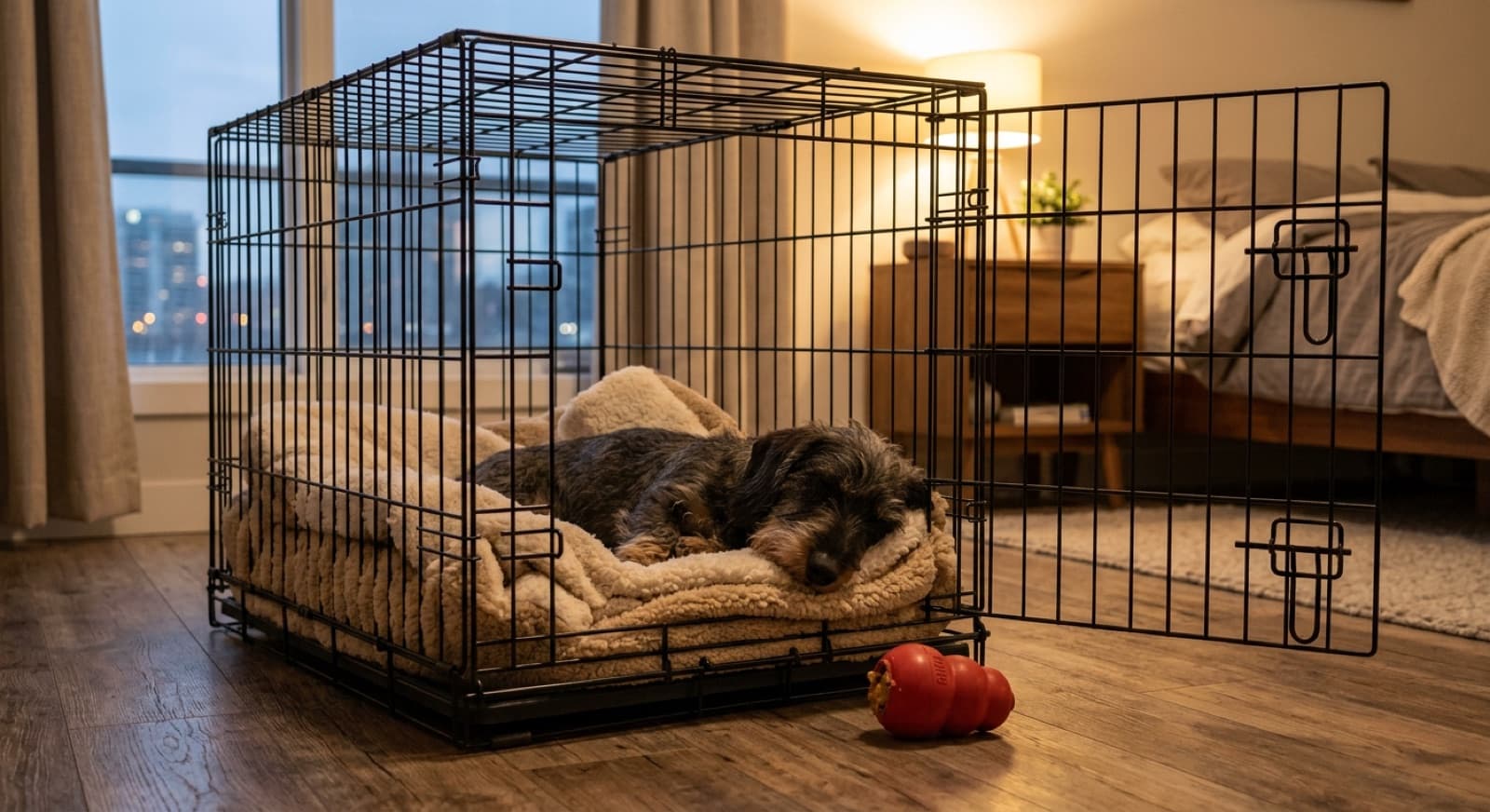
Why Dachshunds resist crates more than most breeds
If your Doxie is fighting the crate harder than your friend's Lab did, you are not doing it wrong. The breed comes with four overlapping reasons to resist.
1. Velcro bonding makes separation feel punishing
Dachshunds were bred for centuries to work closely with one handler. They form intense, one-person bonds and follow that person from room to room. A crate closed across the room can feel like abandonment, not rest. This is normal breed wiring, not a behaviour to correct. The protocol must build separation tolerance in tiny steps, with the dog never crossing the threshold from comfortable to panicked.
2. Stubborn personality outlasts inconsistent owners
The breed's working ancestry rewarded independent decision making. A badger hunter who looked to its handler for every choice would not survive the burrow. That genetic stubbornness shows up in modern Dachshunds as a willingness to hold a position for hours. If you cave once on the crate (let them out when they cry, then close them back in later), they learn that protest works. Consistency matters more with this breed than with most.
3. Vocal by design (the badger bark is built in)
Dachshunds were bred to bark loudly underground so handlers could locate them. That deep, persistent bark is genetic, not a training failure. Many owners hear a crated Dachshund and assume something is wrong. Often the dog is just doing what the breed does. The fix is reducing the trigger (crate-related distress), not punishing the sound.
4. Rescue-history crate trauma
A meaningful share of Calgary rescue Dachshunds came from situations where the crate was the entire world. Shelter kennels, backyard breeder pens, hoarding situations. To these dogs, a crate is not neutral. It is the place they were forgotten in. A new owner introducing a new crate is touching old wiring. Start slower with these dogs. Door open for the first full week. Meals inside, no closing. Trust before duration.
Why crate training is still essential
Given how hard it is, some Calgary owners ask whether they can just skip the crate. With a Dachshund, the answer is usually no. Five reasons crate training pays off.
- Housetraining aid. Dogs do not soil where they sleep. A correctly sized crate teaches bladder control faster than free-roaming. This matters because Dachshunds are notoriously hard to housetrain.
- Safety when you are out. An uncrated Doxie can find trouble fast. Chewed electrical cords, eaten chocolate, fights with the cat, falls from furniture. The crate eliminates all of it.
- IVDD prevention. Dachshunds have the highest IVDD risk of any breed. A crated dog cannot jump off the couch or take stairs unsupervised while you are at work. During an active IVDD recovery, strict crate rest is the standard veterinary protocol for 4 to 8 weeks.
- Travel and vet visits. A Dachshund that is comfortable in a crate handles car rides, vet exam rooms, post-surgical recovery, and emergency boarding without added trauma. A crate-averse Doxie makes every one of these harder.
- Foundation for separation anxiety work. If your Dachshund develops separation anxiety later (and the breed is prone to it), a positive crate is one of the tools you build the recovery plan on. Without it, your options shrink.
Choosing the right crate for a Dachshund
Crate sizing is where most owners go wrong on day one. A pet store will sell you the biggest crate that fits the dog. That is the wrong instinct.
Size: about 6 inches longer than the dog
The dog should be able to stand without ducking, turn around, and lie down stretched. That is the entire space requirement. Mini Dachshunds (under 11 lbs) usually fit a 24 inch crate. Standard Dachshunds (16 to 32 lbs) usually fit a 30 inch crate. Too big means the dog can use one corner as a bathroom and the other as a bed, which kills housetraining. If you bought oversized for a growing puppy, use a divider panel to shrink the usable space and expand it as they grow.
Some of the product links in this section are Amazon affiliate links — we may earn a small commission at no extra cost to you. It never changes which products we recommend.
Wire vs plastic
Wire crates are the default for home use. Better ventilation, easier to clean, fold flat, and you can drape a blanket over three sides if the dog prefers den darkness. Plastic crates feel more enclosed and some Doxies prefer them, but they trap heat in Calgary summers and are harder to clean. Wire with a blanket cover is the most flexible setup.
Soft-sided crates for travel only
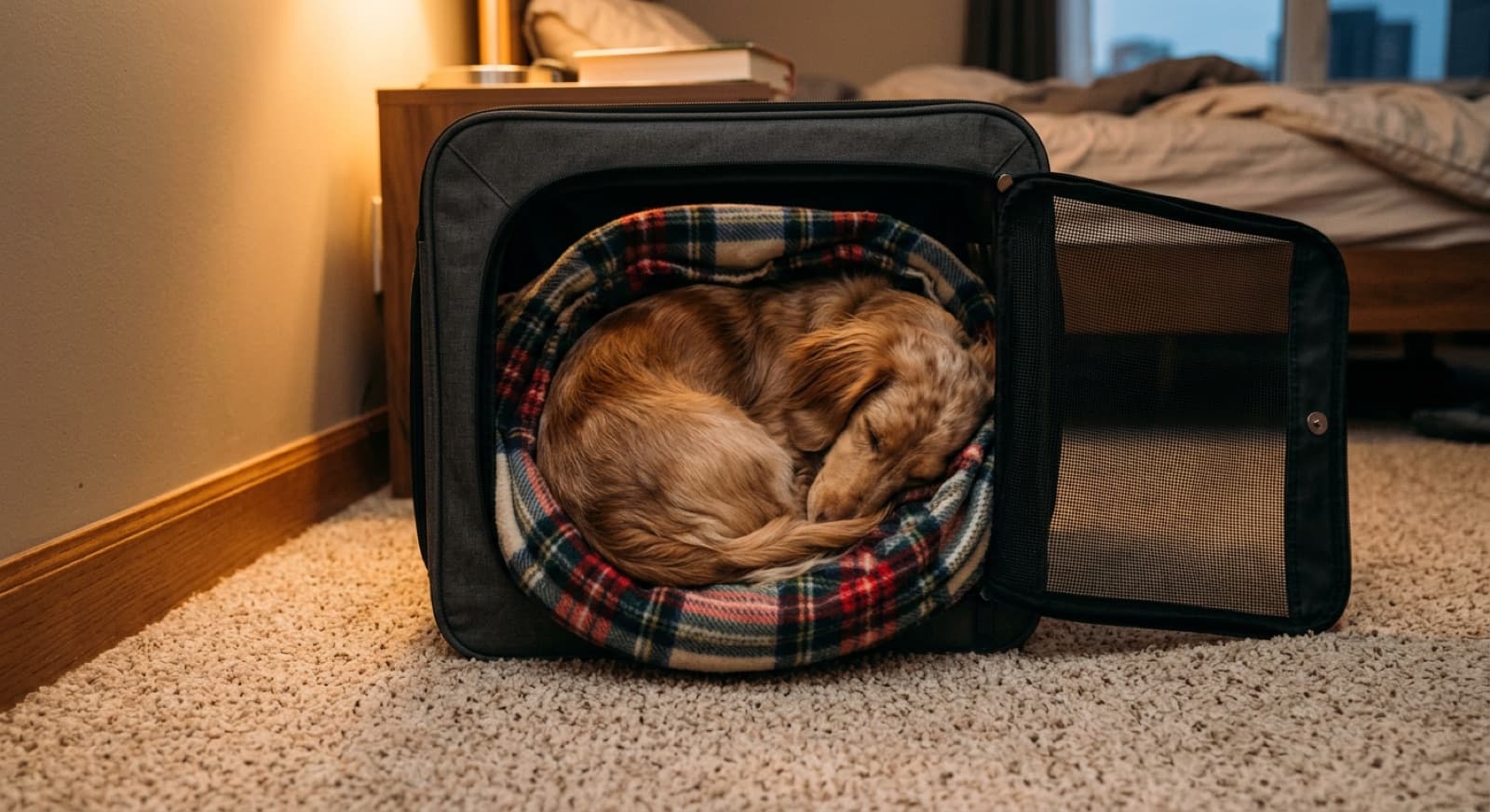
Soft-sided crates work for car trips, vet visits, and short stays away. They are not for unsupervised home use because a determined Dachshund can chew or claw through the fabric. Keep them in the “travel only” category.
Bedding: soft, washable, low
A flat washable pad or low-profile bed works best. Dachshunds sometimes burrow into thick bedding, which is safe and breed-typical, but watch for overheating in Calgary summers above 25C. If your dog burrows hard and the room is warm, switch to a thinner pad. Avoid bedding with stuffing that can be chewed and swallowed.
The 5-phase positive crate protocol
This is the protocol Calgary force-free trainers use for Dachshunds. Move slower than you think you should. Most owner failure is rushing phase 2 or phase 3.
Phase 1 (Day 1 to 3): Crate exists, door open
Put the crate in your living area with the door propped open or removed. Toss a high-value treat (small piece of chicken, freeze-dried liver) inside two or three times a day. Do not lure the dog in. Do not close the door. The dog should investigate on their own terms. If they walk in and out freely, you are winning. The goal of this phase is simply: the crate is a place where good things appear, no pressure attached.
Phase 2 (Day 4 to 7): Meals inside, door open
Feed every meal inside the crate. Door stays open. The dog can walk out at any time. If they refuse to enter, place the bowl just inside the door for a few days, then gradually move it further in. By the end of week one, your Dachshund should be walking in, eating, and walking out without hesitation. If they are not, slow down. Do not move to phase 3 until they are comfortable.
Phase 3 (Week 2): Door closed for short windows during meals
Close the door for 30 seconds while the dog eats. Open it before they finish so the door opening is not the reward they were waiting for. Build up: 30 seconds, 1 minute, 2 minutes, 5 minutes. Stay in the room. Sit calmly. If the dog whines, do not let them out mid-whine (or you teach them whining works). Wait for a 5-second quiet pause, then open. By end of week 2 you want 10 minutes of calm in a closed crate while you are nearby.
Phase 4 (Week 3): Short alone-times in a closed crate
Now you leave the room. Start with 5 minutes. Pop out, come back, casually open the crate. Build to 15 minutes, then 30 minutes. Give a high-value chew (a stuffed Kong, a frozen lick mat) before you leave so the dog has something to do. If the dog panics at any duration, drop back to the last duration where they were calm and rebuild. Do not punish through it.
Phase 5 (Month 2 and beyond): Real alone-time
Now you can leave the house. Build up to 1 hour, 2 hours, 3 hours, 4 hours. Four hours is the responsible ceiling for an adult Dachshund. Longer requires a midday walker or daycare. Overnight in the crate (7 to 8 hours of sleep) usually goes fine once daytime alone-time is solid, because the dog is unconscious for most of it.
Where should a rescue Dachshund sleep the first night?
In your bedroom, in a crate placed next to your bed, within touch and sound range.
Not alone in a separate room. Not in the basement. Not in the laundry room with the door closed. Calgary rescues that place Dachshunds are almost unanimous on this point. A rescue Doxie on their first night is already disoriented: new smells, new family, new sounds. Adding isolation on top creates real trauma and a much harder crate-training arc.
Hearing you breathe and being able to see you through the bars is the single biggest first-night settler for this breed. After 2 to 3 weeks of stable bedroom sleep, you can move the crate further away if you want. Many Dachshund owners never move it, and that is fine.
Setup checklist for night one: crate next to the bed, soft bedding, a worn t-shirt of yours inside (scent comfort), water if the dog is over 6 months old, last potty break right before bed, lights low, calm tone, no big production saying goodnight.
Reading the cry: 4 reasons your Dachshund is crying at night
Not all crate crying means the same thing. You have to read context, not just sound.
1. Adjustment crying (normal, 3 to 7 nights)
A new dog in a new home crying for the first few nights is normal and expected. It usually fades within a week. Signs: crying starts when lights go out, fades to whimpers, then sleep. The dog settles between bouts. Action: stay calm, do not reward by getting up and playing, but do offer quiet reassurance from the bed if the crate is close. Most adjustment crying ends inside a week.
2. Pee-need crying (legitimate, take outside)
Puppies and rescue Dachshunds often need a midnight potty break, especially in the first weeks. Signs: sudden urgent crying after several hours of sleep, no settling between bouts, restless body language. Action: quiet trip outside, no play, no praise beyond a calm “good potty,” straight back into the crate. Treat it like a business trip, not a social visit.
3. Anxiety crying (different problem entirely)
Anxiety crying does not fade within a week. It often pairs with panting, drooling, destruction of bedding, or scratching at the crate door. The dog cannot settle between bouts. Action: this is separation anxiety, not normal crate adjustment. Slow the protocol back to phase 2 or 3, see a Calgary force-free trainer, and read our Dachshund separation anxiety guide. Pushing harder makes anxiety worse.
4. Pain crying (possible IVDD, vet visit)
If a previously settled Dachshund suddenly cries at night and the cry sounds sharp or yelping rather than protest-style, suspect pain. IVDD is the top concern in this breed. Other signs: reluctance to jump, hunched back, dragging back legs, tense abdomen. Action: vet visit, ideally same day. Do not let the dog jump on or off furniture during the wait. This is the one cry you never ignore.
The “ignore the crying” debate
Generic dog training advice tells you to ignore the crying and the dog will give up. With Dachshunds, that approach often backfires. A velcro breed left to cry it out can spiral into separation anxiety, which is much harder to fix than the original crate resistance.
The rule Calgary force-free trainers use is different. Soft whimpers for under 60 seconds: wait it out, see if they self-settle. Escalating cry, scratching, or panic: take the dog out for a quiet potty break, no play, then back in the crate. Build duration in tiny increments rather than testing how long they can cry.
If the cry escalates every single night, your duration is too long for where the dog currently is. Drop back a phase and rebuild. Slower is faster with this breed.
Sleep routine setup
A predictable nightly routine settles a Dachshund faster than any training drill. The routine itself becomes the cue that sleep is next.
- Same time each night. Aim for the same lights-out window 7 days a week. Predictability lowers anxiety.
- Calm wind-down 30 to 45 minutes before bed. No high-arousal play. No new toys. A short walk, then settled time in the living room.
- Last potty at the same time. Dogs learn the rhythm. After 2 to 3 weeks, the body clocks itself.
- Crate cue word. Use a soft phrase like “bedtime” consistently. The word becomes a comfort signal, not a command.
- Lights low, voices low. Big production goodnights amp up the dog. A quiet exit teaches a quiet response.
IVDD-aware crate placement
Dachshunds have the highest IVDD risk of any breed. Crate placement matters for spinal safety, not just convenience.
Ground level only. Never put a Dachshund crate on a bench, dresser, or elevated platform where the dog could jump down. Even a 12 inch drop on the wrong landing can compress a disc.
Ramp if the crate sits on a frame. Some owners use raised crate stands for airflow. If yours does, install a soft ramp the dog can walk down rather than jumping.
Soft supportive bedding. A flat orthopedic pad supports the spine better than a deep mound of blankets the dog has to twist out of.
Active IVDD recovery. If your Dachshund has had an IVDD episode, the vet will prescribe 4 to 8 weeks of strict crate rest. This is not optional. The crate is the recovery tool, not a punishment. Lift the dog in and out, ramp for potty breaks, no jumping on or off furniture.
The biggest mistake: never use the crate as punishment
If you remember one rule from this article, it is this.
Never send a Dachshund to the crate as punishment for barking, peeing on the rug, chewing a shoe, or anything else. The moment the crate becomes “the bad place,” you have lost the positive association you spent weeks building. Rebuilding from a poisoned crate takes weeks of patient food-led work, sometimes with a new crate in a new room because the old one carries the wrong association.
The crate is for housetraining, safety, IVDD prevention, travel, and sleep. It is not a time-out room. If you need to interrupt a behaviour, use a tether to a doorway, an x-pen, or a different gated room. Keep the crate clean of negative associations forever.
Looking for a Dachshund to bring home?
Live listings from 15+ Calgary rescues, refreshed regularly. Adult-rescue Dachshunds often come with foster notes on crate experience, which makes the first-week training arc faster.
See Available Dachshunds →Frequently Asked Questions
Why do Dachshunds resist crates more than other breeds?
Four reasons stack. Velcro bonding makes separation feel punishing. Stubborn personality outlasts inconsistent owners. Vocal protest is bred in (the badger bark is genetic). Many rescue Doxies have crate trauma from shelter or backyard breeder pens. The fix is patient, food-led, positive-only conditioning, never force or “ignore the crying” approaches.
What size crate does a Dachshund need?
About 6 inches longer than the dog from nose to tail base. Mini Dachshunds usually fit a 24 inch crate. Standard Dachshunds usually fit a 30 inch crate. The dog should stand without ducking, turn around, and lie down stretched. Too big lets them soil one corner and sleep in another, which kills housetraining. Use a divider panel if you bought oversized.
Where should a rescue Dachshund sleep the first night?
In your bedroom, in a crate placed next to your bed. Not alone in a separate room. A rescue Doxie on night one is already disoriented. Isolation creates real trauma and a much harder crate-training arc. Hearing you breathe and seeing you through the bars is the biggest first-night settler. After 2 to 3 weeks of stable sleep you can move the crate, or leave it next to the bed permanently.
Why is my Dachshund crying in the crate at night?
Four possible reasons. Adjustment crying (normal, 3 to 7 nights). Pee-need crying (legitimate, take outside, no play). Anxiety crying (paired with panting, drooling, destruction, points to separation anxiety). Pain crying (possible IVDD, sudden onset, sharp yelping cry, vet visit). Read context, not just sound.
Should I ignore my Dachshund crying in the crate?
Not with this breed. Generic “ignore the crying” advice often creates or worsens separation anxiety in Dachshunds. The rule Calgary force-free trainers use: soft whimpers under 60 seconds, wait. Escalating cry, take the dog out for a quiet potty break, no play, back in the crate. Build duration in tiny increments. Slower is faster with this breed.
How long can I leave a Dachshund in a crate?
Puppies under 6 months: 2 hours max. Adult Dachshunds (1 to 8 years): 4 hours is the responsible ceiling. Seniors and IVDD-history dogs: 3 hours max. Overnight, a fully conditioned adult does 7 to 8 hours. If you work full-time, plan for a midday walker or daycare. A 9 hour stretch is not realistic for this breed.
Is a crate safe for a Dachshund with IVDD risk?
Yes, and it is one of your best IVDD prevention tools. A crated dog cannot jump off furniture or take stairs unsupervised. Keys: ground-level placement, ramp if elevated, supportive flat bedding. During active IVDD recovery, strict crate rest for 4 to 8 weeks is the standard veterinary protocol.
What is the biggest crate training mistake?
Using the crate as punishment. Sending the dog there for barking, peeing, or chewing poisons the association forever. Once a Dachshund decides the crate is the bad place, rebuilding takes weeks. Other top mistakes: starting with the door closed on day one, leaving the dog crated past bladder capacity, oversized crate, and placement in an isolated room where the dog feels abandoned.
More Dachshund guides
Dachshund Adoption Calgary →
Where to find rescue Dachshunds in Calgary, real adoption costs, rescue verification, and what to ask the foster.
Dachshund First Week →
The 3-3-3 rule applied to a Dachshund, what to expect day by day, and how to set up a calm decompression arrival.
Dachshund Potty Training →
Why Dachshunds are notoriously hard to housetrain, the Calgary winter potty problem, and how the crate fits into the plan.
Dachshund Separation Anxiety →
Why velcro Dachshunds spiral into separation anxiety, how to tell it apart from normal crate adjustment, and the recovery plan.
Dachshund IVDD Recovery →
The 4 to 8 week strict crate rest protocol, how to set up a recovery crate, and what Calgary IVDD care actually costs.
Dachshund Health Issues →
IVDD, dental, obesity, and the breed-specific health profile every Calgary Dachshund owner should know.
New dog? Start with these care guides
Everything a new adopter needs to set up a safe, happy home.