The short answer
Two health traits define the Dalmatian. Congenital deafness is common (roughly 18 percent in a large UK study, up to about 30 percent in US figures), diagnosed with a BAER test, and very manageable with hand-signal training. And every Dalmatian carries the genetics for urate bladder and kidney stones (a condition called hyperuricosuria), managed with a lower-purine diet, plenty of water, and exercise. Beyond those, watch for skin allergies and hip issues. This is general information, not veterinary advice: build a health and diet plan with your Calgary vet, and learn the signs of a urinary blockage, which is an emergency.
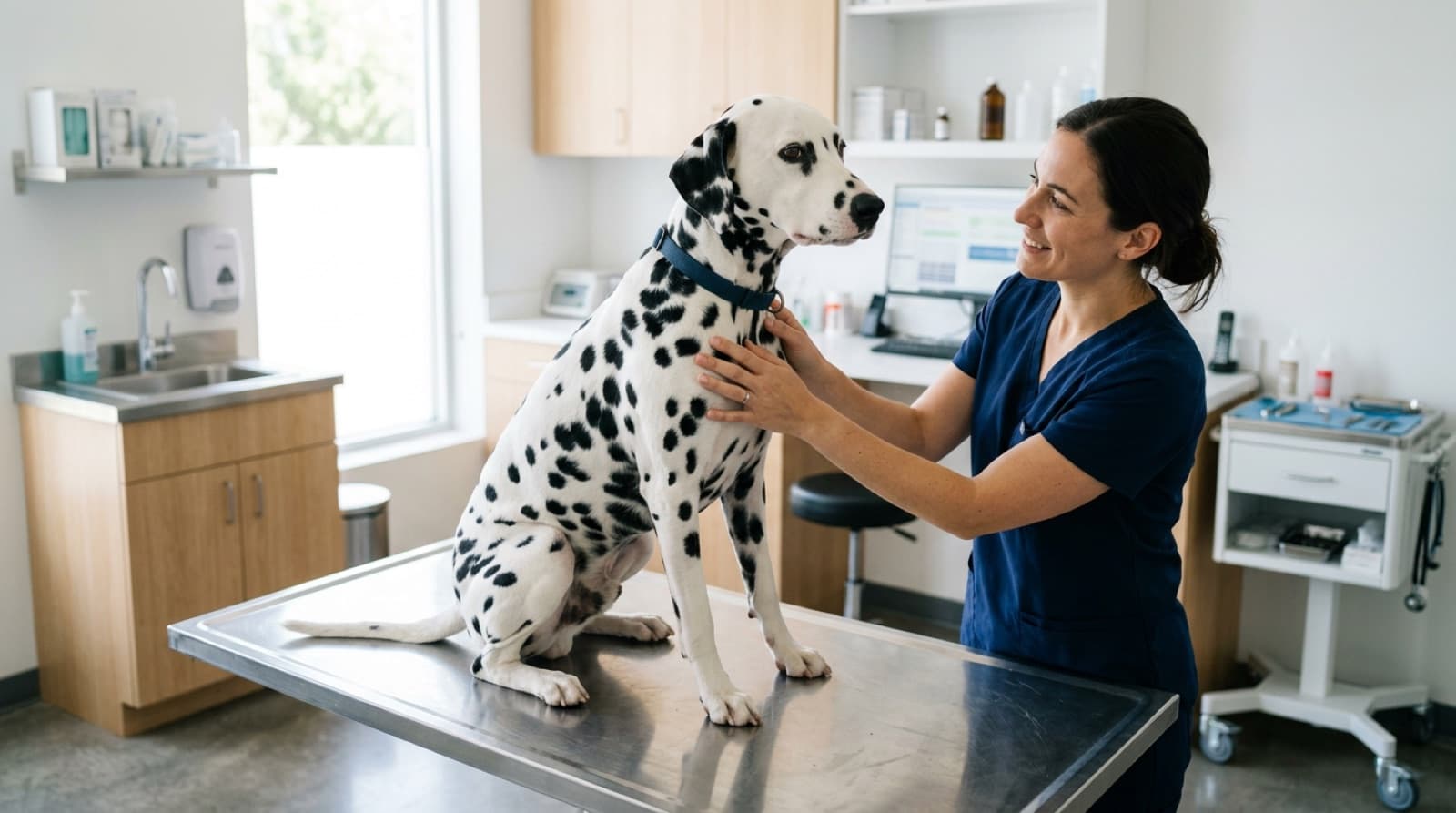
Most breeds have a scattered list of health risks. The Dalmatian has two that stand out so far above the rest that no owner should live with the breed without understanding them: congenital deafness and a breed-wide predisposition to urate urinary stones. Neither is a reason to avoid a Dalmatian. Both reward an informed owner and punish an unprepared one. This guide walks through both in plain language with authoritative sources, then covers the everyday concerns (skin, joints, eyes) and the preventive care that keeps a Dalmatian healthy in Calgary.
Congenital deafness
Congenital sensorineural deafness is the most common inherited health problem in the breed, and Dalmatians have one of the highest rates of any dog. A 2020 study in the Journal of Veterinary Internal Medicine found about 17.8 percent of UK Dalmatians had some congenital deafness (13.4 percent in one ear, 4.4 percent in both), and figures in the United States have been reported as high as roughly 30 percent. It is tied to the same genetics that create the white coat.
Hearing is confirmed with a BAER test (Brainstem Auditory Evoked Response), a quick, non-invasive test that measures each ear's hearing pathway and can be done on puppies from about six weeks. Responsible breeders BAER-test litters. Research also reports an association between blue eyes and a higher chance of deafness, and between colour patches present at birth and a lower chance, though these are statistical tendencies, not guarantees.
Here is the part that matters most for an adopter: a deaf or partially deaf Dalmatian makes a wonderful pet. They learn beautifully on hand signals and vibration cues, are not startled by noise, and are often calmer indoors. The real adjustments are about safety, since a deaf dog cannot hear traffic or a recall: a securely fenced yard, a leash or long line in open areas, and a household that all uses the same hand signals. If you adopt a Dalmatian whose hearing is unknown, ask your Calgary vet about a BAER test so you know exactly what you are working with.
Urate stones: the breed-wide risk
This is the one that is genuinely unique to the breed, and the one that can become an emergency. According to veterinary sources including the UC Davis School of Veterinary Medicine and Cornell University's Riney Canine Health Center, essentially every Dalmatian carries two copies of a mutation that changes how they process uric acid, a condition called hyperuricosuria (HUU).
The practical result is that Dalmatians are prone to urate bladder and kidney stones. In a male dog especially, a stone can lodge in the narrow urethra and cause a complete urinary blockage, which is a life-threatening emergency. That risk is why this section carries a warning border.
The reassuring part is that most Dalmatians never form a stone when they are managed well. The veterinary sources above describe management as a lower-purine diet (limiting the organ meats and other high-purine foods that raise uric acid), plenty of fresh water to keep the urine dilute, and regular exercise. Do not design this diet yourself from a blog: the right food and plan depend on the individual dog, so work it out with your vet, who may also recommend periodic urine checks.
Learn the emergency signs before you need them:
- Straining to urinate with little or nothing coming out
- Frequent small, painful attempts to pee
- Blood in the urine, or licking at the genitals
- Restlessness, pacing, and signs of pain
A dog, particularly a male, that cannot pass any urine needs a 24-hour emergency vet immediately. This is not a wait-until-morning situation. Adopters sometimes also hear about “LUA” (Low Uric Acid) Dalmatians from a breeding backcross project that reduces the trait, but for a rescue dog you should simply assume the standard breed risk and manage accordingly.
Skin allergies and atopy
The short, fine Dalmatian coat looks low-maintenance, and shedding aside it mostly is, but it also shows skin trouble readily. Dalmatians can be prone to allergies and atopic dermatitis, which turn up as itching, redness, recurrent ear or skin infections, and hair loss. Calgary's dry winters and the seasonal pollen swings can both play a role. If your dog is scratching persistently, chewing at its paws, or getting repeat infections, that is a vet conversation, not something to manage with over-the-counter guesswork, because the underlying cause (environmental, food, or parasite) changes the right treatment.
Hips, joints, and eyes
Like many active medium breeds, Dalmatians can develop hip dysplasia, and reputable breeders screen for it. For an adopted adult, watch for stiffness, reluctance on stairs, or trouble rising, and raise it with your vet, who can assess joints and advise on weight and exercise, both of which protect joints over a lifetime. Keeping a Dalmatian lean and well-muscled through daily exercise is one of the best things you can do for its joints.
Some eye conditions also appear in the breed. None of this is a reason to hesitate: a Dalmatian is generally a hardy, athletic dog with a typical lifespan of about 11 to 13 years. The two headline conditions, deafness and urate stones, are the ones that genuinely change how you live with and budget for the breed.
Cost of care and insurance in Calgary
For most of its life a healthy Dalmatian costs about what any medium breed costs in Calgary: routine vet care, quality food, and prevention. The line item that makes people think hard about pet insurance is the urate-stone risk. Clearing a urinary blockage is an expensive emergency, and a dog that forms stones once can do so again, so the math for insurance is more favourable here than for a lower-risk breed.
The practical move is to price a few Canadian insurers while your dog is young and healthy, before any urinary issue can be called pre-existing and excluded. Read what each policy covers and excludes, and know where your nearest 24-hour emergency vet is before you ever need it, because a blockage does not keep business hours. Build a realistic first-year budget with your Calgary vet.
Thinking of adopting a Dalmatian?
An adopted adult from a rescue that has done a vet workup often comes with its hearing status and health history already known, which takes much of the guesswork out of the two big Dalmatian questions. See what is available across Calgary rescues.
See Calgary Dalmatians available now →Frequently Asked Questions
What are the main health problems in Dalmatians?↓
How common is deafness in Dalmatians?↓
What is a BAER test?↓
Why do all Dalmatians need to watch their diet for stones?↓
What are the warning signs of a urinary blockage in a Dalmatian?↓
Are blue-eyed Dalmatians more likely to be deaf?↓
Is pet insurance worth it for a Dalmatian?↓
Continue reading
Where to adopt, costs, energy, and family fit.
Live listings across Calgary rescues.
Daily exercise is part of stone and joint prevention.
Settling a new dog in, including a deaf one.
New dog? Start with these care guides
Everything a new adopter needs to set up a safe, happy home.