The short answer
Dobermans look intimidating. Cropped ears (when present), lean muscle, dark coat, dramatic head carriage. The modern breed standard reads differently than the appearance suggests. The AKC and CKC both describe the temperament as alert, loyal, fearless, and obedient, not aggressive. Most Calgary Dobermans in rescue are stable family dogs whose previous owners failed them on socialisation, training, or basic breed-research, not aggressive dogs. Real aggression risk exists and follows specific patterns: same-sex household conflict, missed socialisation, fear-based reactivity, pain, and aversive training escalation. Each pattern responds to different work.
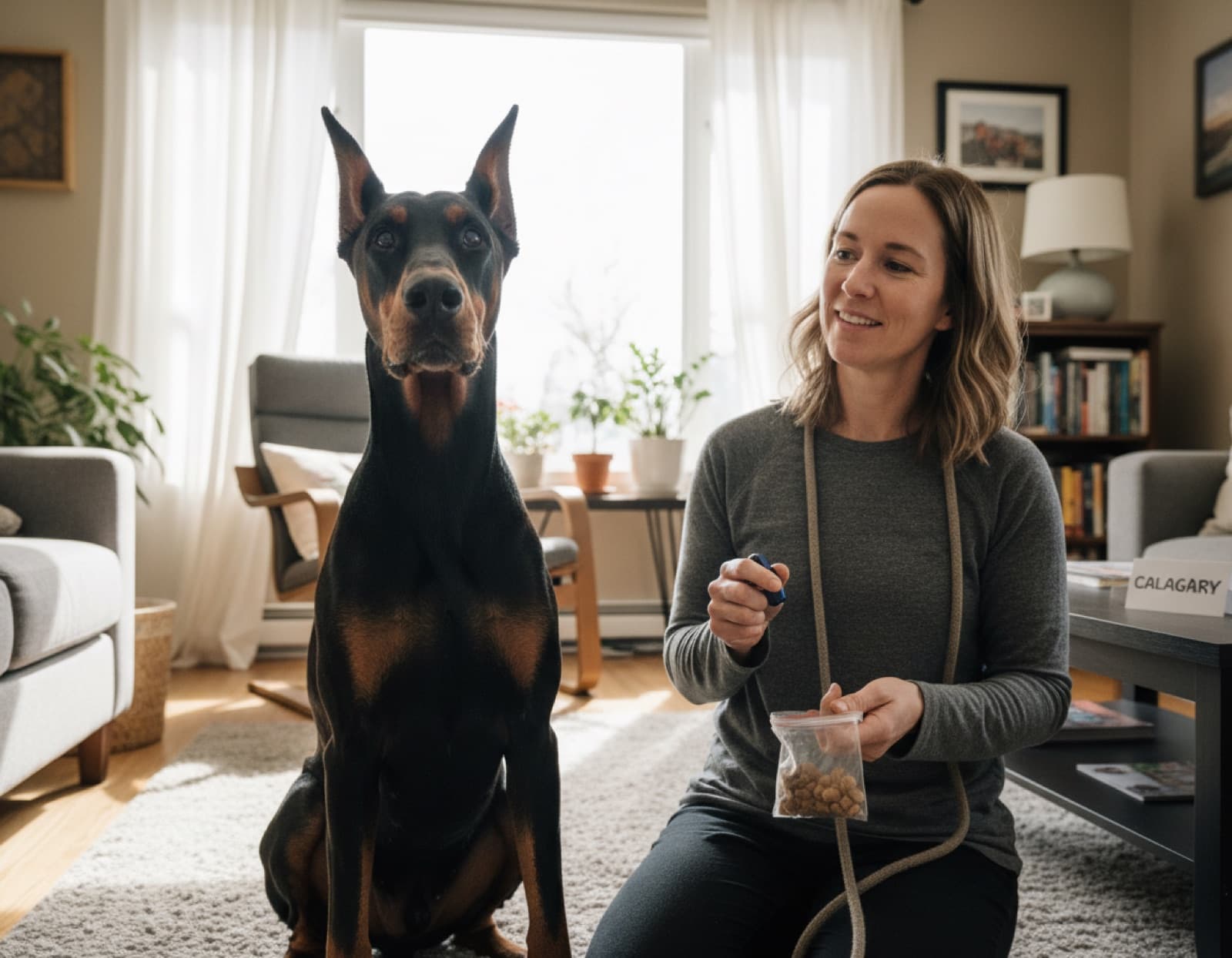
The stigma vs the reality
Dobermans look intimidating because they were designed to. Karl Friedrich Louis Dobermann, a 19th century German tax collector, deliberately bred a dog whose appearance alone would deter trouble. The breed succeeded on that brief. The modern Doberman, however, has been refined over more than a century toward stability, trainability, and human-bondedness, and the current breed standards reflect that.
The American Kennel Club Doberman Pinscher breed profile describes the temperament as “loyal, fearless, alert.” The standard explicitly disqualifies shyness and viciousness. The Canadian Kennel Club breed page reads the same way. The breed is intelligent, athletic, and intensely bonded to its people. It is not bred for aggression, and a Doberman who shows unprovoked aggression in temperament testing is faulted in the show ring.
The disconnect between the breed standard and the public reputation traces to two places. Decades of media depiction (The Omen, Magnum P.I., countless action films) cast the Doberman as a snarling guard. And separately, some working-line breeders through the 1960s and 1970s selected hard for protection work without enough attention to handler-stability balance, which produced a sub-population of dogs that were genuinely sharper than the standard intended. Modern responsible breeders, including the Calgary-area breeders that the Doberman Pinscher Club of Canada lists, have spent decades breeding back toward the standard.
The Doberman you meet at a Calgary rescue is rarely a 1970s working-line refugee. They are far more often a dog who was bought as a puppy by someone who saw them in a movie, then was raised without the socialisation, exercise, mental work, or training a working breed actually needs, and was surrendered at 18 months when the predictable consequences emerged. The dog is the breed standard. The previous home was not.
Where the aggressive-Doberman stereotype comes from
Understanding the stereotype matters because it shapes how Calgary neighbours, landlords, and insurers respond to your Doberman, and how often you will need to explain your dog to strangers. Three sources, in roughly descending importance:
- Selective breeding history. Karl Dobermann needed a dog tough enough to back him up on tax-collection rounds. The early breed was selected for guarding aptitude alongside intelligence and trainability. Through the early 20th century, the Doberman became the working dog of choice for police and military units in Germany and later the United States, including service in both World Wars. That working heritage shaped real genetic tendencies: alertness, environmental awareness, defensive drive when threatened. None of these are aggression in the modern behaviour sense, but they are the foundation a poorly socialised Doberman can default to.
- 1960s and 1970s line drift. Through the post-war decades, demand for personal protection dogs in North America drove some breeders to select hard for sharpness. The resulting sub-population of dogs was meaningfully different in temperament from what the breed standard called for. Modern responsible breeders have spent decades correcting this through careful selection, temperament testing, and outcrossing where genetics allowed. The dogs from this era are long gone, but their behavioural reputation persists in cultural memory.
- Media depiction. The Omen (1976) cast Dobermans as supernaturally menacing. Magnum P.I. featured guard Dobermans named Zeus and Apollo. Decades of action films and television have used the breed as visual shorthand for danger. Most Calgary adults who form first impressions of a Doberman are reading a film image, not a real dog.
The practical implication: a calm well-trained Doberman walking with their Calgary owner along the Bow River pathway is doing public-education work whether the owner wants the job or not. The dog's behaviour shapes whether the next person who meets a Doberman starts from fear or from curiosity.
What aggression actually looks like in Dobermans
“Aggression” is not one thing. In the behavioural literature it is several distinct patterns, each driven by different motivation, each requiring different response. Lumping them together is the most common training mistake Calgary Doberman owners make.
The four patterns most relevant to the breed:
- Territorial alerting. Barking at a person at the door, watching a stranger walk past the yard, alerting on a delivery driver. This is normal Doberman behaviour and is what the breed was developed for. It becomes a problem when the dog cannot disengage, when the alerting escalates to lunging or attempting to reach the person, or when the dog generalises every stranger as a threat. The fix is structured threshold work and reinforcing calm disengagement, not punishment of the initial alert.
- Fear-based reactivity. A dog who feels unsafe choosing offence over flight. Usually traces to missed socialisation, a frightening single-event learning experience, or chronic environmental stress in a previous home. Presents as lunging, barking, snapping at distance from people or other dogs. The dog looks aggressive but is actually overwhelmed. Aversive correction makes this worse because it adds threat. Force-free desensitisation and counter-conditioning at sub-threshold distance is the established protocol.
- Prey drive. Chase response to fast-moving animals (cats, squirrels, rabbits, cyclists, joggers). Distinct from aggression because it is not motivated by threat. Dobermans have moderate-to-high prey drive depending on individual genetics. Management (leash, fenced yard, recall work) is more reliable than trying to extinguish the drive. Around Calgary's off-leash perimeters and river paths, this matters: a Doberman with strong prey drive should not be off-leash in unfenced areas with abundant wildlife.
- Same-sex aggression. Dog-on-dog aggression specifically targeting dogs of the same sex, especially in same-breed households. The Doberman-specific genetic component gets its own section below because most adopters do not know it exists.
Reading which pattern is driving the behaviour is the first job of any force-free trainer or veterinary behaviourist. Treating fear-based reactivity with the protocol for territorial alerting (or vice versa) typically makes the problem worse. If a Calgary trainer is not asking what type of aggression they are looking at, that is a flag.
Same-sex aggression: the genetic predisposition adopters miss
The Doberman breed carries a known genetic predisposition to same-sex aggression. Two males or two females in the same household carry meaningfully higher risk of serious conflict than mixed-sex pairs. Most Calgary first-time Doberman adopters do not know this and learn it the hard way.
What it looks like in practice. Two same-sex Dobermans living together may coexist peacefully through adolescence, then have a sudden escalation around social maturity (typically 18 to 36 months). The fight is rarely the puppy squabble pattern other breeds show. Dobermans are large, athletic, and committed when they engage. Injury risk is real, and once the dogs have fought once, repeat fighting becomes substantially more likely.
The risk applies across spay and neuter status. Hormonal management reduces the risk somewhat but does not eliminate the genetic component. The Doberman Pinscher Club of America and reputable breed-specific rescues consistently advise against placing same-sex Doberman pairs into the same household unless very specific conditions are met.
The pairings that tend to work:
- One male and one female, both spayed and neutered
- Dogs raised together from puppyhood, sometimes
- One Doberman plus one dog of a different breed (sex-mixing still matters, but the same-sex genetics are breed-specific so cross-breed risk is lower)
The pairings to think hard about:
- Two adult male Dobermans
- Two adult female Dobermans (often higher risk than two males, contrary to expectation)
- Adding a second Doberman of the same sex to an existing single-Doberman household
If a Calgary rescue declines to place a second Doberman of the same sex into your home, that is matchmaking by people who have seen the failure cases. The right second dog for an existing Doberman household is usually an opposite-sex Doberman or a different breed entirely. If you already have two same-sex Dobermans and tension is developing, work with a force-free trainer experienced with multi-dog homes immediately, and if any real fighting starts, escalate to a board-certified veterinary behaviourist. Do not wait for a second incident.
Leash reactivity in rescue Dobermans
Leash reactivity is one of the most common behaviour patterns in Calgary rescue Dobermans, and one of the most fixable when approached correctly. A dog that lunges, barks, or stiffens at the sight of another dog while on leash usually traces back to one of three things: missed early socialisation, frustration at being restrained from investigating, or a previous frightening on-leash experience.
The protocol that works, drawn from the established force-free behaviour literature and supported by the American Veterinary Society of Animal Behaviour position statement on humane training, is desensitisation with counter-conditioning at sub-threshold distance.
What this looks like in Calgary practice:
- Identify the threshold distance at which your Doberman can see another dog and stay relaxed. For a moderately reactive dog this might be a full block. For severe reactivity it might be across a parking lot. Start there, not closer.
- Pick a route with predictable trigger appearances and good escape options. A wide pathway like the Bow River route past Edworthy Park lets you control distance better than a narrow sidewalk in Beltline.
- Mark and feed at every relaxed glance toward the trigger. Use very high-value food (cooked chicken, cheese, hot dog pieces). The marker creates the association: seeing a dog produces something good.
- End the session before the dog crosses threshold. Three relaxed encounters at distance beats one explosive one up close.
- Decrease distance gradually over weeks, not minutes. Premature distance reduction is the most common owner mistake.
What does not work, and actively backfires on Dobermans: leash pops, prong collars, e-collars, yelling, alpha rolls, or any tool whose mechanism is “the dog learns to stop reacting because reacting hurts.” The Doberman associates the pain not with their own reaction but with the trigger that appeared at the same time, and the underlying fear or frustration escalates. A Calgary trainer who recommends correction-based reactivity work for a Doberman is using the wrong protocol for this breed.
Force-free Calgary trainers including Raising Canine and Pup City Pup Academy run reactive dog classes that follow the desensitisation protocol. The investment typically resolves moderate leash reactivity within three to six months when the household stays consistent between sessions.
The critical 6 to 16 week socialisation window
If you are raising a Doberman puppy in Calgary, the 6 to 16 week socialisation window is the single most important period for shaping the adult dog. Missed window equals lifelong reactivity risk. The window does not pause for Calgary winter.
The AVSAB position statement on puppy socialisation is unambiguous: structured exposure starts before the vaccine series finishes, in carefully chosen low-risk settings. For a working breed like the Doberman, the consequences of missing the window are higher than for many other breeds, because the adult dog defaults to defensive alerting rather than calm confidence when foundation is missing.
What “socialisation” means for a Doberman puppy. Not flooding with strangers. Not a busy off-leash park before vaccines are complete. The goal is structured, positive, choice-based exposure to:
- People who look and sound different: tall, short, kids, seniors, hats, beards, hoods, mobility aids, deeper voices, higher voices
- Surfaces: gravel, grass, tile, metal grates, wood decking, snow once it lands in October
- Sounds: Chinook wind gusts, transit, kitchen appliances, vacuums, doorbells, traffic, recorded fireworks at low volume
- Calm, vaccinated adult dogs that the foster home or a force-free trainer has vetted, not free-for-all dog park interactions
- Brief friendly vet visits with no procedures: counter visit, treat, leave
- Handling: paw touches, mouth touches, ear touches, collar grabs, brushing, all paired with food
- Car rides that do not end at the vet
What to avoid: letting strangers hover-pet or hug the puppy, forcing interaction the puppy is declining, taking the puppy to a busy off-leash park before vaccines are complete, allowing uninvited dogs to charge or crowd the puppy, punishing the puppy for moving away from a stimulus.
Calgary winter timing. If your Doberman puppy's 8 to 14 week window falls in a deep cold snap, outdoor exposure is limited. Creative indoor socialisation works: pet store off-hours visits, parking garage walks, friends' homes, calm visits to a force-free puppy class. The window does not pause for Chinooks. A Doberman puppy who spent January and February in the basement because it was cold outside reaches 16 weeks with the same socialisation deficit as a puppy who spent that time in a kennel. Plan for it.
A Doberman whose socialisation window is missed cannot be fully rebuilt later. Behaviour work after 16 weeks is rehabilitation, not foundation, and the prognosis is meaningfully worse. This is the single highest-stakes period in the dog's life.
Force-free training fundamentals
Aversive tools on a Doberman are the fastest way to manufacture defensive aggression. This is not opinion. It is the formal position of the AVSAB, the American Veterinary Medical Association, and the IAABC, and it applies with extra weight to sensitive working breeds.
What “aversive” means in this context: prong collars, e-collars, choke chains, leash pops, alpha rolls, pin-downs, dominance theory, hitting, yelling-as-correction. Any method whose mechanism is “the dog learns to avoid the punishment.”
Why this matters specifically for Dobermans. The breed is bright, sensitive, and intensely handler-bonded. Aversive correction does not teach a Doberman to comply. It teaches the Doberman that the handler is unpredictable and that defensive behaviour is necessary. Combined with the breed's natural alertness and protective drive, you can manufacture a dangerously reactive adult dog through six months of prong-collar training that started with the best intentions. The IAABC position statement and the IAABC clinical animal behaviour consultant directory both reflect this consensus.
What force-free training actually looks like for a Doberman:
- Reward-based marker training. A clicker or verbal marker (“yes”) followed by food. The dog learns precisely which behaviour earned the reward.
- Positive reinforcement for the behaviours you want. Calm sit at the door earns a treat. Quiet body posture in the presence of a stranger earns a treat. The behaviours you reinforce are the behaviours you get.
- Recall as the priority skill. Dobermans have moderate-to-high prey drive and high cognitive engagement; a reliable recall is the difference between a Doberman who can earn off-leash time in fenced Calgary off-leash zones and a Doberman who must stay leashed for life.
- Loose-leash walking with a flat collar or front-clip harness. No prong, no choke, no e-collar.
- Engagement and impulse control work. Eye contact on cue, place training, settle on a mat. The skills that make daily life manageable.
- Counter-conditioning for reactivity. The protocol described in the leash reactivity section, applied to whatever the dog is reactive about.
Vetting a Calgary trainer for a Doberman. Ask three questions before booking: (1) Do you ever use prong, choke, or e-collars? (Correct answer: no.) (2) Have you worked with working breeds like Dobermans, German Shepherds, Belgian Malinois? (Correct answer: yes, with examples.) (3) What do you do when a dog growls at you during a session? (Correct answer: I add distance and reassess; I do not correct the growl.) If the trainer fails any of these, leave. There are enough force-free options in Calgary that there is no reason to compromise on a Doberman.
Mental enrichment for a working breed
Calgary owners consistently underestimate the mental work a Doberman needs. The breed was developed for jobs that combined physical work with cognitive engagement: protection work, military service, search-and-rescue, police work. A Doberman who gets a long walk but no mental challenge is a Doberman who finds their own work to do, and that work usually looks like destructive chewing, fence patrolling, hyper-arousal in the home, obsessive licking, or developing same-household conflict.
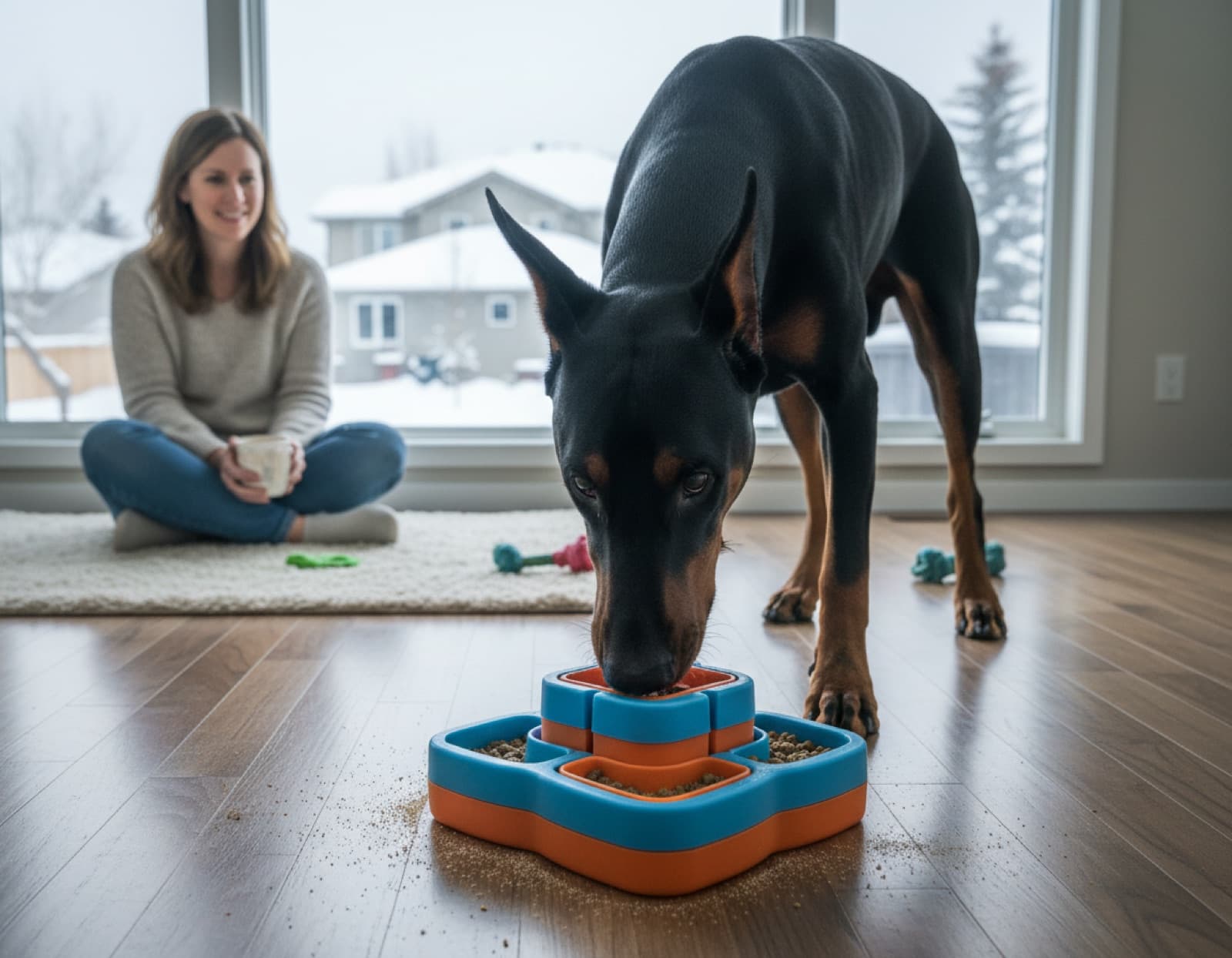
Plan for 30 to 45 minutes of structured mental work daily on top of physical exercise. This is not optional for the breed. Options that work for Calgary Dobermans:
- Obedience drills. Five to ten minute sessions of focused reward-based training throughout the day. Sit, down, stay, recall, place, leave it, drop it. Daily, brief, and high-frequency beats one long session.
- Scent work. Hiding food or scented objects around the house or yard. The dog uses their nose to find them. Mentally taxing in a way that physical exercise is not.
- Puzzle feeders and slow-feed bowls. Replacing the food bowl with puzzle feeders for at least one meal a day. Cheap, effective, and the dog earns their food through problem-solving.
- Trick training. Beyond basic obedience, into spin, bow, paw target, retrieve to hand, place an object in a basket. Builds cognitive engagement and reinforces the handler-bond.
- Structured tug. Tug with rules (start on cue, release on cue, no teeth on skin) is excellent for a Doberman's drive without being problematic. Tug as a free-for-all is not.
- Recall practice. In progressively distracting environments. A Doberman with a reliable recall earns more freedom; a Doberman without one is leashed forever.
- Agility, rally obedience, nosework, or dog sports. Calgary has structured dog sport options, and Dobermans excel at most of them. The handler-engagement and physical-plus-mental combination is what the breed wants.
The pattern most Calgary Doberman surrenders follow: dog is exercised physically but not mentally, dog develops bored-Doberman behaviour at 14 to 20 months, owner labels the dog “too much,” dog is surrendered. The fix is not more walking. The fix is more thinking.
Resource guarding in rescue Dobermans
Resource guarding is relatively common in adult Doberman rescues, particularly dogs coming from unstable or food-insecure backgrounds. A dog that stiffens when approached while eating, growls over a high-value chew, or guards a sleeping spot is showing one of the most common behaviour patterns in shelter and rescue dogs of any breed.
The protocol that works is trade-up training. The protocol that does not work is taking the item away, alpha-rolling the dog, or punishing the growl.
Management first. Prevent rehearsal of the guarding behaviour while training catches up. Feed the dog in a quiet room with the door closed. Pick up high-value chews when not directly supervising. Teach household members, especially children, not to approach the dog with food or bones. Do not reach into the food bowl while the dog is eating. Do not take items away by hand.
Then training. Trade-up exercises change the dog's association with people approaching their resource. The protocol:
- Approach the dog while they have a low-value item (a piece of kibble, a boring chew).
- Drop a higher-value treat near them as you approach (cooked chicken, cheese).
- Walk away.
- Repeat dozens of times across days. The dog learns that a person approaching their resource produces an upgrade, not a removal.
- Gradually increase the value of the item the dog has while running the exercise.
For mild guarding, a force-free Calgary trainer can guide the protocol. For severe guarding (snapping, biting, guarding from primary household members, guarding that is escalating despite trade-up work), escalate to a board-certified veterinary behaviourist. Do not wait. Resource guarding that progresses to a bite incident is a high-stakes situation for both the dog and the household.
When to involve a veterinary behaviourist
A force-free trainer is the right starting point for most Doberman behaviour work. A board-certified veterinary behaviourist (DACVB) or a qualified IAABC clinical animal behaviour consultant is the right escalation when the situation crosses specific lines.
Escalation criteria. Call a veterinary behaviourist if any of these apply:
- The dog has bitten with skin contact, punctures, or multiple bites in one incident (not just an air-snap)
- Aggression has appeared or worsened suddenly in an adult dog, after a thorough medical workup has ruled out (or identified) pain
- Aggression is generalised rather than tied to a single predictable trigger
- The dog is showing aggression toward primary household members, not just strangers
- Severe separation panic that is not responding to early intervention (defer to the dedicated Doberman velcro and separation anxiety guide for the full protocol)
- Two same-sex Dobermans in the household with developing tension
- Children are in the household and the situation feels unsafe for them
- Two or more force-free trainers have flagged the case as out of their scope
What a veterinary behaviourist does. A DACVB is a licensed veterinarian with post-graduate specialty training in behaviour medicine. They can rule out and treat medical contributors, co-manage cases with your force-free trainer, and where appropriate prescribe behaviour-supporting medications as part of an integrated plan. We do not recommend any specific medication in this article. Medication decisions belong with the prescribing clinician who has examined the dog.
How to get a referral in Calgary. Start with your regular vet, who can refer to a DACVB. In Alberta the nearest specialists are typically based in larger centres and some offer remote-consultation models for Calgary cases. Western Veterinary Specialist Centre and VCA Canada West are the Calgary specialty practices most commonly involved when a referral is needed. An IAABC certified consultant can also be approached directly without a vet referral, though for a true aggression case the integrated medical-and-behaviour model is preferable.
Do not wait for a serious incident. A Doberman that air-snapped once at a visiting child is the right time to escalate, not the time to dismiss. Early intervention has a much better prognosis than crisis intervention after a bite.
Browse adoptable Dobermans in Calgary
Most Calgary rescue Dobermans are stable family dogs whose previous owners did not put in the socialisation, mental work, or force-free training the breed needs. The dog is rarely the problem.
See Available Dobermans →Calgary force-free trainer referrals
The Calgary trainers most commonly recommended within the Pawfinder rescue network for working breeds use force-free, reward-based methods exclusively. Two practices most often cited:
- Raising Canine. Calgary force-free training practice with experience across working and guardian breeds. Offers private consultations, group classes, and reactive dog programming. Confirm current intake and class schedule directly with them.
- Pup City Pup Academy. Calgary positive-reinforcement trainer working with rescue dogs and working breeds. Group classes plus private sessions. Same vetting questions apply: no prong, no choke, no e-collar.
The IAABC directory linked above also lists certified consultants serving Calgary by remote consultation, which can be useful for cases where in-person specialty isn't immediately available locally. For any Doberman behaviour work, the trainer's experience with sensitive working breeds matters more than proximity. Drive an extra ten minutes for the right trainer if needed.
The honest reality of most Calgary rescue Dobermans
The dog that comes home from a Calgary rescue is rarely the snarling Doberman of public imagination. Most are dogs whose previous owners did one or more of the following: bought a puppy from an inappropriate source without breed research, skipped the socialisation window, used aversive training tools, did not provide the mental work the breed needs, allowed same-sex household conflict to develop, or ran into financial constraints when cardiac monitoring or other medical work became necessary. The dog is then surrendered as “too much,” “aggressive,” or “not the right fit.”
At Calgary rescues including the Calgary Humane Society, AARCS, BARCS Rescue, and the broader rescue foster network, these dogs go into foster homes where their temperament is observed in a real household. The foster home learns the dog's actual reactivity profile, their socialisation gaps, their training history, and what they need in their next home. The rescue then matches the dog to an adopter prepared to do the work.
The honest reality is that the Doberman you bring home from a Calgary rescue is far more often a dog who has been failed by humans than a dog who is genuinely dangerous. The breed responds to thoughtful ownership with the steady, loyal, balanced adult dog the breed standard describes. The breed responds to careless ownership with the reactive dog of public stereotype. The difference is the household, not the genetics.
If you are considering a Doberman adoption, plan to do the work described in this guide before the dog comes home. Set up the force-free trainer, plan the mental enrichment schedule, talk to your insurance broker about the breed restriction (Dobermans are commonly restricted on Canadian home insurance, addressed in detail in the Doberman adoption Calgary guide), and align the household on the breed's needs. The dogs surrendered to rescue are very often dogs whose adopters hoped to be the exception. Plan for the work instead.
Sources and further reading
- American Kennel Club: Doberman Pinscher breed profile and temperament standard
- Canadian Kennel Club: Doberman Pinscher breed standard
- American Veterinary Society of Animal Behaviour (AVSAB): position statements on puppy socialisation and humane training
- International Association of Animal Behaviour Consultants (IAABC): clinical animal behaviour consultant directory
- Doberman Pinscher Club of America: breed temperament and welfare resources
This article is informational. It is not behavioural or veterinary advice for an individual dog. For specific aggression, fear, or pain concerns, work with your Calgary veterinarian, a force-free trainer experienced with working breeds, and where appropriate a board-certified veterinary behaviourist.
Frequently Asked Questions
Are Dobermans really that aggressive?
Not inherently. The modern American Kennel Club and Canadian Kennel Club breed standards both prioritise balanced, stable temperament, not aggression. A well-bred and well-raised Doberman is alert, loyal, and discerning rather than reactive. Most of the aggressive-Doberman reputation traces back to 1970s working-line selective breeding for guard work, media depictions like The Omen, and breeder ethics deterioration in some lines. Real aggression risk in Dobermans is usually environmental: missed early socialisation, fear-based reactivity in rescue dogs from unstable backgrounds, undiagnosed pain, same-sex household conflict, or the use of aversive training tools on a sensitive working breed. A Calgary Doberman raised with structured socialisation and force-free training is typically a steady family dog.
Can two female Dobermans live together?
Generally not recommended. Same-sex aggression is a known genetic predisposition in the Doberman breed, and it applies to two females as much as two males. Mixed-sex pairs (one male, one female, both spayed and neutered) are the safer same-household configuration. Two-Doberman homes that work tend to involve dogs raised together from puppyhood, opposite sexes, careful resource management, and adults who actively prevent rehearsal of conflict. Calgary rescues will often decline to place a second Doberman of the same sex into an existing Doberman home, and this is matchmaking, not gatekeeping. If the conflict starts, escalation in adult Dobermans can be sudden and serious. Consult a force-free trainer or veterinary behaviourist before adding a second Doberman.
How do I socialize an adult rescue Doberman?
Slowly, with choice, and never by flooding. An adult rescue Doberman whose 6 to 16 week socialisation window was missed cannot be retroactively given the same foundation a puppy gets, but you can build confidence and reduce reactivity through structured exposure. Start at distance: pick environments where the dog can see triggers (people, dogs, traffic) at a range where they stay relaxed, pair every glance at the trigger with high-value food, and end before the dog crosses threshold. Calgary force-free trainers experienced with working breeds run reactive dog classes that use this exact protocol. Avoid busy off-leash parks, do not force greetings, and respect when the dog turns away. Progress is measured in months, not weeks. Most rescue Dobermans settle into a stable adult temperament within six to twelve months when the work is done right.
Why is my Doberman suddenly reactive on leash?
New leash reactivity in an adult Doberman is almost always one of three things. First, missed early socialisation catching up as the dog matures, particularly between 14 and 24 months when working breeds finish neurological development and become more environmentally reactive. Second, leash frustration: the dog wants to investigate but cannot, and barrier frustration looks identical to aggression. Third, and most under-diagnosed, pain. Sudden behaviour change in an adult Doberman is medical until proven otherwise: dilated cardiomyopathy, hip and elbow issues, cervical spondylomyelopathy (Wobbler syndrome), and dental disease all drive new reactivity. Get a thorough vet workup first, then work with a Calgary force-free trainer on the behaviour piece. Aversive correction will make leash reactivity worse, not better.
What is the critical socialisation window for a Doberman?
Roughly 6 to 16 weeks of age, with the heaviest weight on 8 to 14 weeks. This window is consistent across breeds per the American Veterinary Society of Animal Behaviour guidance, and for Dobermans it is especially load-bearing because the breed is alert, environmentally aware, and prone to defensive reactivity when foundation is missing. A Calgary Doberman puppy in this window needs structured exposure to a wide variety of people, surfaces, sounds, calm vaccinated dogs, and handling, all paired with food and choice. Calgary winter timing matters. If the window falls during a minus 25 stretch, plan creative indoor socialisation: pet store off-hours visits, parking garages, friends and family homes, a force-free puppy class. The window does not pause for cold snaps, and missing it has lifelong behavioural consequences.
Do Dobermans need a lot of mental stimulation?
Yes, more than most owners expect. Dobermans are a working breed with high cognitive drive, and physical exercise alone does not satisfy them. Plan for 30 to 45 minutes of structured mental work daily on top of physical exercise: obedience drills, scent work, puzzle feeders, trick training, structured tug games with rules, recall practice, or low-level agility. A Doberman that gets a long walk but no mental work tends to find their own work to do, and that work usually looks like destructive chewing, fence patrolling, hyper-arousal in the home, or developing obsessive behaviours. Calgary owners often underestimate this on adoption and surrender the dog at 14 to 20 months when the bored-Doberman behaviour pattern crystallises. The mental work is non-negotiable for the breed.
Can I use a prong collar or e-collar on a Doberman?
No. The American Veterinary Society of Animal Behaviour, the American Veterinary Medical Association, and the International Association of Animal Behaviour Consultants all formally recommend force-free, reward-based training methods as both more effective and lower-risk for aggression than aversive methods. Dobermans are a sensitive working breed and respond to pressure with escalating defensiveness rather than compliance. Prong collars, e-collars, leash pops, alpha rolls, and pin-downs tend to manufacture defensive aggression in this breed faster than in many others. If a Calgary trainer recommends any of these tools, find a different trainer. Force-free options are widely available in Calgary, and there is no reason to compromise on a Doberman.
How do I handle resource guarding in a rescue Doberman?
Manage first, then train. Management means preventing rehearsal: feed the dog in a quiet room, pick up high-value chews when not supervised, do not approach the dog while they have food or a bone, and teach household members not to take items away. Training means trade-up exercises: approach the dog while they have a low-value item, drop a higher-value treat near them, walk away. Repeat until the dog associates a person approaching their resource with something good appearing. Never punish a growl, never force-take an item, and never use the alpha-roll dominance approach with a guarding dog. For mild guarding, a Calgary force-free trainer can guide the protocol. For severe guarding (snapping, biting, or guarding from primary household members), escalate to a board-certified veterinary behaviourist (DACVB). Do not wait for an incident.
When should I call a veterinary behaviourist for my Doberman?
Escalate from a force-free trainer to a board-certified veterinary behaviourist (DACVB) or a qualified IAABC clinical animal behaviour consultant when: the dog has bitten with skin contact or punctures (not just air-snapped), aggression has appeared or worsened suddenly in an adult (medical workup first), aggression is generalised rather than tied to a specific predictable trigger, the dog is showing aggression toward primary household members, fear or panic is rapidly escalating and not responding to early intervention, or the household has two Dobermans of the same sex with developing tension. A DACVB is a licensed veterinarian with post-graduate specialty training in behaviour medicine. Calgary owners typically need a referral from their regular vet. Do not wait for a serious incident; early escalation has a much better prognosis.
How long does it take a rescue Doberman to settle in Calgary?
Six to twelve months is the realistic timeline for full settling, with measurable progress in the first three months. The decompression period is roughly the first three weeks: minimise outings, no visitors, no busy environments, no demands beyond house training and basic routine. Months one to three are foundation: predictable schedule, force-free training class, learning the household rhythm, building handler bond. Months three to six are the work phase: structured socialisation, addressing any reactivity, building confidence in Calgary-specific environments (river paths, off-leash perimeters, winter walks). Months six to twelve are integration: the dog becomes a settled household member. Pushing the timeline forward almost always backfires. Most behaviour problems in newly adopted Calgary Dobermans trace back to the first three weeks being treated as a normal household transition rather than a decompression.
Doberman Adoption Calgary
Where to find Dobermans in Calgary, rescue vs breeder costs, Doberman rescue verification, free-Doberman warning signs, ear-crop and tail-dock ethics.
Doberman Velcro and Separation Anxiety
Why Dobermans bond so intensely, the difference between velcro behaviour and clinical separation anxiety, and the force-free protocol for alone-time training.
Doberman Health Issues
Dilated cardiomyopathy, cervical spondylomyelopathy, hip and elbow dysplasia, and other Doberman-specific health concerns Calgary owners need to plan for.
Dobermans for Adoption in Calgary
Current Doberman and Doberman-mix listings from Calgary Humane, AARCS, BARCS, and the partner rescue network. Updated regularly.
New dog? Start with these care guides
Everything a new adopter needs to set up a safe, happy home.