The short answer
Yes, Great Danes are “heartbreak dogs” in the sense the breed community means it: a 7 to 10 year average lifespan paired with an unusually deep bond. The breed suits Calgary households with detached-home space, a giant-breed budget ($200 to $300 a month in food, higher vet costs, pet insurance from day one), a support network of a giant-breed-experienced vet, and emotional preparation for an earlier goodbye. The breed is wrong for apartment dwellers, tight-budget households, and first-time owners without that network. Most Dane owners who have been through the loss say they would do it again.
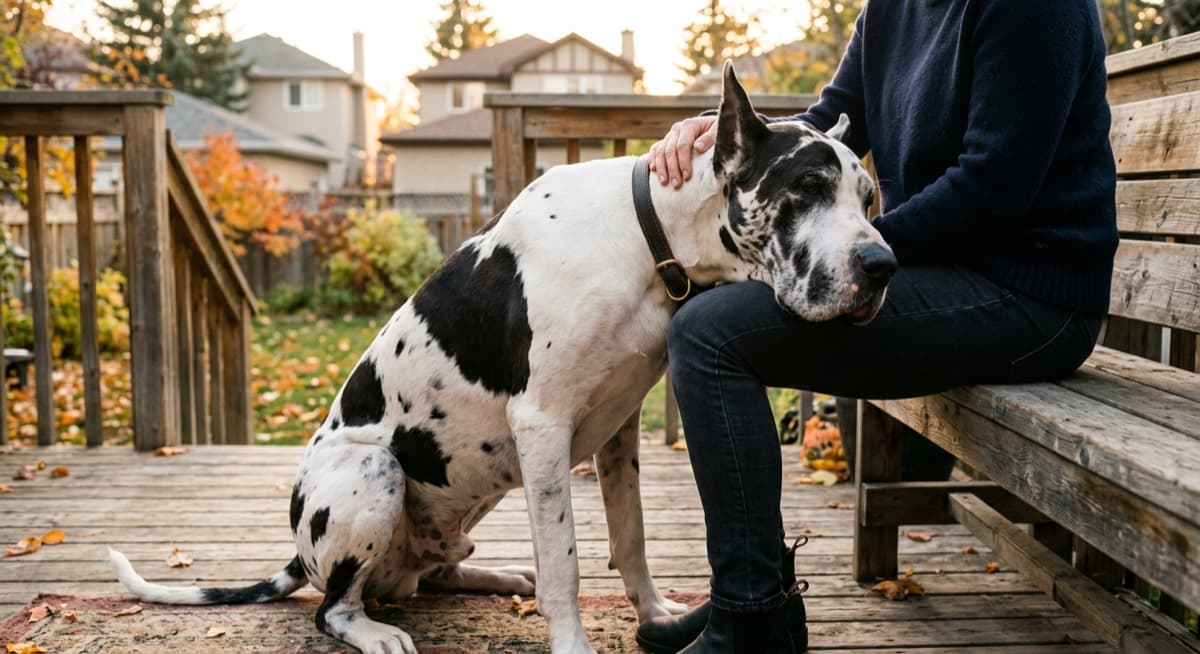
Search Reddit for “Great Dane lifespan” and the same threads come back: 100 to 180 comments, families asking whether the breed is really a heartbreak dog, and owners answering yes, and yes, and yes again. The replies that follow are the part most prospective adopters need to see. Owners describe the grief as harder than they expected. They also describe the daily relationship as worth it, and most of them adopt another Dane. This article is the decision guide that question deserves: what the label actually means, the honest pros and cons, which Calgary households the breed fits, and which it does not.
What “heartbreak dog” actually means
The phrase shows up across breed forums, rescue intake notes, and veterinary literature. It captures two facts together. First, Great Danes live an average of roughly 7 to 10 years, according to the American Kennel Club and the Great Dane Club of America. That is roughly five years shorter than a Labrador and roughly seven years shorter than a small breed. The size that defines the Dane is the same trait that shortens lifespan, a pattern that holds across giant breeds.
Second, the bond owners build with a Dane is unusually intense. Danes are leaning dogs. They follow their people from room to room, they rest their heads on laps and beds, they are physically present in the household in a way smaller breeds are not. The bond is not deeper because the dog is “better.” It is deeper because the dog is constantly with you, weighs 100 to 175 pounds, and is hard to ignore in a way a Beagle is not.
Put those together and you get the heartbreak pattern: a fast, deep attachment to a dog who will probably leave the household before you are ready. The breed-defining medical emergency, bloat (GDV), can also shorten the timeline further; the American Veterinary Medical Association lists GDV among the top emergencies in giant breeds. The deeper conditions and breed health detail belong on our main Great Dane adoption guide; this page focuses on the decision.
Honest pros of the Great Dane
The Dane pros that recur across owner reports are specific, not the generic “loving and loyal” lines that apply to every breed.
- Calm, quiet, gentle temperament. Adult Danes are famously low-key indoors. Most prefer the couch to the yard, and most have softer reactivity profiles than working breeds of similar size. The Great Dane Club of America describes the breed as a friendly companion dog, not a working or guarding line.
- Presence and bond. A Dane in the home is impossible to overlook. Owners describe the daily relationship as more attached than they have had with smaller dogs.
- Surprisingly moderate exercise needs. Two walks a day, 30 to 45 minutes each, is enough for most healthy adult Danes. They are giant, but they are not Border Collies. Calgary's shorter walking seasons fit the breed reasonably well.
- Good with kids over five, with supervision. Most Danes are patient with children, and the breed's usual reaction to small noisy humans is to walk away rather than escalate. Knock-over risk is real with toddlers (covered below), but temperament is rarely the issue.
- Visible in public. A Dane in Calgary's off-leash spaces (Nose Hill, Fish Creek, Bowmont) gets stopped constantly. Owners who enjoy the social side of dog ownership find this part fun. Owners who do not are warned to choose another breed.
- The community. Dane owners gravitate toward other Dane owners. The breed has a tight informal network: meetups, online groups, second-Dane mentorship between owners. The community itself becomes part of the value of owning the breed.
Honest cons of the Great Dane
The cons matter more than the pros for the decision, because the pros are obvious from photos and the cons are what catches owners off guard.
- Short lifespan. 7 to 10 years is the headline. Plan for grief at year 8 or 9, not year 14. A Dane adopted at age 2 is roughly a 5 to 8 year companion in realistic terms.
- Cost reality. Food alone commonly runs $200 to $300 a month in Calgary, and giant-breed vet doses scale with body weight. Surgery, anesthesia, and medication costs are higher than for medium dogs because they price per pound. Pet insurance is essentially mandatory for a planned Dane budget.
- Space. A 150-pound dog needs floor space, not just a yard. Apartments in Calgary's Beltline, Bridgeland, or Inglewood often have weight limits that exclude Danes outright, and stairs become a daily joint strain.
- Knock-over risk with toddlers. Most Dane injuries to small children are accidental, not behavioural. A tail at hip height swings into a toddler's face. A turning shoulder flattens a small child. Most Calgary rescues prefer to place Danes in homes with kids aged five and up.
- Drool, shedding, leaning. Danes drool, and they leak it onto walls, couches, and visitors. They shed short coarse hair that embeds in fabric. They lean on people, which is endearing when it is your dog and uncomfortable when you are someone else.
- Separation anxiety risk. The same bond that makes the breed feel close also makes Danes prone to separation anxiety. Households that leave a dog alone for full work days need a plan: a dog walker, daycare a few days a week, or a partner working from home.
- Bloat and other giant-breed conditions. Bloat (GDV) and dilated cardiomyopathy (DCM) are real and serious. The breed's health profile is heavier than average, and a single medical event can rewrite a year of family budget. See our main Dane guide for full health detail.
- Drag on home decor. Couches absorb dog. Hallways become slow zones. Coffee-table items move. The breed is hard on furniture not because Danes are destructive but because they are physically large in a normal-sized house.
Who Great Danes are right for
The breed fits a fairly narrow profile of Calgary households. The criteria below are common to successful Dane adoptions in the breed's rescue intake notes.
- Detached home with space and minimal stairs. Single-storey or two-storey homes with a fenced yard suit Danes best. Bungalows in established Calgary neighbourhoods like Bowness, Killarney, or Acadia work especially well for senior Danes.
- Budget room for $300 to $500 a month above the adoption fee. Food, pet insurance, gear, and routine vet care add up. Households where that number is comfortable, not stretched, do better with the breed.
- Adults or families with kids aged five and up. The temperament is friendly enough for kids; the size argues against toddlers.
- Owners who want a calm, present dog. Danes are companions, not adventure dogs. Households that want a co-worker at the home office, a couch buddy, a steady presence in the family suit the breed better than households that want an athletic partner.
- Households that can plan emotionally for a 7 to 10 year commitment. Saying out loud “this dog will probably die before our kids are in high school” is hard, but it is the right conversation to have at the application stage, not at the grief stage.
- Access to a giant-breed-experienced Calgary vet. Anesthesia protocols, weight-management plans, and breed-specific health screening for DCM and joint issues are easier with a vet who has handled Danes before. Build that relationship before adoption, not after the first scare.
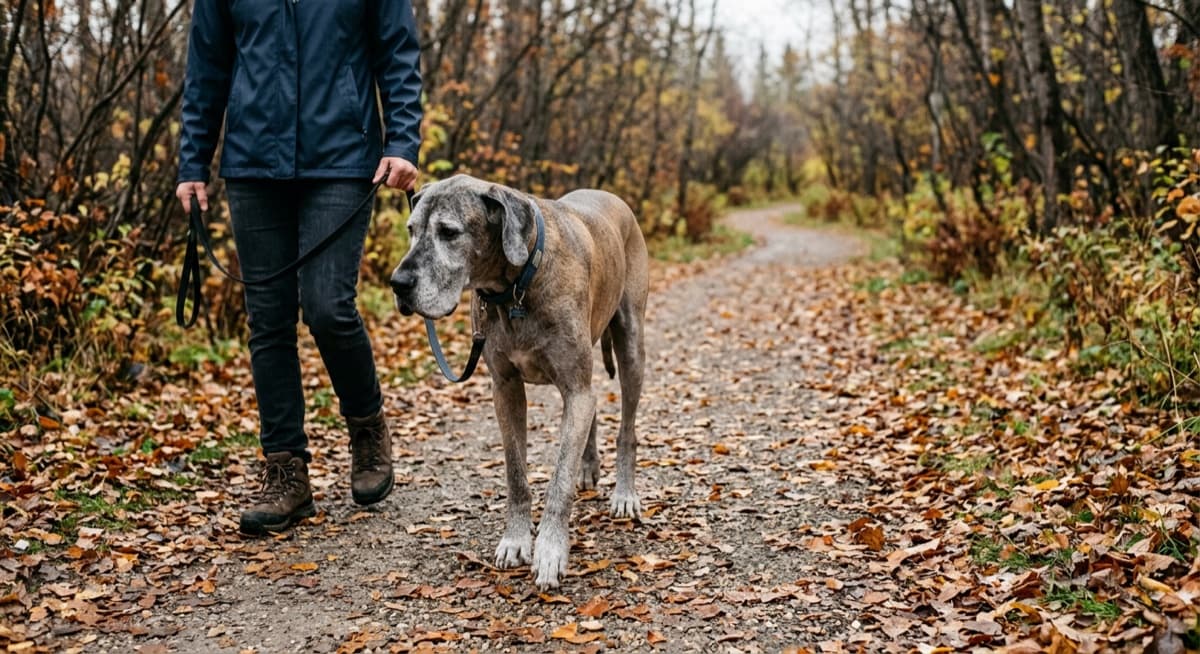
Who Great Danes are NOT right for
The mismatch patterns below are specific. None of them are character flaws; they are real reasons the breed will create more stress than reward.
- Apartment dwellers. Even the largest Calgary apartments often carry weight limits, stair tolls, and elevator etiquette challenges that make Dane life harder than it needs to be. The breed survives in apartments; it does not thrive there.
- Tight-budget households. If the monthly numbers do not have $300 to $500 of breathing room for food, insurance, and routine care, a Dane will push the household into financial stress within the first year. Adopting a Lab or a medium mixed breed leaves you the same dog-love with less budget risk.
- First-time owners without a giant-breed support network. The Dane is not a beginner-friendly breed by default. First-time owners who have a giant-breed-experienced vet, a force-free trainer, and a Dane owner mentor lined up before adoption do fine. Without that scaffolding, the learning curve is steep and the cost of mistakes is real.
- Families with toddlers or babies on the way. Knock-over risk and the household stress of a new baby plus a giant dog rarely combine well. Many Calgary rescues will steer families with toddlers toward a medium breed and a future Dane.
- Households that travel often without the dog. Boarding a Dane is expensive (giant-breed surcharges are common at Calgary kennels), and friend-network favours are harder to ask for. If the household is gone weekends or full work weeks, a smaller, more boardable dog is gentler on the dog and the wallet.
- Households that would not handle an early loss. If the idea of losing a dog at age 8 changes from “hard but bearable” to “I do not think I could do it,” the breed is not the right one. Choose a longer-lived breed. The grief at year 8 with a Dane is real, and not every household's mental-health profile is set up for it.
Why owners still say it was worth it
The most consistent finding in the breed forums is the “still worth it” reply. Owners who have lost a Dane describe the years leading up to the loss in unusually warm language, and most adopt again. A few reasons that pattern holds:
- Daily quality of relationship. Most owners describe the day-to-day with a Dane as easier and more affectionate than dog-life with smaller, busier breeds. The trade-off is fewer years, with better years.
- The bond is part of the gift. Owners who pre-grieve a Dane describe the depth of the bond as the same trait that makes the loss hard. Removing the bond removes the breed appeal.
- Repeat adopters dominate the community. The breed's rescue intake notes show repeat Dane families more often than first-timers. People who have done it once tend to do it again. That is the strongest endorsement the breed has.
- The breed's temperament is rare. Calm, gentle, leaning, household-attached giant breeds are not common. Mastiffs and St. Bernards share parts of the profile but none of them sit on couches quite the way a Great Dane does. Owners who fall in love with that specific profile do not substitute another breed easily.
The honest framing most experienced Dane owners give: shorter than I wanted, worth every year, would not pick a different breed.
Preparing emotionally before adoption
The emotional preparation matters as much as the financial preparation. A few patterns Calgary Dane owners describe:
- Pre-grief is normal. It is common to grieve a Dane while they are still healthy. The lifespan reality lives in the background of daily life, especially after year five. That is not a sign you bonded wrong; it is a sign you understood the breed.
- Build the support network early. A Calgary vet experienced with giant breeds, a force-free trainer, and an established Dane owner mentor inside the first year. The community part matters: Dane owners help other Dane owners through the hard months in a way breed-agnostic friends usually cannot.
- The two-Dane pattern. Some owners get a second Dane while the first is still healthy, so the household has a younger dog when the senior passes. It eases the household transition without removing the grief. It costs more during the overlap and adds adolescent energy to a senior's last years. Some families prefer it; others prefer to grieve fully before adopting again. Both are legitimate.
- Plan the end-of-life conversation early. Decide in advance how the household will handle medical decisions when they come. Whether you would choose surgery for a senior Dane with bloat. What in-home vs. clinic euthanasia would look like. Having had the conversation when the dog is healthy lowers the cost of having it when the dog is sick.
- Lean on the community. Calgary Dane meetups exist informally through rescue networks. Reddit's r/greatdanes and r/dogs are active. The breed's grief support is one of the most consistent themes in those forums and a real resource when the year-8 conversations start.
See Great Danes available now
If the decision lands on yes for your household, browse the Calgary Great Dane breed page. Listings refresh regularly across 15+ rescues, and giant-breed openings move fast.
Browse Calgary Great Danes →Calgary readiness checklist
Before applying, the household can pressure-test itself against these criteria. Most successful Calgary Dane adopters can answer yes to all of them.
- Space: a detached or semi-detached home, ideally with a fenced yard and minimal stair use for the dog. Confirm rental terms allow giant breeds if the household rents.
- Cost: $300 to $500 a month of budget room above the adoption fee, plus a separate emergency fund of $3,000 to $5,000 for unplanned giant-breed vet events. See our Calgary adoption costs guide.
- Pet insurance: price a policy with a giant-breed-aware provider before adopting, not after. Premiums for Danes commonly run higher than for medium breeds because of bloat and DCM risk.
- Vet relationship: identify a Calgary vet experienced with giant breeds and book a first-visit consult before bringing the dog home. Ask explicitly about gastropexy timing and DCM screening protocols. The Orthopedic Foundation for Animals publishes breed-specific screening recommendations a vet can walk through with you.
- Bylaw and licence: Calgary requires a dog licence for every dog three months and older under the Responsible Pet Ownership Bylaw. See our Calgary dog bylaws guide.
- Family alignment: every adult in the household has said yes out loud, including the part about the 7 to 10 year lifespan. Surrenders happen most often when one partner committed and the other did not.
- Schedule: someone is home for most of the day, or there is a budget for daycare or a dog walker for the work hours. Separation anxiety is a real risk in the breed.
- Climate plan: a coat for routine winter walks, paw care for sidewalk salt, and shorter outings during Chinook swings and below -20°C cold snaps. Danes are short-coated and Calgary winters require adaptation.
If most of those land in the “yes” column, the breed is a realistic choice. If several land in the “maybe” or “no” column, the same affection can come from a Mastiff mix, an adult Lab, or a slower senior dog with a longer lifespan ahead.
Frequently Asked Questions
Are Great Danes really heartbreak dogs?↓
How long do Great Danes live on average?↓
Is it worth getting a Great Dane knowing the short lifespan?↓
Who should NOT get a Great Dane?↓
How do you cope with knowing they have a short lifespan?↓
Should I get a second Great Dane while the first is alive?↓
Are Great Danes good first-time dogs?↓
What do most Great Dane owners say after their first?↓
Continue reading
Great Dane adoption in Calgary
Where Danes appear, what they cost, the bloat warning, breed health concerns, and Calgary climate notes for short-coated giants.
Great Dane bloat (GDV) guide
The breed-defining emergency: symptom recognition, the gastropexy conversation, and the Calgary 24-hour emergency vet plan every Dane owner needs.
Great Dane cost of ownership
Year-one and lifetime budget for a Great Dane in Calgary: food, insurance, vet care, and what most first-time owners miss.
Browse Calgary Great Danes
Currently available Great Danes and Dane mixes across 15+ Calgary rescues, refreshed regularly.
New dog? Start with these care guides
Everything a new adopter needs to set up a safe, happy home.