The short answer
Great Dane rescues in Calgary screen carefully because giant-breed returns are common when adopters are unprepared. Apply across Calgary Humane Society, AARCS, Pawsitive Match, ARF Alberta, BARCS, and Cochrane Humane Society at the same time. Be honest about your housing, work hours, budget, and experience. Show you understand the 7 to 10 year lifespan, bloat (GDV), and giant-breed cost. The realistic timeline is two weeks to several months. Foster-to-adopt is the underrated path. If you get a no, it is about this dog, not you forever. Apply again.
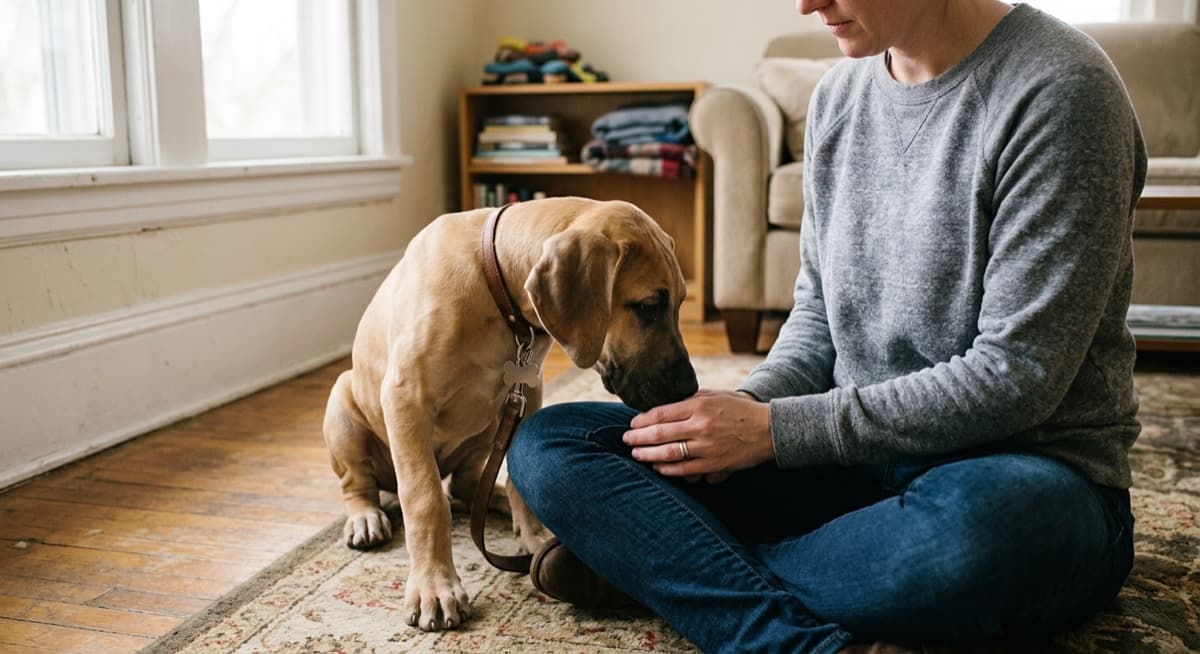
Search any Calgary adoption forum and the same Great Dane complaint comes up: the rescues are impossible. The application is too long. The vet reference is too much. The wait list is too cold. Some of that frustration is fair. Most of it misreads what foster-based rescues are doing. This guide walks through the actual rescue process for a Great Dane in Calgary: why the screening feels strict, what the rescues are really looking for, how to write an application that gets read, and what to do if the first answer is no. The goal here is not to argue with rescues; it is to help Calgary adopters get through the process without losing the dog they want.
Why some Dane rescues are “hard to adopt from”
The strict feel of Dane rescue applications is not arbitrary. Foster-based rescues across Calgary report consistent patterns with giant breeds that drive the screening:
- Returns are higher with giants. Many surrenders happen in the first two years once monthly cost reality lands. Food at $200 to $300 a month, vet doses scaled to body weight, and gear that wears out fast catch first-time owners off guard.
- Lifespan grief returns the dog. A Dane who lives 7 to 10 years is sometimes surrendered mid-life when the family realises they cannot face another short life. Rescues screen for adopters who understand the lifespan going in.
- Knock-over liability with toddlers. A 150-pound dog turning around in a hallway can flatten a small child by accident. Many rescues prefer to place Danes in homes with school-age kids and up.
- Bloat (GDV) requires owner readiness. The breed-defining emergency is a same-hour 24-hour-emergency-vet decision. Rescues want adopters who already know the signs.
- Naive-applicant volume. Big dogs attract big interest. Foster-based rescues see dozens of applications per Dane and have to filter for fit before placement.
None of this is gatekeeping for its own sake. It is the rescue's practice of placing the dog once, not twice. The Calgary rescues that screen the hardest also have the lowest return rates, and that protects the next dog, too. For the broader lifespan and bloat context, read our companion Great Dane adoption guide.
Calgary rescues to apply to
No single rescue will have a Great Dane on the floor most weeks. Apply across several at the same time so you are in the queue when one appears. Each rescue's process is a little different.
- Calgary Humane Society: largest Calgary shelter, generally first-come same-day adoption at the building for dogs on the floor. Bring ID, lease or proof of housing, and be ready to commit if approved.
- AARCS: foster-based, application-and-match. Application reviewed first, then a meet-and-greet with the foster. AARCS publishes structured behaviour evaluations; read the foster notes carefully. The AARCS adoption process is documented at aarcs.ca/adopt.
- Pawsitive Match: Calgary foster-based; periodically takes in Danes and Dane mixes. Application, vet reference, and a meet-and-greet with the foster.
- ARF Alberta: Calgary foster-based; mid-to-large dogs frequently, occasional giants. Foster notes drive matching.
- BARCS Rescue: Calgary foster-based; transports many medium-to-large dogs and occasional Mastiff or Dane mixes.
- Cochrane Humane Society: Cochrane-based, serves the broader Calgary region; occasional giant intakes.
- A national Great Dane rescue: a national breed-specific rescue that has historically coordinated Alberta placements when transport and foster homes line up. Apply through the rescue directly and expect a longer screening process given the breed-specific focus.
Set notifications on the LocalPetFinder Great Dane breed page. Listings refresh regularly, which matters for giant-breed dogs because adopters often apply within hours of a new posting.
The application process, step by step
Foster-based rescues follow roughly the same six-step pattern. Knowing the order helps you prepare in parallel rather than scrambling at each stage.
- Application form. Online questionnaire covering household, housing, work hours, prior pets, kids, fencing, budget, vet history, and dog-specific questions. Expect 30 to 60 minutes to do it carefully. The form is what gets you read; rushed answers do not.
- Vet reference. If you have had pets before, the rescue will call your vet. They are checking for routine care, vaccination history, and whether you paid your bills. New owners without a vet history get asked more questions in the interview instead.
- Personal references. Some rescues ask for one or two non-family references who know you with animals. A neighbour, a coworker, or a friend who has dog-sat is fine.
- Phone or video interview. A volunteer or coordinator walks through the application and asks follow-ups. This is the screen where they decide whether to bring you forward to a foster.
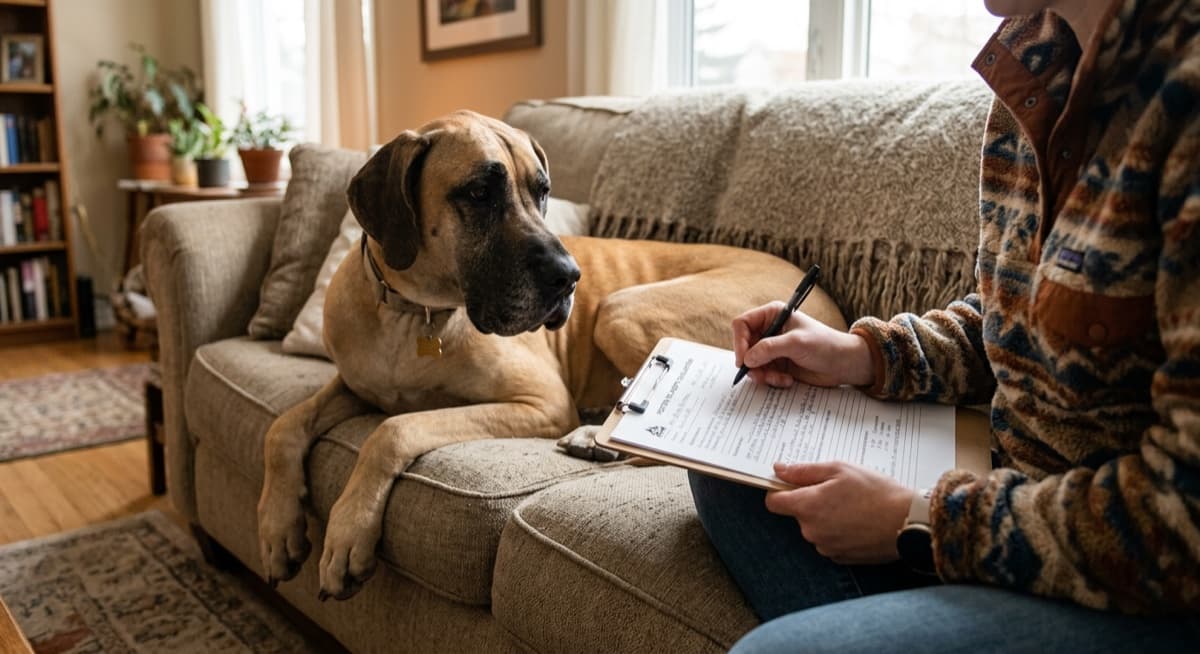
- Home check. Sometimes in person, sometimes a video walkthrough. They are looking for fencing, stairs, where the dog will sleep, and whether the space matches what you wrote on the form. This is not a white-glove inspection.
- Meet-and-greet with the foster. You meet the dog with the foster family. The foster knows the dog best and is usually the deciding voice. Bring the whole household, including other dogs if relevant.
Some adopters clear all six steps in two weeks. Others wait six weeks between the application and a meet-and-greet because the right Dane has not come through yet. The bottleneck is almost always inventory, not paperwork.
What rescues are actually looking for
The popular assumption is that rescues want a six-figure income, a backyard the size of a soccer pitch, and a stay-at-home owner. That is not the screen. Calgary rescues report a more practical set of fit indicators:
- Stable housing that allows giant breeds. Own or rent, no major difference; the rescue wants to know weight limits, breed restrictions, and whether your landlord knows about the dog. Many Calgary buildings in Beltline, Bridgeland, or Inglewood have weight limits that exclude Danes.
- A realistic plan for work hours. Eight to nine hours alone is workable for an adult Dane with a midday break or a dog walker. Twelve hours is not. Be honest; rescues match accordingly.
- Budget readiness. Not income; readiness. You can describe how you would handle a $3,000 vet bill or a $200 monthly food line. A first-time owner with a savings cushion beats a higher-earning applicant who has not thought it through.
- An understanding of bloat (GDV) and the lifespan. If your application mentions you know about bloat warning signs, the 7 to 10 year lifespan, and where the closest 24-hour emergency vet is, it stands out. This is the single highest-impact thing a Calgary adopter can put on a Dane application.
- Honest answers about kids, pets, and prior experience. A first-time owner is fine. A first-time giant-breed owner is fine. Lying about a reactive incident or a past surrender is not.
- A willingness to learn. Rescues love adopters who ask the foster questions instead of telling the foster what the dog needs.
The pattern across all of these: rescues want adopters who have thought about the dog more than they have thought about themselves. Show that and the application reads differently.
Set notifications for Calgary Great Danes
See current Great Danes and Dane mixes across 15+ Calgary rescues in one place. Listings refresh regularly, and giant-breed openings can clear within a day, so applying within hours of a new posting matters.
See Calgary Great Danes available now →Writing a strong application
Rescue coordinators read dozens of applications per Dane. The ones that get a callback share a few habits. The ones that get skipped share the opposite.
What stands out:
- Specific, not generic. Instead of “I love dogs,” write “I have wanted a Great Dane since fostering one for a friend in 2024, and I have spent the past year researching giant-breed nutrition and growth-rate management.”
- Honest about experience. “First-time giant-breed owner; have had two medium-breed rescues for the past ten years.” That is fine. “Experienced with Danes” without a story behind it reads as filler.
- Show you know the breed. Mention the 7 to 10 year lifespan in your own words. Mention bloat / GDV warning signs. Mention your nearest 24-hour emergency vet. These three sentences are the single biggest signal that you are ready.
- Real numbers for the budget. “I have $1,500 a month allocated to the dog: roughly $250 food, $150 routine vet and meds, $100 insurance, $1,000 buffer for emergencies.” A made-up number is worse than no number; a thought-through number is gold.
- A specific plan for work hours. “I work from home three days a week; a dog walker covers Tuesday and Thursday midday.”
- Calgary-specific detail. Mention your neighbourhood, your nearest off-leash park (Nose Hill, Bowmont, Fish Creek, Edworthy, Sue Higgins), and how you will manage Calgary's short-coat-on-prairie-winter problem. Coats, paw balm, –20°C limits.
What gets skipped:
- One-paragraph applications that answer “why this breed” with “they are beautiful.”
- Vague budget answers (“I can afford a dog”).
- Claims of experience that the vet reference will contradict.
- Long passages about how the dog will improve your life. The screen is about the dog's life, not yours.
- Asking when you can pick up the dog before the meet-and-greet.
An application that takes 45 to 60 minutes of careful writing gets read in the same five minutes a one-paragraph application does, but it reads completely differently.
Common rejection reasons
When a Calgary rescue passes on an application, the reasons usually fall into one of these buckets. None of them are about your worth as a person.
- Lifestyle mismatch with this specific dog. The Dane is reactive to other dogs; you have a 4-year-old who has friends over. The Dane is anxious about being alone; you work twelve-hour shifts. This is the most common reason and it is not personal.
- No fenced yard when the foster notes require one. Some Danes are placed only in fenced-yard homes; others are fine with apartment life. The foster decides per dog, not per breed.
- Housing risk. Lease that bans large dogs, weight limit you cannot get waived, condo board approval not in writing. Rescues will not place a dog into a housing situation that could force a surrender.
- Work hours that do not match the dog. Most adult Danes manage eight or nine hours with a midday break. Some do not. The foster knows which.
- Financial readiness questions unanswered. The screen is not about income; it is about whether you have thought about the cost. A vague budget answer reads as unprepared.
- Vet reference issues. Past pets without routine care, unresolved bills, or unaddressed health concerns are red flags. If your history is complicated, address it directly in the application.
- A better-fit applicant. Sometimes the rescue has two strong applications and picks the one that matches the dog's notes more precisely. That is not a rejection of you; it is a match for the dog.
Foster-to-adopt: the underrated path
Foster-to-adopt is the path most first-time Calgary Dane adopters do not consider, and it is often the easiest way in. The arrangement is simple: you take the dog home as a foster, the rescue covers vet costs during the trial, and if the fit works you finalize the adoption. If it does not work, the dog comes back without a failed adoption on its record.
Why it works for giant breeds:
- The rescue sees you with the dog. A two-week foster shows the rescue more than a one-hour meet-and-greet ever could. Adopters who foster well are often the first call when a similar dog comes in.
- You see the dog in your home. A Dane on a foster sofa is a different read than a Dane at a meet-and-greet. Stairs, neighbours, work schedule, kid reaction: you learn all of it in real time.
- Lower stakes. If the dog turns out to be reactive to your cat, the foster ends without a paperwork hangover. The rescue places the dog elsewhere and you stay on the foster list.
- Cost is covered during the trial. Food, vet, and gear are usually rescue-covered during foster. You take on the cost when you finalize.
AARCS, Pawsitive Match, ARF Alberta, and several other Calgary rescues actively recruit fosters. Apply through the foster page on each rescue's website. The first foster is rarely a Dane, but it puts you in the network so that when one comes in, you are on the call list.
Adult Dane vs puppy from rescue
The expectation most Calgary adopters arrive with is “rescue Dane puppy.” The reality is that almost all surrendered Danes in Calgary rescues are 2 to 7 years old. Purebred Dane puppies are very rare in rescue. The puppies that do appear are usually Dane mixes.
The adult Dane case is stronger than most first-time owners realise:
- Known temperament. Foster notes describe a real, settled personality. With a puppy, you are guessing.
- Past the growth window. The first 18 months of a giant breed's life are the most expensive and joint-sensitive. An adult is past that.
- House manners established. Most adult rescue Danes are housetrained, walk reasonably on leash, and have basic cues.
- Lifespan math still works. A 3-year-old Dane is a 4 to 7 year commitment given the breed's 7 to 10 year average. That is the same range you would get with a Lab adopted at 8.
- Bonding is fast. Adult rescue Danes are famously affectionate with new owners after a 3-3-3 decompression window.
If you have your heart set on a Dane puppy and rescue is not producing one, the honest options are (a) wait for a Dane mix puppy through Calgary rescues, (b) consider a young adult under 2 years old which is closer to puppy than most adopters expect, or (c) look at a CKC-registered breeder with health-tested parents, which is a $1,500 to $3,500 purchase, not a rescue. The breeder path is outside the scope of this guide; for context on cost, read our Great Dane cost of ownership guide.
Realistic timeline expectations
The honest range for Calgary Dane adoption is two weeks to several months. The variance is almost entirely about whether a fit-Dane appears, not about how long paperwork takes.
| Path | Typical timeline | Notes |
|---|---|---|
| CHS, Dane on the floor | Same day | First-come, screened at the building. |
| Foster-based rescue, dog already listed | 2 to 4 weeks | Application, reference, meet-and-greet. |
| Foster-based rescue, waiting for a Dane | 1 to 6 months | Inventory drives this, not paperwork. |
| Foster-to-adopt | 2 weeks to several months | Foster first, finalize later. |
| Breed-specific national rescue | 2 to 6 months | Transport coordination adds time. |
Apply at several rescues simultaneously. There is no penalty for being in multiple queues, and Calgary rescues do not coordinate denials with one another. The applicant who is approved fastest is almost always the one who started earliest.
Realistic Calgary inventory
Purebred Great Danes appear in Calgary rescues a few times a year, not weekly. Dane mixes (with Mastiff, Lab, or Shepherd lines) are more common. When a Dane or Dane mix does list, foster-based rescues often see ten or more applications within forty-eight hours.
The practical tactics that work:
- Set notifications on the LocalPetFinder Great Dane breed page; listings refresh regularly.
- Follow each Calgary rescue on Instagram or Facebook; new intakes are often posted there first.
- Pre-write your application in a document so you can paste it into a new form within an hour of seeing a listing.
- Open to Dane mixes — many are an easier fit than purebreds and adopt out faster.
- Consider a young adult (under 2 years) as a middle ground if you are set on a younger dog.
What to do if your application is rejected
Rejection feels personal. It almost never is. Foster-based rescues turn down strong applicants every week because the dog's notes pointed somewhere else. Here is how to handle a no without losing momentum.
- Do not argue with the coordinator. The fastest way to get blocklisted is to push back hard on a no. Thank them and ask if there is anything you can address for next time.
- Ask for specific feedback. “Was it housing, work hours, experience, or something about the dog?” Most coordinators will share a one-line reason if you ask politely.
- Address what you can. Lease question? Get the landlord letter in writing. Work hours flagged? Line up a dog walker and add it to the next application. Fencing question? Quote the install before you reapply.
- Apply elsewhere immediately. Each Calgary rescue has different criteria. A no at one does not predict a no at another.
- Foster first. If you keep getting no for direct adoption, foster a non-Dane through the same rescue. A successful foster track record is the single strongest signal an adoption coordinator can see.
- Take a beat, do not surrender the search. Many adopters are approved on the second or third application after the first one taught them what to write. The dog you end up with is rarely the first one you applied for.
A rejection is feedback, not a verdict. The Calgary rescue community is small, and a thoughtful, persistent applicant who keeps improving is exactly the kind of person every coordinator wants to place a dog with. Keep going. For broader Calgary adoption context, see the Humane Canada adopter resources and the AKC Great Dane breed profile for breed-fit context. The Great Dane Club of America also maintains adopter and breed information that supports rescue applications.
Frequently Asked Questions
Why are Great Dane rescues hard to adopt from?↓
How do I apply to adopt a Great Dane in Calgary?↓
What do Dane rescues look for in adopters?↓
How long does the rescue adoption process take?↓
Can I foster a Great Dane before adopting?↓
Should I adopt an adult Dane or a puppy?↓
What if my rescue application is rejected?↓
Are there Great Dane-specific rescues in Alberta?↓
Continue reading
Great Dane adoption Calgary
The full breed guide: where Danes appear, real costs, lifespan, and the bloat (GDV) warning every Calgary owner has to recognize.
The “heartbreak dog” truth
Why the 7 to 10 year Dane lifespan changes how Calgary families plan for adoption, grief, and the next dog.
What a Calgary Dane really costs
Giant-breed food, vet, gear, and insurance budgeting for Calgary households over the full 7 to 10 year lifespan.
Browse Calgary Great Danes
Currently available Great Danes and Dane mixes across 15+ Calgary rescues, refreshed regularly.
New dog? Start with these care guides
Everything a new adopter needs to set up a safe, happy home.