Smart dog, sensitive dog
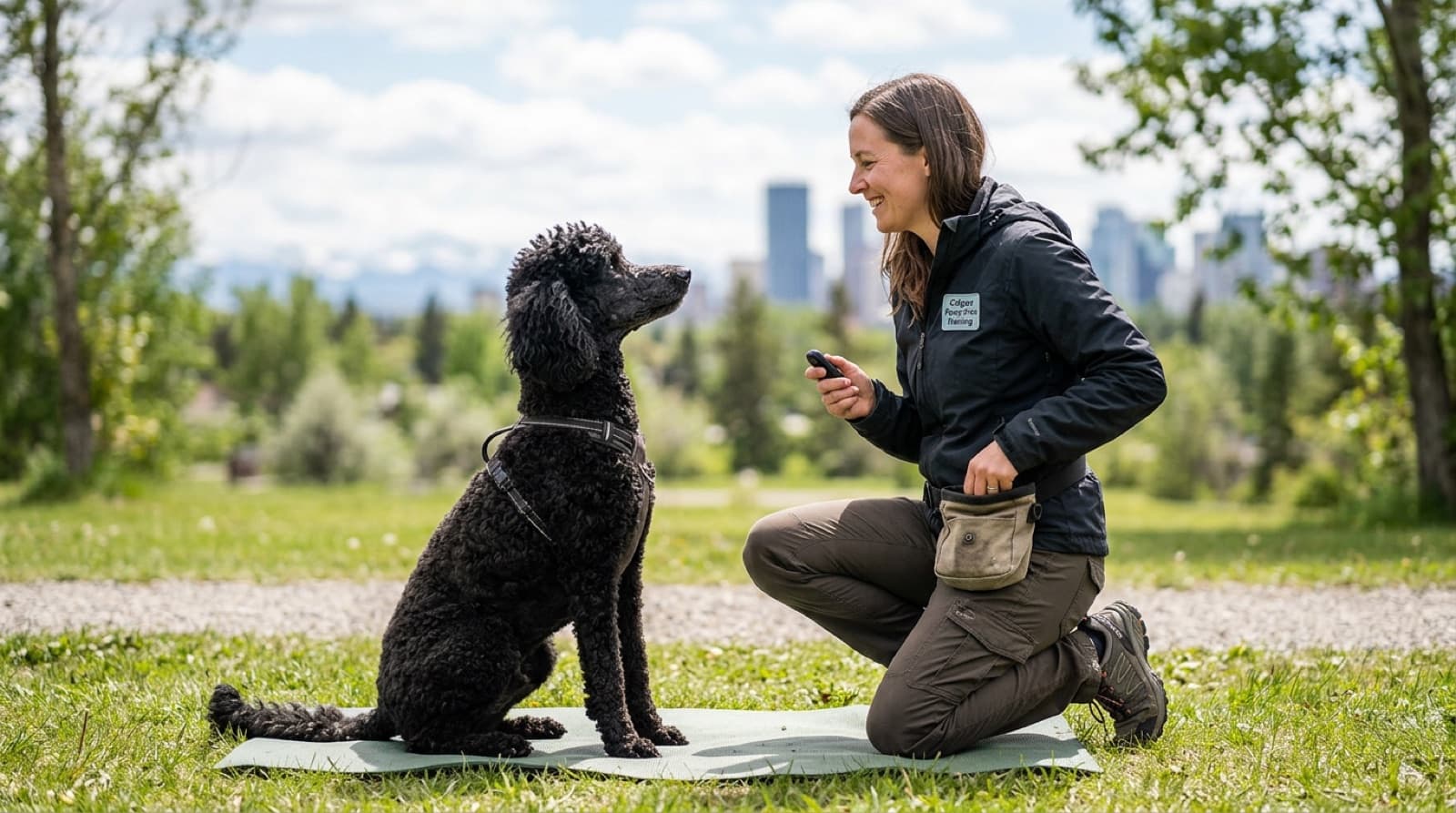
Poodles rank second only to Border Collies for intelligence — many puppies have a 10-cue repertoire by 12 weeks. But intelligence is a double-edged sword: smart dogs need constant mental engagement, notice every handler inconsistency, and learn unwanted behaviours just as fast as wanted ones. Poodles are also unusually sensitive emotionally. Aversive training (yelling, leash pops, e-collars, alpha rolls) damages them long-term in ways the Reddit Poodle community talks about constantly. Force-free positive reinforcement is the only method that works. This guide is what that looks like in practice.
Training Timeline by Age
| Age | Focus |
|---|---|
| 8 to 16 weeks | Critical socialization window. Name, recall, basic cues, crate love, gentle handling, exposure to people/dogs/sounds/surfaces/environments. |
| 16 weeks to 6 months | Reliable recall, leash walking, settle on a mat, polite greetings, “quiet” cue. Start scent work and trick training. |
| 6 to 12 months | Adolescent regression appears. Hold the line on standards. Proof cues in new environments. Increase mental stim difficulty. |
| 12 to 24 months | Adult behaviour emerges. Sport-specific training (agility, rally, obedience). Refine alone-time. Add complex multi-step cues. |
| 2+ years | Maintenance + variety. Bored Poodles regress; keep introducing novel mental challenges weekly. |
What Force-Free Actually Looks Like
1. Use markers and rewards
A clicker, a marker word (“yes!”), or a unique sound. Mark the exact moment of desired behaviour, follow with a high-value treat. Poodles learn marker-reward sequences within 2 to 5 reps.
2. Reward what you want; remove reinforcement from what you do not want
Dog jumps up → turn away, give no attention until 4 paws on floor → mark and reward. No yelling, no kneeing, no punishment. The unwanted behaviour gets nothing; the wanted behaviour gets a party.
3. Manage the environment
If your Poodle counter-surfs, clear the counters until the dog is trained. If your Poodle barks at the window, close blinds or use window film. Management prevents practice of unwanted behaviour while training the alternative.
4. Train in short, frequent sessions
3 to 5 minute sessions, 3 to 5 times per day. Poodles fatigue mentally before physically. Quit while the dog is still engaged and successful. Never train past frustration.
5. Vary everything
Rotate cues weekly. Train in different rooms, surfaces, distractions, locations. Variety keeps Poodles engaged. Boring repetition is when Poodles start “ignoring” you (it is not ignoring; it is checked-out).
Browse adoptable Poodles in Calgary
Foster reports include training history and trainability notes. Many adult rescue Poodles have basic obedience already established.
Mental Stim Menu (Rotate Weekly)
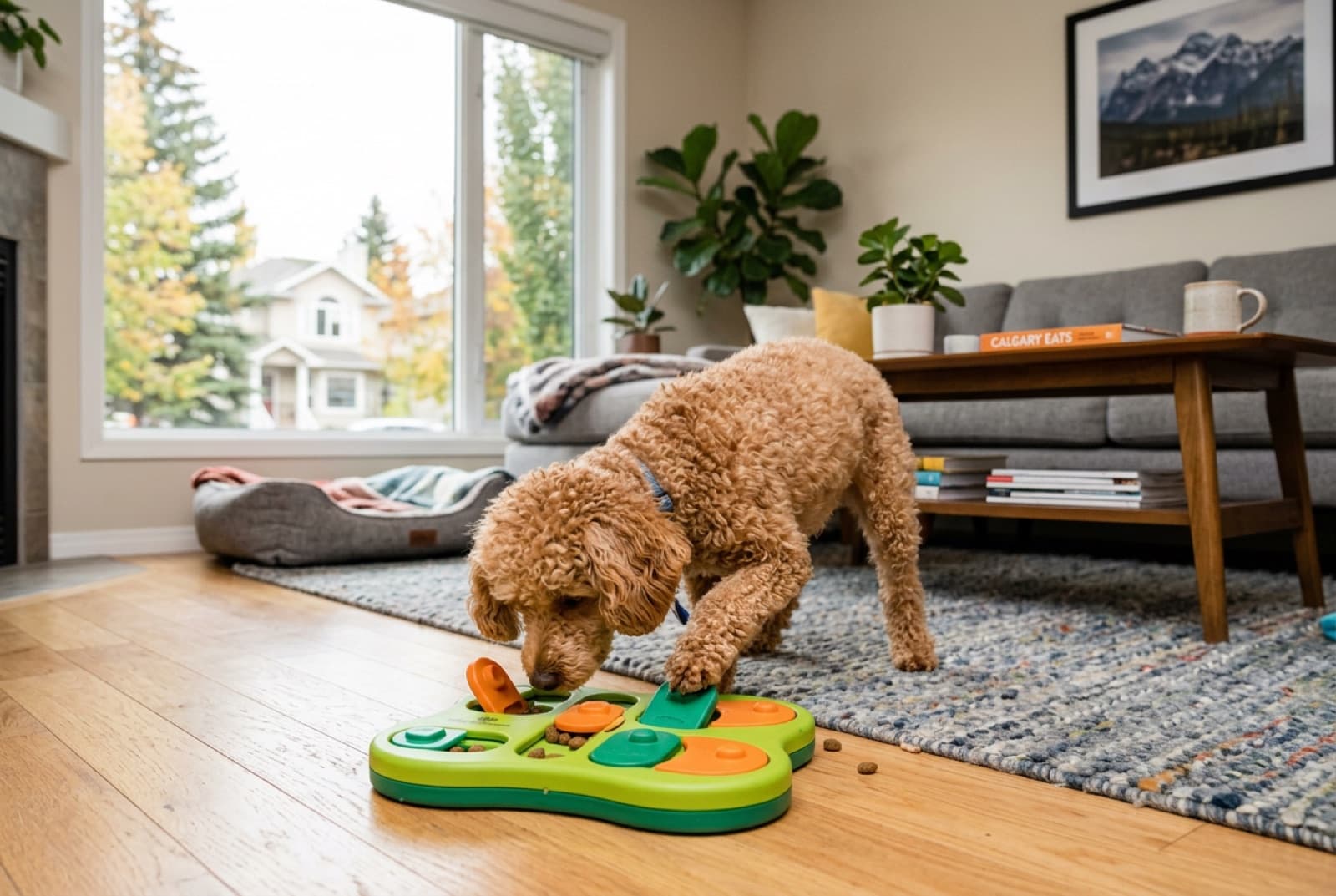
Most Calgary Poodle behaviour problems trace to insufficient mental stimulation, not exercise. Pick 2 to 3 from this list daily; rotate weekly.
Puzzle feeders
Slow-feeders, Kong Wobbler, Outward Hound puzzles. Delay meals from 30s to 15min.
Frozen Kongs
Stuff with wet food, kibble, peanut butter (xylitol-free). Freeze. 15 to 45 minutes of engagement.
Scent work / Find It
Hide treats around the house. Build up to scent containers, novel objects.
Trick training
Spin, bow, target a paw, push a button, ring a bell. Aim for 1 new trick per week.
Dog sports
Agility, rally, obedience, dock-diving, scent work. Calgary clubs: Calgary Agility Club, Northland Dog Training Club.
Snuffle mats + lick mats
Background enrichment during alone time. Cheap, effective, reusable.
Calgary Force-Free Trainers
Dogma Training
Multiple Calgary locations. Wide range — puppy classes, group obedience, private sessions, day training, behaviour modification. Strong reputation for Poodles.
ImPAWSible Possible
Strong puppy and reactive-dog programs. Excellent for separation anxiety and resource guarding cases.
Calgary K-9 Force-Free
Force-free service dog and companion trainer. Strong for high-needs cases.
Sit Happens Calgary
Group classes and private sessions. Good for first-time owners.
Raising Fido
Private and group; strong with sensitive breeds. Owner-operated, individual attention.
AVOID: trainers using e-collars, prong collars, choke chains, dominance theory, or describing themselves as “balanced.” Credential signals for force-free: CCPDT, KPA-CTP, CDBC, PMCT.
Common Poodle behaviour problems
Excessive barking. Teach “quiet” cue, reward calm, manage triggers (window film, white noise), increase mental work.
Resource guarding. Do not punish. Trade-up training with high-value rewards. See a force-free trainer if it escalates to growling or air-snapping.
Separation anxiety. Gradual desensitization protocol. See our separation anxiety guide.
Counter-surfing. Manage environment (clear counters), teach “off” cue, increase mental enrichment.
Demand barking. Ignore the bark, reward calm. Many owners accidentally reinforce by responding (looking, speaking, getting up).
Frequently Asked Questions
Are Poodles easy to train?
Yes for initial cues (30-50% faster than average breed). Harder to maintain reliable behaviour without daily mental work and variety. Smart dog needs constant engagement.
Why force-free for Poodles?
Aversive methods (yelling, e-collars, leash pops) cause measurable harm: shutdown, learned helplessness, fear-based reactivity. Reddit Poodle community is unusually vocal about this. Only force-free works.
How much mental stim daily?
Minimum 30 min dedicated. Puzzle feeders, training sessions, scent work, trick training, sport. Under-stimulated Poodles develop barking, counter-surfing, destructive behaviour.
When to start training a puppy?
Week 1 home (8 weeks). Critical socialization window closes at 16 weeks. Calgary puppy classes (Dogma, ImPAWSible Possible) start at 8-10 weeks.
Common behaviour problems?
Barking, resource guarding, separation anxiety, counter-surfing, demand barking. Most resolve with environment management + mental stim + force-free training.
Calgary force-free trainers?
Dogma, ImPAWSible Possible, Calgary K-9 Force-Free, Sit Happens, Raising Fido. Credentials: CCPDT, KPA-CTP, CDBC. Avoid “balanced” trainers.
Should I crate train?
Yes with positive conditioning. Most Poodles choose crate voluntarily within 2-4 weeks. Max 6-8 hrs adult, 2-4 hrs puppy. Never force-crate.
Good for first-time trainers?
Yes if you commit to force-free from day 1. Forgiving of beginner errors AS LONG AS not aversive. Take 2-3 classes in first 2 years.
More Poodle guides
Poodle Separation Anxiety →
Working full-time, daycare math, the 4-week prevention protocol.
Is a Poodle Right for You? →
10 honest truths + 12-question self-assessment.
True Cost of a Poodle →
Monthly + lifetime cost by size.
Poodle as First Dog →
Yes-if framework for first-time owners.
New dog? Start with these care guides
Everything a new adopter needs to set up a safe, happy home.